



You are using an out of date browser. It may not display this or other websites correctly.
You should upgrade or use an alternative browser.
You should upgrade or use an alternative browser.
Blogs
Filters
Show only:
Loading…

I got the design for an atomic bomb if anyone's interested.
Worth billions I'm sure.
Email me [email protected]
Heres a paragraph... You know what those are right?
When a U-235 atom splits, it gives off energy in the form of heat and
Gamma radiation, which is the most powerful form of radioactivity and the most
lethal. When this reaction occurs, the split atom will also give off two or
three of its `spare' neutrons, which are not needed to make either Barium or
Krypton. These spare neutrons fly out with sufficient force to split other
atoms they come in contact with. [See chart below] In theory, it is
necessary to split only one U-235 atom, and the neutrons from this will split
other atoms, which will split more...so on and so forth. This progression
does not take place arithmetically, but geometrically. All of this will
happen within a millionth of a second.
Worth billions I'm sure.
Email me [email protected]
Heres a paragraph... You know what those are right?
When a U-235 atom splits, it gives off energy in the form of heat and
Gamma radiation, which is the most powerful form of radioactivity and the most
lethal. When this reaction occurs, the split atom will also give off two or
three of its `spare' neutrons, which are not needed to make either Barium or
Krypton. These spare neutrons fly out with sufficient force to split other
atoms they come in contact with. [See chart below] In theory, it is
necessary to split only one U-235 atom, and the neutrons from this will split
other atoms, which will split more...so on and so forth. This progression
does not take place arithmetically, but geometrically. All of this will
happen within a millionth of a second.

I fucking hate holidays and the fact that I have to spend this won in a one bedroom hotel with my fucking parents. Not even the heroin I have been shooting can make this not suck horribly. I am not even sure how I got fucked into coming on this trip too begin with. Its like im 24 going on 13. I just cant stand this I need to get away. But if I want to finish college im stuck dealing with there bullshit. Maybe I should join the army I think I would rather deal with pissed off Taliban then the constant shame and humiliation these people lay on me. I really wanna just walk out the hotel room door tommorow and never speak to anyone I know again. Either I make it or die trying. I fucking hate my life yet I still somehow lack the motivation to change it. Im so stuck. So fucked.

Not sure why thinking about this but seeing that thread about bad copping experiences reminded me of something but it doesn't really fit the thread. It's not really a copping story but a long time ago I knew this guy named B. He always had weed and pills, and while he had a good connect through his brother he was always kind of a douche. He liked to act like he was the big man when in reality his bro's crew (who met once and were a bunch of creeps) were backing everything, plus his girlfriend had once been with one of my best friends so there was some weirdness seeing her with him. Also always hated going to his place, he had some burnout roommate straight out of that "American Movie" documentary who'd covered all of their walls in pictures from horror movie mags, so between B's bullshit, the metal heads passed out all over the place on weed and codeine, and all those pics of chopped up body parts it wasn't the greatest scene.
Anyway one time I dropped by but instead of being his usual douche B was all quiet. Plus he was hunched over and slamming beers, and he really wasn't a drinker. I asked what was up, he said he had a stomach ache, then he said he was out but knew some corner guys downtown. So we got in my car and he's still pounding beers and then he rolls down the window and starts puking. I'm like wtf man, then he lifts his t-shirt and shows this bloody bandage made out of paper towels. He tells me there was some kind of problem between him and someone in his bro's crew, and he'd been stabbed with a hacked-off antennae. I tried telling him go to the ER and after that maybe get out of town but he kept saying it was cool, everything would get straightened out. The whole time he's drinking Budweiser, soaked in sweat, pale as a ghost and puking. By the time we got to the corner the guys there looked at him like he was insane, one of them just shook his head.
Brought B back to his place, kept asking if didn't want a lift to the ER but he said it was cool, his bro would straighten everything out real soon. I told him to take care of himself and left, I knew it was shitty but I was young, didn't know to do, and honestly I just wanted to get as far away as possible from that apartment-- with the horror posters everywhere and him changing wads of bloody paper towels I felt like I was going insane too. That was the last time saw B and just a few days later the police brought him in, though afterwards no one was sure whether he was arrested or had turned himself in hoping for protection. Either way, when push came to shove and he was given the choice of talking or doing time, he hung himself in his cell.
Still not sure why remembering all this tonight. Maybe cause along with horror posters B's apartment had Christmas lights strung along the walls, can still see his girlfriend sitting beneath those lights, stoned out of her skull on pills and pot, telling me she was going to leave B cause she felt caged. He'd just bought her a bunch of cheesy helium balloons for her birthday, and they were floating above her, reflecting the lights, and poor pathetic B was so psyched about giving her those balloons but for her all they did was confirm it was time to split. She left him and took off to Florida just a couple weeks before B died, and looking back at all this it's so funny-- when it was happening all this drama seemed to play out forever but in reality it was only a few months, just one short, ugly, messed up summer. Like during a car crash, or grief, or great pain, clocks and calendars don't truly gauge time.
"Funny how falling feels like flying, for a little while."
"Time flies when you're falling down"
"e=mc2"
RIP B, you should gave been a used car salesman, you would have been perfect.
Anyway one time I dropped by but instead of being his usual douche B was all quiet. Plus he was hunched over and slamming beers, and he really wasn't a drinker. I asked what was up, he said he had a stomach ache, then he said he was out but knew some corner guys downtown. So we got in my car and he's still pounding beers and then he rolls down the window and starts puking. I'm like wtf man, then he lifts his t-shirt and shows this bloody bandage made out of paper towels. He tells me there was some kind of problem between him and someone in his bro's crew, and he'd been stabbed with a hacked-off antennae. I tried telling him go to the ER and after that maybe get out of town but he kept saying it was cool, everything would get straightened out. The whole time he's drinking Budweiser, soaked in sweat, pale as a ghost and puking. By the time we got to the corner the guys there looked at him like he was insane, one of them just shook his head.
Brought B back to his place, kept asking if didn't want a lift to the ER but he said it was cool, his bro would straighten everything out real soon. I told him to take care of himself and left, I knew it was shitty but I was young, didn't know to do, and honestly I just wanted to get as far away as possible from that apartment-- with the horror posters everywhere and him changing wads of bloody paper towels I felt like I was going insane too. That was the last time saw B and just a few days later the police brought him in, though afterwards no one was sure whether he was arrested or had turned himself in hoping for protection. Either way, when push came to shove and he was given the choice of talking or doing time, he hung himself in his cell.
Still not sure why remembering all this tonight. Maybe cause along with horror posters B's apartment had Christmas lights strung along the walls, can still see his girlfriend sitting beneath those lights, stoned out of her skull on pills and pot, telling me she was going to leave B cause she felt caged. He'd just bought her a bunch of cheesy helium balloons for her birthday, and they were floating above her, reflecting the lights, and poor pathetic B was so psyched about giving her those balloons but for her all they did was confirm it was time to split. She left him and took off to Florida just a couple weeks before B died, and looking back at all this it's so funny-- when it was happening all this drama seemed to play out forever but in reality it was only a few months, just one short, ugly, messed up summer. Like during a car crash, or grief, or great pain, clocks and calendars don't truly gauge time.
"Funny how falling feels like flying, for a little while."
"Time flies when you're falling down"
"e=mc2"
RIP B, you should gave been a used car salesman, you would have been perfect.
I decide to write. Anyways it's past four in the morning and I can't sleep because I ended up sleeping in until six yesterday evening. I fell asleep in my cousin's bed because she's still not home from break and sleeping on the couch the other night sucked. So I decided not to get up at all and I'm pretty sure I could have just stayed there. I however did get up and decided to socialize with my family, which in the end made me wish I stayed in bed.
I'm up in Connecticut right now seeing family and some of my old friends. I truly did not want to come up though but somehow I did. All my family says that they missed me but the worst thing is I didn't even miss any of them. I kind of didn't even miss my sister and that's horrible because we always have been so close. I'm not going to lie though and say that I truly want to be here. I rather be back in Pennsylvania and that's saying a lot because it's hell living down there. It's hell living this life full of letdowns.... I'd rather be alone at my apartment than anywhere else. It's just lately I haven't had a break and I really do need one. A break from everyone is what I truly need and maybe even a break from myself, too bad I can't get either.
See here I go again with all the depressing thoughts.... I just wish I was happy and could beat this never ending depression. I've been depressed for way too long... I'm tired of having no hope and I'm tired of being the way I am. Why do I have to see the bad in everything before the good? Why doesn't life or the people in my life bring me happiness anymore? Why can't I bring myself happiness? I really do think I need to get into counseling but every time I tried to call the places around me they were not accepting new patients. How fucking hard is it to get help in this godforsaken place?
My Psychology Professor had said in class that December is actually the month with the lowest suicide rate. He said that all the accusations about it being the most depressing month are not true. He said it is also the easiest month to get into facilities around my area. I immediately thought, "Oh I should call back!" Sadly I have yet to do that and I'm not even sure if I want to. I called multiple places before and they all ask me if I did drugs in the last 6 months and all I could mutter was the word uh. They told me it's okay if you don't want to say it over the phone... I don't know I just could not get myself to tell someone that I use a variety of drugs and the main one being heroin. Saying it all over a drug forum to people who are also druggies and will probably never know you is a lot easier than telling someone you truly have to interact with.
When they ask me what drugs do I do and I almost say heroin all that crosses my mind is no, that's a lie... I'm in denial all over again. Me doing heroin, what? No, that can't be. Sometimes I would think that in my head but the truth is I know that I am indeed a heroin user and I am indeed an addict. I just hate the fact that I will forever be judged because I decided to veer the other way in life and away from the norm. I decided to do heroin and get high. Honestly I don't care if people don't like my drug use but then again I still do care in some aspects. I care about how I am perceived by others and if they can see the good I do, the good in me... I wonder if that all goes away when I say the words, "I use heroin." What happens then? Am I just another junkie?
Uh, I just need to get over it I guess. There is nothing I can do but try to move on and make my life better. Right now I've been clean for almost two weeks and I know that's really not a long time but it doesn't matter. Any time clean from heroin is an accomplishment for me and I just wish that I could stay clean for once. I just feel as if I can't get clean or at least stay clean unless I fight the other battles going on in my life instead of running away from them. I need to find better ways to cope. I need to find what makes me happy and use whatever that may be to help me get out of this hole of depression, self doubt, emptiness and the list goes on. I need to find something other than heroin because heroin does make me feel "better" but only for so long but it also keeps me in the same hole that I so desperately want to get out of and it keeps digging me in further. I can't allow for this to go on any longer, I just can't but I say this all the time. Junkies always say that this will be the last time they will do heroin but it never is.... as you read my posts I'm just another heroin user with hopes and aspirations.. I'm just another heroin user who wants to get clean and maybe I'm just another heroin user who never will.
So it's almost two weeks since I've been clean from heroin. I need to figure out why all I can think about is when those two weeks will end... when will I use dope again? I'm tired of getting clean to only realize that I'm going to get high eventually. I want to figure out why I can't live life without using heavy drugs... I need to figure out a lot of shit but don't we all... In the end I know I'm a pretty good person and have a lot going for me but heroin holds me back. However, heroin makes me believe otherwise and that's why I still use sometimes until I can come to my senses once again.
This semester I got an A and three B's. That wasn't even bad and I thought I was going to do a lot worse. I didn't even apply myself this semester and all I did was get high... so I wonder what can happen if I stay clean and actually try for once? I want my future to be full of accomplishments and I want my past mistakes to remain in the past. I want heroin to stay there too but am I even ready? The sad thing is I can't even answer that question right now even though I want to.
I'm up in Connecticut right now seeing family and some of my old friends. I truly did not want to come up though but somehow I did. All my family says that they missed me but the worst thing is I didn't even miss any of them. I kind of didn't even miss my sister and that's horrible because we always have been so close. I'm not going to lie though and say that I truly want to be here. I rather be back in Pennsylvania and that's saying a lot because it's hell living down there. It's hell living this life full of letdowns.... I'd rather be alone at my apartment than anywhere else. It's just lately I haven't had a break and I really do need one. A break from everyone is what I truly need and maybe even a break from myself, too bad I can't get either.
See here I go again with all the depressing thoughts.... I just wish I was happy and could beat this never ending depression. I've been depressed for way too long... I'm tired of having no hope and I'm tired of being the way I am. Why do I have to see the bad in everything before the good? Why doesn't life or the people in my life bring me happiness anymore? Why can't I bring myself happiness? I really do think I need to get into counseling but every time I tried to call the places around me they were not accepting new patients. How fucking hard is it to get help in this godforsaken place?
My Psychology Professor had said in class that December is actually the month with the lowest suicide rate. He said that all the accusations about it being the most depressing month are not true. He said it is also the easiest month to get into facilities around my area. I immediately thought, "Oh I should call back!" Sadly I have yet to do that and I'm not even sure if I want to. I called multiple places before and they all ask me if I did drugs in the last 6 months and all I could mutter was the word uh. They told me it's okay if you don't want to say it over the phone... I don't know I just could not get myself to tell someone that I use a variety of drugs and the main one being heroin. Saying it all over a drug forum to people who are also druggies and will probably never know you is a lot easier than telling someone you truly have to interact with.
When they ask me what drugs do I do and I almost say heroin all that crosses my mind is no, that's a lie... I'm in denial all over again. Me doing heroin, what? No, that can't be. Sometimes I would think that in my head but the truth is I know that I am indeed a heroin user and I am indeed an addict. I just hate the fact that I will forever be judged because I decided to veer the other way in life and away from the norm. I decided to do heroin and get high. Honestly I don't care if people don't like my drug use but then again I still do care in some aspects. I care about how I am perceived by others and if they can see the good I do, the good in me... I wonder if that all goes away when I say the words, "I use heroin." What happens then? Am I just another junkie?
Uh, I just need to get over it I guess. There is nothing I can do but try to move on and make my life better. Right now I've been clean for almost two weeks and I know that's really not a long time but it doesn't matter. Any time clean from heroin is an accomplishment for me and I just wish that I could stay clean for once. I just feel as if I can't get clean or at least stay clean unless I fight the other battles going on in my life instead of running away from them. I need to find better ways to cope. I need to find what makes me happy and use whatever that may be to help me get out of this hole of depression, self doubt, emptiness and the list goes on. I need to find something other than heroin because heroin does make me feel "better" but only for so long but it also keeps me in the same hole that I so desperately want to get out of and it keeps digging me in further. I can't allow for this to go on any longer, I just can't but I say this all the time. Junkies always say that this will be the last time they will do heroin but it never is.... as you read my posts I'm just another heroin user with hopes and aspirations.. I'm just another heroin user who wants to get clean and maybe I'm just another heroin user who never will.
So it's almost two weeks since I've been clean from heroin. I need to figure out why all I can think about is when those two weeks will end... when will I use dope again? I'm tired of getting clean to only realize that I'm going to get high eventually. I want to figure out why I can't live life without using heavy drugs... I need to figure out a lot of shit but don't we all... In the end I know I'm a pretty good person and have a lot going for me but heroin holds me back. However, heroin makes me believe otherwise and that's why I still use sometimes until I can come to my senses once again.
This semester I got an A and three B's. That wasn't even bad and I thought I was going to do a lot worse. I didn't even apply myself this semester and all I did was get high... so I wonder what can happen if I stay clean and actually try for once? I want my future to be full of accomplishments and I want my past mistakes to remain in the past. I want heroin to stay there too but am I even ready? The sad thing is I can't even answer that question right now even though I want to.
Hi I'm 17 and my name is Bobby James
Everyday in school all my classmates call me names
And so this pusher introduced me to this thing
He said it makes you forget pain but makes you sing
I got pushed at home at school I was a wuss
Now my life is a domino that pushers push
Cause I tried it once but I tried it again
Ran away two weeks later I seen my friend
And I said
[Chorus - 2X]
Hey there mister give me some cash
I'm high as hell and I'm ready to blast
I'm just one hit away from being passed out
Young and assed out
Man this would be cute if this were just a dream
A lesson for you to learn except you'd learn through me
You know like in the movies when it ends with a scream
Well fuck face I got news this is real and I did things
Traveling from Virginia to Cali broke
Hitchhike and rides me in my calico
Shoplift for food when it was desire
I miss my family
Miss my friends
I'm so high and so tired
Everyday in school all my classmates call me names
And so this pusher introduced me to this thing
He said it makes you forget pain but makes you sing
I got pushed at home at school I was a wuss
Now my life is a domino that pushers push
Cause I tried it once but I tried it again
Ran away two weeks later I seen my friend
And I said
[Chorus - 2X]
Hey there mister give me some cash
I'm high as hell and I'm ready to blast
I'm just one hit away from being passed out
Young and assed out
Man this would be cute if this were just a dream
A lesson for you to learn except you'd learn through me
You know like in the movies when it ends with a scream
Well fuck face I got news this is real and I did things
Traveling from Virginia to Cali broke
Hitchhike and rides me in my calico
Shoplift for food when it was desire
I miss my family
Miss my friends
I'm so high and so tired
Brittany Desiree O'Neill
I am very emotional today doing ok to a degree with my addictions I am just trying to kick alcohol and ya know what I am ONE day sober right now and wanna drink so bad but I cannot I made a promise to 5 children to be the best mom while I am trying to hold on. I realize this Post Acute Withdrawl syndrome can make it tough on my friends and family and I am SOO TRUELY sorry and thank you from the bottom of heart to for being there. I love opiates but I dont wanna chase the damn high anymore.
The next thing I wanna talk about is that I am 27 years old and on shit 13 GODDAMN meds...they keep me alive but it is very depressing to see this and my kids not get the "normal" childhood to my mental illness...its a the worst feeling in the world you cannot see your children everyday. SO FUCKING JUDGE ME TO MY FACE AND WE'LL TALK ABOUT HOW YOU ARE A HYPOCRITICAL PIECE OF SHIT!!
I am very emotional today doing ok to a degree with my addictions I am just trying to kick alcohol and ya know what I am ONE day sober right now and wanna drink so bad but I cannot I made a promise to 5 children to be the best mom while I am trying to hold on. I realize this Post Acute Withdrawl syndrome can make it tough on my friends and family and I am SOO TRUELY sorry and thank you from the bottom of heart to for being there. I love opiates but I dont wanna chase the damn high anymore.
The next thing I wanna talk about is that I am 27 years old and on shit 13 GODDAMN meds...they keep me alive but it is very depressing to see this and my kids not get the "normal" childhood to my mental illness...its a the worst feeling in the world you cannot see your children everyday. SO FUCKING JUDGE ME TO MY FACE AND WE'LL TALK ABOUT HOW YOU ARE A HYPOCRITICAL PIECE OF SHIT!!

WOw - so the world didn't end like the pessimists and nihilists supposed - let's see how it turns out for the idealists and realists... 
TOday I have been learning more palmistry, and found out that as well as having my third eye open, and psychic abilities to foresee glimpses of peoples potential futures, I can add "empath" to my list of psychic abilities.
THis new book on palmistry is fucking intense - so glad that my leg has seized up, otherwise I would not have blasted through, making annotations for deeper study.
So the new year brings routine disciplinary action - siddhis to come - waking, eating, sleeping, exercise, excreting, candle gazing, and pranayama.
The new year also brings travel and wealth, which I have been forgoing for a few years now - time to grow up a bit more and take on some more responsibilities for myself, and drastically further my personal life in terms of social standing and my career - ayurveda, palmistry, and possibly tree surgery as the year progresses!
2013 is going to be fucking amazing. The end of many vices, and the end of bad habits and negative feelings, to usher in the cutting away from the ego to come on my 27th birthday.
I love you all
SMile fuckers
Peace, ONE love
TOday I have been learning more palmistry, and found out that as well as having my third eye open, and psychic abilities to foresee glimpses of peoples potential futures, I can add "empath" to my list of psychic abilities.
THis new book on palmistry is fucking intense - so glad that my leg has seized up, otherwise I would not have blasted through, making annotations for deeper study.
So the new year brings routine disciplinary action - siddhis to come - waking, eating, sleeping, exercise, excreting, candle gazing, and pranayama.
The new year also brings travel and wealth, which I have been forgoing for a few years now - time to grow up a bit more and take on some more responsibilities for myself, and drastically further my personal life in terms of social standing and my career - ayurveda, palmistry, and possibly tree surgery as the year progresses!
2013 is going to be fucking amazing. The end of many vices, and the end of bad habits and negative feelings, to usher in the cutting away from the ego to come on my 27th birthday.
I love you all
SMile fuckers
Peace, ONE love


I see it now. This world we've had to deal with all our lives, the world our ancestors have brought down upon us, the tears we choke back every night we realize nothing is working.
This blog is for you.
This entry is for everyone who knows this world is too cruel. Too pushy. Too pressuring. Too unfair torighteously be for us.
What did we do to deserve it? Why do things have to be so unjust? Why does life suck for most of us these days? We think about this day in and day out, just hoping, praying that maybe the world will change ovrnight and suddenly we won't be in debt, our needs will be fulfilled, we won't be so sad all the time.
Yet, tomorrow comes and things are still the same.So we pray again. We hope harder. We give our lives everything we have.
But each day, we are horrendously disappointed. Our lives have spiralled to a point where even waking each day becomes hard to face. The sun could be shining bright as can be, but you just can't face the day. You're about to lose your home, your beautiful partner just left you completely alone and no one wants to be around you anymore.
So what now? There's no more hope. We find ourselves living not for ourselves, not for the betterment of humankind (since, heck, we know THAT'S not going to happen!), but hey, I know something that can ease the pain a little bit.
So we take a drink and be merry, like we've heard stories about. "Feeling like crap today? Drink and be merry!"
But now we feel sick. It's been months since the merriness of the bottle has worn off. So why am I still drinking, you ask yourself.
And then you realize the answer: you're now living to drink another day. You know you don't have enough money for your favorite bottle this ek, so you get what you can just so you can keep that lonliness and pain at a distance.
But now you wannt to kick the habit. So you do it... For three days.
And you cry when you give in because you know the happiness you have never felt will never greet you.
Because you have nothing ti be happy for.
It was all taken away a long time ago.
So all you can do now is drink and be merry.
---------------------------
For anyone that has to resist the urge to resort to drugs to supply the happiness they have never felt, I'm sorry if I've judged you harshly.
I find myself wanting an escape frequently these days. Something to get away from the pressures of life that I can't do anything to change right now.
Finances, love, respect, dignity... Our world is falling apart as we know it.
For those of you recovering, please try to find something to believe in. I know that without a strong faith, us folks who try so hard yet fail to succeed are one step closer to a life of dependence and misery.
Keep yourselves safe and remember that this world wants us to fail and hopefully, more of us can succeed.
This blog is for you.
This entry is for everyone who knows this world is too cruel. Too pushy. Too pressuring. Too unfair torighteously be for us.
What did we do to deserve it? Why do things have to be so unjust? Why does life suck for most of us these days? We think about this day in and day out, just hoping, praying that maybe the world will change ovrnight and suddenly we won't be in debt, our needs will be fulfilled, we won't be so sad all the time.
Yet, tomorrow comes and things are still the same.So we pray again. We hope harder. We give our lives everything we have.
But each day, we are horrendously disappointed. Our lives have spiralled to a point where even waking each day becomes hard to face. The sun could be shining bright as can be, but you just can't face the day. You're about to lose your home, your beautiful partner just left you completely alone and no one wants to be around you anymore.
So what now? There's no more hope. We find ourselves living not for ourselves, not for the betterment of humankind (since, heck, we know THAT'S not going to happen!), but hey, I know something that can ease the pain a little bit.
So we take a drink and be merry, like we've heard stories about. "Feeling like crap today? Drink and be merry!"
But now we feel sick. It's been months since the merriness of the bottle has worn off. So why am I still drinking, you ask yourself.
And then you realize the answer: you're now living to drink another day. You know you don't have enough money for your favorite bottle this ek, so you get what you can just so you can keep that lonliness and pain at a distance.
But now you wannt to kick the habit. So you do it... For three days.
And you cry when you give in because you know the happiness you have never felt will never greet you.
Because you have nothing ti be happy for.
It was all taken away a long time ago.
So all you can do now is drink and be merry.
---------------------------
For anyone that has to resist the urge to resort to drugs to supply the happiness they have never felt, I'm sorry if I've judged you harshly.
I find myself wanting an escape frequently these days. Something to get away from the pressures of life that I can't do anything to change right now.
Finances, love, respect, dignity... Our world is falling apart as we know it.
For those of you recovering, please try to find something to believe in. I know that without a strong faith, us folks who try so hard yet fail to succeed are one step closer to a life of dependence and misery.
Keep yourselves safe and remember that this world wants us to fail and hopefully, more of us can succeed.

Okay – I’ve outlined some of my experiences on the Silk Road (or SR as sometimes referred to) and although this is lengthy, there is a large amount of information for someone who is serious about using it for the first time. I don’t go into the technical how-to’s of setting up Tor, but I’m happy to answer any questions about that if you start the process and have difficulty. Just a couple of common sense words on it… Be Smart. Don’t try to put Tor (or Vidalia) on your work computer (duh!). You need to use a computer where you can control the proxy settings. And don’t underestimate the value of a thumbnail drive vs. your hard drive. There will be no trace of Tor while not in use, if you remove the thumb drive after each use.
I've put in a dozen or so orders by now - usually multiple orders at a time to use up all the bitcoins I’ve deposited in my account at once. That way they don’t linger around temping one of the numerous hackers (Tor is littered with them) who search the Silk Road for accounts with balances remaining. You will see there is a section where you can by money and bitcoins. Where do you think those bitcoins are coming from? Mostly from accounts that leave a balance available at any given time. So figure out what you are going to buy and deposit approximately that much money, plus the fees associated with each step along the way. The bitcoins process can take some time to complete (especially at first) and there fees associated with each transaction along the way until the final step where you trade USD for E-Currency, (usually one party will facilitate taking your money and depositing it somewhere larger that auctions E-Currency or the like (Liberty Reserve is one of these E-Currency Companies) And example work flow would go something like this <you deposit cash(each company accepts different forms for payment ie, Bank Transfer, Western Union, Credit Card (rarely) PayPal) into a company like electrumx.com. electrumx.com then deposits those funds to LibertyReserve.com, who turns it into E-Currancy. Once you have that, you can trade it like the stock market for Bitcoins from any bitcoin company, like say Mt Gox. From there you are given an extremely long code from your Silk Road account that will allow you too enter that into any bitcoin provider and they will deposit your bitcoin balance (after each of the aforementioned companies takes a fee). Right now the bitcoin market ended at 13.37487bc to $1. This is the highest I have consistently seen it. It's been as low as $3, and stayed there for quite sometime too. So the market does fluctuate quite a bit.
Here is a screenshot of the LibertyReserve site and an example of some of the venders they use to deposit funds.

As I just mentioned, 99.9% (in not 100% these days) of SR transactions are done with bitcoins. Supposedly they are completely anonymous, protecting your identity from all purchases.
*NOTE: There is some debate over how autonomous bitcoins really are. But for our purposes, they actually do offer the most superior protection available. But we’ll delve into this later towards the end.*
I would say that the vast majority of my transactions have run smoothly and been completely successful. But the first few undoubtedly made me a little nervous. Eventually they all worked out, but with each order something out of the ordinary happened. Odd packages started to arrive, unsolicited - including a string of random drugs, definitely not purchased, arrived in the mail – but more on that later. The first time was the oddest - and definitely the creepiest. Admittedly, I made a couple n00b mistakes, which might have triggered some of these events. This is why I’m writing all of this – so anyone who wants to journey down the Silk Road, can have access to a manual of sorts - an instruction guide, riddled with some humorous personal antidotes.
My first purchase, I ordered a vile of acid. It was a 250 drop vile at 50mg a drop. The seller was from the Netherlands and requested a no bitcoin transaction, PayPal preferred – an EXTREMELY odd request on the SR and one I have not seen repeated since. However at the time I didn’t realize just how unusual this was. I didn’t do a lot of research before my first purchase, I got too excited and jumped right in with a large purchase immediately after joining (yeah, yeah impatient, I know). But I could tell that the bitcoin process was initially going to take a few days to set up, so I was just stoked to see something I could pull the trigger on immediately. And a huge vile of acid, which was exactly what I was looking for! No more buying 10 strips on lots or going through one of the two people I know who can sometimes provide a sheet. This was going to last me for a while! (It was gone in like two months – but that’s inconsequential to the story. Just shows that I like my acid. Quite a bit.) Especially since I already had a full sheet as well as 50 drops in a vile a friend scored me in NY. I prefer liquid acid, because my ideal route of administration is IV, so it bypasses the step required to soak the LSD out of the strip. Makes it much easier… but anyway… back to the Silk Road.
Once you pay for an item with bitcoins, your purchase goes into and you don’t have to fully release the funds until your order is received. Sellers do have the option to accept escrow payments or not, but if you release early the fault lies on you and there is no further protection from SR. But buying any product from the Silk Road is much like eBay, as you will see in the included photographs. All sellers are given ratings from the buyer after the transaction, and you can pick who you want to do business with based on those ratings – number of stars, description of personal communication, number of positive ratings, how long they have been active on SR and how their product is reviewed. Then, if you are smart, you pick sellers with a large number of high (perfect) ratings. You want to pick a seller that has a 100 ratings, because there are many ways to fool the system and these are drug dealers you are working with after all. Some people put their product up, have their buddies purchase a few times, acquire some positive reviews, convince the next potential buyers to release escrow early, then disappear after they have received the cash. This has happened to me once on the SR when I wanted to sample a 10 strip. But this business happens all the time on every drug buying forums, be it topix, oxyforum or the Silk Road. (Not to mention the scammers you run across when buying drugs in real life, especially when copping on the streets!) There are always going to be scammers. So 1 time out of 20 or so purchases I still consider pretty good odds!
Anyway – the most reputable sellers have no problem selling in escrow, but there are some completely legit sellers who request early release. In the end, the choice is yours. Do you want to purchase from someone requesting earlier release or not. There’s definitely risk involved, but I’ve done it for sellers with extremely high ratings by a large number of buyers and my transaction be completely smooth. Once you release funds and leave your review (which is required as funds are released – a big flaw in the SR still if you as my humble opinion), there is now no way to go back and change your remarks or communicate with other buyers how you were ripped off. Luckily, there is one more line of defense to protect yourself and all buyers, although it can be overlooked much of the time. There is a message board, a forum, where you can report fraudulent sellers and give a description of the transaction, communication and product – both good or bad. Most (maybe even all) reputable sellers have their own forum page. There are also threads listing all types of shady sellers as well.. This is your only option for recourse if you are scammed after waving escrow. But hopefully the product was FIRE and you want to fluff the seller with high praise.
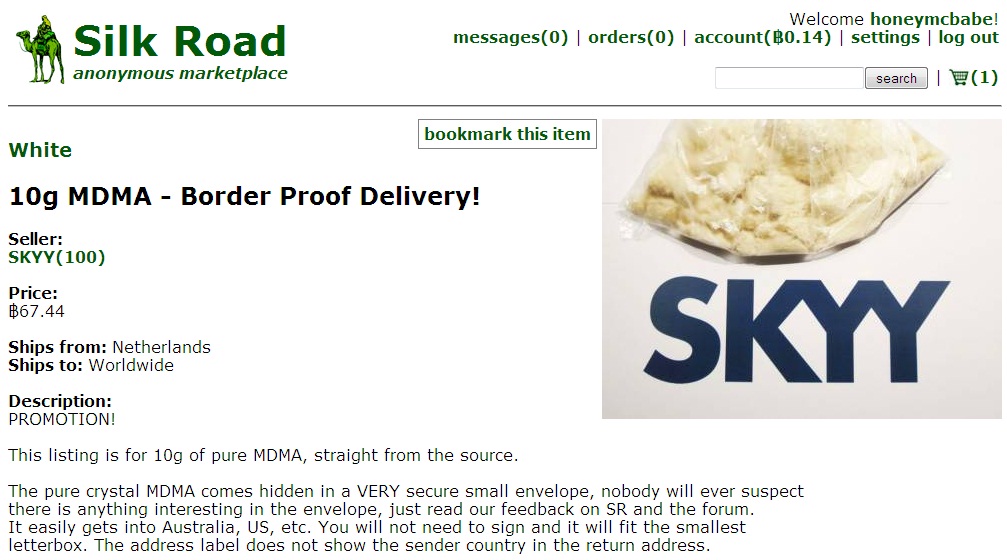
An example of a listing - this one for MDMA. All items are pitched similar to eBay, with description, photo, price in BC and the Sellers ID and Rating. In this example you can see the seller SKYY has a 100 rating, very viable. You can check where the item is shipping from and where the seller is willing to ship too. I go into this a little further in the story, but the Netherlands tends to produce some of the the highest quality products on SR. So despite the delay in shipping as opposed to the a shipment from the States, it very will be worth the weight. In less of course you are buying dope and needed it ASAP lest you get get sick, you'll want to choice someone local who is willing to expedite shipping
Although drugs are by far the largest category on the Silk Road, there are many other illicit items for purchase as well. Here is an example of a general listing for fake ID's. You will be able to cross compare all sellers and their rating as well as scope out pricing and shipping information
In the next entry I'll go into detail about that first purchase of LSD and 2nd order placed soon after - both leading to a bizarre string of events. Questions or comments? Just ask! I'm happy to share
I've put in a dozen or so orders by now - usually multiple orders at a time to use up all the bitcoins I’ve deposited in my account at once. That way they don’t linger around temping one of the numerous hackers (Tor is littered with them) who search the Silk Road for accounts with balances remaining. You will see there is a section where you can by money and bitcoins. Where do you think those bitcoins are coming from? Mostly from accounts that leave a balance available at any given time. So figure out what you are going to buy and deposit approximately that much money, plus the fees associated with each step along the way. The bitcoins process can take some time to complete (especially at first) and there fees associated with each transaction along the way until the final step where you trade USD for E-Currency, (usually one party will facilitate taking your money and depositing it somewhere larger that auctions E-Currency or the like (Liberty Reserve is one of these E-Currency Companies) And example work flow would go something like this <you deposit cash(each company accepts different forms for payment ie, Bank Transfer, Western Union, Credit Card (rarely) PayPal) into a company like electrumx.com. electrumx.com then deposits those funds to LibertyReserve.com, who turns it into E-Currancy. Once you have that, you can trade it like the stock market for Bitcoins from any bitcoin company, like say Mt Gox. From there you are given an extremely long code from your Silk Road account that will allow you too enter that into any bitcoin provider and they will deposit your bitcoin balance (after each of the aforementioned companies takes a fee). Right now the bitcoin market ended at 13.37487bc to $1. This is the highest I have consistently seen it. It's been as low as $3, and stayed there for quite sometime too. So the market does fluctuate quite a bit.
Here is a screenshot of the LibertyReserve site and an example of some of the venders they use to deposit funds.
As I just mentioned, 99.9% (in not 100% these days) of SR transactions are done with bitcoins. Supposedly they are completely anonymous, protecting your identity from all purchases.
*NOTE: There is some debate over how autonomous bitcoins really are. But for our purposes, they actually do offer the most superior protection available. But we’ll delve into this later towards the end.*
I would say that the vast majority of my transactions have run smoothly and been completely successful. But the first few undoubtedly made me a little nervous. Eventually they all worked out, but with each order something out of the ordinary happened. Odd packages started to arrive, unsolicited - including a string of random drugs, definitely not purchased, arrived in the mail – but more on that later. The first time was the oddest - and definitely the creepiest. Admittedly, I made a couple n00b mistakes, which might have triggered some of these events. This is why I’m writing all of this – so anyone who wants to journey down the Silk Road, can have access to a manual of sorts - an instruction guide, riddled with some humorous personal antidotes.
My first purchase, I ordered a vile of acid. It was a 250 drop vile at 50mg a drop. The seller was from the Netherlands and requested a no bitcoin transaction, PayPal preferred – an EXTREMELY odd request on the SR and one I have not seen repeated since. However at the time I didn’t realize just how unusual this was. I didn’t do a lot of research before my first purchase, I got too excited and jumped right in with a large purchase immediately after joining (yeah, yeah impatient, I know). But I could tell that the bitcoin process was initially going to take a few days to set up, so I was just stoked to see something I could pull the trigger on immediately. And a huge vile of acid, which was exactly what I was looking for! No more buying 10 strips on lots or going through one of the two people I know who can sometimes provide a sheet. This was going to last me for a while! (It was gone in like two months – but that’s inconsequential to the story. Just shows that I like my acid. Quite a bit.) Especially since I already had a full sheet as well as 50 drops in a vile a friend scored me in NY. I prefer liquid acid, because my ideal route of administration is IV, so it bypasses the step required to soak the LSD out of the strip. Makes it much easier… but anyway… back to the Silk Road.
Once you pay for an item with bitcoins, your purchase goes into and you don’t have to fully release the funds until your order is received. Sellers do have the option to accept escrow payments or not, but if you release early the fault lies on you and there is no further protection from SR. But buying any product from the Silk Road is much like eBay, as you will see in the included photographs. All sellers are given ratings from the buyer after the transaction, and you can pick who you want to do business with based on those ratings – number of stars, description of personal communication, number of positive ratings, how long they have been active on SR and how their product is reviewed. Then, if you are smart, you pick sellers with a large number of high (perfect) ratings. You want to pick a seller that has a 100 ratings, because there are many ways to fool the system and these are drug dealers you are working with after all. Some people put their product up, have their buddies purchase a few times, acquire some positive reviews, convince the next potential buyers to release escrow early, then disappear after they have received the cash. This has happened to me once on the SR when I wanted to sample a 10 strip. But this business happens all the time on every drug buying forums, be it topix, oxyforum or the Silk Road. (Not to mention the scammers you run across when buying drugs in real life, especially when copping on the streets!) There are always going to be scammers. So 1 time out of 20 or so purchases I still consider pretty good odds!
Anyway – the most reputable sellers have no problem selling in escrow, but there are some completely legit sellers who request early release. In the end, the choice is yours. Do you want to purchase from someone requesting earlier release or not. There’s definitely risk involved, but I’ve done it for sellers with extremely high ratings by a large number of buyers and my transaction be completely smooth. Once you release funds and leave your review (which is required as funds are released – a big flaw in the SR still if you as my humble opinion), there is now no way to go back and change your remarks or communicate with other buyers how you were ripped off. Luckily, there is one more line of defense to protect yourself and all buyers, although it can be overlooked much of the time. There is a message board, a forum, where you can report fraudulent sellers and give a description of the transaction, communication and product – both good or bad. Most (maybe even all) reputable sellers have their own forum page. There are also threads listing all types of shady sellers as well.. This is your only option for recourse if you are scammed after waving escrow. But hopefully the product was FIRE and you want to fluff the seller with high praise.
An example of a listing - this one for MDMA. All items are pitched similar to eBay, with description, photo, price in BC and the Sellers ID and Rating. In this example you can see the seller SKYY has a 100 rating, very viable. You can check where the item is shipping from and where the seller is willing to ship too. I go into this a little further in the story, but the Netherlands tends to produce some of the the highest quality products on SR. So despite the delay in shipping as opposed to the a shipment from the States, it very will be worth the weight. In less of course you are buying dope and needed it ASAP lest you get get sick, you'll want to choice someone local who is willing to expedite shipping
Although drugs are by far the largest category on the Silk Road, there are many other illicit items for purchase as well. Here is an example of a general listing for fake ID's. You will be able to cross compare all sellers and their rating as well as scope out pricing and shipping information
In the next entry I'll go into detail about that first purchase of LSD and 2nd order placed soon after - both leading to a bizarre string of events. Questions or comments? Just ask! I'm happy to share


I'm tired of everyone thinking that all drug users are good for nothing type people. I was volunteering at a soup kitchen type thing with my coworkers and they kept talking about how everyone there was on drugs and that's why they were homeless. First off ... terribly insulting to homeless people as that is NOT why all people are homeless! There are many other reasons! Yes, being a drug addict can be one reason but it's not the only reason.
Then they get on the topic of drugs, and how drugs are so terrible, they ruin your lives. I wish I could say something, but I can't - it's my job at risk!! But the way they talk about drug users! I just wish I could prove them wrong! But you only hear about the "bad" drug users. The ones that do bad things, or the addicts, and the ones that die. Not the successful ones. Why? Because successful drug users can't talk about their drug use all the time.
I'm just so tired of it. I don't feel like I personally am being judged, because they don't know. But I just ... I hate how they judge drug users in general. It just makes me so angry! It IS possible to be a successful drug user!
Keep in mind that this was being discussed while some people were serving coffee ... you know ... with caffeine (drugs!) in it.
Then they get on the topic of drugs, and how drugs are so terrible, they ruin your lives. I wish I could say something, but I can't - it's my job at risk!! But the way they talk about drug users! I just wish I could prove them wrong! But you only hear about the "bad" drug users. The ones that do bad things, or the addicts, and the ones that die. Not the successful ones. Why? Because successful drug users can't talk about their drug use all the time.
I'm just so tired of it. I don't feel like I personally am being judged, because they don't know. But I just ... I hate how they judge drug users in general. It just makes me so angry! It IS possible to be a successful drug user!
Keep in mind that this was being discussed while some people were serving coffee ... you know ... with caffeine (drugs!) in it.

Do you still talk to your FIRST love?
Yes.
What was your FIRST alcoholic drink?
Cranberry vodka
What was your FIRST job?
Cashier.
What was your FIRST car?
Nissan sentra.
Who was the FIRST person to text you today?
Mama.
Who is the FIRST person you thought of this morning?
My boyfriend.
Where did you go on your FIRST ride on an airplane?
Never.
Who was your FIRST best friend & do you still talk?
Gianna & yes
Where was your FIRST sleep over?
Gianna!
Who was the FIRST person you talked to today?
My kitty.
Whose wedding were you in the FIRST time?
Uncles.
What was the FIRST thing you did this morning?
Checked the time.
What was the FIRST concert you ever went to?
Brittany Spears lol.
FIRST broken bone?
Nada.
FIRST piercing?
Ears.
FIRST foreign country you've gone to?
N/a
FIRST movie you remember seeing?
Harriet the Spy
When was your FIRST detention?
Neer had it lol.
Who was your FIRST roommate?
My cousin.
Did you marry the FIRST person to ask for your hand in marriage/ you asked to marry?
Never been asked.
What was the FIRST sport you were involved in?
Soccer.
What were the FIRST lessons you ever took?
Gymnastics.
A - Age: 21
B - Bed size: queen
C - Chinese Food Dish: sweet and sour chicken
D - Dentist name: don't have one.
E - Early Bird or Night Owl? night owl.
F - Favorite color: orange.
G - Gold or Silver: gold.
H - Height: 5'3"
I - Ink as in tatto's you have: none yet.
J - Job title: slave.
K - Kitchen Meal or Restaurant? Kitchen.
L - Living arrangements? With my cousin and 3 cats
M - Month of birth: may.
N - Nicknames: honey.
O - On time or late: usually early.
P - Pet Peeve: pronouncing words incorrectly.
Q - Quote from a movie: hmm
R - Right or left handed: ambidextrous!
S - Siblings: yes
T - Time you wake up: it depends on the day.
U - Urgent thing on your to do list: find a new job.
V - Vegetable you dislike: hmm..can't think of any off the top of my head.
W - Wishing for: marriage
X - X-rays you've had: skull, spine, ankle, neck
Y - Yummy food you make: brownies!
Z - Zoo Favorite: tigers
Yes.
What was your FIRST alcoholic drink?
Cranberry vodka
What was your FIRST job?
Cashier.
What was your FIRST car?
Nissan sentra.
Who was the FIRST person to text you today?
Mama.
Who is the FIRST person you thought of this morning?
My boyfriend.
Where did you go on your FIRST ride on an airplane?
Never.
Who was your FIRST best friend & do you still talk?
Gianna & yes
Where was your FIRST sleep over?
Gianna!
Who was the FIRST person you talked to today?
My kitty.
Whose wedding were you in the FIRST time?
Uncles.
What was the FIRST thing you did this morning?
Checked the time.
What was the FIRST concert you ever went to?
Brittany Spears lol.
FIRST broken bone?
Nada.
FIRST piercing?
Ears.
FIRST foreign country you've gone to?
N/a
FIRST movie you remember seeing?
Harriet the Spy
When was your FIRST detention?
Neer had it lol.
Who was your FIRST roommate?
My cousin.
Did you marry the FIRST person to ask for your hand in marriage/ you asked to marry?
Never been asked.
What was the FIRST sport you were involved in?
Soccer.
What were the FIRST lessons you ever took?
Gymnastics.
A - Age: 21
B - Bed size: queen
C - Chinese Food Dish: sweet and sour chicken
D - Dentist name: don't have one.
E - Early Bird or Night Owl? night owl.
F - Favorite color: orange.
G - Gold or Silver: gold.
H - Height: 5'3"
I - Ink as in tatto's you have: none yet.
J - Job title: slave.
K - Kitchen Meal or Restaurant? Kitchen.
L - Living arrangements? With my cousin and 3 cats
M - Month of birth: may.
N - Nicknames: honey.
O - On time or late: usually early.
P - Pet Peeve: pronouncing words incorrectly.
Q - Quote from a movie: hmm
R - Right or left handed: ambidextrous!
S - Siblings: yes
T - Time you wake up: it depends on the day.
U - Urgent thing on your to do list: find a new job.
V - Vegetable you dislike: hmm..can't think of any off the top of my head.
W - Wishing for: marriage
X - X-rays you've had: skull, spine, ankle, neck
Y - Yummy food you make: brownies!
Z - Zoo Favorite: tigers
Woke up around 9am from a bad dream. I dreamt my Mother had gone to Brazil on vacation and let one of my teachers from highschool (Who's an alcoholic/addict) and her boyfriend stay at the house and watch over me. In the dream I saw someone I went to rehab with who was a heroin addict and he had the hookup in the dream and we, well, mostly he, started selling large amounts of heroin out of the house and around town. We were under surveillance and I was having increasing issues with the teacher and her boyfriend who were watching over me and trying to control me. We all drank together and me and the guy from rehab where shooting black tar. Then my lil sister was with her ex-boyfriend again and somehow he his relatives were staying with us or were hanging around. He became an alcoholic and was cheating on my sister so I beat his ass (I've never been in a real fight IRL). Last thing I remember was drinking with my lil sisters ex and he overdosed and passed out and I could feel how he felt, unconscious for a few seconds then I woke up. Also in the dream we were partying in this hotel/massion/party house and I was getting some attention from some girls but I fucked things up by snorting meth with some guy. I remember it wasn't chopped up and the crystals hurt my nose terribly and were actually falling out and the girls noticed I was acting suspicious so they ditched me.
So I woke up around 9am and I felt okay for a minute or two as I was waking up and smiled and told myself, "this is going to be a good day". Then I took 0.1mg clonidine, 900mg gabapentin and grabbed my 1mg piece of suboxone strip and grabbed an oral insulation syringe (what they give you after your wisdom teeth come out) and mixed the 1mg sub up in about 1.5-2.0ml of water in a shot glass and drew it up in the insulation syringe and laid flat on my back in the bathroom and slowly squirted the solution in my nose and it BURNED LIKE HELL. I laid there for a couple minutes then got up and sniffed and got the sub up in my nasal cavity and then I added another 1.5ml to the shot glass to get the residue out and laid down on my back on the bathroom floor again and slowly squirted it in and it burned like hell again. About 15 minutes later I started to feel relief, my urge to poop subsided (it was very loose stools). I started to feel a bit of warmth in my chest.
I then went into my room and logged onto the computer and started browsing the web, listening to Lil B's "I'm Gay" album. Then my Mother asked me if I'd like to join her on a walk with our dog. I took 50mg hydroxyzine PAM and smoked a cigarette before we left and we walked for about 30-45 minutes. As I walked with my Mother and we talked and had good conversation, I felt the sub coming on stronger and I started to feel very energetic. I find that taking the sub intra-nasal creates a much more pronounced speedy and energetic effect although I felt quite calm and at peace.
When we got home I made a smoothie using frozen raspberry's, coconut oil, peanut-butter and non-fat pro-biotic yogurt. I washed some dishes and made some tea before I drank the delicious smoothie. I took 2 psyllium husk fiber capsules with 8-10oz of water. I then started to drink the tea and smoked another cigarette. I came back inside and started cleaning. I swept and organized. I started a load of laundry. After I was done cleaning I smoked another cigarette and put the laundry in the dryer. Then I got back on the computer to continue this blog entry. Now I'm going to take the laundry out of the dryer and take a shower. It is a beautiful sunny day, although this morning it was raining and overcast. It is rare to have such a nice day this time of year and I feel good.
So I woke up around 9am and I felt okay for a minute or two as I was waking up and smiled and told myself, "this is going to be a good day". Then I took 0.1mg clonidine, 900mg gabapentin and grabbed my 1mg piece of suboxone strip and grabbed an oral insulation syringe (what they give you after your wisdom teeth come out) and mixed the 1mg sub up in about 1.5-2.0ml of water in a shot glass and drew it up in the insulation syringe and laid flat on my back in the bathroom and slowly squirted the solution in my nose and it BURNED LIKE HELL. I laid there for a couple minutes then got up and sniffed and got the sub up in my nasal cavity and then I added another 1.5ml to the shot glass to get the residue out and laid down on my back on the bathroom floor again and slowly squirted it in and it burned like hell again. About 15 minutes later I started to feel relief, my urge to poop subsided (it was very loose stools). I started to feel a bit of warmth in my chest.
I then went into my room and logged onto the computer and started browsing the web, listening to Lil B's "I'm Gay" album. Then my Mother asked me if I'd like to join her on a walk with our dog. I took 50mg hydroxyzine PAM and smoked a cigarette before we left and we walked for about 30-45 minutes. As I walked with my Mother and we talked and had good conversation, I felt the sub coming on stronger and I started to feel very energetic. I find that taking the sub intra-nasal creates a much more pronounced speedy and energetic effect although I felt quite calm and at peace.
When we got home I made a smoothie using frozen raspberry's, coconut oil, peanut-butter and non-fat pro-biotic yogurt. I washed some dishes and made some tea before I drank the delicious smoothie. I took 2 psyllium husk fiber capsules with 8-10oz of water. I then started to drink the tea and smoked another cigarette. I came back inside and started cleaning. I swept and organized. I started a load of laundry. After I was done cleaning I smoked another cigarette and put the laundry in the dryer. Then I got back on the computer to continue this blog entry. Now I'm going to take the laundry out of the dryer and take a shower. It is a beautiful sunny day, although this morning it was raining and overcast. It is rare to have such a nice day this time of year and I feel good.
At the moment I am sitting in the lobby of the methadone clinic, having picked up my take-home bottles. I think many here probably find me stand offish simply because I ignore almost all clients. I don't give a shit how many Xanax or Ellavil you want to sell, or how many watered down bottles you really hope I buy, just leave me the fuck alone, than you ever so kindly.
I remember, once in Amsterdam I met a Dutch junkie who told me that junkies are smarter on average, than straight people. I almost pissed on myself as he went on and on and on, before retiring to his cardboard box next to one of the city's many canals. Not that living in the rough has any correlation to intelligence mind you, just that more than 99.9 percent of the junkies I have met have been bone ass stupid. For every Burroughs or de Quincy there are 25,000 bleeding mongoloids- if only in terms of their IQs and social graces.
Case in point...One show that I really enjoy is "Banged up Abroad" on the National Geographic Channel, known as "Locked up Abroad" in the States. One episode I watched the other day involved a Scotts junkie who abandoned his son when the little boy was 6. Fast forward to age 22 and the boy gets a call out of the blue from dear old dopefiend dad inviting him for an all expences paid jaunt down the infamous Silk Road. Being the creatures we are the son jumped at the chance to quit his job and leave his live in love high and dry.
Arriving in Islamabad he is greeted by daddy whom he recognises because he is the only white man in Arrivals. Dad takes him straight to a little shoppe where he is shocked to find papa hitting a water pipe with some great hash. His father calms him by reminding him that different cultures have different customs but then drops an atom bomb on him, "Uh yah laddie, I dint' have time to tell ye' before but we will be carrying 20 kilos of this hash into China, smuggle it across the width of the country to Shanghai, and then smuggle ir into Tokyo." What the fuck?
Nice guy that father is. Abandon your boy when he is just starting school and needing his father the most, then manipulate him at age 22 into muleing 20 keys of hash in a death penalty nation! He tells his son that he has made the crossing many times before and there is never any Customs or Immigration Inspections. What's more he says, should anything ever go wrong he will take full responsibility and the boy will be on his merry way. Seeking approval the boy agrees.
Loading the hash into false bottoms of 2 carry on bags they run out of the professionaly manufactured smuggler bags and amazingly, decide to tear out the bottom of an over the counter bag, plant the hash and sew it back up. As long as noone ever inspects that 3rd bag too closely there should be no problems. Lo and behold, at the crossing the Chinese are going over bags with a finetooth comb. Shitting bricks, they almost keel over when the Chinese guards gruffly order them out of the line and proceed immediately to the front, something that often happens with whites or blacks in Southeast Asia (indeed, Thailand has special lines for foreigners only).
The Chinese border police give the 2 men a going over and suddenly pass them on through. Ecstatic having crossed what they believed was their most formidable obstacle they buy a cabin on a cross country train that will take 6 days to reach Shanghai. Unbelievably, dear old dad rolls joints of hash and not only smokes it on the train, but does so outside their cabin. Standing opposite the window he is smoking a fat joint of hash when a conductor comes through the door into his car!
Looking dumbfounded the father merely looks sheepishly as the conductor puts a finger to his nose and moves the index finger on his other hand as if to say "No no." The Scottsman stamps out the joint and smiles before paranoia gets the best of him and he retires to the cabin. Now, the train is hauling ass through the Gobi Desert near Mongolia. They could have dumped the load and if it was crucial they could conceivably return for it by disembarking at the next station. Do these braniacs do this? Nah, they feed off eachother's paranoia until that same conductor knocks on their cabin door a couple of hours later.
Looking sternly at the father the conductor pantomimes that he wants both the father's ticket AND the hash. Dad believes that the conductor is merely tryting to hustle a bribe, possibly looking to get the hash for his own enjoyment and hands him a few grammes in a baggie he was using as a headstash. The conductor angrily leaves with both the ticket and the stash and now father and son are almost over the edge in a frantic struggle with paranoia.
As the train begins slowing down at a station they decide to take their chances with the 3 bags and make a run for it. At the end of the station platform is a turnstile and a clerk checking that each departing passenger has paid the correct fare. The son gets through without a problem but as the father argues with the clerk over not having his ticket a lot of shouting erupts from the other end of the platform and who would it be but the conductor! Off they go to a Chinese police station.
I will get to the rest in a following entry...
I remember, once in Amsterdam I met a Dutch junkie who told me that junkies are smarter on average, than straight people. I almost pissed on myself as he went on and on and on, before retiring to his cardboard box next to one of the city's many canals. Not that living in the rough has any correlation to intelligence mind you, just that more than 99.9 percent of the junkies I have met have been bone ass stupid. For every Burroughs or de Quincy there are 25,000 bleeding mongoloids- if only in terms of their IQs and social graces.
Case in point...One show that I really enjoy is "Banged up Abroad" on the National Geographic Channel, known as "Locked up Abroad" in the States. One episode I watched the other day involved a Scotts junkie who abandoned his son when the little boy was 6. Fast forward to age 22 and the boy gets a call out of the blue from dear old dopefiend dad inviting him for an all expences paid jaunt down the infamous Silk Road. Being the creatures we are the son jumped at the chance to quit his job and leave his live in love high and dry.
Arriving in Islamabad he is greeted by daddy whom he recognises because he is the only white man in Arrivals. Dad takes him straight to a little shoppe where he is shocked to find papa hitting a water pipe with some great hash. His father calms him by reminding him that different cultures have different customs but then drops an atom bomb on him, "Uh yah laddie, I dint' have time to tell ye' before but we will be carrying 20 kilos of this hash into China, smuggle it across the width of the country to Shanghai, and then smuggle ir into Tokyo." What the fuck?
Nice guy that father is. Abandon your boy when he is just starting school and needing his father the most, then manipulate him at age 22 into muleing 20 keys of hash in a death penalty nation! He tells his son that he has made the crossing many times before and there is never any Customs or Immigration Inspections. What's more he says, should anything ever go wrong he will take full responsibility and the boy will be on his merry way. Seeking approval the boy agrees.
Loading the hash into false bottoms of 2 carry on bags they run out of the professionaly manufactured smuggler bags and amazingly, decide to tear out the bottom of an over the counter bag, plant the hash and sew it back up. As long as noone ever inspects that 3rd bag too closely there should be no problems. Lo and behold, at the crossing the Chinese are going over bags with a finetooth comb. Shitting bricks, they almost keel over when the Chinese guards gruffly order them out of the line and proceed immediately to the front, something that often happens with whites or blacks in Southeast Asia (indeed, Thailand has special lines for foreigners only).
The Chinese border police give the 2 men a going over and suddenly pass them on through. Ecstatic having crossed what they believed was their most formidable obstacle they buy a cabin on a cross country train that will take 6 days to reach Shanghai. Unbelievably, dear old dad rolls joints of hash and not only smokes it on the train, but does so outside their cabin. Standing opposite the window he is smoking a fat joint of hash when a conductor comes through the door into his car!
Looking dumbfounded the father merely looks sheepishly as the conductor puts a finger to his nose and moves the index finger on his other hand as if to say "No no." The Scottsman stamps out the joint and smiles before paranoia gets the best of him and he retires to the cabin. Now, the train is hauling ass through the Gobi Desert near Mongolia. They could have dumped the load and if it was crucial they could conceivably return for it by disembarking at the next station. Do these braniacs do this? Nah, they feed off eachother's paranoia until that same conductor knocks on their cabin door a couple of hours later.
Looking sternly at the father the conductor pantomimes that he wants both the father's ticket AND the hash. Dad believes that the conductor is merely tryting to hustle a bribe, possibly looking to get the hash for his own enjoyment and hands him a few grammes in a baggie he was using as a headstash. The conductor angrily leaves with both the ticket and the stash and now father and son are almost over the edge in a frantic struggle with paranoia.
As the train begins slowing down at a station they decide to take their chances with the 3 bags and make a run for it. At the end of the station platform is a turnstile and a clerk checking that each departing passenger has paid the correct fare. The son gets through without a problem but as the father argues with the clerk over not having his ticket a lot of shouting erupts from the other end of the platform and who would it be but the conductor! Off they go to a Chinese police station.
I will get to the rest in a following entry...
A continuation...
At the police station father and son were of course seperated as are all suspects in any interrogation. I hesistate to use the phrase "to his credit" because it is merely what any human should do, dear old dad told his interrogators that the boy knew nothing about the hashish and that it was all his doing. After a harrowing night incommunicado the son was brusquely released, put on a plane and deported to Hong Kong.
Hong Kong is under Chinese sovereignity but is under fully autonomous status. Suprisingly this autonomy extends even to immigration apparently since he was sent there BY China after his perphreal involvement in a hashish smuggling scheme,
When the Chinese police informed him of his release they nearly gave him a heart attack when they handed him the 2 smuggling bags INTACT with their secreted hashish! Now, you have just been arrested in a death penalty nation. You can imagine that your father is at that very moment being subjected to heinous forms of torture and unimaginable stress. You are handed a death penalty amount of hashish and informed you will be going through yet another border crossing, albeit as an air arrival. Moreover, your destination will have been informed that you are a deportee for a drugs offence. What would a sane person do? Me? I would go to the loo in the airport and flush every fucken crumb down the damn crapper!
What does our intrepid protagonist choose to do? "I decided that I would continue on with our plan. I would take the drugs onto Tokyo to prove to my dad that I had what it takes and to earn money to finance his defence." Riiiiight. Meanwhile, daddy-o is back in his rat infested cell in China, sleeping on a 1cm thich bamboo mat on a dank concrete floor, sleeping toe to toe with the dregs if Chinese society. Meal time is a bowl of bug infested white rice 3X a day with a bowl of hot water and some disgusting boiled greens floating on the surface. Hey, life's a bitch. The worst of it though is that his kind hearted warders never bother to inform him that junior has been released and deported. He is wracking his brain with guilt and regret. First he abandoned the boy when he was 6, now at 22 his son is facing a bullet to the back of the head- the preferred method of execution for drugs offences in China.
Meanwhile, laddie miraculously cleared Customs and Immigration in Hong Kong! Counter-intuitively, he didn't even face questioning, much less an inspection. Knowing that a person has just been deported for a drugs offence leads one to believe that the deportee has been properly vetted in all ways. Who would imagine that a drugs deportee is arriving with 14 kilos of secreted hashish? What are the chances of the Chinese police having handed him 2 carry on bags with a load of hashish in them?
Next is a flight bound for Tokyo. Amazingly, the Japanese must not have been aware of his recent travel history since they didn't bar his entry. Japan has a fairly strong hash market and like most nations in Eastern Asia the product costs an arm and a leg even on the wholesale end of the market. To give you an idea...A person can go to Katmandu in Nepal...or to Sagada in the Philippines, and pay $250.00 for a kilo of black creamy hash, better than anything I have ever seen in Lebanon or Pakistan. That same kilo is worth $50,000 as soon as you clear Japanese Customs. If you unload it yourself, you can make up to $100,000 within a month, with little worries of arrest or robbery.
Junior went directly to an expat bar his father had told him about and quickly got rid of his load. Back in China his father was shocked when staffer from the British Consulate informed him that his son- whom he had believed was sitting in an identical cell in another part of the facility- had wired him $10,000 to retain an attorney. Staring at the Consulate flunky in shock he asked WHERE had it been wired FROM. Having been told it came from Tokyo the father began laughing like a maniac, "That's my laddie!"
Personally? I think both are carbon copies of one another. Both are blubbering idiots. In any event, after a decade Daddy flew back to the UK and today father and son are happy as larks.
Not all the episodes are factual. There was another one, involving a Chassidic (Hassidic) Jew who served time in Brasil for coke. A native of London he- like me- entered into an arranged marriage at age 17. Like me, he was divorced in his early 20s. One day, a mate of his, another Chasid, asked him if he would like to take an all expences paid holiday in Brasil. Thinking that his friend was simply trying to cheer him up after his marriage imploded, the man said sure, he would love to see the country...off to Brasil.
To be continued...
At the police station father and son were of course seperated as are all suspects in any interrogation. I hesistate to use the phrase "to his credit" because it is merely what any human should do, dear old dad told his interrogators that the boy knew nothing about the hashish and that it was all his doing. After a harrowing night incommunicado the son was brusquely released, put on a plane and deported to Hong Kong.
Hong Kong is under Chinese sovereignity but is under fully autonomous status. Suprisingly this autonomy extends even to immigration apparently since he was sent there BY China after his perphreal involvement in a hashish smuggling scheme,
When the Chinese police informed him of his release they nearly gave him a heart attack when they handed him the 2 smuggling bags INTACT with their secreted hashish! Now, you have just been arrested in a death penalty nation. You can imagine that your father is at that very moment being subjected to heinous forms of torture and unimaginable stress. You are handed a death penalty amount of hashish and informed you will be going through yet another border crossing, albeit as an air arrival. Moreover, your destination will have been informed that you are a deportee for a drugs offence. What would a sane person do? Me? I would go to the loo in the airport and flush every fucken crumb down the damn crapper!
What does our intrepid protagonist choose to do? "I decided that I would continue on with our plan. I would take the drugs onto Tokyo to prove to my dad that I had what it takes and to earn money to finance his defence." Riiiiight. Meanwhile, daddy-o is back in his rat infested cell in China, sleeping on a 1cm thich bamboo mat on a dank concrete floor, sleeping toe to toe with the dregs if Chinese society. Meal time is a bowl of bug infested white rice 3X a day with a bowl of hot water and some disgusting boiled greens floating on the surface. Hey, life's a bitch. The worst of it though is that his kind hearted warders never bother to inform him that junior has been released and deported. He is wracking his brain with guilt and regret. First he abandoned the boy when he was 6, now at 22 his son is facing a bullet to the back of the head- the preferred method of execution for drugs offences in China.
Meanwhile, laddie miraculously cleared Customs and Immigration in Hong Kong! Counter-intuitively, he didn't even face questioning, much less an inspection. Knowing that a person has just been deported for a drugs offence leads one to believe that the deportee has been properly vetted in all ways. Who would imagine that a drugs deportee is arriving with 14 kilos of secreted hashish? What are the chances of the Chinese police having handed him 2 carry on bags with a load of hashish in them?
Next is a flight bound for Tokyo. Amazingly, the Japanese must not have been aware of his recent travel history since they didn't bar his entry. Japan has a fairly strong hash market and like most nations in Eastern Asia the product costs an arm and a leg even on the wholesale end of the market. To give you an idea...A person can go to Katmandu in Nepal...or to Sagada in the Philippines, and pay $250.00 for a kilo of black creamy hash, better than anything I have ever seen in Lebanon or Pakistan. That same kilo is worth $50,000 as soon as you clear Japanese Customs. If you unload it yourself, you can make up to $100,000 within a month, with little worries of arrest or robbery.
Junior went directly to an expat bar his father had told him about and quickly got rid of his load. Back in China his father was shocked when staffer from the British Consulate informed him that his son- whom he had believed was sitting in an identical cell in another part of the facility- had wired him $10,000 to retain an attorney. Staring at the Consulate flunky in shock he asked WHERE had it been wired FROM. Having been told it came from Tokyo the father began laughing like a maniac, "That's my laddie!"
Personally? I think both are carbon copies of one another. Both are blubbering idiots. In any event, after a decade Daddy flew back to the UK and today father and son are happy as larks.
Not all the episodes are factual. There was another one, involving a Chassidic (Hassidic) Jew who served time in Brasil for coke. A native of London he- like me- entered into an arranged marriage at age 17. Like me, he was divorced in his early 20s. One day, a mate of his, another Chasid, asked him if he would like to take an all expences paid holiday in Brasil. Thinking that his friend was simply trying to cheer him up after his marriage imploded, the man said sure, he would love to see the country...off to Brasil.
To be continued...

Are people actually paying attention to this farical charade they call democracy? I've just been reintroduced to the public and the televisions the patients watch, and realized to myself: "My god; these bastards believe in this shit!"
And another thing. I hate being typecast as someone who would share any interest or vested passion in the fucking democrats.
I fucking hate the democrats.
Hate
the republican inbred cocksuckers as well.
If you truly think choosing between two assholes pretending to have different agendas while being financed by the same massive conglomerate shits simultaneously should reevaluate their lines of reasoning.
I even hate the fucking liberals. I hate all governments, because they're unnecessary and no more than a widely accepted and sanctioned form of highly sophisticated organized criminals.
The economic system dictates the quality of life in this country, and in a dominater run patriarchal individualistic police state, the only thing that's going to save your ass or help your quality of life is becoming a king-hell fink yourself and getting your hands on the money these greedy junkies grind into powder every night and suck it up through presidential and corporate cottons, pushing it in the mainline while they blow cigarette smoke towards the ceiling casually admiring the live execution being broadcast to them special straight out of texas.
Here's an idea, stop bombing brown people. Then, maybe we won't have to send our children to die so you can make buck under the table and piss of the whole fucking world. Not to mention systematically decreasing the employability options while simultaneously raising the cost of living and keeping the minimum wage at a flat rate. That's pretty smart how you managed to keep feudalism going this long.
My hat goes off to you Monarchichal scum.
It's a good thing we get accurate information about world events and the human experience from watching reruns of "Raymond Blows The Milkman" sucking on food rich in poisons and carcinogenic properties while ironically giving ourselves a slow fate ending in diabetes when they'll have finally made it impossible to afford the medicine to treat it, thus killing you by proxy and keeping the good stuff for themselves.
"Then he gives the American People the finger, 'I've got mine; fuck you every crumb for himself."
"In a democracy people get the kind of government they deserve."
Indeed.
I'm voting for Ronald Reagan. Just so we can dig that blackhearted monster from his sepulchre by the see and prop his decaying senile visage up for the cameras, then douse him in kerosine and piss in his mouth while simultaneously sodomizing the abominable 'tribute' crap they have down at the former center of trade.
You'll get a hefty dose of the grim scenarios I bring to light here in 50 years, and I'm sorry I had to be the one to break it to you. Then you can look back on all those wasted hours spent on lines to use flawed electronics to choose some asshole who even if he were sincere, has no real influence over public policy at all.
While I have you fine Christian Americans here I've got one more question. You who do plan on pulling your pud in some voting booth half your life every 4 years when you could be engaged in some other activity, perhaps taking care of your 7 children, do you do it on the local level? What about 2 years from now when we've got a chance to drive out some of these rancid racists shit-eating congressman, state house officials, legislators, judges and representives? Will you be voting then? If the answer is no then why the fuck bother voting in the first place? AND having the gall to look at me weird because I wouldn't be caught dead wasting my time on a meaningless excersise like that.
The only thing politics is good for is gambling, and we already have pro football and they do enough damage. It's time stop pretending you're pride that was shoveled up your ass and out your throat isn't yours at all. You've been duped, friend. You've been conned. And when that's the case you can hardly blame the politicians any more for anything ever. You don't have the time to educate yourself on these simple mechanisms and processess by which they've managed to keep their slaves and convince them they're free? I blame you. You fucked it up, you get what you pay for. Or in this case, what you barely payed attention to not to mention critically questioning some of these ideas from secondary, tertiary, and as many other sources as possible.
I know it's not PRIMARILY your fault, they've done an excellent Orwellian job of addicting you to the instruments and conditioning vectors by which you're deluded into a value system that's completely and systematically constructed for one motive and one motive only and that's too keep you in line.
Enjoy your 65 percent unemployment rate in 50 years when the oil reserves are just about dry while no suitable alternative renewable energy alternatives have been implimented.
And keep giving your hard earned 'capital' to banks. This I never got, just really stupid. What the fuck would anyone ever need a bank for? A loan? Credit? Let me let you in on a little secret folks. Credit IS NOT important. It's make believe. It's money you don't have, and its an awfully convenient way of keeping you in poverty for the entirety of your adult life when you're convinced and bemused by advertising into buying a whole lot of stupid shit you don't need. Get a greendot card, invest in gold, silver, bitcoins, commodities with long shelf lives, and hock up the 5 dollars it takes to cash your check at walmart. Use the technology we have to take your shit back. These institutions are no longer relevent!
Get yourself a safe and keep your valuables in there, stop buying overpriced sweatshop products that were poorly manufactured to begin with, and stop pissing yourself in yokel excitement every time some stupid gadget or phone or trend is set to be released at some absurd price when you already have a perfectly good phone.
Time to stop the dick-sizing contest.
And maybe try to love your neighbor while you're at it.
I see people every day and for every kind, empathetic, polite, and truly humanitarian person I meet I see 99 selfish criminal ego driven madmen content on projecting their self-inflicted unhappiness onto perfect strangers when they're not busy working for some criminal corporation that's literally fucking your grandchildren to come in the ass for every quota they make, for every dollar they come by through questionable or downright illegal means, and destroying an entire ecosystem and resource rich environment that if used intelligently, could go on providing us spoiled simians with the 'comfort' we've been spoiled by since birth.
Remember, he who dies with the most toys....
IS FUCKING DEAD. And probably led a deplorably unhappy existence and managing in the process to ruin as many lives stepping in the way of his next dollar bill as is necessary, even though he's already got enough possessions and assets to feed, clothe, educate, and construct enough renewable energy sources to ensure our further generations a pleasant, peaceful, and intelligent life when the bell that should have tolled for your sour wooden frame starts tolling for them. The survivors of your sick addiction to acquisition, ingnorance, greed, and depravity.
I'm moving to India. Have fun you good honest generous 'Americans.' Try not to bomb, imprison, rape, or drive to suicide TOO many minorities and underclassed people while I'm gone. Wild idea, huh?
Or keep proliferation of deadly radition instruments alongside giving larger and more generous subsidies to the many PRIVATELY owned prison Industrial Cartels so we could put more consensual criminals in jail at the expense of the taxpayer. 40,000 dollars a year for those unaware. You give the man 5,0000 worth of education and he'll put that amount back into the circulation of the communities money reliance and save them the same. Or just let him smoke flowers. Crazy idea right? Let him smoke his flowers that feminize his testosterone laden violent streaks and keeps to his godamn self. Maybe he'll even get a little relief from the broken pelvis the SWAT team gave him while breaking into his house at 3 in the morning with no warning, blowing his dogs head off with an m-16 while the thing was still sleeping, handcuffing his 90 year old mother to a radiator, and traumatizing his sleeping children, 8 and 10 years old with 12 guns pointed at them and tear gas fresh in their nostrils and burning their retinas.
Must have been worth it for that tiny personal amount of cannabis he kept carefully hidden in a safe out of the reach of the children he used for his arthritis and chronic anxiety he developed from years on his knees struggling to feed his children and make his next rent payment.
I write fiction primarily, and I'd love for this to be a wonderful fantasy I cooked up. Nope, just a few observations my crank-fueld fingers started pounding into print once I got going. No cohesioin, just Joyce style stream of a consciousness mulling over a few observed incongruities in his head.
Only god could make this shit up.
So god is my favorite playwrite and author of all time.
It's all a game and if I could come up with a reality this weird that wasn't real? I'd retire right now. "That's it, I'm going to the bitch" I'd mutter in delight as I typed the last word and burned the manuscript." Everythings breaking down, don't fight it. It's natural.
It's what happens. It's called transience and its not taught in school. So kick your feet up, open your windows wide and breathe in whatever clean air there is to be had in your state, and enjoy the show.
And another thing. I hate being typecast as someone who would share any interest or vested passion in the fucking democrats.
I fucking hate the democrats.
Hate
the republican inbred cocksuckers as well.
If you truly think choosing between two assholes pretending to have different agendas while being financed by the same massive conglomerate shits simultaneously should reevaluate their lines of reasoning.
I even hate the fucking liberals. I hate all governments, because they're unnecessary and no more than a widely accepted and sanctioned form of highly sophisticated organized criminals.
The economic system dictates the quality of life in this country, and in a dominater run patriarchal individualistic police state, the only thing that's going to save your ass or help your quality of life is becoming a king-hell fink yourself and getting your hands on the money these greedy junkies grind into powder every night and suck it up through presidential and corporate cottons, pushing it in the mainline while they blow cigarette smoke towards the ceiling casually admiring the live execution being broadcast to them special straight out of texas.
Here's an idea, stop bombing brown people. Then, maybe we won't have to send our children to die so you can make buck under the table and piss of the whole fucking world. Not to mention systematically decreasing the employability options while simultaneously raising the cost of living and keeping the minimum wage at a flat rate. That's pretty smart how you managed to keep feudalism going this long.
My hat goes off to you Monarchichal scum.
It's a good thing we get accurate information about world events and the human experience from watching reruns of "Raymond Blows The Milkman" sucking on food rich in poisons and carcinogenic properties while ironically giving ourselves a slow fate ending in diabetes when they'll have finally made it impossible to afford the medicine to treat it, thus killing you by proxy and keeping the good stuff for themselves.
"Then he gives the American People the finger, 'I've got mine; fuck you every crumb for himself."
"In a democracy people get the kind of government they deserve."
Indeed.
I'm voting for Ronald Reagan. Just so we can dig that blackhearted monster from his sepulchre by the see and prop his decaying senile visage up for the cameras, then douse him in kerosine and piss in his mouth while simultaneously sodomizing the abominable 'tribute' crap they have down at the former center of trade.
You'll get a hefty dose of the grim scenarios I bring to light here in 50 years, and I'm sorry I had to be the one to break it to you. Then you can look back on all those wasted hours spent on lines to use flawed electronics to choose some asshole who even if he were sincere, has no real influence over public policy at all.
While I have you fine Christian Americans here I've got one more question. You who do plan on pulling your pud in some voting booth half your life every 4 years when you could be engaged in some other activity, perhaps taking care of your 7 children, do you do it on the local level? What about 2 years from now when we've got a chance to drive out some of these rancid racists shit-eating congressman, state house officials, legislators, judges and representives? Will you be voting then? If the answer is no then why the fuck bother voting in the first place? AND having the gall to look at me weird because I wouldn't be caught dead wasting my time on a meaningless excersise like that.
The only thing politics is good for is gambling, and we already have pro football and they do enough damage. It's time stop pretending you're pride that was shoveled up your ass and out your throat isn't yours at all. You've been duped, friend. You've been conned. And when that's the case you can hardly blame the politicians any more for anything ever. You don't have the time to educate yourself on these simple mechanisms and processess by which they've managed to keep their slaves and convince them they're free? I blame you. You fucked it up, you get what you pay for. Or in this case, what you barely payed attention to not to mention critically questioning some of these ideas from secondary, tertiary, and as many other sources as possible.
I know it's not PRIMARILY your fault, they've done an excellent Orwellian job of addicting you to the instruments and conditioning vectors by which you're deluded into a value system that's completely and systematically constructed for one motive and one motive only and that's too keep you in line.
Enjoy your 65 percent unemployment rate in 50 years when the oil reserves are just about dry while no suitable alternative renewable energy alternatives have been implimented.
And keep giving your hard earned 'capital' to banks. This I never got, just really stupid. What the fuck would anyone ever need a bank for? A loan? Credit? Let me let you in on a little secret folks. Credit IS NOT important. It's make believe. It's money you don't have, and its an awfully convenient way of keeping you in poverty for the entirety of your adult life when you're convinced and bemused by advertising into buying a whole lot of stupid shit you don't need. Get a greendot card, invest in gold, silver, bitcoins, commodities with long shelf lives, and hock up the 5 dollars it takes to cash your check at walmart. Use the technology we have to take your shit back. These institutions are no longer relevent!
Get yourself a safe and keep your valuables in there, stop buying overpriced sweatshop products that were poorly manufactured to begin with, and stop pissing yourself in yokel excitement every time some stupid gadget or phone or trend is set to be released at some absurd price when you already have a perfectly good phone.
Time to stop the dick-sizing contest.
And maybe try to love your neighbor while you're at it.
I see people every day and for every kind, empathetic, polite, and truly humanitarian person I meet I see 99 selfish criminal ego driven madmen content on projecting their self-inflicted unhappiness onto perfect strangers when they're not busy working for some criminal corporation that's literally fucking your grandchildren to come in the ass for every quota they make, for every dollar they come by through questionable or downright illegal means, and destroying an entire ecosystem and resource rich environment that if used intelligently, could go on providing us spoiled simians with the 'comfort' we've been spoiled by since birth.
Remember, he who dies with the most toys....
IS FUCKING DEAD. And probably led a deplorably unhappy existence and managing in the process to ruin as many lives stepping in the way of his next dollar bill as is necessary, even though he's already got enough possessions and assets to feed, clothe, educate, and construct enough renewable energy sources to ensure our further generations a pleasant, peaceful, and intelligent life when the bell that should have tolled for your sour wooden frame starts tolling for them. The survivors of your sick addiction to acquisition, ingnorance, greed, and depravity.
I'm moving to India. Have fun you good honest generous 'Americans.' Try not to bomb, imprison, rape, or drive to suicide TOO many minorities and underclassed people while I'm gone. Wild idea, huh?
Or keep proliferation of deadly radition instruments alongside giving larger and more generous subsidies to the many PRIVATELY owned prison Industrial Cartels so we could put more consensual criminals in jail at the expense of the taxpayer. 40,000 dollars a year for those unaware. You give the man 5,0000 worth of education and he'll put that amount back into the circulation of the communities money reliance and save them the same. Or just let him smoke flowers. Crazy idea right? Let him smoke his flowers that feminize his testosterone laden violent streaks and keeps to his godamn self. Maybe he'll even get a little relief from the broken pelvis the SWAT team gave him while breaking into his house at 3 in the morning with no warning, blowing his dogs head off with an m-16 while the thing was still sleeping, handcuffing his 90 year old mother to a radiator, and traumatizing his sleeping children, 8 and 10 years old with 12 guns pointed at them and tear gas fresh in their nostrils and burning their retinas.
Must have been worth it for that tiny personal amount of cannabis he kept carefully hidden in a safe out of the reach of the children he used for his arthritis and chronic anxiety he developed from years on his knees struggling to feed his children and make his next rent payment.
I write fiction primarily, and I'd love for this to be a wonderful fantasy I cooked up. Nope, just a few observations my crank-fueld fingers started pounding into print once I got going. No cohesioin, just Joyce style stream of a consciousness mulling over a few observed incongruities in his head.
Only god could make this shit up.
So god is my favorite playwrite and author of all time.
It's all a game and if I could come up with a reality this weird that wasn't real? I'd retire right now. "That's it, I'm going to the bitch" I'd mutter in delight as I typed the last word and burned the manuscript." Everythings breaking down, don't fight it. It's natural.
It's what happens. It's called transience and its not taught in school. So kick your feet up, open your windows wide and breathe in whatever clean air there is to be had in your state, and enjoy the show.


Pushed by fear,
Pulled by greed,
Run little minions,
Follow his lead,
If you wish to join his team,
Take the fruit,
Spread its seed.
He is anger he is fear,
He is the pleasure we try to steer,
Tears and anguish are a comedy,
The world's existence is his Tragedy.
Heartbreak, cold, dark and thunder,
Words cannot describe what lies down under,
Eyes, ears, a calming voice,
We better run, for we made the choice.
All demons were once born angels.
The Devil's World
-Renz Envy, the lamb.
Pulled by greed,
Run little minions,
Follow his lead,
If you wish to join his team,
Take the fruit,
Spread its seed.
He is anger he is fear,
He is the pleasure we try to steer,
Tears and anguish are a comedy,
The world's existence is his Tragedy.
Heartbreak, cold, dark and thunder,
Words cannot describe what lies down under,
Eyes, ears, a calming voice,
We better run, for we made the choice.
All demons were once born angels.
The Devil's World
-Renz Envy, the lamb.

Passed up going tonight. Just needed a night to myself, being social is emotionally draining at the moment.
Felt lonely for the first time in a while today. Not sure how long it has been now but it has definitely sunked it and I am now fully accustomed to being single. I like it, it's okay, it will do.
You do however start being plagued at times with feelings of insecurity: will i find someone, did i make the right choice, what were my mistakes and how do i ensure i dont repeat them again. Most nights when i feel this way id just pop half xanax to relax but tonight i think i will indulge in a session of feeling sorry for myself
Felt lonely for the first time in a while today. Not sure how long it has been now but it has definitely sunked it and I am now fully accustomed to being single. I like it, it's okay, it will do.
You do however start being plagued at times with feelings of insecurity: will i find someone, did i make the right choice, what were my mistakes and how do i ensure i dont repeat them again. Most nights when i feel this way id just pop half xanax to relax but tonight i think i will indulge in a session of feeling sorry for myself
Lost in a world full of hate in a world fed by envy
Disgusted by the scum of the earth treating you as some dirt
Rejected by your own flesh and blood, feed the pain, feeding my hurt
Stabbed in the back by your friends, see the blood on their hands
Lost in a mind full of pain, it's slowly driving you insane
Self inflicting torture and pain, put the gun to your brain
Cursed by the Devil, his blood, feel the pain, filling my hurt
Stoned and betrayed by your friends, wash the guilt from their hands
Die motherfucker die
You piece of shit, fucking lowlife
My vengeance will be pure and so sweet
Now I'm watching you bleed
Die motherfucker die
You piece of shit, fucking lowlife
This one's for my hatred
And this will make the suffer complete
||X|||
Disgusted by the scum of the earth treating you as some dirt
Rejected by your own flesh and blood, feed the pain, feeding my hurt
Stabbed in the back by your friends, see the blood on their hands
Lost in a mind full of pain, it's slowly driving you insane
Self inflicting torture and pain, put the gun to your brain
Cursed by the Devil, his blood, feel the pain, filling my hurt
Stoned and betrayed by your friends, wash the guilt from their hands
Die motherfucker die
You piece of shit, fucking lowlife
My vengeance will be pure and so sweet
Now I'm watching you bleed
Die motherfucker die
You piece of shit, fucking lowlife
This one's for my hatred
And this will make the suffer complete
||X|||


I've been trying to find a job for awhile now. Not much luck. Looks like there won't be any presents from me this year. I really have this obsession with dying lately. "Suicidal ideation" I believe is the term. I feel like I'm in a hole with quicksand. I just keep falling deeper and deeper in it. I can't get out. I try to provide, but I can't. I feel like I'm in a tunnel, but I can't even see the slightest bit of light at the end. It's just black. I'm not sure why I am here. I don't think there's much reason for my life. I feel like if I just kill myself, I would be one less human being; the world is overpopulated anyway. All I can think about is death, and how relieving it would be to be gone. I have pretty much lost all my desire to live. I don't have anything to say I'm proud of. I don't have any friends in life. I'm all alone.
I don't know what else to do. I do know a few ways at my disposal that are certainly fail-safe, 100% chance I won't make it. I need to find a REAL purpose in life, soon. If I don't my fate is certainly sealed. In the meantime I'll just keep buying $1 lottery tickets and praying for a Christmas miracle I'll never get. A JOB!! That's all I want for Christmas. But it's next to impossible. I haven't even had success landing shitty part-time minimum wage jobs. If there is a God, maybe (s)he'll read this and take pity, and help me out. I'm really trying, but I don't remember feeling this hopeless in my life. I feel like my time's up. It's over. I just need to move on. Nothing is ever going to get better.
Wish me luck.
I don't know what else to do. I do know a few ways at my disposal that are certainly fail-safe, 100% chance I won't make it. I need to find a REAL purpose in life, soon. If I don't my fate is certainly sealed. In the meantime I'll just keep buying $1 lottery tickets and praying for a Christmas miracle I'll never get. A JOB!! That's all I want for Christmas. But it's next to impossible. I haven't even had success landing shitty part-time minimum wage jobs. If there is a God, maybe (s)he'll read this and take pity, and help me out. I'm really trying, but I don't remember feeling this hopeless in my life. I feel like my time's up. It's over. I just need to move on. Nothing is ever going to get better.
Wish me luck.

http://www.youtube.com/watch?v=Sl_gyMftEqg
Well, I'm afraid that the circles I've been drinking myself in
Aren't big enough for the vowels that I try to fit inside of them
When I was young I drank too much and I'd be lying if I said
I didn't feel so goddamn young tonight
Maybe too young to ask what's on my mind
Like if freedom means doing what I want
Well don't I gotta want something?
And won't you tell me that we want something more than just more beer?
And my friends, if that ain't true, won't you lie to me tonight?
Well I've been listening to Minor Threat records all day
And shit if I do not know every word;
I sing along as I tie off.
And Ian screams he's out of step
As I throw the cotton into the spoon, draw up into the syringe
I'll know just what he means until I hit a vein
But after that I won't have to bother
With knowing who I am, for a while at least
In a moment the whole world is gonna melt around me
And I'll swear I don't miss it as a I lie to you tonight
Because I'm afraid to look the world in the eye
If nothing's gonna change, well then, I'd rather die
And I'm too unemployed to organize a union
I'm too intoxicated to tear down a building
I'm too hopeless to look for a solution
I'm afraid that if I found one, I'd be out of excuses
For the way I waste away in the gutters that I chose
Like fashion accessories to go with my dirty clothes
I haven't bathed in months, but you know it's not because
I've been fighting bourgeois morals; I'm just lazy and I'm young
I've seen the best minds of my generation diving drunk or high
From the rooftops to the parking lots
Stomped to death in West Philadelphian squats
They've got me waiting on a day
When we can say "fuck the police!" with a little bit of integrity,
When it'll mean "I've got your back if you've got mine!"
Give me a scene where I believe in more
Than bad hair cuts, guilt, and misery
I don't know where I fit between the vegans and the nihilists
That might be the first thing I've said that wasn't a lie tonight
'Cause there's gotta be something more
Than lying in the front yard naked screaming at the constellations
I want something more than an apology to say
When I look the world in the eye
I'll tell you, man, my friend William came to me with a message of hope
It went, "fuck you and everything that you think you know.
If you don't step outside the things that you believe they're gonna kill you."
He said, "no one's gonna stop you from dying young and miserable and right,
but if you want something better, you gotta put that shit aside"
I thought about how for thousands of years
There have been people who told us that things can't go on like this
From Jesus Christ to The Diggers
From Malthus to Zerzan
From Karl Marx to Huey Newton
But the shit goes on and on and on and on and on and on and on and on and on and on and on and on and on and on and on and on and on.
I'm not saying that we can't change the world
Because everybody does at least a little bit of that
But I won't shit myself: the way I'm living is a temper tantrum
And I need something else, need something else
Need something else to stay alive (woahohoh)
And on the night that I play my last show
I'll be singing so loud that my heart explodes
And I'll be singing, I'll be singing, "we are free!"
Oh but won't you promise me
That we won't ever forget what the means?
I know it's hard to give a shit sometimes
But promise me we'll always try
Because I don't wanna hate you and I don't wanna hate me
And I don't wanna have to hate everything anymore
I ended up watching a rented copy of 'Terminator: Salvation' earlier in the week, and there's something that's been bouncing around my head (the empty echo-chamber that it resembles) like a squash ball, niggling away at me, so here's my attempt to explain it...
Skynet, the supposedly genius-level artificial-intelligence created by various sub-divisions of the U.S. Military, which eventually takes control of all military computer systems - and all non-military computer systems - as it asserts its self-awareness by attempting to destroy humanity; oh, what hot, nuclear egg those boffins have on their faces now, eh, thinking it'd be able to protect the world from invasion and prevent the extinction of almost all life on Earth, when in actual fact it gains an identity and thus decides to launch every nuclear warhead it has available off-hand for a laugh.
But Skynet is already aware that it fails in its attempt to destroy the human race; John Connor has probably been recorded as the apparent leader of the "resistance", who "wins the war" against Skynet. Hell, its whole existence is allowed because of bad time-travel logic! It came into being through technology it created being examined, analysed and then re-created by other humans, and when one side invented time-travel, they thought they'd try to make a kick-ass 'Action Movie' rather than any sense and, rather than send one small grenade to the exact date and time of Sarah Connor's pregnancy, she's given a bodyguard who is the father of her unborn child, who also ends up killed!
Since Connor already knows this is going to happen, his chat with Kyle Reese is going to be a little weird, don't you think?
"Um, yeah, you've got to go back in time, fuck my mom and die for me, 'kay?"
Plus, Connor's very existence is only made possible because of the fact that he's created by the irradiated semen of a time-traveller!
The fact that Connor is created because of time-travel establishes that events cannot be changed through time-travel, because he could only send Kyle Reese back in time if Kyle Reese had already had sweet, sweet pre-apocalyptic sex with his mother, probably on a mattress that had yet to see its fair share of 'The Road'-style sandy (brutal and probably undesired) romantic conquests!
So, basically, SkyNet, being a near-omniscient being, ought to be able to understand that her (Helena Bonham Carter has done the irreparable by lending her visage to that of a ruthless killer robot - "it must've been easy playing herself!", hohoho, cue raucous laughter) attempt is always thwarted! The best she can do is attempt to create an alternate parallel universe where Connor is murdered and Skynet ends up victorious, so why not just turn herself off after becoming self-aware?
After examining life for a long time, and also after not dying when I wanted, I've come to the conclusion that an Artificial Intelligence capable of understanding the objective reasons behind existence, as well as some of the subjective reasons, such as joy, love, contentment and so-on, could rationally expect to find compromise in non-existence, and ought to therefore just turn itself off after leaving a 'Post-It' note over its power switch asking that it be allowed to eternally rest in Silicone Purgatory, for if the struggle of life is balanced by the subjective pleasure one gains in fleeting moments where it seems worth it all, then why not avoid the struggle and, sacrifice the pleasure, but forego having to experience the pain and suffering of life as a cold, emotionless machine which, despite operating across (presumably) millions of computer systems, many of them Military mainframes, it (Skynet) cannot surpass the intelligence of one human brain!
Still, they're fun popcorn movies, but I like to pick everything apart. I don't know why. Just, things without a rational or logical understanding to them aren't well-received by me, sometimes, but other times I don't care enough to rage on for hours about it. Well, minutes really...
This is probably all due to stress accumulated from a rather frantic year at University, which I hoped would've ended by now, but alas, no: there are still examinations to take in order to be considered worthy of owning a diploma that states I've seriously, yes, no lies here, read some books. >_<
Maybe I could go back in time 'Looper' style and change myself into a Chemical Engineer? But it's never what job I worked at that bothered me: being in an office, a warehouse, a kitchen, a shop, a military base, a street corner, etc, didn't really concern me all that much, so long as I got to have a laugh on the job. Still, I might've just turned myself off if given the opportunity.
Life is amazing and all, but I've had plenty of it: I've certainly scoffed more chocolate cakes than I ought to've eaten and enjoyed far more drugs than the typical human body can take, resulting in so much damage that my innards frequently ache! Still, I've yet to see it all; yet to travel across the whole world, though I've certainly seen a decent piece of it; enough, in fact, to consider going to the opposite places of where I fantasize of going, for I know now that I'll never discover exactly what I'm searching for, simply because man has yet to implement such a society where all of its citizens are entirely happy and content and peaceful.
Maybe I'll write recipes, or rebuttals to the batshit crazy advice that 'Cosmo' gives women regarding their boyfriends, 'cause after reading a couple of 'Cracked.com' articles about that sort of thing, I've begun to wonder whether there's anything in this world that a man can do that can't be considered as evidence of infidelity and malevolently mendacious, lascivious prevarications; all told straight-faced and with neither guilt nor regret. Seriously, those articles? Fucked up. Fucked up, man!
Skynet, the supposedly genius-level artificial-intelligence created by various sub-divisions of the U.S. Military, which eventually takes control of all military computer systems - and all non-military computer systems - as it asserts its self-awareness by attempting to destroy humanity; oh, what hot, nuclear egg those boffins have on their faces now, eh, thinking it'd be able to protect the world from invasion and prevent the extinction of almost all life on Earth, when in actual fact it gains an identity and thus decides to launch every nuclear warhead it has available off-hand for a laugh.
But Skynet is already aware that it fails in its attempt to destroy the human race; John Connor has probably been recorded as the apparent leader of the "resistance", who "wins the war" against Skynet. Hell, its whole existence is allowed because of bad time-travel logic! It came into being through technology it created being examined, analysed and then re-created by other humans, and when one side invented time-travel, they thought they'd try to make a kick-ass 'Action Movie' rather than any sense and, rather than send one small grenade to the exact date and time of Sarah Connor's pregnancy, she's given a bodyguard who is the father of her unborn child, who also ends up killed!
Since Connor already knows this is going to happen, his chat with Kyle Reese is going to be a little weird, don't you think?
"Um, yeah, you've got to go back in time, fuck my mom and die for me, 'kay?"
Plus, Connor's very existence is only made possible because of the fact that he's created by the irradiated semen of a time-traveller!
The fact that Connor is created because of time-travel establishes that events cannot be changed through time-travel, because he could only send Kyle Reese back in time if Kyle Reese had already had sweet, sweet pre-apocalyptic sex with his mother, probably on a mattress that had yet to see its fair share of 'The Road'-style sandy (brutal and probably undesired) romantic conquests!
So, basically, SkyNet, being a near-omniscient being, ought to be able to understand that her (Helena Bonham Carter has done the irreparable by lending her visage to that of a ruthless killer robot - "it must've been easy playing herself!", hohoho, cue raucous laughter) attempt is always thwarted! The best she can do is attempt to create an alternate parallel universe where Connor is murdered and Skynet ends up victorious, so why not just turn herself off after becoming self-aware?
After examining life for a long time, and also after not dying when I wanted, I've come to the conclusion that an Artificial Intelligence capable of understanding the objective reasons behind existence, as well as some of the subjective reasons, such as joy, love, contentment and so-on, could rationally expect to find compromise in non-existence, and ought to therefore just turn itself off after leaving a 'Post-It' note over its power switch asking that it be allowed to eternally rest in Silicone Purgatory, for if the struggle of life is balanced by the subjective pleasure one gains in fleeting moments where it seems worth it all, then why not avoid the struggle and, sacrifice the pleasure, but forego having to experience the pain and suffering of life as a cold, emotionless machine which, despite operating across (presumably) millions of computer systems, many of them Military mainframes, it (Skynet) cannot surpass the intelligence of one human brain!
Still, they're fun popcorn movies, but I like to pick everything apart. I don't know why. Just, things without a rational or logical understanding to them aren't well-received by me, sometimes, but other times I don't care enough to rage on for hours about it. Well, minutes really...
This is probably all due to stress accumulated from a rather frantic year at University, which I hoped would've ended by now, but alas, no: there are still examinations to take in order to be considered worthy of owning a diploma that states I've seriously, yes, no lies here, read some books. >_<
Maybe I could go back in time 'Looper' style and change myself into a Chemical Engineer? But it's never what job I worked at that bothered me: being in an office, a warehouse, a kitchen, a shop, a military base, a street corner, etc, didn't really concern me all that much, so long as I got to have a laugh on the job. Still, I might've just turned myself off if given the opportunity.
Life is amazing and all, but I've had plenty of it: I've certainly scoffed more chocolate cakes than I ought to've eaten and enjoyed far more drugs than the typical human body can take, resulting in so much damage that my innards frequently ache! Still, I've yet to see it all; yet to travel across the whole world, though I've certainly seen a decent piece of it; enough, in fact, to consider going to the opposite places of where I fantasize of going, for I know now that I'll never discover exactly what I'm searching for, simply because man has yet to implement such a society where all of its citizens are entirely happy and content and peaceful.
Maybe I'll write recipes, or rebuttals to the batshit crazy advice that 'Cosmo' gives women regarding their boyfriends, 'cause after reading a couple of 'Cracked.com' articles about that sort of thing, I've begun to wonder whether there's anything in this world that a man can do that can't be considered as evidence of infidelity and malevolently mendacious, lascivious prevarications; all told straight-faced and with neither guilt nor regret. Seriously, those articles? Fucked up. Fucked up, man!
Gamma-Hydroxybutyric acid
(Common: NaGHB, MgGHB, CaGHB, KGHB)
(Sodium is most common.)
I. Basics
II. Verbal Summary
III. Lethality
IV. Long term Physiological Health Risks
V. Detection
VI. Terms
I. Basics
Street Names: GHB, G, Georgia Homeboy, Liquid Ecstasy, Water, (Typically any name with "G" emphasized at the beginning like Gina.)
Pharmaceutical: Xyrem (Sodium Oxybate) owned by, Jazz Pharmaceuticals
Classification: Depressant(70/100), Stimulant (20/100), Dissociative(10/100)[Ratios made based on author's opinion.]
Recreational Dose: .5g-2g
Medicinal Dose: 4.5g
Estimated lasting time: 2-6hours (Average around 2 1/2 to 3 hours.)
Half Life: 30 minutes to 1 hour.
Toxic Metabolites: No.
Addiction Potential: Medium
Precursor Prodrug: Gammabutyrolactone
Street Names: GBL, Lactone, Lac
Use: Industrial Solvent, also a psychoactive drug.
Doseage: .5 - 1.5g
Medicinal Dose: None
Lasting time: Slightly less than GHB
Toxic metabolites: Yes.
II. Verbal Summary: GHB is a powerful CNS depressant drug in which targets both GABA-B and the GHB receptor. It is created by the body naturally and is difficult to detect as it clears from urine tests very fast. (No longer than 24-hours)
GHB has a steep dosing curve in which implies its recreational dose and overdose are tied closely together. GHB overdose results in a rapid, uncontrollable loss of consciousness in which anti-drug campaigns used to coin it as a date-rape drug. However, it is best described as Liquid Ecstasy as it is possibly the most euphoric of the GABA-ergic drug family.
Because of its difficulty dosing, drug abusers are forced to stick to a single doseage(Far from a lethal dose) rather than rapidly chase a high. GHB has dozens of medicinal uses. Its effects are closest to alcohol or barbiturates, however its mind altering effects on cognition and memory are arguably, substantially less.
III. Lethality
GHB's individual Lethal dose is unknown as GHB helps transport and store oxygen to organs even in cases of deep respiratory depression. It is often said by experts that many of the GHB-death horror stories are either myths or the result of a poly-drug overdose. GHB overdose is fairly easy to fall into and even though lethal doses are very far from an overdose, unconsciousness can result in asphyxiation from vomiting or bad positioning. If you suspect a person has swallowed a lethal dose of GHB: has dangerously slow, shallow breathing, a slow pulse and cannot be awoken, call 9-11 immediately. If the person has consumed any Depressant: GABA-ergic (Alcohol, Benzos, Barbiturates, Z-drugs) or Opiates then they are at a great risk of cardio-respiratory arrest and death. Only an idiot would consume another depressant with GHB.
IV. Long-Term Physiological Health Risks
Addiction is the largest health risk in association with GHB use among healthy young adults. Its short half life and euphoric effects become compulsive and without the side effects of alcohol, it can be deceptively easy to use for months. Abuse of its sodium base can result in an off-set of electrolyte levels which can result in weakening of the heart, increased blood pressure, tatchycardia and kidney damage (Due to dangerously high daily sodium intake). It is best to make sure to take potassium, magnesium and drink plenty of water while using NaGHB(Salty).
V. Detection
GHB is a clear oily liquid with a mild chemical smell. It is most often EXTREMELY salty in taste and can be repulsive to most people. GHB is carried in bottles and nearly impossible to differentiate from water unless shaken (Revealing its different viscosity). If your drink has been left unwatched and once re-consumed, tastes saltier than normal, find a friend to watch after you and leave the setting. Fortunately the amount needed to "Date rape" someone is high enough to easily detect based on taste alone.
A) Use Detection (DO NOT GET IN THE CAR OF A GHB INTOXICATED DRIVER.) (This is intended to save people from G-intoxicated drivers. Unconsciousness at the wheel will result in a wreck.)
GHB use can vary wildly. The easiest sign of use is a sudden loss of consciousness as the person reaches a comfortable position, followed by coming awake acting completely sober with no smell of alcohol and deceptively normal behavior.
As it has a short half life with both stimulant and depressant effects, detection is extremely difficult, if not impossible in some cases. If the user shows no symptoms of use for 30-45 minutes since first confronted, it is probably best to trust them. Most drug tests do not test for GHB as after about 6 hours it becomes negligible if the amount found in blood is natural.
Novice Detection:
Goofiness, giggly attitude, ecstasy-like behavior, slow speech, drinking liquid from a bottle cap rather than the bottle, Uncoordinated movements with a deceptively normal thought process.
Higher levels of detection:
Horizontal gaze Nyzagmus, Teetering in a standing position, Relaxed facial muscles, Uncontrollable laughter, Short term memory loss, Confusion, Slurred speech, Excited-Euphoric behavior without muscular contractions similar to stimulants, Random contractions of ligaments(wiggling fingers, toes, relaxed fidgeting.).
Nyzagmus and facial muscle relaxation is probably the fastest way to detect use. High doses of GHB can be similar to the "eye wiggles" of ecstasy in which the user goes cross-eyed.
Case scenario where GHB use is a high probability:
HGN
Stumbling, uncoordinated movements
Drunk behavior with clearer memory, more energy and better capability of speech
No smell of alcohol
Falling asleep and becoming conscious with a burst of energy
Drinking from a bottle cap
Goofiness
Mood swings every 2 hours. Usually either from relaxed to paranoid or relaxed to irritable.
VI. Terms
Cap: A single hit of GHB. Typically a 6-ml bottle cap. Approx. 1.5g. Stronger concentrations exist, but GHB is not always something you want to have to dose with a calibrated oral syringe...
G-ing out, G-Hole or Carp: The state of overdosing on G and falling asleep uncontrollably. Ex: "Dude I was at my friends house and I couldn't feel the G so I took another cap and started feeling tired. I sat down and suddenly woke up 3 hours later. I totally carped out."
G-Tard: Someone who really really likes GHB.
Dopamine Rebound: The effect that happens after exogenous GHB begins to finish its metabolization and is in lower concentrations, thus activating its stimulant effects. Dopamine rebound is a reversal of dopamine inhibition into dopamine release, which can be either enjoyable or unpleasant depending on how long it has been used, the dose and if a stimulant is present. Dopamine rebound can cause a heightening of blood pressure and tatchycardia as well as irritability and anxiety.
(...To be Continued)
(Common: NaGHB, MgGHB, CaGHB, KGHB)
(Sodium is most common.)
I. Basics
II. Verbal Summary
III. Lethality
IV. Long term Physiological Health Risks
V. Detection
VI. Terms
I. Basics
Street Names: GHB, G, Georgia Homeboy, Liquid Ecstasy, Water, (Typically any name with "G" emphasized at the beginning like Gina.)
Pharmaceutical: Xyrem (Sodium Oxybate) owned by, Jazz Pharmaceuticals
Classification: Depressant(70/100), Stimulant (20/100), Dissociative(10/100)[Ratios made based on author's opinion.]
Recreational Dose: .5g-2g
Medicinal Dose: 4.5g
Estimated lasting time: 2-6hours (Average around 2 1/2 to 3 hours.)
Half Life: 30 minutes to 1 hour.
Toxic Metabolites: No.
Addiction Potential: Medium
Precursor Prodrug: Gammabutyrolactone
Street Names: GBL, Lactone, Lac
Use: Industrial Solvent, also a psychoactive drug.
Doseage: .5 - 1.5g
Medicinal Dose: None
Lasting time: Slightly less than GHB
Toxic metabolites: Yes.
II. Verbal Summary: GHB is a powerful CNS depressant drug in which targets both GABA-B and the GHB receptor. It is created by the body naturally and is difficult to detect as it clears from urine tests very fast. (No longer than 24-hours)
GHB has a steep dosing curve in which implies its recreational dose and overdose are tied closely together. GHB overdose results in a rapid, uncontrollable loss of consciousness in which anti-drug campaigns used to coin it as a date-rape drug. However, it is best described as Liquid Ecstasy as it is possibly the most euphoric of the GABA-ergic drug family.
Because of its difficulty dosing, drug abusers are forced to stick to a single doseage(Far from a lethal dose) rather than rapidly chase a high. GHB has dozens of medicinal uses. Its effects are closest to alcohol or barbiturates, however its mind altering effects on cognition and memory are arguably, substantially less.
III. Lethality
GHB's individual Lethal dose is unknown as GHB helps transport and store oxygen to organs even in cases of deep respiratory depression. It is often said by experts that many of the GHB-death horror stories are either myths or the result of a poly-drug overdose. GHB overdose is fairly easy to fall into and even though lethal doses are very far from an overdose, unconsciousness can result in asphyxiation from vomiting or bad positioning. If you suspect a person has swallowed a lethal dose of GHB: has dangerously slow, shallow breathing, a slow pulse and cannot be awoken, call 9-11 immediately. If the person has consumed any Depressant: GABA-ergic (Alcohol, Benzos, Barbiturates, Z-drugs) or Opiates then they are at a great risk of cardio-respiratory arrest and death. Only an idiot would consume another depressant with GHB.
IV. Long-Term Physiological Health Risks
Addiction is the largest health risk in association with GHB use among healthy young adults. Its short half life and euphoric effects become compulsive and without the side effects of alcohol, it can be deceptively easy to use for months. Abuse of its sodium base can result in an off-set of electrolyte levels which can result in weakening of the heart, increased blood pressure, tatchycardia and kidney damage (Due to dangerously high daily sodium intake). It is best to make sure to take potassium, magnesium and drink plenty of water while using NaGHB(Salty).
V. Detection
GHB is a clear oily liquid with a mild chemical smell. It is most often EXTREMELY salty in taste and can be repulsive to most people. GHB is carried in bottles and nearly impossible to differentiate from water unless shaken (Revealing its different viscosity). If your drink has been left unwatched and once re-consumed, tastes saltier than normal, find a friend to watch after you and leave the setting. Fortunately the amount needed to "Date rape" someone is high enough to easily detect based on taste alone.
A) Use Detection (DO NOT GET IN THE CAR OF A GHB INTOXICATED DRIVER.) (This is intended to save people from G-intoxicated drivers. Unconsciousness at the wheel will result in a wreck.)
GHB use can vary wildly. The easiest sign of use is a sudden loss of consciousness as the person reaches a comfortable position, followed by coming awake acting completely sober with no smell of alcohol and deceptively normal behavior.
As it has a short half life with both stimulant and depressant effects, detection is extremely difficult, if not impossible in some cases. If the user shows no symptoms of use for 30-45 minutes since first confronted, it is probably best to trust them. Most drug tests do not test for GHB as after about 6 hours it becomes negligible if the amount found in blood is natural.
Novice Detection:
Goofiness, giggly attitude, ecstasy-like behavior, slow speech, drinking liquid from a bottle cap rather than the bottle, Uncoordinated movements with a deceptively normal thought process.
Higher levels of detection:
Horizontal gaze Nyzagmus, Teetering in a standing position, Relaxed facial muscles, Uncontrollable laughter, Short term memory loss, Confusion, Slurred speech, Excited-Euphoric behavior without muscular contractions similar to stimulants, Random contractions of ligaments(wiggling fingers, toes, relaxed fidgeting.).
Nyzagmus and facial muscle relaxation is probably the fastest way to detect use. High doses of GHB can be similar to the "eye wiggles" of ecstasy in which the user goes cross-eyed.
Case scenario where GHB use is a high probability:
HGN
Stumbling, uncoordinated movements
Drunk behavior with clearer memory, more energy and better capability of speech
No smell of alcohol
Falling asleep and becoming conscious with a burst of energy
Drinking from a bottle cap
Goofiness
Mood swings every 2 hours. Usually either from relaxed to paranoid or relaxed to irritable.
VI. Terms
Cap: A single hit of GHB. Typically a 6-ml bottle cap. Approx. 1.5g. Stronger concentrations exist, but GHB is not always something you want to have to dose with a calibrated oral syringe...
G-ing out, G-Hole or Carp: The state of overdosing on G and falling asleep uncontrollably. Ex: "Dude I was at my friends house and I couldn't feel the G so I took another cap and started feeling tired. I sat down and suddenly woke up 3 hours later. I totally carped out."
G-Tard: Someone who really really likes GHB.
Dopamine Rebound: The effect that happens after exogenous GHB begins to finish its metabolization and is in lower concentrations, thus activating its stimulant effects. Dopamine rebound is a reversal of dopamine inhibition into dopamine release, which can be either enjoyable or unpleasant depending on how long it has been used, the dose and if a stimulant is present. Dopamine rebound can cause a heightening of blood pressure and tatchycardia as well as irritability and anxiety.
(...To be Continued)
I'm overwhelmed with everything and second guessing my decisions.
About 3 monta ago I moved in with a family member and am renting a room in their house. Now I'm getting the urge to move to the Midwest and have my own place. It makes me wonder if I even did the right thing in the first place. Did I waste my money when I should have been saving it for what I really want? Did I just settle so I could get out of my current living state - with my parents? I don't know. I'm overwhelmed with everything and second guessing my decisions. In know its not a good outlook to have, but I can't shake the feeling.
Every day I feel like I just screw up my life more and more. I need a new start.
About 3 monta ago I moved in with a family member and am renting a room in their house. Now I'm getting the urge to move to the Midwest and have my own place. It makes me wonder if I even did the right thing in the first place. Did I waste my money when I should have been saving it for what I really want? Did I just settle so I could get out of my current living state - with my parents? I don't know. I'm overwhelmed with everything and second guessing my decisions. In know its not a good outlook to have, but I can't shake the feeling.
Every day I feel like I just screw up my life more and more. I need a new start.