aspiringdrugdesign
Bluelighter
- Joined
- Jul 5, 2017
- Messages
- 67
Does anyone have any insight on my mitragynine idea? I'm genuinely curious




N&PD Moderators: Skorpio
You are using an out of date browser. It may not display this or other websites correctly.
You should upgrade or use an alternative browser.
I Like to Draw Pictures of Random Molecules
aspiringdrugdesign
Bluelighter
Does anyone have any insight on my mitragynine idea? I'm genuinely curious



Nagelfar
Bluelight Crew
Does anyone have any insight on my mitragynine idea? I'm genuinely curious
OK, let me explain why your logic here is the same as the 'methylenedioxy on everything' fallacy:
---
Morphine skeleton substitution pattern and it's numbering system:

---

^Codeine, which is 3-methyl-morphine (morphine with a methyl-ether on the three position)
way less potent than morphine & needs to me liver de-methylated (heptatic first pass metabolized) to even become morphine. It is inactive (compared to morphine activity) because the methyl's specific location blocks the mu-opioid receptor binding site with its specific/particular molecular conformation.
---
Heterocodeine (6-methyl-morpine)

^This is a methyl on the 6 position of the morphine molecule. It doesn't block the binding site, and though it is still de-methylated by heptatic metabolism, it is six times more potent (or thereabout) than morphine because it is more structurally stable and less labile (the word "labile" can be thought of in terms of its anagram "liable" as in 'liable (to metabolize)', quicknesss with which it breaks down.
---
heroin is 3,-6-acetyl (di-acetyl, or acetylated in two separate beginning places, a split in the branches each having one acetyl; as different from bi-acetyled, acetylated twice along the same branch in some sequence), now it is 1 and a half times the potency of morphine because of logP from the acetyl, it is a prodrug, most prodrugs are *less* potent because it has to become the drug, the heroin branches immediately cleave to morphine (for the most part), omitting the 3 position, and getting 6-MAM, is even more potent still, but it is more work for not so much benefit to selectively acetylate just the six position when a good yield will also react with the three position that goes bye-bye anyway upon crossing the BBB.
Now the kratom active metabolites, how they fit the G-coupled protein receptor at mu, is different than the phenathrene morphanins.
This answer help?
Last edited:
aspiringdrugdesign
Bluelighter
That was actually a really good read! So are SARs not really dependent on the receptor being binded to, only the structure class being modified? I really want to learn more about them or how to even understand changes in structure and their effects, but I'm unsure where to start.
Both: SAR is what makes a difference for a drug's binding to a receptor, sometimes this is generalized when a 'structure class' binds so comparably that SAR follows analogous tendencies. But you should try to not isolate one factor too much to focus on and hope or assume that the rest will stay the same. Things like lipophilicity and metabolic stability will always still be a factor and may surprise you by throwing your assumptions about a SAR pattern out of whack.
SAR is about biological activity which is not limited to pharmacodynamics [at the receptor].
Whether it is a good idea or not to take a structural modification like methylenedioxifying out of context really depends IMO: in doing so you may (intentionally or not) be taking a standard approach like creating an ester and it might actually not be such a bad idea..
The methylenedioxy has mythical status for the empathogen / stimulant PEA world but it otherwise not such a common structure so often it will be silly to attach it onto some very different drug somewhere.
Acetylating hydroxies on mitragynine may not really be useful for the lipophilicity reasons you'd acetylate opiates (actually not sure), but it might allow you to protect a group that is known to make the compounds unstable and the reason kratom extracts apparently don't have a long shelf-life (in the case of esterifying 7-hydroxy). So making the black tar heroin version of kratom alkaloids could actually be interesting? Even if inadvertently. However having to inject that seems like a terrible prospect so you would have to extract and purify to make a powder to make it snortable cause otherwise by taking it orally the acetoxy will be metabolized too much and your only benefit then may be the shelflife.
The logic that mitragynine is an opioid may be more irrelevant than dodgy/bad when the acetylation is aimed at things like shelf-life of isolates or the log P (and thus things like absorption, pharmacokinetics etc). IMO it is not comparable to 'put a methylenedioxy on everything' because that is aimed at the SAR more often focused on: the pharmacodynamics i.e. what happens at the receptor.
Esterifying is still not exactly universally applicable, but it is also not as case-dependent as whether a methylenedioxy has any business being on a molecule.
On an unrelated note, and nagelfar might love this:

Meteloidine, an alkaloid found not only in Datura/Brugmansia but I think also in Australian Erythroxylum species. AFAIK it is not known what alkaloids like these do.
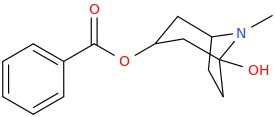
This is 1-hydroxytropacocaine I thought is found in E. Novogranatense (which I am growing a couple seedlings of), though wiki claims it is found in E. Coca.
Last edited:
It is really propene (propylene gas, for common name) ala H2C=CH-CH3
It is the second smallest alkene, after ethene (or so called ethylene) and is a gas at room temperature and pressure.
Didferent chemical from propylene glycol and propane or butanone...
Wiki "propene" and look for brief
See I read the articles all of them and they seemed to switch what they were talking about,but what is propylene gas?
It is really propene (propylene gas, for common name) ala H2C=CH-CH3
It is the second smallest alkene, after ethene (or so called ethylene) and is a gas at room temperature and pressure.
Didferent chemical from propylene glycol and propane or butanone...
Wiki "propene" and look for brief
Yes, but you will need different condition. I assume this is not synthesis discussion because conditions to control for cumene process are for industrial plants and not easily achievable in unprepared lab.
The difference is that for propene, you use acid to protonate it making it the C3 carbocation
In case of isopropyl alcohol, acid also protonates the hydroxyl group, the dehydration to C3 carbocation.
After then the C3 carbocation reacts with benzene forming cumene, later steps are all the same.
What to control is the condition (say, temp and pressure), the toxicity of benzene, the {##^*%%}smell of cumene,
The explosive cumene hydroperoxide, the corrosive and toxic of phenol etc.
I work in a professional org. synth wet lab, and never have an idea to "run" this process in my lab scale!

Bagseed
Bluelighter
why would you synth acetone anyway? it is easily available.
Nagelfar
Bluelight Crew
On an unrelated note, and nagelfar might love this:
Absolutely, thank you, as you know I'm always looking for metabolites, bio-synth precursors and relatives, and synth analogues of the like compounds
Actually, here pure acetone is restricted for private persons due to its use in explosive making so it is not really an innocent topic nor is it a pointless synth for people involved with that in countries like these. Not accusing you but assuming that this is not the only time you have a synthy question try a less inappropriate forum for that? A hydroxide like sodium hydroxide is a base though not an acid.
Thank you for informing me,and I know just through I'd ask anyway.
Actually, here pure acetone is restricted for private persons due to its use in explosive making so it is not really an innocent topic nor is it a pointless synth for people involved with that in countries like these. Not accusing you but assuming that this is not the only time you have a synthy question try a less inappropriate forum for that? A hydroxide like sodium hydroxide is a base though not an acid.

JK25
Bluelighter
Midnight Sun
Bluelighter
a very simple kavain analogue:

a little more involved, but adopts a conformation more resembling barbiturates:

Nagelfar
Bluelight Crew
Is no one going to answer my question is there are way to make phenols fumes none corrosive and what is the procedure for C3 carbocation just want a answer cause my mind is still racing on these questions.
The C3 locant of what molecular/chemical structure? Depending on the QSAR, the process is *entirely* different. Each molecule is highly *relative* depending on the constituent parts, a C3 position is the numbered position for that individual structure counted around from a center point. (or am I mistaking the question, anyone back me up / refute me here?)
Midnight Sun
Bluelighter

I don't know if it would work but I thought to break up/unconstrain the piperidine moiety of allylprodine (for safety's sake given the subpar QC standards in many clandestine labs) -- anyway, the end result vaguely resembles tapentadol. I couldn't help but note how at least in two dimensions there is also an overlay with diarylethylamines (the most relevant to this being lefetamine) however I think in those particular cases the phenyl rings are oriented differently in 3D space
On that note there's also a passing resemblance to methadone:

Either of these two despite their differences more or less overlay allylprodine in 3 dimensions albeit in different ways so they probably are active to some extent.  *shrugs*