• LAVA Moderator: streaM Freak

the market: stocks, bonds, options, whatever

What you have to consider is there was no established central bank in the tulip price surge. and that we aren't adding 1T of new debt every month now.
It may correct. However if there ever is a return to the gold standard the price of gold will surge again with that correction.
 
Yeah I finally got the chart to work and edited the tulip chart out of that post. They're definitely not the same. My point is silver looks just like the bubble chart, and recently hit high 80's RSI on the weekly charts I posted here last month, which has signalled at least a medium term top every time in the last 20 years
 
yeah, history repeats itself. And I don't doubt it.
I'd say about 90% of stocks are going to crash with a market crash looming.
Alternative currencies will boom. But not without chaos of course.
 
Now I am honestly not sure what to do.
No, neither am I.

I have a very modest sized private pension, and until very recently 100% of it was in equities, mainly in the form of US or Global index funds. And wow have things gone well over the last 4 years or so, when I began doing this, as a very late starter.

Although I am aware of the nature of the youtube algorithm, so that if you watch one video about being in a massively overvalued bubble, due to pop any time soon, followed by a potential large and sustained market downturn, then youtube is going to feed you loads more of the same, just presenting one side of things.

It's just become clear that I need to watch a few videos stating the opposite.

But anyway I've realised that due to my age and risk tolerance, having 100% of my pension in equities at this stage is far too risky, especially considering the state of the market right now, and just a rookie error. (Although some long term experienced investors do do the same.) So I'm in the process of 're-allocating' 20% - 30% from equities into something safer. It's more about the re-allocation, than trying to time the market, although there is no denying that this seems like a fantastic time to lock in some profits and put them somewhere safer. Plus having some safe funds means I'll be able to use them to buy more funds at a discount, if and when the dip, crash, or correction happens.

I'm not selling the whole 25% or so all at once, things may still keep going up for months or years. I'm selling off little bits every 10 days or so, kind of 'dollar cost averaging' my way out, so that hopefully I wont sell too much too soon and miss some more potentially large gains, but also hopefully wont be as badly burned if things start falling.

Of course it's not a perfect strategy, if things do suddenly drop very suddenly and dramatically then I will lose a lot of those gains that I and everyone else 'onboard the train' have been lucky to make over the last 3 years.
 
Last edited:
No, neither am I.

I have a very modest sized private pension, and until very recently 100% of it was in equities, mainly in the form of US or Global index funds. And wow have things gone well over the last 4 years or so, when I began doing this, as a very late starter.

Although I am aware of the nature of the youtube algorithm, so that if you watch one video about being in a massively overvalued bubble, due to pop any time soon, followed by a potential large and sustained market downturn, then youtube is going to feed you loads more of the same, just presenting one side of things.

It's just become clear that I need to watch a few videos stating the opposite.

But anyway I've realised that due to my age and risk tolerance, having 100% of my pension in equities at this stage is far too risky, especially considering the state of the market right now, and just a rookie error. (Although some long term experienced investors do do the same.) So I'm in the process of 're-allocating' 20% - 30% from equities into something safer. It's more about the re-allocation, than trying to time the market, although there is no denying that this seems like a fantastic time to lock in some profits and put them somewhere safer. Plus having some safe funds means I'll be able to use them to buy more funds at a discount, if and when the dip, crash, or correction happens.

I'm not selling the whole 25% or so all at once, things may still keep going up for months or years. I'm selling off little bits every 10 days or so, kind of 'dollar cost averaging' my way out, so that hopefully I wont sell too much too soon and miss some more potentially large gains, but also hopefully wont be as badly burned if things start falling.

Of course it's not a perfect strategy, if things do suddenly drop very suddenly and dramatically then I will lose a lot of those gains that I and everyone else 'onboard the train' have been lucky to make over the last 3 years.

Yes, news articles and other types of influential messaging seem to be very contradicting at this time. I believe that that is intentional, having investors basically "see what they want to see", in order to gauge the level of fear from institutional and casual investors.

At the end of the day, it's informed gambling, and most of our opponents are professionals with a lot of influence.

It's smart to put things in perspective - I did the same thing - I think to myself, yes October was a complete wash, but prior to that I was able to do x y z which allowed me to do this and that.

It's unfortunate that the wellbeing of the people and the health of the stock market isn't more linear, but realistically if you are making more than 10% annually you are beating the market.

As for the current moment, sure there may be buying opportunities, but with the technology so new it's hard to predict exactly who will benefit and when.
 
Last edited:
I'm definitely not buying any more equities for the time being. I'm in sell mode. Once I've got my 'emergency fund' and allocations and 'dry powder' where they need to be, I may think again.

In an ideal world all that will happen at the very peak, and then I can start buying equities again during the dip.

I'm not seriously kidding myself that I'm going to be that lucky though.

All the financial channels keep saying that no one can get the timing of the height of the peak and the depths of the dip spot on, but to my way of thinking you don't need to, as long as you're within 10% or so of either, (or even just sold for a lot more than you bought) and have funds to keep doing regular DCA during any dip, then that should be more than good enough.

Not sure if I'm right about that though.
 
Last edited:
I'm definitely not buying any more equities for the time being. I'm in sell mode. Once I've got my 'emergency fund' and allocations and 'dry powder' where they need to be, I may think again.

In an ideal world all that will happen at the very peak, and then I can start buying equities again during the dip.

I'm not seriously kidding myself that I'm going to be that lucky though.

All the financial channels keep saying that no one can get the timing of the height of the peak and the depths of the dip spot on, but to my way of thinking you don't need to, as long as you're within 10% or so of either, and have funds to keep doing regular DCA during any dip, then that should be more than good enough.

Not sure if I'm right about that though.

Yeah having "cash" on hand is good for dips.. something I learned the hard way recently.

Yep and compounding small percentages, way underrated. Do 1.1 to the 72nd power. It's about 1,000. Which means if you get 10% monthly (not as easy as it sounds) on your entire portfolio for 6 years, you can turn 1,000 into nearly 1 million.

That said, a big part of my strategy is hunting for what I perceive to be undervalued, get in at the floor and get out real fast. Like I'd take 10% all day long.

And IMO, the less eyes on the ticker the better. Once everyone is trading them they are a lot less likely to follow a pattern that makes any sense.
 
Looking like today will be the first day MDGL has ever closed above $500. They're only at like 1/5th of the revenue they'll have a few years from now, and they'll become profitable too. Up there with the safest stocks to buy during a recession or a big market pullback. If they get approval in 2027 to prescribe it for Cirrhosis then they could realistically have ~$10B in revenue/year by 2030
 
No, neither am I.

I have a very modest sized private pension, and until very recently 100% of it was in equities, mainly in the form of US or Global index funds. And wow have things gone well over the last 4 years or so, when I began doing this, as a very late starter.

I think I've pointed this out before but the equities boom these past four years have been teh result of an insane expansion in the M2 money supply, much of which was plowed into share buybacks -


But anyway I've realised that due to my age and risk tolerance, having 100% of my pension in equities at this stage is far too risky, especially considering the state of the market right now, and just a rookie error. (Although some long term experienced investors do do the same.) So I'm in the process of 're-allocating' 20% - 30% from equities into something safer. It's more about the re-allocation, than trying to time the market, although there is no denying that this seems like a fantastic time to lock in some profits and put them somewhere safer. Plus having some safe funds means I'll be able to use them to buy more funds at a discount, if and when the dip, crash, or correction happens.

There are all kinds of equities. S&P 500 is highly concentrated in tech right now so, of course, when tech corrects it weighs heavily on these index funds.

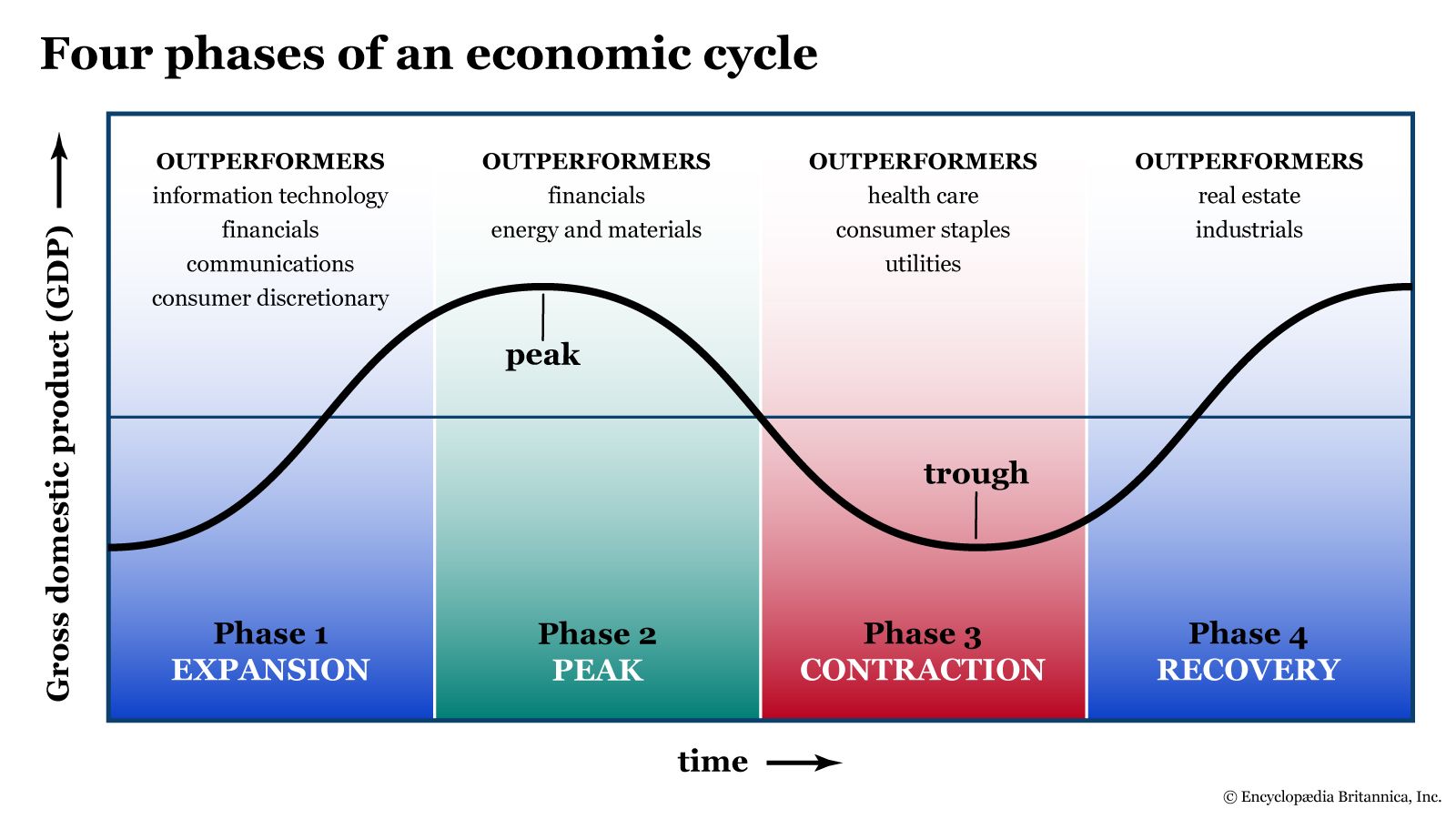
Follow the business cycle and you can make safe bets in equities as they're rising -

infographic-economic-cycle.jpg


Healthcare and utilities have been rising, signaling a shift into phase three.

In the short term, tech may move sideways for a while as massive capex will take a year or more to really bear fruit.

I'm not selling the whole 25% or so all at once, things may still keep going up for months or years. I'm selling off little bits every 10 days or so, kind of 'dollar cost averaging' my way out, so that hopefully I wont sell too much too soon and miss some more potentially large gains, but also hopefully wont be as badly burned if things start falling.

Of course it's not a perfect strategy, if things do suddenly drop very suddenly and dramatically then I will lose a lot of those gains that I and everyone else 'onboard the train' have been lucky to make over the last 3 years.

Inflation compounds. Remember that every time you sell equities, which keep up with inflation. Safe investments don't. I've seen people retire poor by selling too much of their equities and they weren't left with enough to get back into the market when there was a dip.

The only amount of your portfolio that you should have in fixed income investments is the *bare minimum* that you would need to survive for a few years if there's a bear market, so that you don't have to sell equities at a loss to cover the cost of living.

Personally, I rather have that in sectors negatively correlated with growth (tech) because those rise and pay steady dividends, which have preferential tax treatment compared to something like bonds.
 
Just doubled my ZSL at $11.15 to a 1/4 total position. Can double down two more times, but if silver closes at a new high this or next week then I'll probably just take my losses. Hopefully it rolls over this or next week and I can ride it down
 
I think I've pointed this out before but the equities boom these past four years have been teh result of an insane expansion in the M2 money supply, much of which was plowed into share buybacks -


There are all kinds of equities. S&P 500 is highly concentrated in tech right now so, of course, when tech corrects it weighs heavily on these index funds.

Follow the business cycle and you can make safe bets in equities as they're rising -


Healthcare and utilities have been rising, signaling a shift into phase three.

In the short term, tech may move sideways for a while as massive capex will take a year or more to really bear fruit.


Inflation compounds. Remember that every time you sell equities, which keep up with inflation. Safe investments don't. I've seen people retire poor by selling too much of their equities and they weren't left with enough to get back into the market when there was a dip.

The only amount of your portfolio that you should have in fixed income investments is the *bare minimum* that you would need to survive for a few years if there's a bear market, so that you don't have to sell equities at a loss to cover the cost of living.

Personally, I rather have that in sectors negatively correlated with growth (tech) because those rise and pay steady dividends, which have preferential tax treatment compared to something like bonds.
Thanks for all the info, the cyclical performance of the different market sectors is not something I'd heard much about previously. But it does look like something that's worth finding out more about.

I'm just following the general advice for investing in index funds. After watching numerous channels, I've found my pick of a small handful that I personally trust for giving sensible advice.

70/30 would seem to be a sensible allocation for someone of my age, who is also currently undergoing undetermined but possibly serious health scares. That 30% is for multiple options. Tax free cash withdrawal if required to cover living expenses, (my emergency fund currently only covers about 6 months living expenses, so that is rather short) or possibly dry powder for re-investing during any dips.

I had my pension 100% all in equities until a few weeks ago. Previously I'd followed the advice about 'ignore the noise, you're in it for the long term, so any short term volatility doesn't matter'.

I did that for 4 years but now I am getting spooked by nearly every finance channel agreeing that the major US index funds used in most private pensions in the UK are in an overvalued bubble.

I'm following the advice that if anything worries you, that means you need to adjust your allocation to something that you're more comfortable with.

So 70/30 will be fine for me for a while.

Especially if i manage to get all of that 30% sold while the market is still rising. Meaning large profits. I'm just selling bit by bit, as who knows how much longer things will keep going up?

The eroding effect of inflation does not unduly concern me with the 30%, its basically all free profit money anyway. Plus in the UK for every £100 you invest into a private pension the government gives you £20 tax allowance (for basic rate tax payers). So even in a safe money market fund which pays 4.9% I think, I'm already massively up. I think inflation in the UK is currently less than 4.9% or it's there or there abouts anyway. I'd basically be getting a 24.9% return on anything I put into the pension, even if I used the safest option of a money market fund. I know equities can do massively better than that, as they have done over the last 4 years. But right now I need to de-risk for my own peace of mind. It's the right move for my circumstances.

The worst thing would be for me to be 100% in equities and have the market drop by any large amount for a sustained period, and need to withdraw during the dip, and having to seal heavy losses.

That would be the biggest mistake of all, although I know prolonged dips of 10 years or so are exceptionally rare. Has there been like 3 over the last 100 years? But who knows when the next one of those will be?

I'm keeping things to a level that I understand, I'm not going to be doing things that I don't understand. Which is also another fundamental rule.
I see the whole thing as a balancing act, with many factors affecting the desired balance, but most of all is the individuals time horizon.

I currently dont know what mine is any more, until I get the results of tests and and treatments required, and if they are succesful or not.

 
Last edited:
I finally acted decisively after Friday's falls in the S&P 500 and another US index fund I have.

Of course, I have no way of knowing, but I suspect this could be it; the start of the downturn/crash/correction.

Better to sell off the majority of those funds right now, take a load of profits, put them somewhere safe imo.. As opposed to hanging on out of greed hoping they'll go up more, but at the same time constantly worrying and checking if they have started their free-fall.

I'm much more at peace with my portfolio now. My remaining funds are mostly Global, with a little European and UK. And now even less left in the S&P 500 and another US fund, so that I can keep an eye on how they are doing. So fairly well diversified I hope and nowhere near as US AI heavy.

The whole AI bubble is really scary. All the pundits are saying that the run away prices are based on the assumption that the AI companies are going to make vast amounts of money. But none of them actually are doing, and there doesn't seem to be any prospect that they will any time soon. And all the growth has been financed on the big companies doing circular deals between themselves.

It's basically exactly the same as the dot.com crash and the housing market crash, where things just became wildly overvalued, and all 3 scenarios are / were basically built on a house of cards in the sand.

Most predictions are that this crash wont be as bad or as long as the previous 2, but I'm glad that I got out when I did. Even if things go on to reach astronomical heights over the coming months. But that seems increasing unlikely.

Everyone seems to be saying time is up. I cant find anyone saying the opposite.
 
I finally acted decisively after Friday's falls in the S&P 500 and another US index fund I have.

Of course, I have no way of knowing, but I suspect this could be it; the start of the downturn/crash/correction.

Better to sell off the majority of those funds right now, take a load of profits, put them somewhere safe imo.. As opposed to hanging on out of greed hoping they'll go up more, but at the same time constantly worrying and checking if they have started their free-fall.

I'm much more at peace with my portfolio now. My remaining funds are mostly Global, with a little European and UK. And now even less left in the S&P 500 and another US fund, so that I can keep an eye on how they are doing. So fairly well diversified I hope and nowhere near as US AI heavy.

The whole AI bubble is really scary. All the pundits are saying that the run away prices are based on the assumption that the AI companies are going to make vast amounts of money. But none of them actually are doing, and there doesn't seem to be any prospect that they will any time soon. And all the growth has been financed on the big companies doing circular deals between themselves.

It's basically exactly the same as the dot.com crash and the housing market crash, where things just became wildly overvalued, and all 3 scenarios are / were basically built on a house of cards in the sand.

Most predictions are that this crash wont be as bad or as long as the previous 2, but I'm glad that I got out when I did. Even if things go on to reach astronomical heights over the coming months. But that seems increasing unlikely.

Everyone seems to be saying time is up. I cant find anyone saying the opposite.

I've sort of given up trying to make predictions, but what you said about "coming to terms" with situations is extremely valuable skill. Makes falls less painful and wins more pleasantly surprising. Makes it so one doesn't chase loses or get too cocky with gains.

At the end of the day, of we zoom out on the Dow Jones, it's clear what direction is the more likely of the two.

The only scary things is, yesterday hasn't came yet. And sometimes corrections or downturns can last years.
 
Historically, buying the S&P500 at ~23 P/E results in only -2% to +2% annual return over the next 10 years. We're above 23 right now

The P/E ratio for the S&P 500 is approximately 28 to 31, depending on the calculation method (trailing twelve months vs. reported quarterly). The trailing twelve-month P/E is around 30.96, while the quarterly P/E was 27.88 in Q2 2025. The forward P/E, based on future earnings estimates, is lower at around 24.31
 
I've sort of given up trying to make predictions, but what you said about "coming to terms" with situations is extremely valuable skill. Makes falls less painful and wins more pleasantly surprising. Makes it so one doesn't chase loses or get too cocky with gains.

At the end of the day, of we zoom out on the Dow Jones, it's clear what direction is the more likely of the two.

The only scary things is, yesterday hasn't came yet. And sometimes corrections or downturns can last years.
Yeah I guess it's a bit silly of me to be making predictions, I'm just as much in the dark as everyone else. But a lot of pointers seem to be indicating that things are nearing the point of the bubble bursting.

Those that already have their allocations right, and have much longer time horizons are better off holding throughout. As painful as that may be. But as you say, if you zoom out, things always keep going up.

I'm more about re-allocating things at this stage due to my age and health factors, rather than trying to time the market. The re-allocating is something that any sane person in my situation would have done.

But I can't deny that it seems a fantastic opportunity to lock in profits right now, to do the re-allocating.

It's definitely been prompted by worries of a sustained downturn and having all my gains potentially wiped out, and a lack of funds to buy more during any dip.

So I'd have been fucked in that scenario. Hopefully now I will be more prepared, and will have options.
 
Yeah I guess it's a bit silly of me to be making predictions, I'm just as much in the dark as everyone else. But a lot of pointers seem to be indicating that things are nearing the point of the bubble bursting.

Those that already have their allocations right, and have much longer time horizons are better off holding throughout. As painful as that may be. But as you say, if you zoom out, things always keep going up.

I'm more about re-allocating things at this stage due to my age and health factors, rather than trying to time the market. The re-allocating is something that any sane person in my situation would have done.

But I can't deny that it seems a fantastic opportunity to lock in profits right now, to do the re-allocating.

It's definitely been prompted by worries of a sustained downturn and having all my gains potentially wiped out, and a lack of funds to buy more during any dip.

So I'd have been fucked in that scenario. Hopefully now I will be more prepared, and will have options.

Sounds very healthy outlook for yourself.

I don't know the gains you made and don't really care to, but if you have grown your portfolio even by 10% year over year average, personally I'd think that's enough reason to celebrate and enjoy the new financial cushion you have, especially at a time like this, and sort of take a step back.
 
Top