Says he wants to do both. Make the condensation product with Lysergamide (That is just LSA correct?) but then says also want to make the alkylamine with isovalerAMINE and Lysergic Acid. I hadn't heard of isovaleramine but is 3-methylbutanamine and comes from valerian rootWhat compound is Nichols trying to make? The adduct or the alkylamide?
Says he wants to do both. Make the condensation product with Lysergamide (That is just LSA correct?)
Wouldn't it look like Cinnamylidene-bislysergamide sort of and create a dimer type compound?
Ooh snap the article is unacessible on sci-hub? Can you access it? Was my structure correct?Better yet
Correct. See the synonyms listed here:
https://pubchem.ncbi.nlm.nih.gov/compound/442072#section=Depositor-Supplied-Synonyms
The Theoretical Synthesis and in silico Modelling of Lysergic Acid Biscinnamylidene Amide from the Adduct Formation of d-Lysergic Acid Amide and Cinnamaldehyde. Victor Chiruta. 2022. Journal of Chemistry Studies, 1(1), 01-06. 10.32996/jcs.2022.1.1.1
Very curious as the functional group that is reacting with the amide is the exact same...![]()
LSA adducts
It has been documented that lysergic acid amide (LSA) is capable of forming adducts with various aldehydes.[1]psychonautwiki.org
The condensations of aldehydes with acid amides have been studied by a very large number of workers and the literature is extensive. Often the condensation is brought about by merely heating the aldehyde with the amide alone, in other cases condensing agents of several kinds have been used, such as, hydrogen chloride, potassium hydroxide, potassium carbonate, diethylamine, triethylamine, sulphuric acid dilute, anhydrous sodium acetate with, or without, acetic anhydride. Frequently, the condensation has been carried out without a solvent.
As lar as we are aware, there has been only one such condensation reported, and that is by Gupta, of cinnamaldehyde with phenylacetamide, brought about without any condensing or catalytic agent, by merely heating the two together, and resulting in the production of cinnamylidene-bisphenylacetamide. In the present paper, the condensations of this aldehyde are studied with four amides, namely, phenylacetamide, acetamide, propionamide and benzamide, under several different conditions of temperature, molecular proportions and catalytic influences. The condensations in all cases take place and produce the cinnamylidene-bisamides. The yields are fair and at times good, but are not generally as good as were noted with salicylaldehyde in Part 1.
p-hydroxybenzaldehyde condenses readily with formamide, acetamide, propionamide, benzamide and phenylacetamide, and the products are the corresponding p-hydroxybenzylidene-amides, as in the cases of the o- and m-hydroxybenzaldehydes. The condensations are brought about by heating the aldehyde with the amide for 4-5 hours at 130C, in the presence of absence of a trace of organic bases like pyridine and piperidine. The presence of the base improved the yield only slightly. The yields, however, were uniformly very good, never being less than 60% of the theoretical, and reaching up to 92% as the highest...
Piperonal condenses best when heated without any other condensing reagent, with seven of the common amides, giving characteristic piperonyl bisamides. It does not condense with formamide
The condensation of benzaldehyde and o-chlorobenzaldehyde with several amides has been studied, in the presence as well as in the absence of pyridine. The base slightly increased the yield in many cases. The rise of temperature as well as the prolongation of heating raised the yield more effectively. All the products were the corresponding bisamides. The presence of chlorine on the aromatic ring of the aldehyde, had the expected tendency to increase the yield, particularly in the condensations with benzamide, propionamide and n-heptamide. Condensations with formamide, as has been the general experience, did not give good yields; in all other cases, the yields were good, starting from 30% and reaching up to 86% in some cases.
In the papers so far published in this series, the condensation and the conditions of condensation of eighteen aldehydes with more or less common amides have been studied. Almost all the aldehydes have been aromatic: cinnamaldehyde and dihydrocinnamaldehyde being the only exceptions, in the sense that, though each contains a benzene ring, the aldehyde group is not situated on the ring but is on the side chain...
I read every book I come across which even attempts to touch on psychedelic chemistry, Lysergamide Synthesis Unveiled by Michael Yost is perhaps the most tragic as it is moreso the reflection of a deeply unwell person undergoing profound stressors in their life, writing nonsense in an unnecessarily massive font size. I do suspect that anybody who is trying to make a claim as significant as the one Stahl is making here should have meaningful evidence from a peer reviewed source, and while I can find things pointing towards entheogenic combination drugs as unique as blue lotus and syrian rue being used here in the cult of Bes ( https://www.nature.com/articles/s41598-024-78721-8 ), I can't find shit about the claims that Stahl is making. I will read this when I can get my hands on it though and report back.I haven't read the book (I'm not personally planning on it but all this weird shit kind of makes me want to) but I'm not particularly impressed with the interview. I kinda feel bad for McKenna.. Stahl stumbles around quite a bit in his talk, but Dennis doesn't really have the chemistry background to refute it. I still think the paper describing and proving that refluxing ground ergot with lye to break the toxic ergopeptides into LSA is 10,000x more plausible then the adduct theory. . Both the technology and material were available to the greeks as the mesopotamians were distilling as early as 1300 bc. Like I said, I invite you to explore the 3 links that I posted above. Both on the nexus and shroomery they really tear into the theory.
I do suspect that anybody who is trying to make a claim as significant as the one Stahl is making here should have meaningful evidence from a peer reviewed source,
...
I can't find shit about the claims that Stahl is making.
First I should say that the main problem isn't necessarily whether or not kykeon might have been psychoactive. It seems plausible and it's more than just a suggestion -- there have been residues of ergot alkaloids (similar to LSD) found on multiple Greek and Roman pottery vessels, including those used in mystery religions. Not a ton, but some. In my opinion this possibility becomes much stronger when we add evidence from other branches of ancient Indo-European religion. Vedic soma shares several characteristics with kykeon, and there's also lots of evidence that Indo-European peoples in northern Europe used alcohol mixed with other psychoactive substances (e.g., black henbane) for ritual purposes. So to me it seems plausible (though not conclusive) that ancient Indo-Europeans, including the early Greeks, may have used some sort of alcohol-based psychoactive brew for religious rituals, for divination, and various other things. Not conclusive, but not at all far-fetched, possibly even likely.
...the paper describing and proving that refluxing ground ergot with lye to break the toxic ergopeptides into LSA is 10,000x more plausible then the adduct theory.
LA-111 Ergine, d-Lysergamide
This is an active compound and has been established as a major component in morning glory seeds. It was assayed for human activity, by Albert Hofmann in self-trials back in 1947, well before this was known to be a natural compound. An i.m. administration of a 500 microgram dose led to a tired, dreamy state with an inability to maintain clear thoughts. After a short period of sleep, the effects were gone and normal baseline was recovered within five hours. Other observers have confirmed this clouding of consciousness leading to sleep. The epimer, inverted at C-8, is isoergine or d-isolysergamide, and is also a component of morning glory seeds. Hofmann tried a 2 milligram dose of this amide, and as with ergine, he experienced nothing but tiredness, apathy, and a feeling of emptiness. Both compounds are probably correctly dismissed as not being a contributor to the action of these seeds.
I even think it's possible that @Allylbenzene is an alt based on:
a) how you defend tregar's utter nonsense
I assure you, I am quite arrogant consciously as well.
I also believe this, having followed the last few years of discussion on the shroomery threads primarily, the use of puppet accounts is both obvious and perplexing. I would caution against casting such a wide net (i.e. any new account who has only posted here = tregar), as I'm at least one exception on that list. I have my own reason for limited and focused posting in this thread, but it's not because I'm an alt of tregar. I've seen his face, and I've looked in a mirror, and it's not a match (if it were, I assure you I'd attempt to stop the madness like in this movie).I believe that Matthew Stahl, along with @tregar @jpritikin @Quantamide @bluelightbird @peaches88 @flame_assay who was banned for being a Tregar alt name ALREADY, @69Ron @sandycoast (shroomery) are all the exact same people at least physically. Not nearly as sure mentally. Based on the way the schills and Tregar talk back and forth with eachother, it could be multiple personality disorder? There's probably dozens of other alts that aren't even in this thread would be my guess.
Tregar you have probably rediscovered something that has long been a curiosity, for example on the now defunct blacklight site there was TLC posted of morning glory seed extract treated with methanol, acetaldehyde-methanol or with acetaldehyde-methanol-water, the extract treated with acetaldehyde-methanol without the water showed a clear difference in the alkaloid profile, with a shift to several new non polar spots which couldn't be identified. IIRC Erhlichs was used to develop the plates so these were indole compounds.
The most interesting thing was that when any water was added to the methanol acetaldehyde, the alkaloid mixture was not changed at all which goes against the idea that this can likely happen in highly watery mixtures like sherry wine, but the underlying chemistry is 100% real.
Vector (advanced chemist like myself):
tregar, you have probably rediscovered something that has long been a curiosity, for example on the now defunct blacklight site there was TLC posted of morning glory seed extract treated with methanol, acetaldehyde-methanol or with acetaldehyde in ph=4 water, the extract treated with acetaldehyde-methanol and acetaldehyde in ph=4 water showed a clear difference in the alkaloid profile, with a shift to several new non polar spots which couldn't be identified. Very likely the LSA converted to LSH (LSA + acetaldehyde = LSH). IIRC Erhlichs was used to develop the plates so these were indole compounds.
The wiki page for Dave Nichols "LSP" is fairly good imo. Lysergic acid 3-pentylamide was Nichols LSD analog #16 which he synthesised in his paper "LSD and it's Lysergamide cousins". There's interesting similarities between 3-pentanone (3-LSP) and isovaleraldehyde (the I in so-called LSI).
LSH itself is a hemiaminal, Lysergic-C(=O)-NH-CH(OH)CH3, though not particularly stable, this leads to the question can LSH be converted into a mixed acetal with greater stability and effect Lysergic-C(=O)-NH-CH(OR)CH3 ? where R is CH3 or C2H5, which would be more non polar than LSA or LSH
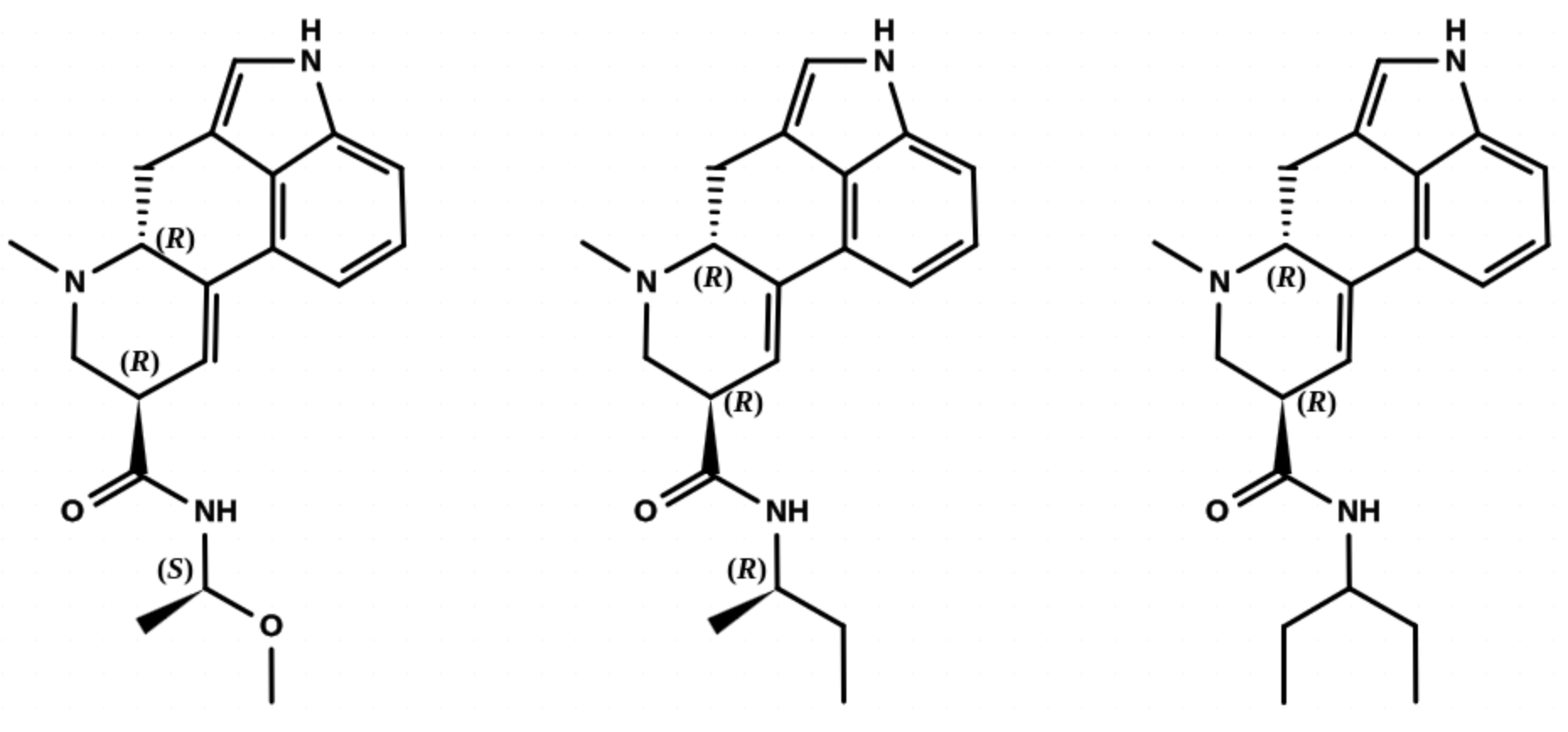
Personally, I've already moved on to other areas of interest. I'm specifically interested in the conversion of the hemiacetal LSH (from fresh seeds) into a stable acetal. This is real chemistry that can be done in anhydrous methanol with an acid catalyst like PPTS. The structural similarity of this product, lysergic acid α-methoxyethylamide, would be closer to products like LSB (specifically the R stereoisomer) or LSP, which meet or exceed the potency of LSD in animal drug discrimination assays. This is not a new idea, and the aforementioned vecktor suggested it briefly in the above thread:
For reference, the structures of lysergic acid (S)-α-methoxyethylamide (assume this stereoisomer would be most active), (R)-2-butylamide (LSB), and 3-pentylamide (LSP):
![]()
Source: https://www.reddit.com/r/LSA/comments/1s4gabe/comment/ocmywh4/NV1989NV said:Oh yes I have already thought of this.
The esterification doesn't work because it reduces to lysergic acid as the nitrogen is more weakly electronegative than the oxygen and gets replaced instead forming lysergic acid, Secondly, placing an acetate group right there would be unstable and cause the acetate to break off. This was a mechanism I was considering for the conversion of methylergometrine to LSB as it would break off the R-OH, but this is a hard to attack group and it would do this:
R-CH₂(CH₃)₂OH is substituted at the R position, replacing the nitrogen with an R-OCOCH₃ (acetyl group connected by the oxygen) which would then break off to form R-OCH₃ (methyl-LA) and CO₂ and the methyl-LA then breaks into lysergic acid. At least, that is the mechanism as I understand it. I failed to come up with a solid mechanism to effectively attack the R-OH moiety on methylergometrine. This mechanism is also true for LSH. The hydroxyl group is kinda the thing we don't want. Regardless, anything nitrogen containing is susceptible to becoming oxygen containing really quickly.
Do you guys want me to retry the esterification and report if the effects are sleepy or not? The method used here is really bad tbh. It's based upon biology that's not going to work because it's presuming first pass metabolism that isn't happening. Lysergamides are deactivated metabolically. Esterification can be done using ethyl acetate rather than acetic acid. I'd only need two experiments with two different bases, and I can use a TLC to interpret the results too. P.S. I believe that sodium ethoxide is the best base for this but I haven't definitively confirmed this. It might end up causing the creation of lysergine or lysergol.
I do realize I drew it wrong and it wouldn't be the dimer and just never updated it. So I deleted wrong image.I also believe this, having followed the last few years of discussion on the shroomery threads primarily, the use of puppet accounts is both obvious and perplexing. I would caution against casting such a wide net (i.e. any new account who has only posted here = tregar), as I'm at least one exception on that list. I have my own reason for limited and focused posting in this thread, but it's not because I'm an alt of tregar. I've seen his face, and I've looked in a mirror, and it's not a match (if it were, I assure you I'd attempt to stop the madness like in this movie).
The way I've looked at this up until now is as follows:
My reasoning for at least attempting to reproduce his procedure was that, despite the obvious misinformation, deception, and nonsense chemistry, he really did perform what he describes. I purchased his book soon after it was released (I do not recommend spending your money on this, it's basically his rambling megaposts copied into book format, with added pictures). The pictures demonstrate that he actually did this procedure. One comment he makes that the final residue resembles "slimy banana peel" is exactly what I observed, so that was additional confirmation that he at least made it that far. In summary, I wanted to see if there was perhaps a real observation, being buried by poor chemistry and communication skills. There wasn't.
- Tregar is an unreliable source at best, with misinformation that could lead to harm in the worst case
- Tregar has used puppet accounts on multiple forums to artificically support his claims or bury unwanted scrutiny (demonstrated deception)
- Tregar has no clear motivation to lie; I'm doubtful it's been a ruse for book sales, so I'm left to believe it's either for attention, or he truly believes what he's saying
@Didgital you may find this thread (from 2020) an interesting read, if you haven't already.
https://www.bluelight.org/community...52-like-upgraded-version-of-lsd.890589/page-4
Within that thread, you'll find the original quote from vecktor regarding some old TLC results. For comparison, I've added the version that tregar continuously uses in his posts.
Notice the difference? The observations and conclusions of vecktor are completely changed to fit tregar's needs. The presence of water precludes any change in the alkaloid profile. In the original thread, vecktor exhaustively tries to communicate this to tregar, but it's like watching a chemist talk to a politician, the latter just repeats what he wants to hear. It doesn't help that tergar also constantly edits his posts.
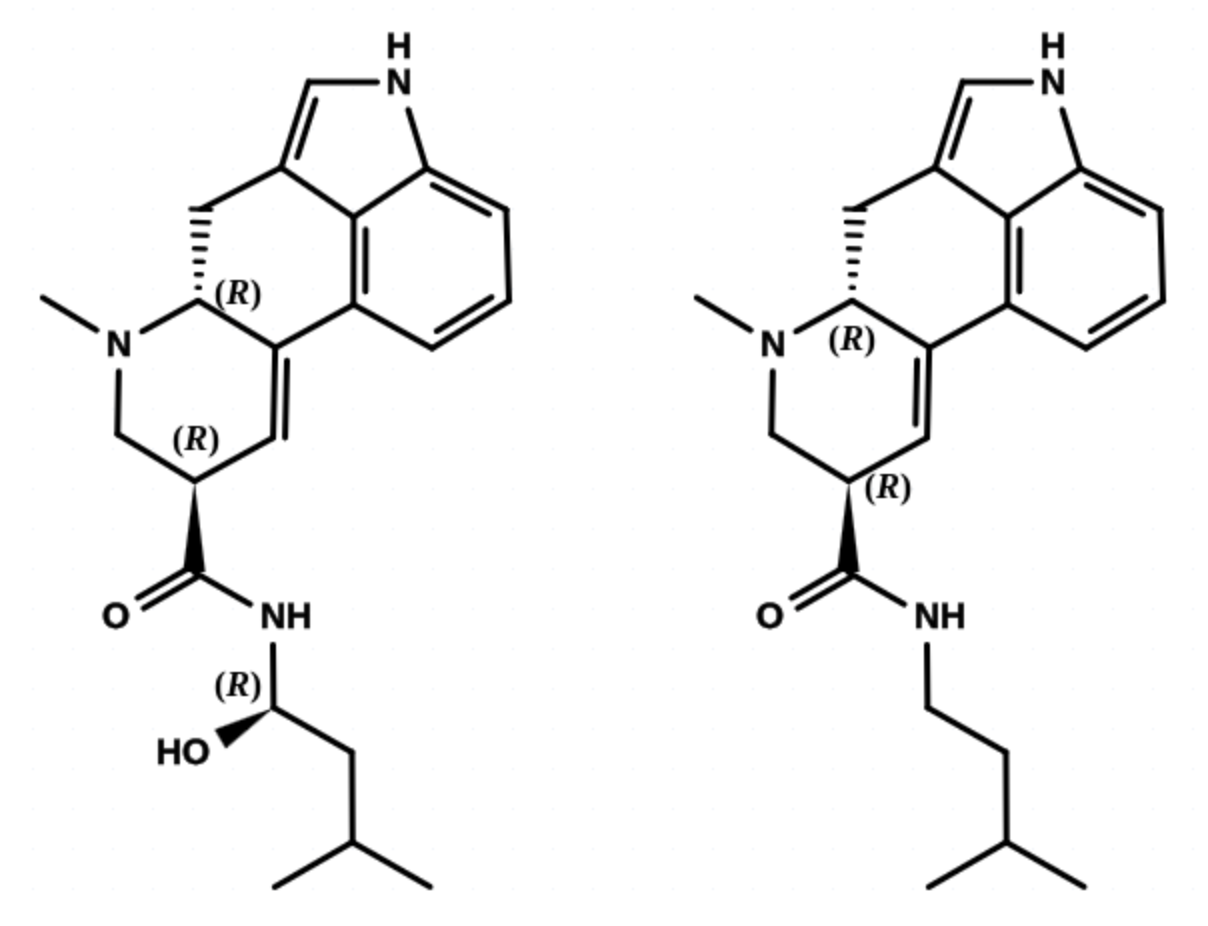
@Allylbenzene I'm honestly surprised Nichols is entertaining this idea, as the structure isn't something I'd expect to be very active based on the extensive work that Nichols and others have done with di- and monosubstituted N-alkylamides. For reference, the structures of lysergic acid (R)-α-hydroxyisovaleramide (left, the hypothetical adduct) and lysergic acid isovaleramide (right) are below.
![]()
Personally, I've already moved on to other areas of interest. I'm specifically interested in the conversion of the hemiacetal LSH (from fresh seeds) into a stable acetal. This is real chemistry that can be done in anhydrous methanol with an acid catalyst like PPTS. The structural similarity of this product, lysergic acid α-methoxyethylamide, would be closer to products like LSB (specifically the R stereoisomer) or LSP, which meet or exceed the potency of LSD in animal drug discrimination assays. This is not a new idea, and the aforementioned vecktor suggested it briefly in the above thread:
For reference, the structures of lysergic acid (S)-α-methoxyethylamide (assume this stereoisomer would be most active), (R)-2-butylamide (LSB), and 3-pentylamide (LSP):
![]()
...the original quote from vecktor regarding some old TLC results....which goes against the idea that this can likely happen in highly watery mixtures like sherry wine, but the underlying chemistry is 100% real.
LSH decomposes in ionic conditions, neutral water (plain water), when heated, or in alkaline environments.
downwardsfromzero said:This was one of the more visual attempts with natural lysergamide-containing seeds. The experience followed a night involving the consumption of a significant amount of brandy, thus there was an incontestable residue of acetaldehyde in my body.
The seeds themselves, being HBWR, were much more likely to have contained LSA as the principal alkaloid; they will not have been particularly fresh. Although the inference counts as purely anecdotal, I feel it supports at least one of these ideas:
- ...that the 1-acetaldehyde adduct of LSA (or, possibly from what we've learned so far, iso-LSA) is likely to be more of a visionary entheogen than plain LSA itself.
- ...that post-alcoholic acidity in the body promotes the formation of the more visionary iso-LSA from the LSA equilibrium mixture in vivo.
- ...that under physiological conditions, acetaldehyde inhibits the breakdown of LSH such that - in the aforementioned instance - sufficient LSH reached the appropriate receptor sites to produce a mild but significant entheogenic experience.
- ...and/or...:
- ...that, under physiological conditions, acetaldehyde reacts with LSA at the amide nitrogen to (re-)form LSH.
While I consider the last option the least likely, and in the past I have argued against the possibility of it happening, it's still not something I would discount entirely. Still, I wouldn't bank on it and would advise all readers that acetaldehyde conversion of seed extracts containing lysergamide are best carried out in vitro as ethanol and acetaldehyde present health hazards when ingested!
I've been calling it isopentanal (3-methylbutanal); it seems to be present in barley grains – specifically in fermented drinks – alongside others like isobutanal & 2-methylbutanal. The literature seen thus far indicates small amounts as Skorpio has highlighted.For reference, the structures of lysergic acid (R)-α-hydroxyisovaleramide (left, the hypothetical adduct) and lysergic acid isovaleramide (right) are below.
Yeah I can see where you're coming from as far as isovaleraldehyde mirroring Nichols' 3-LSP, I mean his LA-3Cl-SB would be even more interesting to take on assuming somebody could access the precursors to try to go from LSA -> LA-3Cl-SB. As far as I'm aware the sole synthesis of LA-3Cl-SB to ever be performed was when Nichols did it. I bet that strapping a 6-(2-haloalkyl) onto that compound would be of interest too, I wonder how different characteristics of a 6-substitution impact the stereoisomerism noticed in the ~23x potency difference of LA-3Cl-SB isomers.IIRC I'm sure there are literature mentions of theories that lysergamide sources were involved in the Kykeon & Soma. Tregar seems to have merely rediscovered the LSA/aldehyde thing (it's not exactly 'news') and contextualised it with Kykeon & Soma. The barley (grain/grass) aldehydes seem relevant (especially since fermentation increases aldehyde content); imo isopentanal (isovaleraldehyde) is most fascinating from a SAR perspective as it's reminiscent of the potent 3-LSP Nichols discovered.
I may apply for a mod position just so I can delete this entire thread which in all reality, is a promotion for a book thats filled with bogus info.
fair enough. I just don't think we should give him a bandstand. This thread was meant* to be an advertisement for his book.That would be a bad thing, if for any reason because in the event that the same type of thread grows elsewhere, the arguments in this one will be gone. I'm a big believer in perserving information, and that includes misinformation.