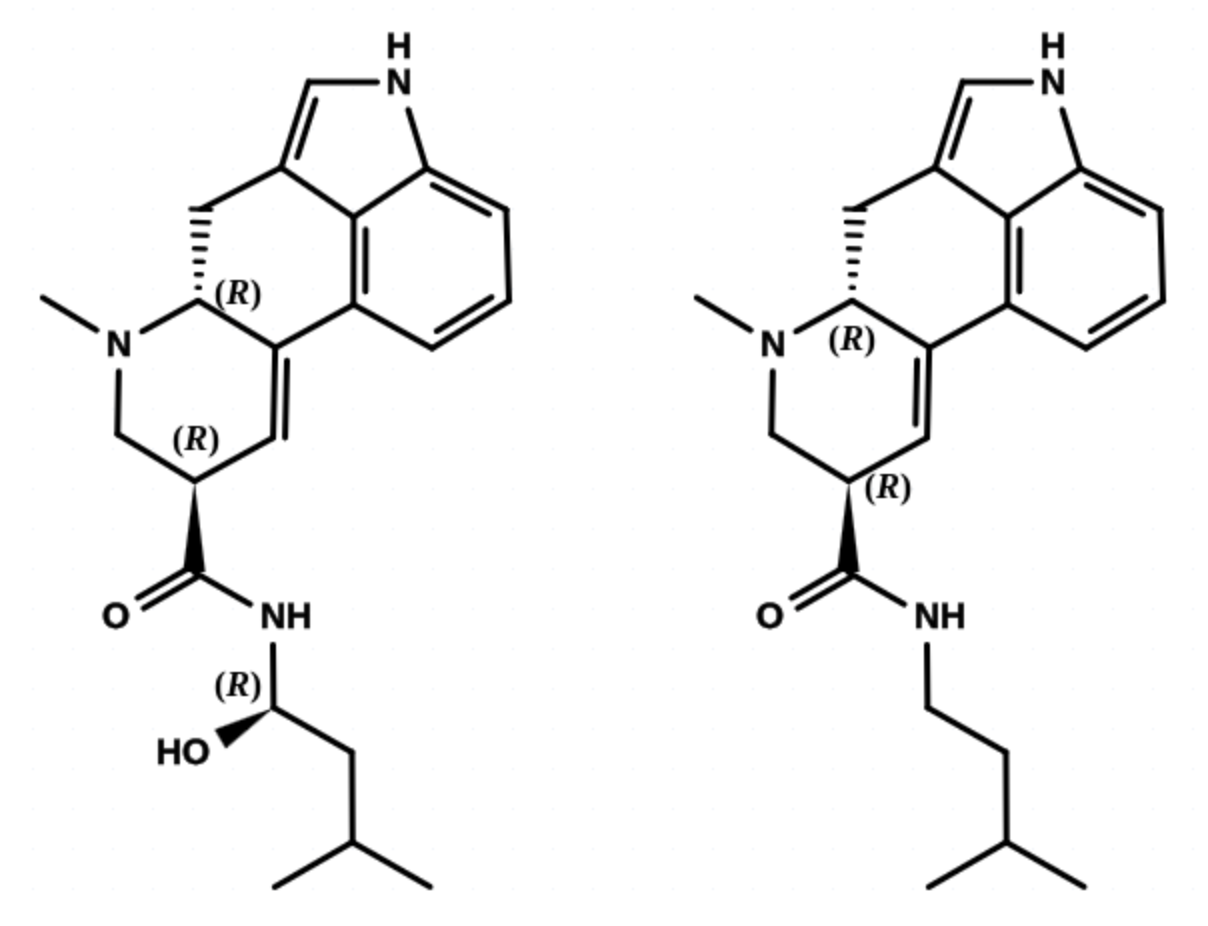
Says he wants to do both. Make the condensation product with Lysergamide (That is just LSA correct?) but then says also want to make the alkylamine with isovalerAMINE and Lysergic Acid. I hadn't heard of isovaleramine but is 3-methylbutanamide and comes from valerian rootWhat compound is Nichols trying to make? The adduct or the alkylamide?
Says he wants to do both. Make the condensation product with Lysergamide (That is just LSA correct?)
Wouldn't it look like Cinnamylidene-bislysergamide sort of and create a dimer type compound?
Ooh snap the article is unacessible on sci-hub? Can you access it? Was my structure correct?Better yet
Correct. See the synonyms listed here:
https://pubchem.ncbi.nlm.nih.gov/compound/442072#section=Depositor-Supplied-Synonyms
The Theoretical Synthesis and in silico Modelling of Lysergic Acid Biscinnamylidene Amide from the Adduct Formation of d-Lysergic Acid Amide and Cinnamaldehyde. Victor Chiruta. 2022. Journal of Chemistry Studies, 1(1), 01-06. 10.32996/jcs.2022.1.1.1
The condensations of aldehydes with acid amides have been studied by a very large number of workers and the literature is extensive. Often the condensation is brought about by merely heating the aldehyde with the amide alone, in other cases condensing agents of several kinds have been used, such as, hydrogen chloride, potassium hydroxide, potassium carbonate, diethylamine, triethylamine, sulphuric acid dilute, anhydrous sodium acetate with, or without, acetic anhydride. Frequently, the condensation has been carried out without a solvent.
As lar as we are aware, there has been only one such condensation reported, and that is by Gupta, of cinnamaldehyde with phenylacetamide, brought about without any condensing or catalytic agent, by merely heating the two together, and resulting in the production of cinnamylidene-bisphenylacetamide. In the present paper, the condensations of this aldehyde are studied with four amides, namely, phenylacetamide, acetamide, propionamide and benzamide, under several different conditions of temperature, molecular proportions and catalytic influences. The condensations in all cases take place and produce the cinnamylidene-bisamides. The yields are fair and at times good, but are not generally as good as were noted with salicylaldehyde in Part 1.
p-hydroxybenzaldehyde condenses readily with formamide, acetamide, propionamide, benzamide and phenylacetamide, and the products are the corresponding p-hydroxybenzylidene-amides, as in the cases of the o- and m-hydroxybenzaldehydes. The condensations are brought about by heating the aldehyde with the amide for 4-5 hours at 130C, in the presence of absence of a trace of organic bases like pyridine and piperidine. The presence of the base improved the yield only slightly. The yields, however, were uniformly very good, never being less than 60% of the theoretical, and reaching up to 92% as the highest...
Piperonal condenses best when heated without any other condensing reagent, with seven of the common amides, giving characteristic piperonyl bisamides. It does not condense with formamide
The condensation of benzaldehyde and o-chlorobenzaldehyde with several amides has been studied, in the presence as well as in the absence of pyridine. The base slightly increased the yield in many cases. The rise of temperature as well as the prolongation of heating raised the yield more effectively. All the products were the corresponding bisamides. The presence of chlorine on the aromatic ring of the aldehyde, had the expected tendency to increase the yield, particularly in the condensations with benzamide, propionamide and n-heptamide. Condensations with formamide, as has been the general experience, did not give good yields; in all other cases, the yields were good, starting from 30% and reaching up to 86% in some cases.
In the papers so far published in this series, the condensation and the conditions of condensation of eighteen aldehydes with more or less common amides have been studied. Almost all the aldehydes have been aromatic: cinnamaldehyde and dihydrocinnamaldehyde being the only exceptions, in the sense that, though each contains a benzene ring, the aldehyde group is not situated on the ring but is on the side chain...
I read every book I come across which even attempts to touch on psychedelic chemistry, Lysergamide Synthesis Unveiled by Michael Yost is perhaps the most tragic as it is moreso the reflection of a deeply unwell person undergoing profound stressors in their life, writing nonsense in an unnecessarily massive font size. I do suspect that anybody who is trying to make a claim as significant as the one Stahl is making here should have meaningful evidence from a peer reviewed source, and while I can find things pointing towards entheogenic combination drugs as unique as blue lotus and syrian rue being used here in the cult of Bes ( https://www.nature.com/articles/s41598-024-78721-8 ), I can't find shit about the claims that Stahl is making. I will read this when I can get my hands on it though and report back.I haven't read the book (I'm not personally planning on it but all this weird shit kind of makes me want to) but I'm not particularly impressed with the interview. I kinda feel bad for McKenna.. Stahl stumbles around quite a bit in his talk, but Dennis doesn't really have the chemistry background to refute it. I still think the paper describing and proving that refluxing ground ergot with lye to break the toxic ergopeptides into LSA is 10,000x more plausible then the adduct theory. . Both the technology and material were available to the greeks as the mesopotamians were distilling as early as 1300 bc. Like I said, I invite you to explore the 3 links that I posted above. Both on the nexus and shroomery they really tear into the theory.