• N&PD Moderators: Skorpio

Novel Opioids

Potent & legal tramadol derivatives anyone?
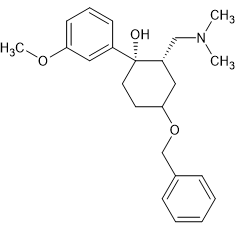

US Patent 5801201A 1-phenyl-2-dimenthylaminomethyl-cyclohexan-1-ol compounds as pharmaceutical active ingredients

The EC50 of compound 2 is 0.049mg/kg
The EC50 for tramadol is 14.70mg/kg

By my reckoning, that's some x300 more potent. I suggest the higher LogP would actually result in an in vivo potency greater than the EC50 value would suggest.

Anyone familiar with the QSAR of the tramadol derivatives will immediately ask if the lessons learns were applied in this patent. They were NOT as far as I can tell, and I'm sure we are all aware that with DAST, a good fume-cupboard and nerves of steel, one can convert the (+) M1 metabolite of tramadol into a far more potent compound.

I seem to remember that the simpler 3-ketone derivative of tramadol was briefly used in human trials but research was discontinued because it had 'failed to reach clinical endpoints'. In the associated patent, they don't provide an easily read ED50 but rather specify a dose and detail what % of animal models stopped writhing.

Only 10mg/Kg was injected and writing stopped in a given %:

Compound 2 96% (racamate of m-MeO)
Compound 3 92% (trans pair of above)
Compound 4 100% (racemate of m-OH i.e. akin to M1 metabolite of tramadol).

Are the only results provided.

So basically, it seems like they just wanted to test the ROUGH activity to decide if it was worth further developing that series.

US6890959B2 'Aminomethyl-phenyl-cyclohexanone derivatives'

It seems like no article detailing the work was ever published, but maybe I just couldn't find it?
 
Last edited:

US Patent application 20210130282A1 'Process for the preparation of (1r,2r)-3-(3-dimethylamino-1-ethyl-2-methyl-propyl)-phenol'


Interesting to note that while PubChem notes that the hexyl homologue of tapentadol is supposed to be covered in the above patent, but I cannot find where it does.

The fact that 'tahexadol' is apparently commercially available therefore make me wonder if it's an impurity (which notwhere is it listed as being) or, possibly, Grunenthal (in this case) realized that there patent didn't cover what one assumes would be a full agonist (overlaying the agonist isomer of picendaol as it does), realized that such an omission could come back to bite them and PubChem relies on manufacturers listing what the patents cover. Note only patent APPLICATION so it's clever - anyone making the homologue would surely be tied up in court.

Of course, an RC supplier wouldn't be so constrained. Oh, and the tepentadol patent references the picendaol patent - so it appears that they did model their design on something already known to be active.
 
Have you actually tried Tapentadol yet? It's not abusable. It can't compete with something like fentanyl and produces practically no euphoria.
 
I was referring to a tapentadol analogue. Assuming the length of the benzylic side-chain alters QSAR in the same manner as it does in other opioids with a benzylic alkyl, you will know two things.

-The N-propyl has much higher intrinsic opioid activity
-The overall opioid potency is significantly higher.
 
Maybe you could try writing to Grünenthal. I know Helmut Buschmann has a direct email address although when I wrote to him before I had zero response.
 
Maybe you could try writing to Grünenthal. I know Helmut Buschmann has a direct email address although when I wrote to him before I had zero response.

The original work was undertaken some 30+ years ago. Even so, it's unusual to get no response. Maybe old fashioned snail-mail would be more effective? But then again, even though many researcher carry on working long after most people retire, I imagine anyone actuallly named on a paper of patent would have moved on long ago.

I mean, when Dan retired from Upjohn, he worked in cancer research for over 2 decades. I THINK he finally retired at about 91, but then he was an unusual person. He was REALLY pleased to note Grunenthal's next generation of opioid analgesics borrowed heavily from his 1970s work on BDPC. I mean, what can you say about a man who admits that MDPC was never tested 'because in the excitement, we forgot'. Few are so honest about mistakes.

But look at that patent. I CANNOT see where examples with an N-propyl side-chain on the benzylic carbon are covered and yet PubChem insists it's there! A few specialist suppliers even offered it... so MAYBE it's worh contacting them so see if they know about it's activity?
 
Oh I see what you mean now, i think you mean the n-propyl (capital N implies nitrogen).

I think the compound is just covered in the patent clauses without it ever being manufactured as such.

My recommendation for you is to try tapentadol and see if you like it. I couldn't see that it is a good opioid but a guy I know online said it gives him a euphoric buzz.
 
Well, if you can point to it in the patent, I would appreciare it. As you know, the rule with ANY patent is 'you can't patent what you can't make' so even if they never intended to market the drug, the widespread practice is to cover all related drugs to prevent 'me too' drugs.

I didn't just ask, I did spend a few hours reading the patent.
 

I MAY have misremembered a patent but then I'm almost certain the one I lost was for ketobemidone derivatives with differing N-substituents... and it was in English. I'm sure it stated that the compounds were some x25 more potent than ketobemidone but quickly concluded that it was likely to be kappa activity i.e. not practical. Reaxys was great. Just draw a scaffold and it would find every reference to derivatives... which is why I'm almost sure that while this is similar, the one I recall was different.
 
echiboline derivatives similar but safer than erseroline.

US4996223A 'New organic compounds having opioid properties'.

The only vague lead I found was a paper listing the alkaloids found in the Australian plant Hodgkinsonia frutescens AKA turkey bush. A bit later I found a German language article that goes into more detail on non-phenolic examples.


I don't see this in any way as offering a usable product but it may help someone to build a better training-set.
 
Last edited:
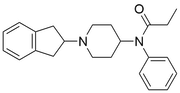
Does anybody know the literature entry for 2cb-fentanyl?
 
Does anybody know the literature entry for 2cb-fentanyl?

I think that's another one of the compounds someone who didn't quite understand QSAR just asked for a 2,5-dimethoxy-4-bromo moiety to be added. Certainly I've come across the 25D4Br pattern in all manner of psychoactives without once ever reading of a single human trial.
 
A bit late to the party, but I feel like there are possibilities to be had playing around with 4-cinnamyl-piperazines, swapping out the 1-butyryl for a 1-propionyl or a 1-valeryl on bucinnazine 🤔 they are even mentioned in some research papers but I cant remember any mentions of their potency

One could further substitute the 2nd and 6th position with alkyls or halogens for new presumably legal compounds to be pumped out
 

Also curious if anything worthwhile can even be done with the thiambutenes, for some reason my brain gets reminded of diphenidine when I look at the molecule. Weaker potency Opioids should also be hopefully more euphoric than the dissapointing fentanyl and zene families…
 

Also curious if anything worthwhile can even be done with the thiambutenes, for some reason my brain gets reminded of diphenidine when I look at the molecule. Weaker potency Opioids should also be hopefully more euphoric than the dissapointing fentanyl and zene families…

I believe a few legal homologues did turn up on the RC market briefly. That's the problem when there is no human data on a compound. It's impossible to predict the SUBJECTIVE effects.

It's funny to me that we made AH-7921 FIRST, decided it was no fun and went with U47700. Then someone else began to offer AH-7921 and to no surprise to me, it disappeared quickly.
 
U-47700 looks like a decent drug although I learned that there has been some fatalities.
 
U-47700 looks like a decent drug although I learned that there has been some fatalities.

Yep - I 100% demanded it only be retailed as 5mg tablets... and was ignored. THAT is when I quit and why I quit. I knew what would happen if powder got onto the streets.
 
Last edited:
How about tetrahydroisoquinolines? Some of these are byproducts from alcohol use.

Binding of β-Carbolines and Tetrahydroisoquinolines by Opiate Receptors of the δ-Type
- https://onlinelibrary.wiley.com/doi/abs/10.1111/j.1600-0773.1984.tb01998.x

Opiate receptor binding and analgesic effects of the tetrahydroisoquinolines salsolinol and tetrahydropapaveroline
- https://pubmed.ncbi.nlm.nih.gov/6244607
Salosolinol and tetrahydropapaveroline bind to opiate receptors in rat brain with affinities of 6.2 and 1.95 x 10(-5)M respectively. Their ability to displace 3H-naloxone is decreased about 4-fold by 100 mM sodium ion. Both of these agents have antinociceptive effects when given to rats intraventricularly. Their potency is comparable to the enkephalins, and their effect is blocked by naloxone.

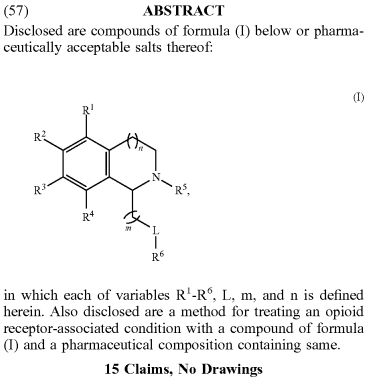
Tetrahydroisoquinolines for use as MOR/NOP dual agonists
- https://patents.google.com/patent/US10597378B2/en
image.png
 
Top