You DO decarboxylate and the product is the appropriate ketone
Sorry maybe I was saying or thinking wrong... Or hell maybe i'm wrong now... but I was thinking to start?
think like Diethyl(phenylacetyl)malonate to P2P I guess? Not quite... Anyways best I got...
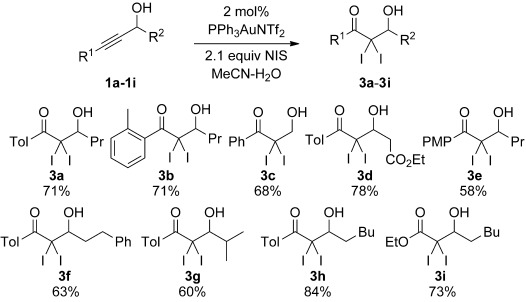
We next set out to determine the scope of the reaction by applying these conditions to various propargylic alcohols (Scheme 3). Pleasingly, a selection of different α,α-diiodo-β-hydroxyketones 3a–3 i could be obtained in moderate to excellent yield from the corresponding alcohols. As well as secondary alcohols, a primary alcohol (3c) could also be employed. Tertiary alcohols were not suitable substrates, though this is perhaps unsurprising given the large steric demands of the geminal diiodo unit. The reaction could also be applied to the synthesis of a diiodohydroxyester (3 i) from the corresponding alkynyl ether.
novel metal-free intramolecular oxidative decarboxylative coupling of primary α-amino acids with 2-aminobenzoketones with different quinazolines can be selectively obtained by various oxidants?
α‐Amino Acid Esters via Palladium‐Catalyzed Oxidative Amination of Vinyl Ethers Using Hydrogen Peroxide as Oxidant and Oxygen Source
Enantioselective Hydroalkoxylation of 1,3-Dienes via Ni-Catalysis Seems... interesting?
Through our independent investigations, we discovered a complementary and enantioselective Ni-catalyzed hydroalkoxylation of dienes. Petroleum feedstocks and readily available dienes can be transformed into chiral allylic ether building blocks with high regio- and enantiocontrol via Ni-catalysis under solvent-free conditions
https://www.researchgate.net/journa...1YmxpY2F0aW9uIiwicGFnZSI6InB1YmxpY2F0aW9uIn19
maybe α‑Acyloxylation ? Or am I wrong thinking I need... 1,2-diol? β-diketones, β-Enaminones,β-diketone compounds with nitriles to give enaminones ?
Perchloric Acid Adsorbed on Silica Gel (HClO4—SiO2) as an Inexpensive, Extremely Efficient, and Reusable Dual Catalyst System for Acetal/Ketal Formation and Their Deprotection to Aldehydes/Ketones
DOI:
10.1002/chin.200720046
α‑Acyloxylation of Ketones/Cyclic Ethers Mediated by Hypervalent Iodine(III) Reagents as Oxidants and Nucleophilic Sources
Though I guess where i'm not thinking right is Secondary Amides with Enamines or Ketones
also this peaked interest of course...
Most interesting glancing is
Commercially available MSTFA [2,2,2-trifluoro-
N-methyl-
N-(trimethylsilyl)acetamide] is a highly effective TMS (trimethylsilyl) source for the convenient preparation of cyclic acetals under modified Noyori's conditions. The reactions proceeded smoothly under mild conditions, affording a wide range of the corresponding cyclic acetals with excellent yields in the presence of catalytic TMSOTf.
S. Radomkit, J. A. H. White, E. Chong, Y. Zhang,
J. Org. Chem.,
2024,
89, 5555-5559.
Reactions of β-diketone compounds with nitriles catalyzed by Lewis acids: a simple approach to β-enaminone synthesis
Using a photochemical method for acetalization of aldehydes under low-energy visible light irradiation, a broad range of aromatic, heteroaromatic, and aliphatic aldehydes have been protected under neutral conditions in good to excellent yields using a catalytic amount of Eosin Y as the photocatalyst. Even challenging acid-sensitive aldehydes and sterically hindered aldehydes can be converted, while ketones remain intact.
H. Yi, L. Niu, S. Wang, T. Liu, A. K. Singh, A. Lei, Org. Lett., 2017, 19, 122-125.
Ammonium salts that can act as hydrogen-bond donors exert a remarkable acceleration on the rates of the regioselective arylation of electron-rich olefins by aryl halides in ionic liquids and common solvents.
J. Mo, J. Xiao, Angew. Chem. Int. Ed., 2006, 45, 4152-4157.
A catalytic method has been developed, which allows aryl halides to couple with various electron-rich olefins to give 1,1 0 -substituted olefins. The palladium-catalysed coupling in ionic liquid solvent proceeds with high efficiency and remarkable regioselectivity without the need for any costly or toxic halide scavengers. Parallel to this, an environmentally-appealing method for the asymmetric reduction of ketones has been established, with which a variety of chiral alcohols can be accessed with high enantioselectivity in water with no need for any organic solvents. The same chemistry has been explored for the reduction of aldehydes, which is shown to be fast and highly chemoselective. These methods add new tools to the armoury of synthetic chemists.
Progress in Electrochemically Empowered C−O Bond Formation: Unveiling the Pathway of Efficient Green Synthesis
The invention provides a method for synthesizing alpha-iodo-beta keto acetal compounds, which comprises the steps of feeding enamine ketone containing N, N-disubstituted structure and iodine simple substance in 1:2 molar equivalents, adding alcohol as solvent and reactant, heating for reaction, and purifying by silica gel column chromatography to obtain target products; the product is characterized by an acetal having an iodo substitution in the alpha-position and a ketocarbonyl group in the beta-position. The method has the advantages that (1) the reaction does not need any metal catalysis or any additional organic solvent, the alcohol is a reactant and also acts as a solvent, and the atom economy is high; (2) the raw materials are simple and easy to obtain, and the reaction of the easily obtained enaminone and alcohol in the elemental iodine is adopted; (3) simple operation and good total yield.
I heard this is probably used or looks familiar or most common
Various types of carbonyl compounds are efficiently converted to their 1,3-dioxanes by the use of 1,3-bis(trimethylsiloxy)propane (BTSP) and a catalytic amount of iodine under essentially neutral aprotic condition.
B. Karimi, B. Golshani, Synthesis, 2002, 784-788.
A thiol-promoted site-specific addition of 1,3-dioxolane to imines through a radical chain process enables a metal-free and redox-neutral conversion of inexpensive materials to a broad range of protected α-amino aldehydes in very good yields using only a catalytic amount of radical precursor. Both the thiol and a small amount of oxygen from air are indispensable to the success of this reaction.
H. Zeng, S. Yang, H. Li, D. Lu, Y. Gong, J.-T. Zhu, J. Org. Chem., 2018, 83, 5256-5266.
Aliphatic and aromatic ketones can be directly converted into their corresponding α-chloroketone acetals in very good yields using iodobenzene dichloride in ethylene glycol in the presence of 4 Å molecular sieves at room temperature.
J. Yu, C. Zhang, Synthesis, 2009, 2324-2328.[/URL]