Which Drugs Cause the Most Harm? (WARNING: Contains Large Image)

Jabberwocky

Frumious Bandersnatch
Joined
Nov 3, 1999
Messages
1,220
Location
Looking-Glass Land
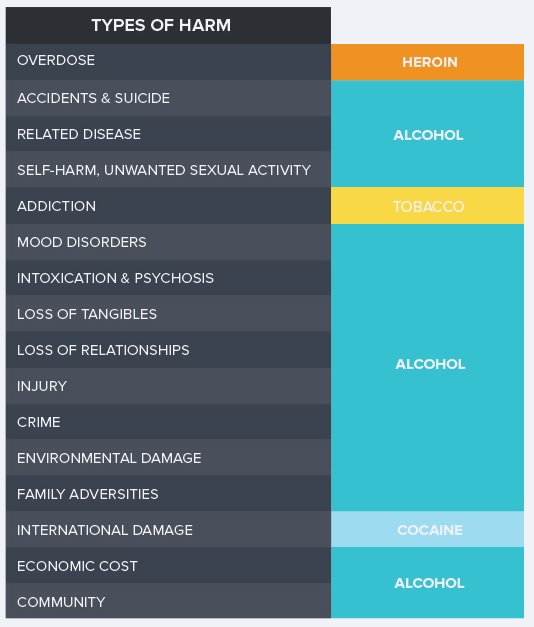
Graphic: Which Drugs Actually Cause the Most Harm?
This infographic ranks the top 10 drugs according to the damage they cause to individuals and society. Are you surprised that alcohol is Number One?


May Wilkerson | 9/17/14 said:
Even though heroin and cocaine often get the worst reps on film and TV, it’s actually your old buddy alcohol (yes alcohol is a drug) that causes the most collateral damage to society. Researchers from the UK (the data is based primarily on findings from this 2010 Lancet paper) have evaluated different drugs based on the harm they cause (to the user as well as to other people) and assigned a “harm score” to each substance. And Florida-based 12 Keys Recovery Center have compiled the findings into an infographic (below), which colorfully illustrates society’s 10 most harmful drugs and the varying types and degrees of fallout they cause.

As you can see, alcohol is among the few drugs that poses a much greater risk to others than to the user themselves. Heroin is responsible for the most overdoses, whereas booze causes the most accidents and suicides. And while alcohol leads to the most family problems, meth ends more relationships. Ecstasy (or “Molly”) has the lowest harm score on the list, whereas alcohol causes the most overall harm (by far), followed by heroin and crack cocaine.


Collateral-Damage-Drugs.jpg
http://www.substance.com/graphic-which-drugs-cause-the-most-harm/12476/
 
Surprising that the unwanted sexual activity "award" didn't go to meth.
 
I was surprised it didn't go to alcohol tbh (as it doesn't make much sense if they're figuring sex work into "unwanted sexual activity", if they did)
 
Last edited by a moderator:
Alcohol lowers inhibitions and makes understanding the consequences of your actions more difficult, and most of all is a great socially acceptable excuse for all kinds of behavior. But it doesn't really cause hypersexuality like that, except in some women. In men it even decreases libido and sexual arousal because it lowers testosterone levels.
 
I really like the article - nicely illustrated. Thinking of PDFing it for my collection, so thanks :)

Re. Recreational drugs & libido - I find that any substance which - soon after it's consumed - creates a euphoric stimulatory effect in my brain/CNS (even if it's not considered a stimulant) eventually ramps up my sex drive big time. The best example I can think of in relation to a drug not necessarily classified as a stimulant, but which stimulates me and increases my libido would most definitely be MDA. At least, I don't think it's classified as a stimulant (stimulant properties or effects, sure, but there's also a psychedelic component as well).

Edit - That said, booze has also had the same effect countless times - that is, until I pass out from trying unsuccessfully to 'partake in the sexual activity.'
 
I think meth simply increases wanted sexual activity, as one is well aware of what they are doing, they are just no longer worried about the consequences.
 
I really like the article - nicely illustrated. Thinking of PDFing it for my collection, so thanks :)

Re. Recreational drugs & libido - I find that any substance which - soon after it's consumed - creates a euphoric stimulatory effect in my brain/CNS (even if it's not considered a stimulant) eventually ramps up my sex drive big time. The best example I can think of in relation to a drug not necessarily classified as a stimulant, but which stimulates me and increases my libido would most definitely be MDA. At least, I don't think it's classified as a stimulant (stimulant properties or effects, sure, but there's also a psychedelic component as well).

Edit - That said, booze has also had the same effect countless times - that is, until I pass out from trying unsuccessfully to 'partake in the sexual activity.'

Funny how opioids have ALWAYS been the only drug I've ever used that will stimulate my libido without fail. Sometimes a good trip on LSD or mushrooms, or a couple lines of my favorite dissociative psychedelic with the right girl will do so in a powerful way, but it's hit or miss. Unlike opioids. Everyone's different I guess. I never understood how stimulants like meth can do that for so many people, perhaps most people, but I'm not complaining.
 
But yours isn't as colorful SJB :(

EDIT: Haha ya that would certainly do it ro. I'm also surprised they don't have a "Down the Rabbit Hole" category with "Datura" next to it. Or Datura would go well next to "Go FUCKING CRAZY" or "Give Parents Heart Attack" :D
 
or meth. Cannabis is harmful for others if I use it? How does that work..??? I'm surprised to see cannabis so far up the list for the harm to others part. I might raid their fridge and eat all their food?
 
The problem with this study (and how often it's quoted) is that they basically just got a bunch of selected (how?) "experts" together to each give a rating based on an "overall" assessment of the various harms of the drug. Given the multi-dimensional nature of "harm" (even if you break it down into harms to self vs. others), there's certainly some "apples vs. oranges" comparisons hidden in these overall scores, and probably a lot of subjectivity of the "experts" as well. Given that their final data is in the form of "numbers", it looks a lot more "scientific" than it probably is. It would be more interesting to try to look at things like:

- The rate of death from the drug
- The cost of drug-related diseases
- The costs of specific types of harms to others
- The costs of crime related to that drug

You'd need to look at it on an overall level (i.e. the absolute amount), but also per-user of the specific drug, because some drugs that are used very uncommonly might therefore have a very low overall impact, but still be much more dangerous to those few users than other more commonly-used drugs (is that perhaps how ketamine comes out less harmful than cannabis in this "study"?) You'd also need to break it down by regulatory framework, wealth of the country, etc., because things like legality, access to health care, etc., would all modify the "harmfulness" of the drug. It would be a harder study to run, and harder to package in a nice infographic, but it would be way more credible than a few hand-picked experts saying "I guess I give that drug a 10, and that other drug a 20".

I agree. As much as I like the Lancet study for helping get the idea out there that illicit drugs are not necessarily more harmful than licit ones, the actual rankings are leagues away from objective and largely coloured by the perception of people who may be experts on some things, but not necessarily experts on all of the detailed categories that these drugs were ranked by.
 
Anybody read about how Big alcohol is appalled at domestic and other violence that some members of the NFL have been engaging in and want people who do this kicked outta the NFL as the are such major sponsors. Has anyone taken them aside and whispered in there ears what their product does and at what extent it is involved in violent crime, sexual assault, health problems including death, and suicide. What a fucking joke big alcohol. 8)
 
First thing I found conspicuous was seeing heroin in the unwanted sexual activity. :? Would think date rape drugs would be ahead of heroin.

I dunno, guess they might be considering how heroin has a tendency to lead some people to engage in prostitution? Which could be considered 'unwanted sexual activity'
(ofc meth, coke, etc do this as well).

Or perhaps, they took into consideration that many heroin addicts could care less about sex. Meaning the individual now considers sex an 'unwanted sexual activity'. :p

Are you surprised that alcohol is Number One?

No
 
Last edited:
^ date rape drugs other than alcohol are a myth fabricated to trick you into aggreeing with the government banning a drug with almost identical effects to alcohol that is thousands of times less toxic that your own body produces naturally (GHB).
 
Last edited:
Oh, my bad...prob should have left that part out considering how little I know about them. The closest I have been to one was listening to that Sublime song in like 7th grade. (afaik anyway) :sus:

The whole study is flawed imo, I don't feel like getting into it though.
 
Top