




Allylbenzene
Bluelighter
- Joined
- Jul 25, 2025
- Messages
- 1,433
Whilst investigating the β-aminoketone metabolites detected after administering pure allylbenzenes (eg studies for elemicin, safrole, myrstricin) which look like this (for safrole):

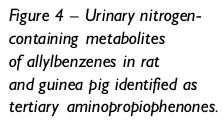
— I found various β-aminoketone-type drugs with a range of activity including muscle relaxants, anaesthetics, opioids and 5-HT3 antagonists. For example:
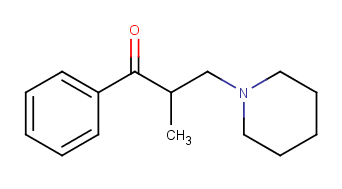
roi posted about it here.
[edit]
@Smyth2 clarifies: "This is called Perisone, CAS Fb: [22385-99-5] HCl: [6281-80-7]". It's a muscle relaxant like other related structures (see below).
Here's some other related drugs that came up:
- Proroxan, non-selective alpha-blocker (α-adrenoreceptor antagonist)
- Propipocaine, local anaesthetic
- Lanperisone, muscle relaxant
- Eprazinone, mucolytic and bronchospasm relieving drug

- Inaperisone - muscle relaxant (inc Tolperisone, Eperisone below)
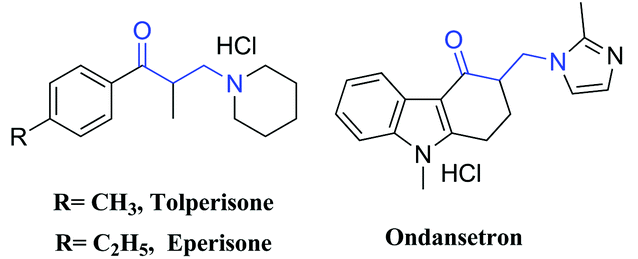
- Ondansetron, 5-HT3 antagonist

- Lobeline
A series of tertiary amine drugs based on this structure (below) which interact with serotonin & dopamine receptors including SERT, 5-HT2A, D1, D2, D3, D4. Designed to be antagonists at these receptors.

Dimethylaminopivalophenone is an opioid analgesic with a potency ½ that of morphine

Based on the indole derivative Ondansetron, here are some simpler ß-aminoketone variations inspired by the allylbenzene metabolites found by Oswald. Ondansetron is a highly selective serotonin 5-HT3 receptor antagonist with low affinity for dopamine receptors.
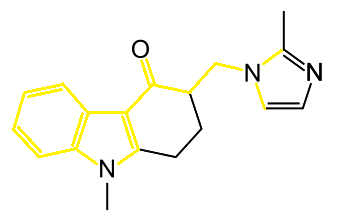


 ...including those based on N-(dimethyl / piperidyl / pyrrolidyl) and the classic 4-hydroxy / 5-methoxy (or 7-methyl) substitutions.
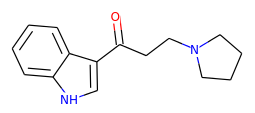
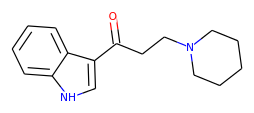
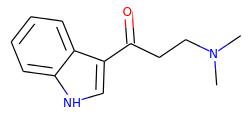
Context - ß-aminoketone metabolites from allylbenzenes, here for safrole:
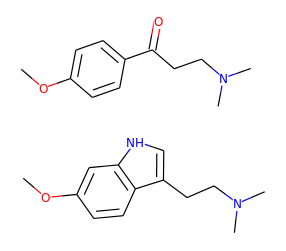
There's also interesting overlap between the ß-aminoketone metabolite of estragole (top) and 6-methoxy-DMT (bottom).
In this context, the equivalent indole substitutions for allylbenzene aminoketone metabolites would be as follows:
A comparison between myrstricin's equivalent indole substitution and myrstricin's aminoketone metabolite that forms in-vivo (the dimethylamine one):
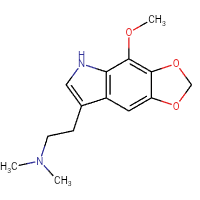
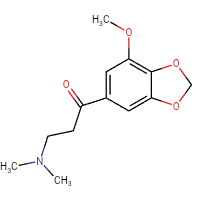
This type of modification could be explored with any indole-based psychoactive.
— I found various β-aminoketone-type drugs with a range of activity including muscle relaxants, anaesthetics, opioids and 5-HT3 antagonists. For example:
[edit]
@Smyth2 clarifies: "This is called Perisone, CAS Fb: [22385-99-5] HCl: [6281-80-7]". It's a muscle relaxant like other related structures (see below).
2-methyl-1-phenyl-3-(piperidin-1-yl)propan-1-one
...
Summary: Substance dissolved incredible easy in water. 50mg rectal seems to be a nice recreational dose, however too euphoric to get work done. Not much of a body high though, seems to be rather mental, no crazy amounts of energy, feels really clean. Comedown is not unpleasant at all, not much of a urge to redose. Short duration (2-3 hours), but pretty enjoyable.
So yeah, if you go the oral route it'll probably take around 100mg. Decent stim, nothing to rave about though.
Recent progress in the chemistry of β-aminoketones
The β-aminoketone moiety has been found to be the basic skeleton of several drugs such as the amine salts “tolperisone (vasodilation)” and “oxyfedrine (therapeutic coronary disease)”, and fluoroaryl derivatives such as “sitagliptin (antidiabetic)”. The objective of this review is to summarize and highlight the chemistry of compounds reported with a β-aminoketone core in the last five years regarding their synthetic strategies, chemical reactivity, and mechanistic synthetic pathways.

Recent progress in the chemistry of β-aminoketones
The β-aminoketone moiety has been found to be the basic skeleton of several drugs such as the amine salts “tolperisone (vasodilation)” and “oxyfedrine (therapeutic coronary disease)”, and fluoroaryl derivatives such as “sitagliptin (antidiabetic)”. The objective of this review is to summarize...doi.org
Here's some other related drugs that came up:
- Proroxan, non-selective alpha-blocker (α-adrenoreceptor antagonist)
- Propipocaine, local anaesthetic
- Lanperisone, muscle relaxant
- Eprazinone, mucolytic and bronchospasm relieving drug
- Inaperisone - muscle relaxant (inc Tolperisone, Eperisone below)
- Ondansetron, 5-HT3 antagonist
- Lobeline
Lobeline has multiple mechanisms of action, acting as a VMAT2 ligand, which stimulates dopamine release to a moderate extent when administered alone... It also inhibits the reuptake of dopamine and serotonin and acts as a mixed agonist–antagonist at nicotinic acetylcholine receptors. It is also an antagonist at μ-opioid receptors.
A series of tertiary amine drugs based on this structure (below) which interact with serotonin & dopamine receptors including SERT, 5-HT2A, D1, D2, D3, D4. Designed to be antagonists at these receptors.
Dimethylaminopivalophenone is an opioid analgesic with a potency ½ that of morphine
Based on the indole derivative Ondansetron, here are some simpler ß-aminoketone variations inspired by the allylbenzene metabolites found by Oswald. Ondansetron is a highly selective serotonin 5-HT3 receptor antagonist with low affinity for dopamine receptors.
> Ondansetron (top)
> simple ß-aminoketone variations based on the yellow sub-structure (below)
a user said:The allylbenzene aminoketone metabolites in their dimethylamine form are chemically more like DMT than phenethylamines.
If you took the pyrrolidine section off of the indole group of 6-methoxy-DMT and replaced it with a keto group, you would have 1'-oxoestragole-DMA, which is the dimethylamine metabolite of methyl chavicol (estragole).
In this context, the equivalent indole substitutions for allylbenzene aminoketone metabolites would be as follows:
Allylbenzene | Indole equivalent | |
estragole | = 4-methoxy | = 6-methoxy |
methyl eugenol | = 3,4-dimethoxy | = 5,6-dimethoxy |
safrole | = 3,4-methylenedioxy | = 5,6-methylenedioxy |
| myrstricin | = 3-methoxy-4,5-methylenedioxy | = 7-methoxy-5,6-methylenedioxy |
A comparison between myrstricin's equivalent indole substitution and myrstricin's aminoketone metabolite that forms in-vivo (the dimethylamine one):
This type of modification could be explored with any indole-based psychoactive.
Last edited:

