The three deadliest drugs in America are all totally legal
German Lopez
May 19, 2014,
As the US debates drug policy and marijuana legalization, there's one aspect of the war on drugs that remains perplexingly contradictory: some of the most dangerous drugs in the US are perfectly legal.
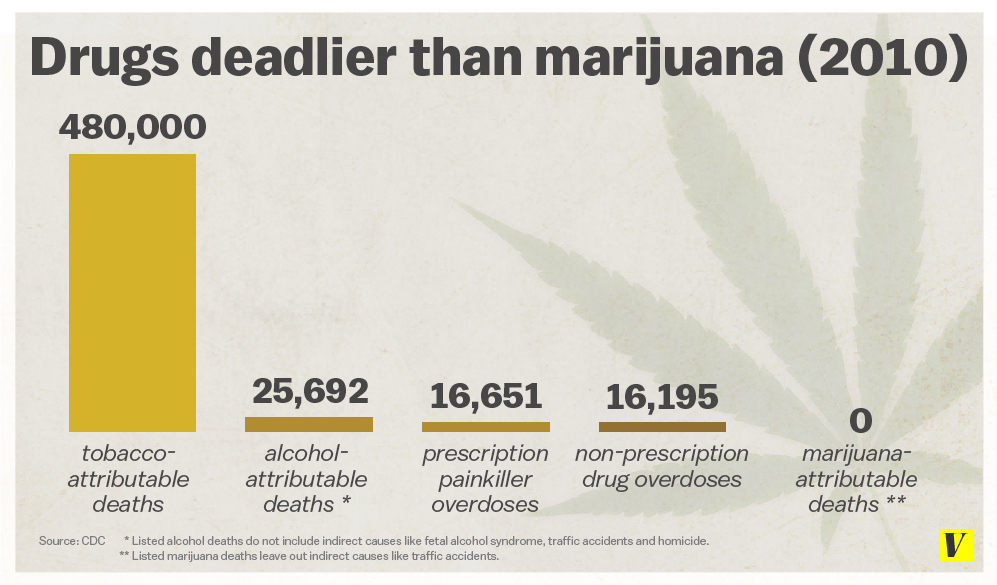
Don't believe it? Just look at this chart, compiled with available data from the Centers for Disease Control and Prevention (CDC):
Drugdeaths
This chart does come with a big qualification: it's not a perfect comparison across the board. One driver of absolute tobacco and alcohol deaths is that both substances are legal and easily available. Other substances would most likely be far deadlier if they were as available as tobacco and alcohol.
But it's already established that it takes less relative doses to die from alcohol than it does to die from marijuana and even cocaine. An American Scientist analysis gauged the toxicity of drugs by comparing a drug's effective dose — the amount it takes to get a desired effect — to its deadly dose. The analysis found alcohol is deadly at 10 times its effective dose, while heroin is deadly at five times, cocaine is deadly at 15 times, and ingested marijuana is deadly at more than 1,000 times. (In practical terms, it's nearly impossible to overdose to death on marijuana because a user would most likely pass out before reaching a fatal dose.)
The direct death and overdose rates, however, leave out other factors that could lead to health and socioeconomic issues. Alcohol in particular is widely associated with various issues — more crime and traffic accidents, for example — that harm both users and society as a whole.
On top of the nearly 26,000 deaths brought on by detrimental health effects, alcohol caused more than 10,000 traffic fatalities in 2010.
In the latest year of data available for drugged driving (2009), the National Highway Traffic Safety Administration found alcohol in 32 percent of deadly traffic accidents. Other drugs, in comparison, were present in about 18 percent of deadly traffic accidents. (About 37 percent of drivers killed in an accident weren't tested for drugs, though.)
Again, some of this is a matter of access. If other drugs were as easily available as alcohol, they could cause more deadly traffic accidents than they do today.
But it's not really disputed that alcohol is one of the most dangerous drugs on the road. Columbia University researchers previously found alcohol increases the risk of a traffic accident 13 times over, while other drugs double to triple the risk and the detection of marijuana in particular less than doubles the risk.
One point of caution with all of these numbers: it's much more difficult to measure how marijuana impairs drivers than it is to measure how alcohol impairs drivers, since marijuana stays in the system for much longer.
Even when accounting for other factors, alcohol and tobacco are still more harmful than marijuana
A previous report published in The Lancet took a comprehensive look at 20 of the world's most popular drugs and the risks they pose in the UK. A conference of drug experts measured all the factors involved — mortality, other physical damage, chance of developing dependence, impairment on mental functioning, effect on crime, and so on — and assigned each drug a score. What they concluded: alcohol is by far the world's most dangerous drug to society as a whole.
continued and charts and graphs http://www.vox.com/2014/5/19/5727712/the-three-deadliest-drugs-in-america-are-all-totally-legal
German Lopez
May 19, 2014,
As the US debates drug policy and marijuana legalization, there's one aspect of the war on drugs that remains perplexingly contradictory: some of the most dangerous drugs in the US are perfectly legal.
Don't believe it? Just look at this chart, compiled with available data from the Centers for Disease Control and Prevention (CDC):
Drugdeaths
This chart does come with a big qualification: it's not a perfect comparison across the board. One driver of absolute tobacco and alcohol deaths is that both substances are legal and easily available. Other substances would most likely be far deadlier if they were as available as tobacco and alcohol.
But it's already established that it takes less relative doses to die from alcohol than it does to die from marijuana and even cocaine. An American Scientist analysis gauged the toxicity of drugs by comparing a drug's effective dose — the amount it takes to get a desired effect — to its deadly dose. The analysis found alcohol is deadly at 10 times its effective dose, while heroin is deadly at five times, cocaine is deadly at 15 times, and ingested marijuana is deadly at more than 1,000 times. (In practical terms, it's nearly impossible to overdose to death on marijuana because a user would most likely pass out before reaching a fatal dose.)
The direct death and overdose rates, however, leave out other factors that could lead to health and socioeconomic issues. Alcohol in particular is widely associated with various issues — more crime and traffic accidents, for example — that harm both users and society as a whole.
On top of the nearly 26,000 deaths brought on by detrimental health effects, alcohol caused more than 10,000 traffic fatalities in 2010.
In the latest year of data available for drugged driving (2009), the National Highway Traffic Safety Administration found alcohol in 32 percent of deadly traffic accidents. Other drugs, in comparison, were present in about 18 percent of deadly traffic accidents. (About 37 percent of drivers killed in an accident weren't tested for drugs, though.)
Again, some of this is a matter of access. If other drugs were as easily available as alcohol, they could cause more deadly traffic accidents than they do today.
But it's not really disputed that alcohol is one of the most dangerous drugs on the road. Columbia University researchers previously found alcohol increases the risk of a traffic accident 13 times over, while other drugs double to triple the risk and the detection of marijuana in particular less than doubles the risk.
One point of caution with all of these numbers: it's much more difficult to measure how marijuana impairs drivers than it is to measure how alcohol impairs drivers, since marijuana stays in the system for much longer.
Even when accounting for other factors, alcohol and tobacco are still more harmful than marijuana
A previous report published in The Lancet took a comprehensive look at 20 of the world's most popular drugs and the risks they pose in the UK. A conference of drug experts measured all the factors involved — mortality, other physical damage, chance of developing dependence, impairment on mental functioning, effect on crime, and so on — and assigned each drug a score. What they concluded: alcohol is by far the world's most dangerous drug to society as a whole.
continued and charts and graphs http://www.vox.com/2014/5/19/5727712/the-three-deadliest-drugs-in-america-are-all-totally-legal