• 🇳🇿 🇲🇲 🇯🇵 🇨🇳 🇦🇺 🇦🇶 🇮🇳
    Australian & Asian
    Drug Discussion


    Welcome Guest!
    Posting Rules Bluelight Rules
  • AADD Moderators: Tronica

The New MDMA Replacements, and the legal implications

The fact of its pharmacological similarity would take some time to prove, as i'm sure first of all identifying the ACTUAL substance involved would need to take place, then all the red tape surrounding that - personal research into its subjective effects versus say MDMA. Would take them ages.

I'm sure the one paper written by Nichols is hardly enough to prosecute someone with - especially seeing as it is only a drug that has been tested on animals, and the human model is still unknown.

What about bringing in a couple of key experts; PhDs in pharmacology that could demonstrate via simplified reasoning and SAR diagrams and explain how and why these compounds were invented? There's probably sufficient anecdotal evidence to also had weight to their reasoning that it has CNS activity.

Have another look at that link posted about Qld analogues and see if you notice anything......shall we say, odd.

A more constructive approach to this thread would be to post all the links (drug laws, various acts and analogue clauses etc) for federal and all states and territory legislation, in a single post. We can then incorporate it into the upcoming HR and related threads header.

 
I suppose you are right p_d, but either way it's going to take time, and resources they likely don't have to blow on a few, how should i put it - ambitious kids importing this substance when it does hit vendors hands - right up until it becomes some kind of epidemic (as we saw with mephedrone). Even then prosecuting the individual under state-law would be futile, as it's a federal case to import drugs into any australian port, not one governed by state law.

Are you aware if any indane type chemicals are listed as border controlled substances? From my knowledge and reasoning none are, and in saying that the whole case, if it was such - would rest on the similarity of 5-iai's pharmacological profile compared with MDA/MDMA and their analogues. Also my point, as i was trying to get across - is we're not even sure how the human model responds to this chemical yet - as far as reliable anecdotal evidence goes at least, and I mean that so far as anyone with any credibility giving their bioassay report.
 
Also my point, as i was trying to get across - is we're not even sure how the human model responds to this chemical yet - as far as reliable anecdotal evidence goes at least, and I mean that so far as anyone with any credibility giving their bioassay report.

I'm sure we'll have a "Danny Burling" chiming in soon.....
 
I also just noticed a reasonably reputable online vendor has "MDAT" available..

p_d could you possibly provide your opinion on this 'aminotetraline' substance, and its possible effects.
 
f&b's comments and Nuke's repsonse of caution pretty much sum up my thoughts st this stage. Probably is active in a similar way to MDAI, but it could also have significant NE and DA activity. Is there no binding data for MDAT?

fastandbulous said:
the aminotetralins are nasty shit from what I've heard (eg 2-aminotetralin landed someone in hospital - personal communication)

nuke said:
Ah, right. It was an older user around here, I forget the name. They said they sampled it up to hundreds of milligrams years back based upon the data in studies and found that instead of producing decent stimulation it actually caused them to black out and nearly die in a dose-unpredictable fashion (under 100mg it felt safe with mild effects, yet going above it caused severe side effects). Yet strangely, the rats found it a favourable stimulant. That was how I originally found out about it, I discovered an old study saying it worked well as an anorectic in rats, then I brought it up here and it turned out someone had already assayed it.

Be careful with this one if you decide to give it a go.
 
I note that the vendors saying that 5-IAI would be in stock today, are now saying mid-June.
 
The only thing the govt/customs can do is hold onto it until further testing is done. They won't be able to hold them ateria long enough for legislation to go through, so they're probably just doing it to annoy the vendors nad to make sure it isn't anything that is currently illegal.
 
Mr Blonde, appreciate your in depth response to my comments from a few days ago, seem like the type of dude i could easily shoot the shit with in person.

Respect.
 
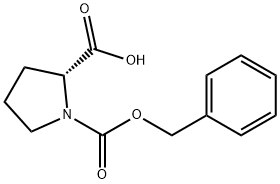
My first thoughts have been echoed elsewhere. Benzyloxycarbonyl-d-proline contains two ring systems, but they are not joined, so the 2a, 3a, 17a etc notations don't mean anything in regards to the amino acid derivative.

Look at N-Benzyloxycarbonyl-d-proline aka 1-[(Benzyloxy)cabonyl]pyrrolidine-2-carboxylic acid (N-CBZ-d-proline)

CAS%5CGIF%5C6404-31-5.gif


Both the aromatic and pyrrolidine rings would be numbered 1-6 and 1-5 respectively, illustrated by the above naming of N-CBZ-d-proline.

Now, consider the standard ring lettering and atom numbering for steroidal compounds

400px-Steroid_numbering.png


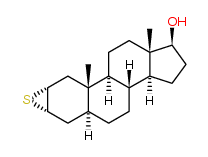
It has been suggested the nomenclature of the compound Epitiostanol aka (2α,3α-Epithio-5α-androstan-17β-ol) has been "borrowed" in the naming of (2α,3α) -epithio-17α-methyl-17β-ol-N-Benzyloxycarbonyl-d-proline. The naming of the NRG2 ingredient is very sus, as there is no definite reference to how the two structures might be linked, and the N of N-Benzyloxycarbonyl-d-proline is a tertiary amine so it can't be connected to the sterol. Perhaps the carboxylic acid of N-CBZ-d-proline could be attached at the 17 position via the 17a methyl ester? All a guess on my part.

Take a look at Epitiostanol

dl308.png


I suspect, as has been previously stated, that the naming could simply be a way of avoiding detection of naphyrone. Until we know more, I'd say be aware that if it isn't naphyrone, and the naming is partly correct, then you are very likely talking about a steroid, and probably something based on epitiostanol.

I'll also add that there was talk some time ago about steroidal compounds with indirect activity (via modulation of GABA). Perhaps this is the first of such compounds? We'll have to wait for an analysis to be done...I'm sure it won't be far away.
 
Does anyone have any specific clauses regarding legality of these products coming into australia?

So one could make an informed decision regarding risk/reward ratio.
 
4-desoxy-MDA is an analogue of MDA under federal law, and is thus illegal.

5-IAI would not be considered an analogue according to the SUSDP, as it has no chemical relatives - but could be considered an analogue due to the reason it was invented and its similar pharmacological profile to MDMA. Still this would take some time to prove and is unlikely to occur.
 
The only thing the govt/customs can do is hold onto it until further testing is done. They won't be able to hold them ateria long enough for legislation to go through, so they're probably just doing it to annoy the vendors nad to make sure it isn't anything that is currently illegal.

Agreed. They will test to try & find a way to stop it, which they will fail at, pass it on, we'll all have a chance to get in quick, if it is anygood, buy up quick before it falls the way of of meph & bk-mdma.
 
Top