



Swiss drug addicts given free heroin

kingpin007

Bluelighter
Joined
Aug 24, 2007
Messages
1,888
Location
(Acacia unit ) Barwon Prison riding my excercise b
Swiss drug addicts given free heroin

Posted Sat Dec 19, 2009 12:50pm AEDT
Updated Sat Dec 19, 2009 1:17pm AEDT
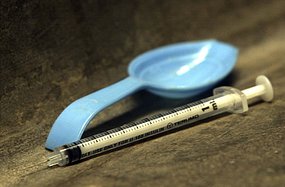
r264620_1105049.jpg


On the face of it, giving drug addicts free heroin is a contentious move, but that is exactly what happens in Switzerland.

A referendum last year was overwhelmingly passed to approve the program, which has been running for years as a trial.

It gives security to a system designed for those addicts who have failed all other treatment options. But it is not without its critics.

On an early morning in the heroin clinic, addicts line up for their turn to receive a syringe with a carefully measured dose of pure heroin.

They take it to a desk and either self-inject, or get a staff member to help.

Amongst the regulars is Jason. He still hopes to kick the habit, but says until then it is a whole lot better than his old life on the streets.

"Before I was on the program I was totally down to the floor. I was around not even 60 kilos," he said.

"I lost my job, I lost my apartment; I looked like shit.

"And then when I came here I was able to work again, I gained quite a lot of weight since then also and then I can be back to life.

"[If I didn't have this program] I would probably be dead."

Dr Christoph Buerki runs the Berne clinic. He has around 200 clients and says the program is good for addicts and for society.

"Once a patient enters our treatment he would very much to a large degree - and the statistics have proven that - would reduce his illegal activities," he said.

"So that's one very, very important point also for society."

Dr Buerki denies criticism that the program is just feeding the addiction and not actually controlling it.

"They come here from the heroin, but once you have them in treatment, you start working with them," he said.

"There's a whole lot of treatment involved in it."

Despite the referendum approving of this program by a two-thirds majority, it is not without its critics, like Sabine Geissbuhler from Parents Against Drugs.

She argues the system just feeds a habit rather than looking for a cure.

"I think it's very bad because there is no goal to make them free of drugs because you can't get free from a drug if you give it," she said.

Whatever side of the argument you are on, no-one would want a return to the early 90s, where public parks in the major cities were turned into drugs bazaars.

Evelyn is a long-term user who is still on the program. She returns to the Berne park where she used to buy her drugs.

It looks very different and a metre of topsoil has to be removed because used needles had contaminated the soil.

The ABC's Foreign Correspondent first met Evelyn 12 years ago when she had joined the heroin trial to escape a life of degradation.

"[I was] begging in the streets for instance or even prostitution. I didn't do that very much, but [I did it and] I hate myself for this," she told the program.

But she says these days life is better.

"I'm still on heroin, but I don't drink anymore, I don't run after the drugs, I don't have to lie to anybody anymore," she said.

Detractors say the fact she is still an addict after all these years is evidence the program has failed.

But she says the fact she is alive and living a productive life without resorting to crime is clear evidence of its success.

Either way, conservative Switzerland opted for a radical solution, one some say could work equally well in places like Australia.

http://www.abc.net.au/news/stories/2009/12/19/2776569.htm

 
^
Most stabilize their dose and eventually hop off completely or to an opiate replacement program. The key you may be missing, is that the effects of the drug itself aren't the most damaging, at least not when we're talking about opiates. The lifestyle and legal status is what causes the most harm. Right now the people in the program get pure/sterile dope and equipment, so they don't have to worry about getting their next dose or the other consequences of using. They can focus on getting their life together, and eventually quitting if that's what they want to do.
 
How can you quit if you get it for free? this baffles me..

If you get it for free in the morning, this eliminates the #1 worry of an addict, leaving the rest of the day to focus on their life, getting better etc.
 
you guys have good points, but it just seems weird to me that you can kick a habit by getting it more or just as much. It does make sense if they have treatment after, they make it sound like they just go there to shoot up.
 
you guys have good points, but it just seems weird to me that you can kick a habit by getting it more or just as much. It does make sense if they have treatment after, they make it sound like they just go there to shoot up.


It's the same concept as Methadone clinics and Suboxone clinics, just with Heroin. I agree with this, it's just sad this will never happen in the US.
 
I am glad this is going so well, who knows how many lives it has saved. I don't see how people can argue the fact they are still using is a failure, drug use isn't the real problem its the inflated csts for an adulterated product, the uncertainty of the next hit, devoting ones life to scoring and using and the profits going to viscious drug gangs that are the real problems, all of which are avoided by supplying the addicts with heroin legally.

I am sure their lives are far from perfect (some heroin lovers on here may argue with me :p) but I am equally sure that their lives are infinitely better than before they were on this program. I am also pretty sure that this is alot cheaper to society than the costs of having these addicts on the street.
 
more heroin clinics the better, even if their not on my continent its a lil reassuring to know others wont have to suffer the bs inconsistencies street life guarantee's when ur trashed 24.
 
The story behind Rx heroin in Switzerland is rather interesting. The country through the 60s and 70s had very tough, draconian drug policies. Finally, the social system began to view this as a disease rather than a criminal issue. The city government of Zurich took a rather radical step. Within a park called Platspitz in 1986, the city began to officially allow the sale, possession, and use of hard drugs. This is in contrast to Amsterdam/ Dutch government, that tolerated "soft drugs" like cannabis and shrooms but aggressively pursued hard drugs. The idea was to contain the addicts in one part of town and provide ancillary social services like needle exchanges, ect...This went on until 1992 when the city closed down the scene in "needle park". By then, the population of needle park soared from a few hundred to tens of thousands. Used IVs, wrappers, and other debris littered every inch of the park. Tables were set up selling coke and heroin. Cops, would do routine visa sweaps when people were observed using but then gave the drugs back if they had a valid visa or ID. When the scene at Platszpitz was closed down, that just caused the scene to move to an abandoned train station called Leiten. Finally, the Swiss authorities wised up resulting in the current Rx Heroin scheme.

I started this thread with more info:

The Swiss Rx Heroin system

Included experiments with Rx cocaine maintainance. An important point. When patients were allowed access to the maxium dose per day (like 750 mg a shot). There dose decreased by an average of 1/2- 1/3 over 18 months of treatment. Anyway gotta go- wife nagging. Check out link.
 
Last edited:
Phrozen:Most stabilize their dose and eventually hop off completely or to an opiate replacement program. The key you may be missing, is that the effects of the drug itself aren't the most damaging, at least not when we're talking about opiates. The lifestyle and legal status is what causes the most harm. Right now the people in the program get pure/sterile dope and equipment, so they don't have to worry about getting their next dose or the other consequences of using. They can focus on getting their life together, and eventually quitting if that's what they want to do.

Phrozen makes, as ususal an excellent point. With lifestyle, "the life" is a big factor that perpetuates use. The legal status makes most people result, out of desperation to engage in potentially dangerous or illegal acts they simply wouldn't have to if it were legal- which causes the most harm. Cues are involved in the whole process of long term craving. You take a mammal, whether a rat or human that was self administering an opiate in a certain locale, take them away, detox them, and then reintroduce them after a significant amount of time in their own environment- they often experience the phenomena of craving. Take a dope fiend, take them out of their environment, and put them in a new environment, give them their accostomed dose of dope (assuming they have a habit), and in many cases the subject will fall out (OD). This has been demonstrated experimentally in human case studies as well as in animal studies.

My theory, which i've mentioned on BL before is that the whole cycle of waking up sick, hustling money, Waiting for the connect/ going into a bad neighborhood to hook up,and finally experiencing that overwhelming relief, comfort, and euphoria of getting right perpetuates the cycle of abuse. Legal access to heroin or heroin maintenance allows for more stable plasma levels of morphine and lessens the reinforcement from the sick/ well cycle- which provides for a further level of stabalization, benefiting from the principal of behavioral extinction. Then the obvious, husting money for dope doesn't eat up their day and they are in a better position to find and hold onto a stable job, which further distances them from the life. It dosen't hurt that they are at a lesser risk of contracting hep C, HIV, endocarditis, or cellulitis which lowers the burden on a health system tetering on the verge of collapse (at least in the US).

Switzerland is composed of Cantons, an administrative unit in between a county and a state, yet with more autonomy than either. Switzerland is a confederation with a relatively weak federal government comparatively speaking. So there is alot of variability where you are- but the the heroin Rx scheme is fairly widespread in many cities, it is my understanding, with different regulations depending on the muncipalities especially regarding safe administration and/or smoking rooms eg closing times. The age limit for all city injection rooms is 18 with the exception of Bern where the age limit is 16.

One of the most interesting developments is in the area of instituting Rx cocaine. This has been discussed at length a hopefully a study and/ or scheme will be instituted. If nothing else, in my opinion, society will benefit from a reduction in property crimes.

Ahkei:If you get it for free in the morning, this eliminates the #1 worry of an addict, leaving the rest of the day to focus on their life, getting better etc.
Amen to that!

MCMG: you guys have good points, but it just seems weird to me that you can kick a habit by getting it more or just as much. It does make sense if they have treatment after, they make it sound like they just go there to shoot up.
But this is exactly what happens- there dose, as I mentioned decreases by atleast 1/2 on average even though they have access to trully heroic doses of heroin. This conclusion is based on sound, peer reviewed studies, and a decade and a half experience of heroin prescription programs, safe injection/smoking rooms, ect... the successful outcomes, as you sugest, are based in part on access to good ancillary services. Breaking the chain of desperation is another factor that accounts for the good outcomes and widespread support of this system by the Swiss government and people. Hell, I feel alot safer knowing my dope fiend neighbour didn't have to resort to stealing to support his habit.

SP: It's the same concept as Methadone clinics and Suboxone clinics, just with Heroin. I agree with this, it's just sad this will never happen in the US.
It's interesting you mention this:

An interesting point brought up in the link I provided is that heroin maintenance, if you read one of the articles I included in the above link in the 50s in the USA was supported by the AMA and American Bar Association, which is amazing to me considering the social and political climate in the US in those days. I highly recomend that link for those interested in heroin prescription and the evolution of the Swiss and world harm reduction model. Lots of links to valuable info which I'll copy and post more of in the thread when I get around to it.

The way the world is changing who knows. They just opened a out in the open MJ medical clinic in my neighborhood and I've seen signs advertising med cannabis delivery. The clinic in OB is very prominent.

Vive La Confederation Suisse!
 
Last edited:
Evelyn is a long-term user who is still on the program. She returns to the Berne park where she used to buy her drugs.

It looks very different and a metre of topsoil has to be removed because used needles had contaminated the soil.

Not that there wasn't an open air drug scene in Bern at a park there but the author of the article I suspect confused the park in Bern with Zurich. The park that had the topsoil replaced was Platszpitz in Zurich. It is in the center of the city near a museum on the banks of a river, and as I mentimed, thousands of used syringes, cookers, wrappers, ect... were found which necessitated a removal of a layer of topsoil back in the early to mid 90s.

In the ten years since the world’s most infamous haunt for addicts closed in Zurich, Swiss drugs policy has come a long way.


The Platzspitz, which had become known as “Needle Park”, attracted hundreds of heroin addicts daily. In the park, users from all over Europe bought their drugs, and injected them openly.

Some social workers and doctors treating drug addicts believed the Platzspitz had its advantages - at least addicts were in one specific place where they could be given clean needles and help quickly if they overdosed.

But bitter complaints from local residents, and concern among Zurich politicians about the city’s image led to the park’s closure. On February 4, 1992, Zurich police move into the Platzspitz and cleared away the addicts.

From then on, although some drugs users did try to gather in Zurich’s Letten area, the open drugs scene was over.


Harm reduction
A direct consequence of the closure of the Platzspitz was the introduction first in Zurich and then right across Switzerland of a series of harm reduction measures for drug addicts.

The measures supplemented Switzerland’s existing policies of repression, education and treatment for drug abuse.

Needle exchanges were set up, where addicts could swap used needles for clean ones. Injection rooms were opened where heroin users could inject their drug away from the streets, and under the supervision of trained medical staff.

Dr Daniel Meili, a leading member of the association for the reduction in the risks of drug abuse, says the past ten years have brought great improvements.

“Things have really got much better,“ he told swissinfo. “We have lots of injection rooms, we have a big methadone programme, and we can even prescribe heroin too.”


Prescribing heroin
Meili is also chief medical officer for Zurich’s programme of heroin prescription. When the programme was first introduced in 1994, it was very controversial, but after studies indicated that addicts on the programme had achieved a better state of health and a more stable life style, other regions of Switzerland introduced heroin prescription too.

Over the past ten years, drug related deaths in Switzerland have fallen, as have levels of HIV infection.

Convinced by the results, Swiss voters decided in 1997 to support continued government funding of the programme. There are now heroin prescription programmes in all of Switzerland’s cities, and in most major towns.

Although other countries such as Holland and Australia have expressed interest in Swiss drugs policy, prescribing illegal narcotics remains very controversial, and Switzerland remains the only country in the world to operate a widespread, government funded programme of heroin prescription.


Getting addicts off drugs
However, some critics say Switzerland’s drugs policy has got out of hand, and that the overall goal - of getting addicts off drugs - has been forgotten.

Walter Häcki, a Swiss People’s Party representative in Lucerne’s cantonal parliament, wants the heroin prescription programme stopped.

“The Swiss government’s policy simply maintains people on drugs,“ Häcki told swissinfo. “What we should be doing is getting them into abstinence programmes, so that in the end they can get off the drugs, and have happy fulfilled lives. Drug addicts have a right to that too.”

Häcki might be surprised to discover that his views are shared at least in part by Robert Reithauer, the social worker in charge of the injection and smokers’ room in Zurich. Where they differ, is over the method of achieving abstinence.

“Of course it’s always better if someone can live their life without being dependent on drugs,“ said Reithauer. “And I’m sure that our programme of harm reduction helps people to find new ways of living.

“We won’t see progress with the people here overnight, but over months or years we will. At some point some of the people here will ask me for help to come off drugs.“

When Reithauer opens the door of the centre each morning, there is a long queue of drug addicts impatiently waiting. Reithauer greets them; he knows most by name.

“If I didn’t have the hope that some of these people would be able to achieve normal drug free lives in the future,“ he said, “I wouldn’t work here anymore.“

by Imogen Foulkes
another article:

The city of Zurich says its pioneering drugs strategy has been a success but must now be adapted to meet other challenges.
Authorities in Switzerland’s largest city admitted on Thursday that they had been so busy tackling the open heroin scene that other areas of addiction had missed out.


The assessment comes ahead of next month’s vote in Zurich on whether to maintain the city’s heroin prescription programme.

After concentrating on the heroin problem for the past ten years, the city now wants to be more active in other areas, including encouraging the reintegration of drug addicts.

In a report entitled “Zurich city policy on drugs and addiction”, the city government analysed the results of its strategy since the end of the open drugs scene around the disused Letten station in 1994.

The report, which was demanded by the city parliament, also outlines future strategy.

“We concentrated our efforts so much on the problems linked with the open [drugs] scene that we neglected other aspects,” commented social affairs director Monika Stocker.

She added that even though the strategy had been successful, bringing about the disappearance of places where heroin was sold and injected, it had to be brought up to date.


Disappearing drug scenes
The city of Zurich has a four-pillar strategy, which includes prevention, repression, survival help and therapy.

Support, in particular, should now be given to heroin addicts across the city, said the report.

Zurich wants to put the accent on reintegration. But this is considered difficult in a climate in which companies continue to close their doors to addicts, and in which the city has SFr3.1 million ($2.46 million) less at its disposal from the canton's coffers because of cost-cutting measures.

The authorities are also going to keep a closer watch on other drugs. While heroin consumption is on the decline, the use of cocaine and ecstasy is on the increase.

Cannabis users, who have until now been under scrutiny by the police and the law, are also to be supervised more closely.


Advice centres
“In order to face the changes in consumption, advice centres have to become more multipurpose,” explained Robert Neukomm, who is responsible for health matters.

The idea is that every addict, whether a consumer of cocaine or alcohol, should be able to get advice.

“We really have to stop differentiating between legal and illegal drugs,” he explained.
Neukomm argued that new solutions had to be found for cocaine addicts who were unemployed and living on the fringe.

“For these addicts, we are at the same point as we were with heroin ten years ago,” he said. But he pointed out that Zurich could not act alone.


Pilot project
A pilot project for the distribution of cocaine under prescription is underway in the city but it is not being supported for the time being by the Federal Health Office in Bern.

However, the office is backing pilot projects in Bern and Basel distributing a substitute drug, Ritalin.

The Zurich authorities also plan to step up prevention measures with young people, particularly those who are jobless.

As far as repression is concerned, the city government is in favour of banning addicts, from certain districts, whatever their nationality, if they are a public nuisance.

swissinfo with agencies
 
Cocaine Rx in Switzerland

I found in the thread i started about harm reduction model of the swiss that although most bluelighters support heroin Rx, cocaine prescription schemes incited some degree of controversy. Anyway: here is article

Doctors push for cocaine prescription

A national conference on cocaine has discussed whether the drug should be prescribed to long-term addicts.
Switzerland has had a programme of heroin prescription for the most hardened addicts for ten years and some doctors believe cocaine addicts could benefit from a similar treatment.


But others have their doubts. Officials from the Federal Health Office are especially concerned about the political impact of introducing cocaine prescription.

There are an estimated 90,000 cocaine users in Switzerland. However, most of them use the drug only on a recreational basis and would not be included in any prescription programme.

The conference, which ended in Bern on Friday, brought together Switzerland’s leading addiction specialists, as well as officials from the Health Office.


" The mortality risk among [cocaine addicts] is quite high. Without treatment many of them will die in the next 10 years. "
Daniel Meili, doctor Multiple dependencies
Daniel Meili, who heads Zurich’s heroin programme, says a typical candidate for cocaine prescription would be an addict with multiple dependencies.

“Of the 150 heroin patients I have here, perhaps a third of them could also benefit from cocaine prescription,” Meili told swissinfo. “They come here to get the heroin, but they are also addicted to cocaine, which they buy on the illegal market.”

“They can spend between SFr10,000-20,000 a month to feed their habit, which means they are often involved in crime.”

Supporters of the programme point to evidence that patients on the heroine scheme have improved health and more stable lifestyles, including proper accommodation and even regular work.

But Meili says that patients who continue to be addicted to cocaine don’t reap any of these benefits.


High mortality
“The mortality risk among these patients is quite high,” he said. “Without treatment, many of them will die in the next ten years.”

But Switzerland’s Federal Health Office is not convinced that introducing cocaine prescription is the answer.

“There’s just no evidence that such a scheme would be successful,” said Markus Jann, head of the drug addiction department.

“We would be very hesitant about trying such a thing, and anyhow we have more important addictions to tackle, such as alcohol or tobacco.”

The Swiss government also feels that this is not the ideal time politically to start talking about something as controversial as cocaine prescription.

Later this month parliament is due to vote on a much-delayed revision of Switzerland’s narcotics law, which if approved, would decriminalise cannabis.

The Federal Health Office – which spent months drafting the legislation and lobbying for it – fears that a rash move towards cocaine prescription could encourage opposition to the law.

But Thomas Zeltner, the department’s director, recently said there would no legal impediment in the way of a pilot project of cocaine prescription. This is a softening of his earlier position, when he insisted cocaine would never be prescribed in Switzerland.


" We have more important addictions to tackle, such as alcohol or tobacco. "
Markus Jann, Swiss Federal Health Office Financial support
Ultimately the decision on a pilot project rests with cantonal authorities. In Zurich there is strong support for such a scheme, although officials there had been hoping for some financial support from the government.

“If Zurich wants to try, we won’t be against it,” Jann told swissinfo. “We will follow it with interest, but there’s no reason for us to finance it.”

“There are many different options for treating cocaine addiction without working with cocaine itself. We haven’t tried everything yet.”

At the conference, Zurich doctors and social workers are expected to unveil a plan for a trial project of prescription involving around 20 patients.

Half of them would be people already on heroin prescription who remain addicted to cocaine, and the other half would be very heavy cocaine users whose health is seriously at risk.

“Obviously it would run in a similar way to heroin prescription,” explained Athos Staub, president of ARUD, a group dedicated to reducing the risks of drug taking.


Party drug
“Just because cocaine is called the party drug doesn’t mean we’d be handing it out on a Saturday night. People would have to come to us and take the drug at our centre,” Staub continued.

Both Staub and Meili are insist that cocaine prescription is worth trying.

“People said ten years ago that heroin prescription wouldn’t work,” said Meili. “In fact it has helped a lot of people.”

“Over the past ten years the problems with cocaine have been getting worse, and based on what I see now, I think legal prescription of cocaine could… help people to live rather than to die.”

swissinfo, Imogen Foulkes
Cocaine Rx in Switzerland

Definitive Resource regarding the Swiss System with lots of links and pictures- Highly recommended for those interested in the topic of the Swiss Harm reduction model in particular, the Platszpitz/Needle park scene in Zurich in the 90s, contemporary heroin Rx, and attempts throughout the world to embrace drug replacement treatment as opposed to incarceration as a sane policy. Harm reduction in general. Lots of stuff for the avid student of harm reduction.
 
Little more on Cocaine Rx

Here is a slightly older article (02') when cocaine Rx consideration as a treatment modality was just starting to gain momentum:

Doctors consider cocaine prescription

Cocaine and crack users have the use of two smoking rooms in Zurich (Keystone Archive)

Switzerland’s policy of harm reduction for drug users could go one step further with a programme of cocaine prescription.

Positive results from Switzerland’s heroin prescription programme, which show patients achieving better health and a more stable life style, have led some doctors to believe that cocaine addicts could be helped in the same way.

Dr Daniel Meili, who is chief medical officer for Zurich’s heroin prescription programme, is pleased with the way patients on the programme have improved, but wants more flexibility in what he can offer them.

“We need more options,“ he said. “We are still too restricted in what we can do and we are not reaching all the people who need our help.“

Meili points out that most heroin addicts continue to use cocaine as well, which they must buy on the illegal drugs scene.

“Most addicts like the combination,“ he explained, “and can’t or don’t want to give up cocaine. And since we don’t have many options for treating cocaine addiction it is difficult to reach these addicts.”

Smokers’ rooms

In an attempt to reach those who use both heroin and cocaine, Zurich opened two smokers’ rooms at the start of this year. They share premises with the injection rooms, and allow addicts to smoke cocaine or heroin in peace.

Robert Reithauer, the social worker in charge of the Selnau drug users centre, admits he was sceptical at first about having a smokers’ room, but says it is working very well.

“The reputation of crack cocaine smokers is very bad,“ Reithauer explained. “They are prone to aggression. But here they can consume the drugs they have bought illegally – cocaine or heroin – under hygienic conditions.“

“We have maybe 20 or 30 people a day coming to use the smokers’ room; some people come two or three times a day, and really we are surprised at how well it is going.”

Good ventilation

The room itself has enough space for three people, and a powerful air conditioning system to ensure that staff at the centre do not inhale the fumes.

There is even a large roll of aluminium foil on the wall, which addicts need to cook up their fix.

One user, who wanted to remain anonymous, said he was pleased with the new room.

“It’s a positive thing,“ he told swissinfo. “If this room wasn’t here we’d be on the streets, or hiding in the public toilets trying to smoke, and we’d be picked up by the police.“

It’s a shocking sight to those more familiar with drug addiction programmes which encourage patients to give up their habit.

But for many medical staff and social workers, the smokers’ rooms are simply a logical extension of the harm reduction policies which began with the needle exchanges and injection rooms.

Ruth Vogt, who is head of drugs policy at Zurich’s social work department, says maintaining contact with as many addicts as possible is crucial.

“There’s no point closing our eyes and hoping they’ll just stop taking drugs,” she told swissinfo. “They won’t stop. And many of these addicts are ill; they are infected with Hepatitis C for example, so it’s much better if we can have the contact with them and provide them with medical and social help.”

Cocaine on prescription

For Ruth Vogt and Daniel Meili, the next step should be to introduce a cocaine prescription programme.

“I think we should try it,“ said Vogt. “Obviously we need to start with a medical trial - a lot of research needs to be done - but I think we should try.“

Meili himself is increasingly impatient with what he sees as a lack of options for treating people addicted to both cocaine and heroin.

“It’s only half a treatment if I can only prescribe them with heroin,“ Meili said. “It means they stay in the illegal drugs scene. They spend a lot of money, they stay in contact with all those people in the scene, and so it is very difficult to change their life and their social situation.”

Meili says he would start prescribing cocaine tomorrow if he was permitted to do so, but agrees that more research is needed.

“The point is that we won’t know if it will work unless we try,“ he explained. “And I don’t want to argue about cocaine prescription on an emotional or idealogical level. I want to discuss it on a medical and scientific basis, and for that we need proper research.”

Scepticism

But at the Federal Health Department in Bern officials are sceptical about cocaine prescription. Ueli Locher, head of drugs policy at the department, says he doubts that many doctors would support such a programme.

“The prescription of cocaine has a lot of problems,“ Locher told swissinfo. “It’s a much more difficult drug to control than heroin, and there are risks associated with it. Users can become psychotic, or aggressive, and there is a risk of heart attack.

“Many doctors have told us that they don’t want to take the responsibility of prescribing it.“

Nevertheless Locher admits that there is a problem over how to treat cocaine addicts.

“Medical professionals have told us they feel helpless, not just in Switzerland but all over the world it’s the same. No one really knows what to do about this.“

Later this year the Federal Health Department will be holding consultation meetings with doctors and social workers to discuss new ways of treating cocaine addiction.

“I really don’t see cocaine prescription as a viable option at the moment,“ said Locher. “But still we should be ready to listen, and be open to new proposals.“

http://www.brugerforeningen.dk/bf.n...A00002360?OpenDocument&K=Skadesreduktion&S=DK

Harm Reduction Swiss Style
 
theres clips of this on youtube. if i had the links in my favourites i would link them in the video thread. i will have a look for them tomorrow morning.
 
theres clips of this on youtube. if i had the links in my favourites i would link them in the video thread. i will have a look for them tomorrow morning.
:D

That would be tight! I had some info in my favorites that discusses a protocal devolped by some of these investigate Rx coke, but not too much has been discussed recently. Ritalin maintenance has been explored- many feel it gives a similar high. There are so many cool links that I had on favorites in the passed that I can't find, some really cool stuff pertaining to drug culture. Especially with the Needle Park scene- which is an important phase in drug policy revission. the park in Zurich was in the news alot in the late 80s early 90s and help up by the press as an example of policy favor. I smoked pot back then and I was in Zurich briefly in the summer of 86 but I hadn't heard of the park until I read an article in 87'. Amsterdam, though a wild scene was for squares and tourists. The hard drug scene in the dam, unless your in the scene has always been a rip off from what I heard and got that vibe. Needle park 86'-87' was for those in the know. A thriving avant garde death metal scene including bands like Celtic frost and Hellhammer grew out of the spirit of creativity and youthful cosmopolitism during those yeats. As far as open air scenes go, Phnom Phen and Tijuana have steped up to carry the torch of free market capitalism and open markets.

One link was a pictoral, from Mother Jones and another eally good website that had a wealth of pictures from the Platszpitz/needle park scene. Can find one little portfolio that one can find in the link but I lost links with great pictures involving the scenes in Platszpitz and Leitten train station.

Seeing contemporary clips would be cool.

FYI, Frankfurt has a good story regarding open drug scene transitioning to safe injection rooms/harm reduction. The modern Dutch have adopted this philosophy in some municipalities. One can get drugs at one such room in Rotterdam (they usually wait outside in countries that don't have Rx schemes) the clinic has "house approved dealers".

From the Needle park days, one of my favorite stories is when a cop passess by some guy choping coke and seperating it in lines at the park. After finding his ID was in order, he was forced to give the drugs back to his chagrin.
 
Last edited:
In the United Kingdom we operate a system where at first you are put on either a methadone or buprenorphine treatment programme, depending on preference. You may also be offered dihydrocodeine if your daily usage is small and the above two drugs don't agree with you.

However, if after a few years you have not managed to kick your habit and are still using on top of your methadone/buprenorphine then you can be prescribed pharmaceutical diamorphine (ie heroin) and have this dispensed by your pharmacist along with syringes and needles. Although this oviously means you have to visit your pharmacist every day in order to reduce the risk of diversion.

I believe this should be extended to more users as it is an excellent harm reduction measure. The potency of the heroin is always going to be the same so it eliminates most, if not all of the risk of overdose due to unexpectedly potent batches of street heroin. It also reduces crime as the user does not have to resort to theft or robbery in order to fund their habit. They are also more likely to lead a stable lifestyle and be in regular employment.
 
How common is a diamorphine script nowadays? From what I've read, it's much less common(and more difficult to obtain) than it used to be a few decades ago.
 
well i don't see this ever happening in the US. no politition will even go near the subject of drugs, and nothing will happen expecially if marijuana isn't legalized thats really the first step. if someone can get their life on track and not be shooting heroin with all kinds of cuts and binders and dirty needles etc. im all for it, i just wish they started realizing the benefits of drug control instead of drug prohibition because i also agree that it is way more of a disease then a crime. not to many people that ive heard of stop doing drugs because of jail...
 
Top
