• N&PD Moderators: Skorpio

Stimulants of the Future II

Status
Not open for further replies.
Nocaine and phenmetrazine are completely different structures imo... if you need to compare it to a phenethylamine then fencamfamine would be the closest one, I think.

Phenmetrazine is actually just a cyclic ethcathinone. And it's not actually even very potent, just that it's effects are way more pleasant than amphetamines.
 
Nocaine and phenmetrazine are completely different structures imo... if you need to compare it to a phenethylamine then fencamfamine would be the closest one, I think.

Phenmetrazine is actually just a cyclic ethcathinone. And it's not actually even very potent, just that it's effects are way more pleasant than amphetamines.

Though there'd be no contradiction to (heh, going like my other in another signs thread) in turning nocaine upside-down and then have having what would constitute the rest of phenmetrazine coming out of the other end, would there be?: or would this make the molecule too bulky, blocking out the activation from either side of the drug.(?)
 
1-Phenyl-2-methylaminobutan-1-one
α-Ethylmethcathinone
"Buphedrone"

Alphaethylmethcathinone.png


A stimulant drug first synthesised in 1928. It has similar effects to methcathinone but is several times more potent by weight.[citation needed]


^ Hyde JF, Browning E, Adams R. Synthetic Homologs of d,l-Ephedrine. Journal of the American Chemical Society. 1928; 50(8):2287–2292.

http://pubs.acs.org/doi/abs/10.1021/ja01395a032
http://en.wikipedia.org/wiki/Buphedrone
--


Anyone looked into this?
there was a thread somewhere, but it didn't contain any extra information.
Looks interesting, yet if the statement is true, could be the next -very addictive- mephedrone.
 
^^^
wow, how unusual that alpha ethylation would increase potency several times. a-ethyl-PEA is less potent than AMP, a-ethyl-DOM is less potent than DOM, MBDB is less potent than MDMA, aET is less potent than aMT and the list goes on.
 
Yeah... I'll believe that when I hear a trusted first-hand report.
 
Does anyone have access to the full paper mentioned in Repulses post?
 
Its about 2-3x the potency of Methcath with a dosage of 10-30mg p.o..But its more like between Methylphenidat/amphetamine than Methcath in its subjective effects.Btw potency INCREASES with alpha-homologation in bk-PEA's!

Posted here (and on many other threads,if you trust f&b and hugo):

http://www.bluelight.ru/vb/showthread.php?t=388959&page=3

"2-(Methylamino)-butyrophenon has about the duration you wish for,seems rather benign in regards to cardiovascular effects and in my view is well balanced between mood-lifting and concentration enhancement.Plus one doesen't feel very exhausted afterwards and the risk for a following depression is smaller.I guess its ratio DA/NA is favourably on the dopaminergic side (do we know the Ki's btw?).

Methcath otoh,the original Propiophenon analog for example is quite euphoric but I can't work on it because of distraction and the cardiovascular effects become a problem if one doses only a bit too high. "
 
wow, how unusual that alpha ethylation would increase potency several times.

It's not unusual with beta-ketones.

MDPV > MDPB > MDPPP
Butylone > Methylone
buphedrone > methcathinone

"and the list goes on. "
 
That's interesting then, though I thought methcathinone was well active at 10-30mg (equipotent or more potent than amphetamine).

Methcathinone: a new and potent amphetamine-like agent.

Glennon RA, Yousif M, Naiman N, Kalix P.

The purpose of the present investigation was to examine the effect of N-monomethylation of phenylisopropylamine derivatives on amphetamine- like activity. In tests of stimulus generalization using rats trained to discriminate 1.0 mg/kg of (+)-amphetamine from saline, the N- monomethyl derivatives of 1-(X-phenyl)-2-aminopropane, where X = 2,4- dimethoxy (2,4-DMA), 3,4-dimethoxy (3,4-DMA), 2,4,5-trimethoxy (2,4,5,-TMA), and 2-methoxy-4,5-methylenedioxy (MMDA-2), did not produce amphetamine-appropriate responding at the doses evaluated. However, the N-monomethyl derivative of cathinone (i.e., methcathinone), like cathinone, resulted in stimulus generalization. Further studies with this agent revealed that (a) in the amphetamine- trained animals, methcathinone (ED50 = 0.37 mg/kg) is more potent than racemic cathinone or racemic amphetamine (ED50 = 0.71 mg/kg in both cases), (b) methcathinone is capable of inducing release of radioactivity from [3H]dopamine-prelabeled tissue of rat caudate nucleus in a manner similar to that observed with cathinone, amphetamine, and methamphetamine, and (c) methcathinone is more potent than cathinone as a locomotor stimulant in mice as determined by their effect on spontaneous activity. The results of the present study provide evidence for a structural analogy between the prototypic psychostimulants amphetamine/methamphetamine and cathinone/methcathinone, and lend further support to the concept that amphetamine and cathinone correspond in their pharmacological effects.


Cathinone: An investigation of several N-alkyl and methylenedioxy-substituted analogs.

Terry A Dal Cason, Richard Young and Richard A Glennon

Structurally, methcathinone is to cathinone what methamphetamine is to amphetamine. Due to increased interest in the abuse of such agents we wished to determine if certain derivatives of cathinone would behave in a manner consistent with what is known about their amphetamine counterparts; that is, can amphetamine structure–activity relationships be extrapolated to cathinone analogs? As expected on the basis of known structure–activity relationships for amphetaminergic agents, both N-monoethylcathinone and N-mono-n-propylcathinone (N-Et CAT and N-Pr CAT; ED50 = 0.77 and 2.03 mg/kg, respectively) produced amphetamine-like stimulus effects in rats trained to discriminate 1 mg/kg of (+)amphetamine from vehicle and were somewhat less potent than racemic methcathinone. In contrast, (−)N,N-dimethylcathinone or (−)Di Me CAT (ED50 = 0.44 mg/kg) was more potent than expected; although (+)N,N-dimethylamphetamine is sevenfold less potent than (+)methamphetamine, (−)Di Me CAT is only about 1.6-fold less potent than (−)methcathinone, and is essentially equipotent with (−)cathinone. In addition, although it has been previously demonstrated that 1-(3,4-methylenedioxyphenyl)-2-aminopropane (MDA) results in stimulus generalization in rats trained to discriminate (+)amphetamine or DOM from vehicle, the cathinone counterpart of MDA (i.e., MDC) resulted in partial (maximum: 58%) generalization in (+)amphetamine-trained animals, and failed to produce >7% DOM-appropriate responding in rats trained to discriminate DOM from vehicle. On the other hand, the N-methyl analog of MDC (i.e., MDMC) behaved in a manner similar to that of the N-methyl analog of MDA (i.e., MDMA); that is, a (+)amphetamine stimulus (MDMC: ED50 = 2.36 mg/kg) but not a DOM stimulus generalized to MDMC. In MDMA-trained rats, stimulus generalization occured both to MDC and MDMC (ED50 = 1.64 and 1.60 mg/kg, respectively). Although this and previous studies have demonstrated that significant parallelisms exist between the structure–activity relationships of amphetamine analogs and cathinone analogs, we now report several unexpected qualitative and/or quantitative differences. It is suggested that caution be used in attempting to draw conclusions or make predictions about the activity and potency of novel cathinone analogs by analogy to the structure–activity relationships derived from amphetamine-related agents; it would appear that each new cathinone analog will require individual investigation.

My guess is that the beta-keto group provides for conformational restriction that allows the cathinones to be excellent DAT/NET substrates but not DA/NE releasers... Hence why N,N-dimethylcathinone is only slightly higher than normal cathinone in terms of dosage, and why the N-pyrrolidinyl analogues are very active stimulants.
 
Yeah, methcathinone is definitely active at 15mg orally. 15mg of amphetamine would also have me going pretty well, if for a short time.
 
Though the usual dose of Methcathinon centers around 30-70mg.And yes 2-(Methylamino)-butyrophenon can be felt at 5mg.
 
My guess is that the beta-keto group provides for conformational restriction that allows the cathinones to be excellent DAT/NET substrates but not DA/NE releasers...

Bingo, except methcathinone appears to act primarily as a releaser.

ebola
 
So, though only sparce sources (for info) exist at this time, it would seem that the mentioned αlpha-ethylmethcathinone is equi-potent or more potent than methcathinone (just like methcathinone vs. amphetamine) ?

Interesting. How would DA/NE affinity line up - close to that of methcathinone, or totally different?
 
General question:
are we just bereft of data on action at adrenergic (not NE!!) receptors, particularly direct agonism thereat? What about propensity to cross the BBB (peripheral vs. central fx)? And what about the actions of metabolites?

These don't seem to enter into discussion too often, but I believe that they explain many differences between stims.

ebola
 
General question:
are we just bereft of data on action at adrenergic (not NE!!) receptors, particularly direct agonism thereat? What about propensity to cross the BBB (peripheral vs. central fx)? And what about the actions of metabolites?

These don't seem to enter into discussion too often, but I believe that they explain many differences between stims.

ebola

I agree with your points, but looking at material posted, it seems the general crowd here seems to look for specific qualities in their stimulants -- few look for a strict adrenergic reaction. Some look for stimulating opiates, some look for MDxx substitutes and yet other look for psychedelic compounds.

It might be, that the factors you mentioned above (BBB, Central/peripheral action, metabolites) be important and certainly central to the nature of the stimulant. Yet, we are mostly talking about chemicals recently invented (or chemicals invented for long, but not yet tested) - therefore it is perhaps too early to discuss how these factors will affect the compounds action in vivo.

Hope I made sense, it's getting a tad bit late over here :|
 
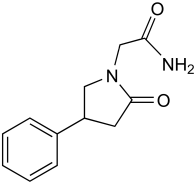
What if add methylendioxy-group to the 2-(4-phenyl-2-oxopyrrolidin-1-yl)acetamide mol.? Or maybe attach methyl group in to the 4-th position of benzol-ring? Carphedon has some slight stimulating properties, I wonder if this actions would increase them, or add some more serotoninergic activity 8)
Carphedon.gif
 
What was the reason dopamine and ephedrine can't cross the BBB? I say pour some acetic anhydride on them to give reverse acetate esters. Like the reverse estered methylphenidate phacetoperane. On ephedrine this would give methyl-amphenidate (somebody invented it in one of the earlier posts). Good chance I'm completely wrong though, I'm not a chemist.


--> Yes (Methyl-)AmphPhenidate it was my idea. :-)


I'm not a chemist, too - however I know enough in order to do some synthesis.

BTW: I've just cooked such a Methamphenidate-like ester of pseudoephedrine ('cuz I had no ephedrine at home) and acetic acid. Since synth. discussions are not being desired I just say: http://en.wikipedia.org/wiki/Fischer_esterification

Although I think Ephedrine acetate would be by far better I'm glad to report the following result:

10mg: Nice Methylphenidate-like mental stimulation but with less side effects and unfortunately very short duration (~15m).

Do you think that derivatives of pseudoephedrine (except meth.) are comonly significant worse than those of Ephedrine (wich seems likely to me)? I did that so-called "cold cat" methcathinone synthesis several times and although the product produced comparable effects to Methcathinone (from other sources) but weaker and they were also very short acting.
 
Status
Not open for further replies.
Top