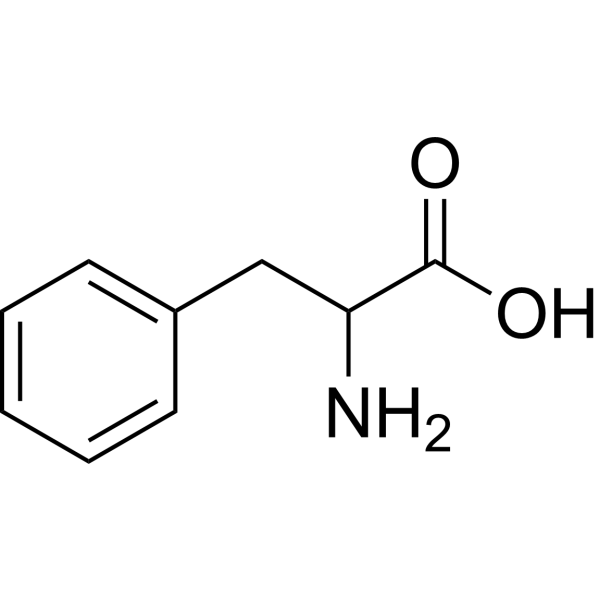
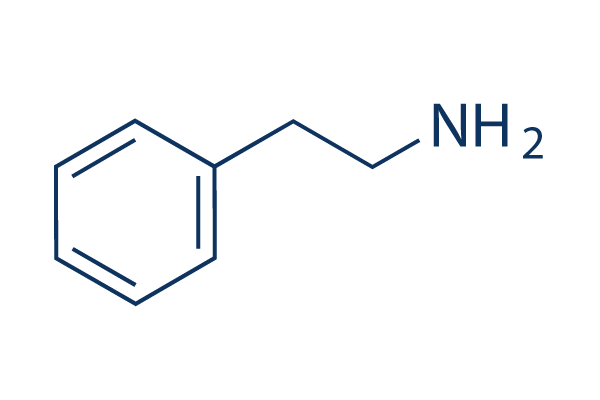
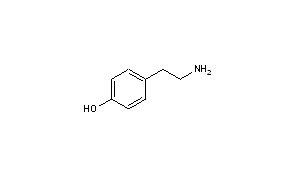
I went deep diving on Phenylalinine and PEA
(edit in progress trying get structures in here)
Phenylalanine
PEA
I looked at the carboxyl substituent on phenylalinine -COOH and was like start here deep dive
Phenylalanine-to-Phenethylamine (PEA): Research Summary
1. Thermal Decarboxylation of L-Phenylalanine
1.1. Reaction overview
Thermal decarboxylation is the conversion of L-phenylalanine into phenethylamine (PEA) through the removal of a carboxyl group as carbon dioxide.
The desired product is 2-phenylethylamine, commonly called phenethylamine or PEA.
However, heating phenylalanine can produce several products through competing reaction pathways. Consequently, the formation of PEA does not necessarily mean it will be the only, or even the predominant, product under every set of conditions.
1.2. Relevant research
Study 1: Chen et al. (2014)
Hydrothermal reaction of phenylalanine as a model compound of algal protein
Source: ScienceDirect
This study investigated the hydrothermal decomposition of phenylalanine at elevated temperatures.
Key findings:
- PEA was identified as a major product at temperatures of approximately 220–280°C.
- Conversion was very low at 130–190°C under the conditions investigated.
- HCN formation
- Styrene formation increased at higher temperatures and with longer reaction times.
Significance: The study establishes that phenylalanine can form PEA through thermal treatment, while also demonstrating that temperature and reaction duration influence product distribution. However, HCN and Styrene are enough to toxify you and more than enough reasons to not muck this up
Study 2: Changi, Zhu, and Savage (2012)
Hydrothermal kinetics and pathways of phenylalanine
Source: DOI: 10.1002/cssc.201200146
This study examined phenylalanine conversion in high-temperature water.
Key findings:
- Experiments investigated temperatures of 220, 250, 280, and 350°C.
- PEA was identified as a major product.
- Styrene and phenylethanols were among the secondary products.
- Added salts increased phenylalanine conversion but decreased PEA yield under the conditions studied, indicating that increased overall conversion does not necessarily improve selectivity for PEA.
Significance: The work highlights the importance of distinguishing between substrate conversion, product yield, and selectivity. These measures are not interchangeable.
Study 3: Aspin et al. (2025)
Survivability and pathways of amino acids in oceanic hydrothermal systems: A mechanistic study of phenylalanine
Source: ScienceDirect
This study investigated phenylalanine degradation and its reaction pathways under hydrothermal conditions.
Key findings:
- Solution pH affected phenylalanine degradation.
- Strongly acidic and strongly alkaline conditions inhibited degradation under the conditions examined.
- PEA could undergo further reactions, including deamination.
Significance: PEA may be an intermediate in a broader reaction network. Its formation and subsequent degradation both influence the final product composition.
1.3. Interpretation of the thermal research
Taken together, these studies establish that thermal treatment can convert phenylalanine into PEA. They also demonstrate several important limitations:
- Competing reactions: Other products may form alongside PEA.
- Further degradation: PEA itself may react further under sufficiently severe conditions.
- Condition sensitivity: Temperature, reaction time, pH, and solution composition affect the observed product distribution.
- Experimental context: The cited research investigates hydrothermal conditions, so its results should not automatically be extrapolated to other heating environments.
It is therefore important to evaluate a thermal process by measuring not only phenylalanine conversion but also PEA yield, selectivity, and final purity.
2. Enzymatic Decarboxylation of L-Phenylalanine
2.1. Reaction overview
The enzymatic route uses a decarboxylase enzyme to catalyze the conversion of L-phenylalanine into PEA and carbon dioxide.
The enzyme is known as L-phenylalanine decarboxylase, classified as EC 4.1.1.53.
Enzymatic catalysis offers a fundamentally different approach from thermal treatment: instead of relying primarily on heat to drive a complex network of reactions, it uses a biological catalyst to facilitate a particular chemical transformation.
2.2. Enzyme and cofactor
L-phenylalanine decarboxylase is the relevant enzyme class for this transformation.
Some amino-acid decarboxylases are pyridoxal-5′-phosphate (PLP)-dependent. PLP is the active coenzyme form of vitamin B6 and participates in the catalytic mechanism of many amino-acid decarboxylation reactions.
However, the cofactor requirements must be verified for the specific enzyme preparation rather than assumed from the general enzyme class.
Authoritative enzyme reference:
- IUBMB Enzyme Nomenclature: EC 4.1.1.53
2.3. Potential enzyme source
Creative Enzymes lists information on L-phenylalanine decarboxylase associated with Streptococcus faecalis.
Reference: Creative Enzymes — L-Phenylalanine Decarboxylase
This listing provides a potential starting point for sourcing an enzyme. However, commercial availability alone does not establish that a preparation is suitable for a particular application.
Before selecting a preparation, confirm:
- Whether the enzyme is currently available.
- Whether its identity and catalytic activity have been experimentally verified.
- Whether it accepts L-phenylalanine as a substrate under the intended conditions.
- Whether it requires PLP or another cofactor.
- Its stability, purity, and storage requirements.
- Whether the supplier provides activity measurements and relevant characterization data.
2.4. Interpretation of the enzymatic route
The enzymatic approach has several potential advantages:
- Catalytic specificity: An appropriate enzyme may favor the desired decarboxylation reaction over competing transformations.
- Milder operating conditions: Enzymatic reactions can often proceed without the extreme temperatures used in hydrothermal studies.
- Potentially improved selectivity: A suitable enzyme may reduce the formation of unwanted thermal degradation products.
- Biocatalytic process development: Enzyme activity, stability, and selectivity can be evaluated independently to determine whether the catalyst is appropriate for the intended application.
Nevertheless, these are potential advantages, not guaranteed outcomes. The actual performance depends on the specific enzyme, its preparation, reaction environment, and substrate compatibility.
In particular, an enzyme listing or enzyme classification is not sufficient evidence that a commercially available preparation will produce a high PEA yield.
3. Comparison of the Two Methods
Characteristic Thermal decarboxylation Enzymatic decarboxylation
Basic principle Heat-driven chemical conversion Enzyme-catalyzed chemical conversion
Starting material L-phenylalanine L-phenylalanine
Desired product Phenethylamine (PEA) Phenethylamine (PEA)
Byproduct of decarboxylation Carbon dioxide Carbon dioxide
Conditions demonstrated in the cited research High-temperature hydrothermal environments Dependent on the selected enzyme
Reaction specificity Competing rnx pathway can produce other compounds Potentially high, depending on enzyme specificity
Important complications Secondary reactions, degradation, and changes in product distribution Enzyme stability, substrate compatibility, and cofactor requirements
Key performance measurements Conversion, PEA yield, selectivity, and product purity Enzyme activity, conversion, PEA yield, selectivity, and product purity
Main research question:
How does the reaction environment affect PEA formation and subsequent degradation?
Can an appropriate enzyme catalyze the reaction efficiently and selectively? - yes this is proven
4. Overall Conclusion
Both thermal and enzymatic decarboxylation provide scientifically established routes for investigating the conversion of L-phenylalanine into phenethylamine.
The thermal route is supported by hydrothermal studies that identify PEA as a major reaction product under certain conditions. However, these studies also demonstrate competing reactions and subsequent degradation, meaning that PEA production must be assessed in the context of the full reaction network.
The enzymatic route offers a potentially more selective alternative. Its feasibility depends on identifying an enzyme with verified activity toward L-phenylalanine and establishing its catalytic performance, cofactor requirements, stability, and product selectivity.
The central distinction is that thermal treatment relies on the overall chemistry of a heated reaction system, whereas enzymatic treatment relies on the catalytic properties of a particular biological molecule.
The cited thermal studies establish PEA formation under their tested conditions, but the degradation byproducts are toxic
Meanwhile, still deep diving (I always appraoch these synthesis with mindstate can i avoid catalyst metal and high pressures)
The 2025 research hydrothermal process still had a silica tube vial SEALED