• N&PD Moderators: Skorpio

Ringed Mescaline Analogue/Chemical Masturbation Thread

Morninggloryseed

Bluelight Crew
Joined
Aug 22, 2000
Messages
13,770
Location
Semi Retired
I was going to write this in the dragonfly, 7-x-tryptamine thread...but didn't want to go too O.T. Then I came up with the idea of having a thread that is off-topic by nature. So the tread asks that you post about chemicals that you feel would be worthy of receptor study/animal discrimination tests...and what about them makes you excited.

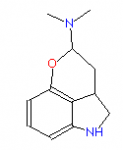
I've been very fascinated with this (seemingly) overlooked puppy.

RM.bmp


It is stated to have 5X the potency of the parent molecule. If that is the case, then certainly substituting a Br or Cl would result in an even more potent compound. Then I got the idea or moving one of the MeOs to replicate the TMA/TMA-2 relationship.

ringed%20mesc%20analogues.bmp


I did a good search but can find no mention of these other compounds anywhere....I guess they have not been investigated.

Do you guys think my reasoning is correct, and that C and D may be a nice place to investigate? How about making a double bond on the indene ring (1-(5,6,7-trimethoxy-1H-inden-3-yl)methanamine) to replicate LSD's double bond? I'm surprised more people have not masturbated to this family.

Link to paper: http://pdf-library.radio879.com/PDF...g a Homology Model of the 5-HT2A Receptor.pdf
 
Last edited:

psychedelics only? I was drawing some structures that (hopefully) will be active psychedelics with depressant rather than stimulant activity. But they're probably just depressants. Hard to say without any testing done, I suppose.
 
3-(2,3,4-trimethoxyphenyl)propionic acid is pretty well available I think. Hmm.
 
Theyre very similar to some Nichols made in J Med Chem 2006 5794. It has benzocyclobutane / pentane analogs of 2CB and some other wierd tricyclic thing. The cyclobutane was a slightly more effective agonist while the others were way off from 2CB.

Just posted in the 7-x-tryptamine thread before i saw this, that if you cyclise the alpha methyl of DOM onto the six position of the ring the amine becomes locked in what must be the active conformation, since it cant move in LSD and LSD works! This looks to me like a better choice for a bicyclic analog.

edit: I didnt see the paper before, strange that the mescaline cyclopentane analog is more potent than mescaline while the 2cb analog is much less potent. I suppose theyre not really mesc or 2cb any more but 2 (or 6)-alkyl-...
 
Last edited:
what about a simple Oxygen replacement of the Nitrogen in the indole in LSD...
 

Attachments

  • ON-LSD.gif
    ON-LSD.gif
    5.5 KB · Views: 175
Also does anyone know if any research or SAR has been done of the part of LSD which doesn't fit in to the B-dragonfly area?

Could it somehow be incorporated in to a more simpler PEA?
 

Attachments

  • LSD-SAR.gif
    LSD-SAR.gif
    5.6 KB · Views: 194
I'm beginning to doubt that the phenylrings in Mescaline and LSD are in the same place as the molecules dock into 5HT2A. the model the paper shows the mescaline molecule docked perpendicular to the orientation in which the LSD molecule is shown to bind in various pictures found on the internet.

exploring beta-phenyl/benzyl/phenylethyl/(1/2/…-indolyl)/(1/2/…-indolylmethyl)/(1/2/…-indolylethyl) substituted mescaline would be interesting. (i'm not sure about the nomenclature of the indolylcompounds at the moment but i think you can get what i'm trying to say). if any of these are active one could say a lot about how tryptamines and phenethylamines are related…


somewhat unrelated but most likely quite active would be a molecule like the following. the demethylated analogues could also be interesting to look at, to see in how far methylgroups are necessary and if the aminogroup in tryptamines is related to the aminogroup in phenethylamines… (please excuse my bad english)

(damn these java drawing applets suck)
 

Attachments

  • molecule.png
    molecule.png
    1.6 KB · Views: 130
Reminisant B said:
Also does anyone know if any research or SAR has been done of the part of LSD which doesn't fit in to the B-dragonfly area?

Could it somehow be incorporated in to a more simpler PEA?

that compound might be pretty interesting as a hemi-fly.
 
Reminisant B said:
what about a simple Oxygen replacement of the Nitrogen in the indole in LSD...

At first I thought "nehhhhhh", replacing an indole moiety with a benzofuran will render a compound toxic or inactive, but then I remembered that bromo-dragonfly incorporates the same structure.
The first question would probably be: are chemically simpler compounds than LSD, like DMT active when you replace the nitrogen atom? I'm really curious about all sorts of benzofurans since they are the basis of a 'hybrid' between PEAs and tryptamines. Currently known to man, LSD is of course the ultimate hybrid and not surprisingly considered one of the richest, most broadest experiences. Which probably has something to do with receptor promiscuity due to the 'hybrid' structure.
Has there been research about all the stuff in between DMT and the parent dragonfly compound?
Or a more general question: is there no development whatsoever on this terrain? And if there is, where would I find everything there is to know about psychedelics and chemistry?

Edit: Shit I see know the link with dragonfly structures has already been laid hehe.

Edit 2: In PIHKAL there's benzofuran PEAs mentioned without any effects, although I think the orientation is wrong when you consider either dragonfly or LSD. The substances I'm referring to are F-2 and F-22, with the basis called just F.
 
Last edited:
I remember posting about benzofurans as direct tryptamine mimics (replacing N in tryptamine with O)

I can't remember the exact answer and can't find post but I think F&B filled in some blanks - they were far less potent. [Hopefully I have remember this correctly]

As LSD is so potent itself the benzofuran might still be active at reasonable doses. [?]

Synthesis might be rather complex though.
 
Last edited:
Black said:
I'm beginning to doubt that the phenylrings in Mescaline and LSD are in the same place as the molecules dock into 5HT2A. the model the paper shows the mescaline molecule docked perpendicular to the orientation in which the LSD molecule is shown to bind in various pictures found on the internet.

exploring beta-phenyl/benzyl/phenylethyl/(1/2/…-indolyl)/(1/2/…-indolylmethyl)/(1/2/…-indolylethyl) substituted mescaline would be interesting. (i'm not sure about the nomenclature of the indolylcompounds at the moment but i think you can get what i'm trying to say). if any of these are active one could say a lot about how tryptamines and phenethylamines are related…


somewhat unrelated but most likely quite active would be a molecule like the following. the demethylated analogues could also be interesting to look at, to see in how far methylgroups are necessary and if the aminogroup in tryptamines is related to the aminogroup in phenethylamines… (please excuse my bad english)

(damn these java drawing applets suck)

b-meo-dmt and bk-dmt would be cool

i wanna c lsd without all the rings

what does it do when you add amino acids to the n of indoles?
 
IGNVS said:
b-meo-dmt and bk-dmt would be cool

i wanna c lsd without all the rings

what does it do when you add amino acids to the n of indoles?

I suspect it would make it impossible to fit in the designated receptors...
There is always a way it approaches and locks in, you can mess around with the other side to change the conformation and electronic charge to modulate receptor affinities - but sticking something as bulky as amino acids even will probably cause (way to much) steric hindrance. Correct me if I'm wrong...
 
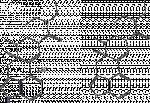
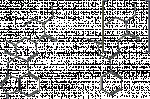
As mentioned before, I am working on an index of known psychedelic structures. I would be grateful if anyone could contribute or add anything I have left. This is in no way authoritative...obviously with the entactogens I left many out.....but in general...am I missing anything??????

I am grateful for any input. My eventual goal is to have something like this....

http://www.isomerdesign.com/Cdsa/scheduleUN.php?schedule=2&section=4&structure=C

Here is what I have so far.


BFA.bmp


IA.bmp


PEAs.bmp


MDPEAs.bmp


As mentioned, I am not yet trying to include every individual known molecule... but rather I am trying to make sure I have each general 'class' of compound. It is both an exercise in chemistry, as well as nomenclature. We call mescaline-like compounds "phenethylamines" and the dragonfly compounds, 'benzodifuranamines"...but we also call mescaline-like compounds, 'phenalkylamines' and benzeneethylamines. Any better suggestions? I like short and tidy, (i.e. let's call the dragonfly group benzofuranalkylamine instead of benzodihydrofuranylalkylamine and mescaline-like groups the phenethylamines instead of phenylalkylamines." What looks best to you?

Yes, very obsessive...but this will come in handy for people like me who get turned on by moloecules.

I am open to any help people would care to give. :)
 
Last edited:
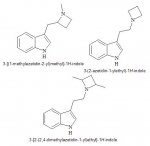
maybe active, but i wouldnt touch them considering the similarity with PYR-T and tihkals comments on it and its 4-HO and 5-MeO couterparts.
sorry beeing not able to contribute to this thread atm, too much basics to learn and therefore no time playing with chemdraw.
 
The azetidine functional group is quite different than the pyrrolidine ring. And it has been proven to work well on the N,N -dialkylamide function on lysergamides. But I hear you about concern...however, the first shown (3-[2-(1-methylazetidin-2-yl)ethyl]-1H-indole) is a true cyclic analogue of a,n-DMT and/or MET...and will probably be more close in action to the Nichols potent indoles (oxygenated tryptamines as he called them in his paper) than the 'pry-t' analogues which do sound quite scary.
 
I don't know why i'm thinking this, but wasn't there something about the pyr-T's to indicate opioid activity? starts digging..
 
The azetidine functional group is quite different than the pyrrolidine ring. And it has been proven to work well on the N,N -dialkylamide function on lysergamides.

Thing is, where azetidine works as a lysergamide is completely different to the amine at the end of the indoleethyl chain. The amide group is a totally different beast to the amine of tryptamines (corresponding to the nitrogen at position 6 of the LSD structure). Lysergic acid pyrrolamide & lysergic acid morpholide are active & similar to LSD, the main difference being the difference in potency. This contrasts starkly to the open chain & heterocyclic amine derivastives of tryptamine. In that case, cyclicization results in a very unpleasant intoxication and I suspect that it would hold true for tryptamines using any cyclicized/heterocyclic amine group such as morpholine & azetidine


I'm beginning to doubt that the phenylrings in Mescaline and LSD are in the same place as the molecules dock into 5HT2A. the model the paper shows the mescaline molecule docked perpendicular to the orientation in which the LSD molecule is shown to bind in various pictures found on the internet.

Which paper? In any case, mescaline is not a good example re: binding orientation as the 3,4,5-trimethoxy groups create steric hinderance due to their closeness, which probably requires the mescaline molecule to do some twisting to fit the 5HT2a receptor - and accounts for it's piss poor potency in comparison to the 4-x-2,5-dimethoxyPEAs - it's the steric hinderance of the adjacent methoxy groups that also makes it pretty invunerable to monoamine oxidase - if you consider what happens when you move one of the methoxy groups by one position (2,4,5-trimethoxyphenethylamine), you get a compound that is chewed up by MAO & never even makes it to the receptor. When both substitution patterns are encountered on a compound that isn't vunerable to MAO (the substituted amphetamines), this slight change results in almost an order of magnitude of difference in affinities. Even other groups substituted into the 3,4 & 5 positions still result in compounds of a low potency and 'unusual' pharmacological profile (eg MMDA, DESOXY), probably due in a fair degree to the bulky groups preventing the aromatic ring taking up the same orientation as it does with LSD

In any case, the orientation of the LSD molecule to the receptor is the one that gives the highest affinity & the more planar the molecule, the higher the affinity (hence DOB-dragonfly having a higher affinity than DOB-fly as the aromatic furan rings are in the same plane as the benzene ring. Remove the 9,10 double bond by saturation and you abolish activity - to me this happens because it abolishes the conjugated double bond system that continues all the way to the carbonyl group of the amide (the carbonyl group can undergo tautomerism in a manner analogous to keto-enol groups), which provides a rigid 'backbone', which is in the same plane as the aromatic indole rings due to the conjugation. This backbone ensures that the C & D rings are held much closer to the aromatic plane and confers the high affinity seen with not just LSD, but other amide nitrogen substituted lysergic acid amides
 
Top