• N&PD Moderators: Skorpio

🌟🌟 Social 🌟🌟 Rectify's molecular poetry thread

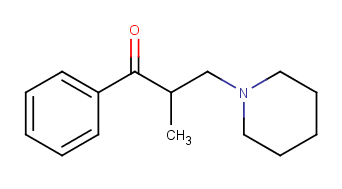
roi posted about this and explicitly specifies the chemical name.
I've not found much on it except dose/ROA/duration guidelines and roi's post. It's listed on pubchem here.

WiY2DNd.png


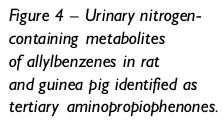
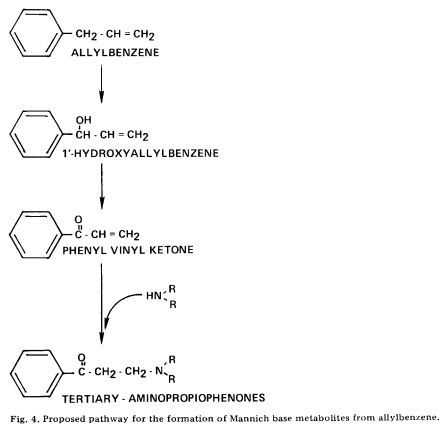
It's also reminiscent of these safrole metabolites:
allylsaf.png
allylconv-text.png


It Looks Like An Opioid To Me.
 
Your agent is Perisone in the above list and is a muscle relaxant not a psychostimulant

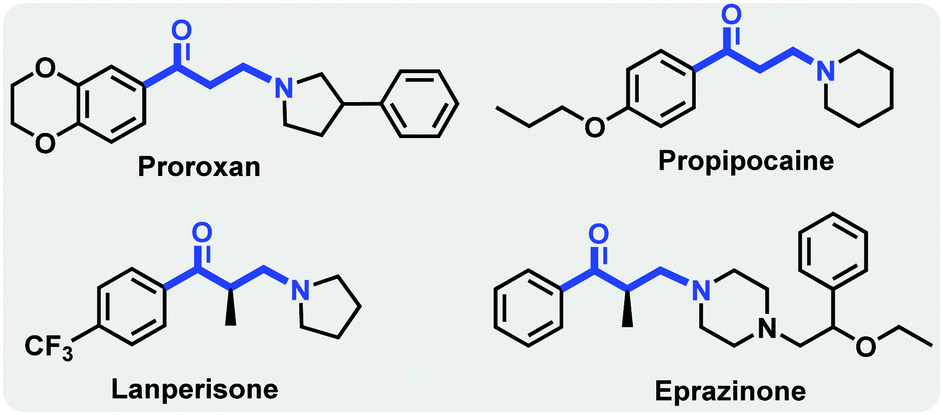
Interesting, I did not come across the name Perisone when looking up that structure. Well, it's very similar to the other *perisone muscle relaxants. Presumably @roi interpreted it as a stimulant based on its structure. I posted some related structures here.

d2cc00169a-f1_hi-res.gif

- Proroxan, non-selective alpha-blocker (α-adrenoreceptor antagonist)
- Propipocaine, local anaesthetic
 
Last edited:
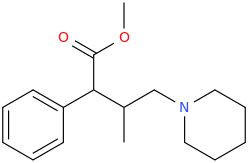
Whatever Class Of Drugs I Am Not 100% Certain, But I Bet This Next One Gets You HIGH. (And Even More If You Slap On A 3,4-methylenedioxy Functional Group!!)

1-phenyl-1-carbomethoxy-2-methyl-3-(1-piperidinyl)propane.png


CASEY
1-phenyl-1-carbomethoxy-2-methyl-3-(1-piperidinyl)propane
 
Yes, looking back on it now I think I was the first person to name your compound Perisone as it is not called this in the official registry.

You did some compelling SAR analysis with other seemingly unrelated chemical drugs.

My acetophenone folder only contains one agent called Pipoctanone which is similar in structure to Propipocaine but is in a different folder since it was mapped according to muscle relaxants in that particular folder.

I have a Mannich folder in my local anesthetics folder though which contains some interesting agents. For example, Digammacaine is made from Perisone proper.

Dyclonine, Propanocaine.
 
Last edited:

But metabolism matters.

There are other papers but they all use animal models and one thing we know is that human metabolism can be quite different. I'm sure as kids we all had it drummed into us that chocolate is toxic to dogs. I haven't investigated the details on the basis that I don't own a dog nor consume chocolate, but I guess it's the example we are all familiar with. Although if someone does know, it would be interesting if only for elucidating the metabolic differences in that case.

But IS there a safe level for epoxides within the human body? The only medicines I could find that actually features an epoxide moiety were cancer medications.
 
"Snakebite spitting spiders eyes
They swallowed up the night
Cried "meltdown zero marsh of lava"
Had supersonic sight
And barriers of you and me piled 1500 high
Stacked here to here in smoking cans
We blackened out the sky
King met king we heard the bell
They kicked away the board
Flew headfirst into bunkers
Then they started out once more
And you and me were born again
As iron-plated pawns
We scorched our way through libraries
We shredded all the lawns
Til everything was rust and powder
Every stone was turned
And random programs re-arranged the areas to burn
The enemy's years ahead
He's tapped into the phone
He hides beneath the furniture
Knows all the special codes
The enemy's our destiny
He's pulling on the cord
He spits a line I spastic dive
And sell him his reward
I perform." - Krishna #4
 
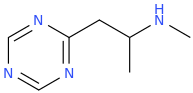
1-(2,4,6-triazaphenyl)-2-methylaminopropane.png


HARRY
1-(2,4,6-triazaphenyl)-2-methylaminopropane

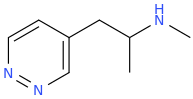
1-(3,4-diazaphenyl)-2-methylaminopropane.png


WILLIAM
1-(3,4-diazaphenyl)-2-methylaminopropane
 
You mention epoxide but those papers propose this route:

image.png


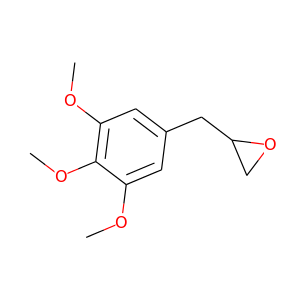
This would be the epoxide for elemicin:

image.png
 
Last edited:

As we see, some propenyl benzense s are converted into propenylbenzenes, which as the old papers suggest but the more recent ones conform.. That's why I asked if there was a safe level known;. I'm pretty sure you derailed a thread on kratom but I hope you read it all because I made what is a generally agreed fact that genetic differences between ethnic groups can alter metabolism hugely. so you need to be carefuly relying on animal models which I think I did point out at that juncture.

Again, the paper limits itself to animal models because the toxicity of both ring-substituted allylbenzenes and ring-substituted propenylbenzenes are both known or believed to be toxic. Not ACUTE toxicity. I'm pretty sure the whole point of those cancer medications was to keep the patient alive. But chronic toxicity is a fer more insidious effect. +

Metabolism is complex and working on the basis 'safe until proven otherwise isn't a good way to proceed. By all means consume as much of whatever you choose - that is your rights. But don't assert safety on the basis of old papers when new papers exist. There are DOZENS of them.
 
Last edited:
I know a few oxirane drugs that are not used to treat cancer. For example, Clomoxir & Etomoxir.

Then there is also NCO 700 (see here) & Palmoxiric acid.

These drugs are Antidiabetic hypoglycaemics and also NCO 700 has some alternative uses.

BADGE is a crazy drug but it looks like some nasty stuff that you would want to avoid it.
 
I know a few oxirane drugs that are not used to treat cancer. For example, Clomoxir & Etomoxir.

Then there is also NCO 700 (see here) & Palmoxiric acid.

These drugs are Antidiabetic hypoglycaemics and also NCO 700 has some alternative uses.

BADGE is a crazy drug but it looks like some nasty stuff that you would want to avoid it.

Well the candidate medicine made it to human trials...twenty five years ago and disappeared. If you know why it REALLY failed to obtain a GSL, I would love to know.

But note that it was intened to treat congestive heart failure and like cancer medications, if the best outcome is to prescribe even a toxic drug, it's acceptable. It is now what I guess would be termed am 'orphan drug' but I note it's only being considered for other diseases that will almost certainly be fatal. That cancers are one appplication seems to suggest that yes, it does alkylate, but if it gives someone an extra few uears of life, it's worth the risk.

So yeah, we DO use medicines we know to be toxic, but only when the outcomes are worse if someone doesn't recieve tratment.

But I still see no rational use-case for things were know to be toxic UNLESS they improve outcomes.

Epoxy resins have been around for decades and are treated with extreme caution. I've only worked with them once and my goodness, the safery measures were pretty strict. Ask a boat builder...
 
Last edited:
That's why I asked if there was a safe level known;. I'm pretty sure you derailed a thread on kratom but I hope you read it all because I made what is a generally agreed fact that genetic differences between ethnic groups can alter metabolism hugely.

I did read it and do agree that genetic differences will influence metabolism. I was pointing out that dietary aspects will also influence metabolism (albeit temporarily) enough to influence drug metabolism.

Apart from nutmeg the most common allylbenzene source is probably basil (estragole). I think I read a paper claiming a safe level of pesto per day. In other cultures the ingredients for a Chai drink include milk boiled with cloves, nutmeg, mace - all high allylbenzene spices (with black pepper, cardamom, cinnamon, star anise). This mix is reminiscent of the 1991 Space paste recipe from erowid used for psychoactive purposes.
 
I know a few oxirane drugs that are not used to treat cancer. For example, Clomoxir & Etomoxir.

Then there is also NCO 700 (see here) & Palmoxiric acid.

These drugs are Antidiabetic hypoglycaemics and also NCO 700 has some alternative uses.

BADGE is a crazy drug but it looks like some nasty stuff that you would want to avoid it.

FYI that's a glycidate ester, not an epoxide. I think it well worth reading the chemisties of both,
 
This mix is reminiscent of the 1991 Space paste recipe from erowid used for psychoactive purposes.

Yes, but you appear to mistake science as a set of facts when it's a PROCESS. I'm old enough to have worked with certain ring-substituted allylbenzenes but even then, we still performed the work in a fume-cupboard because the risk was known but not quantified. The University of Sydney studied over 4400 poisonings poisonings in man.


Sadly what the papers (because it's always important to check citations) don't tell us is what ethnicity of the victims was (political correctness gone mad) and people will tend to use the essential oils that are available to them. But the fact that the rate of poisonings was increasing should be a concern.


A mixture of in vivo and in vitro modeling.


Note that epoxide is only mentioned once in the above paper.


Note that it's only mentioned twice in the above paper. But I think the key points to note are that terminal alkene moieties turn up in some unepected places. As with all things, it's the dose that makes the poison be it acute or chronic.

That's why Skorpio was happy to say he had actually tasted an essential oil on one occassion because I suggest he knows that it's chronic toxicity that is the real problem. I could go on as there really are dozens of papers if you simply use Google Scholar.

I'm sort of dubious of the International Journal of Aromatherapy article because it's classed as a predatory journal i.e. 'pay to publish'. there is no conflict of interest mentioned and you will notice how old the references are. I'm also troubled by the fact that it doesn't follow the accepted format of academic papers nor does it test hypotheses, it simply assumes them to be factual. I agree that it most certainly IS dose dependent, but do you want to take the risk?

Oh, and finally the author has no appropriate academic qualifications and his business is SELLING essential oils - which I would consider a pretty hefty conflict of interest.

I don't know if things have changed but thirty years ago several works by the philosopher Karl Popper were required reading for individuals persuing post graduate education. I think the key takeaway is that whatever hypothesis a researcher seeks to prove, it's only able to prove a hypothesis to be wrong. The best a proven hypothesis can provide is a weight of evidence. So do you want some more weight of evidence? Because there is a lot of it and more will emerge, I'm sure.

BTW I can well imagine why traditional medicines used essential oils. I'm pretty sure that they are quite capable of killing certain bacterial infections, as an example. But it's not as if pharmacutical companies didn't investigate traditional remedies and in some cases it's led to some quite spectacular advances, But they are also VERY careful of not ending up at the end of a class action lawsuit for damages.

I think I already mentioned that the COX-2 inhibitors arrived with great fanfair only to be withdrawn from the market some years later. Go through all the medicines that have been withdrawn from the market BEFORE the FDA or anyone else flagged an issue. This is because we now have what is termed 'stage 4 trials' AKA pharmcovigilance i.e. even when a medicine gets a GSL, the makers still have to keep tabs on outcomes. I was prescribed a COX-2 inhibitor for a week but I suppose the doctor considered a 7 day course offered more benefits than risks.

So as I asked before, what are the use cases? How much are people consuming? How are they consuming them? Because risk is a sliding scale but your use case has to justify the risks or uninformed people will be harmed, which is contrary to the Bluelight goal of harm reduction. I've always maintained that all adults should have the choice to imbibe any compound they choose as long as it's an informed choice.

 
Last edited:
I agree that it most certainly IS dose dependent, but do you want to take the risk?

Sure, I was just pointing out commom dietary sources of concentrated allylbenzenes. This paper does a risk assessment for dutch pesto.
The worldwide consumption of pesto has increased due to recent interest in Mediterranean cuisine, which is considered to be healthy and valuable.
...
In 1999, the Committee of Experts on Flavoring Substances of the Council of Europe concluded that methyleugenol is a naturally-occurring genotoxic carcinogenic compound with a DNA-binding potency similar to that of safrole.

A re-evaluation of the mainstream cancer doctrine might be worth considering.

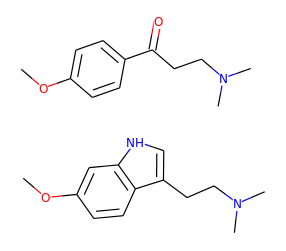
I don't plan on using these oils. I'm mainly interested in the active metabolite(s) and how they might be formed. On that note, here's an estragole metabolite (as per Oswald) compared to 6-methoxy-DMT. I wonder what the 3D overlay looks like.

image.png


1'-oxoestragole-dimethylamine = CN(C)CCC(=O)C1=CC=C(C=C1)OC
6-meo-DMT = CN(C)CCC1=CNC2=C1C=CC(=C2)OC
 
Last edited:
Top