• N&PD Moderators: Skorpio

Question about codeine > morphine metabolization

Mr Blonde

Bluelighter
Joined
Oct 1, 2006
Messages
13,811
Location
Brisbane, Australia
Hey, this may seem like a stupid question but I'm only new to neuropharmacology and the organic chem behind how my favorite chemicals work, I'd just like this cleared up though...

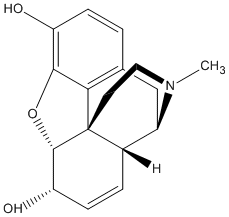
Codeine
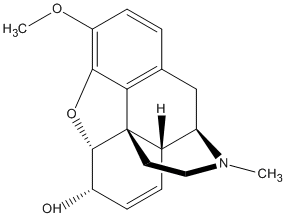
Codeine.gif


Morphine
Morphine.gif


Ok...so codeine has to be O-demethylated (have the methyl group removed from the oxygen) to morphine, and I know this occurs in the liver. The enzyme responsible is CYP2D6.

However, during this process, does the CYP2D6 enzyme also alter that amine group to the position it takes on the morphine diagram? Does the wedge bonded hydrogen also move? Or do these not really matter in terms of the morphine molecule fitting into the opiate receptor?

Also, if anyone can explain it, how does that extra methyl group allow codeine to be a full opiate receptor agonist but have a very weak affinity for the receptor?

 
Hehe, that's just the way they've been drawn - confusing, I know. That amine bridge is the same spatial orientation on both... if it wasn't, it'd have been drawn as a hashed line, not a wedge.
As for it's affinity, i'm not sure of codeine's in-vivo activity where demethylation does not occur. I believe it is active but very low affinity.
Anyway, that 3 position hydroxyl being methylated will block it's ability to bond to the necessary amino acid residue and cause the conformational change into the active state... it changes the polarity heaps. The 3 position hydroxyl is the one essential to activity... you can methylate the 6 position hydroxyl and it doesn't matter... or replace it with another group like a ketone (the -one's) or a methylene group (increases potency lots!).
 
Last edited:
So...really they are both depicting the same version of that amine bridge?

Damn, lol...well that makes a lot more sense now. So I could draw morphine with the amine placed like on the codeine?

What about that hydrogen on a wedged bond? Is that also in the same position, just drawn differently?
 
Correct, the actual angle of the lines means nothing, the shading/wedging of the lines is what actually shows the stereochemistry.
Yes, you could draw it the same way. It's up to personal preference, how you draw the bridge. Personally, I like the way it's drawn on the codeine molecule image you posted, it's more representative of the actual conformation of the bridge afaik.
Oh and Mr Blonde i've edited my first post to include brief info on binding. (just in case you missed it :))
 
Thanks for the reply, Matt Psy...I think I also prefer the way it is drawn on the codeine molecule, I'll use that in future!

I'm interested in what you said about the de-methylated 3-position oxygen being needed to bind to amino acid at the opiate receptor sites...do you have any references or websites I can look at to learn more about how actual binding occurs at the receptors?

McWally, I drew those two images as practice in ChemDraw, basing them on how they appear on Wikipedia...and yes, it is very misleading! lol :)

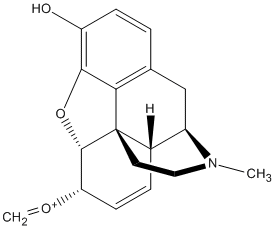
ETA: Matt, would this be the potentiated methylene morphine you mentioned?

MethyleneMorphine.gif
 
Last edited:
Close but no cigar. Oxygen's not invited to the party at -6 anymore - get rid of him. The CH2 (methylene) is directly doublebonded to that six-membered ring.

When you say you'd like to learn more about ligand-receptor binding, do you mean in general or specific to opioids? I can't really help if you mean the latter, I don't have many papers on opioids, nor do I know much about their pharmacology... yet! (i've been meaning to put some time toward it soon)
 
Damn...OK well I'll fix it up on my computer then!

As for ligands and their receptors...just in general at first, but opioids are my favorite so once I get the basics I'll probably put some effort into focusing on them.
 
Wiki says its the CYP3A4 enzyme thats responsible for the production of norcodeine (N-demethylated)
 
Yeah, but norcodeine is not recreational. CYP2D6 demethylates at the oxygen, which creates morphine.

I don't have to tell you the recreational value in that, right? =D

Basically, 10% of the codeine ingested should be converted to morphine, and the rest metabolized to nocodeine and other useless metabolites.

However, in a certain % of white people, their livers lack CYP2D6 so they won't get morphine...some have stronger enzymes so they will produce a higher % of morphine...and so on.
 
Back in the 70s, the famous 'fours and dors' was the way to go. Doriden (glutethimide, a sedative/hypnotic) increased the rate at which codeine-> morphine because it's an enzyme inducer. 4s were tylanol number 4 (is that 30mg codeine + 500mg APAP?). Doriden is no longer around, but para amino glutethimide is still used in medicine and the sandimayer reaction will snap off the amino. If you could find another enzyme inducer, better still.
Oh, for Europeans, dihydrocodeine is the thing, since reflux in 15%HBr in GAA removes the ether producing dihydromorphine in 97% yield...
 
Yah, not that it's hard to make DHC from codeine anyway though : > .
 
Mr Blonde said:
Yeah, but norcodeine is not recreational. CYP2D6 demethylates at the oxygen, which creates morphine.

I don't have to tell you the recreational value in that, right? =D

Basically, 10% of the codeine ingested should be converted to morphine, and the rest metabolized to nocodeine and other useless metabolites.

However, in a certain % of white people, their livers lack CYP2D6 so they won't get morphine...some have stronger enzymes so they will produce a higher % of morphine...and so on.

Strangely enough, norcodeine can substitute for Morphine, and at much lower doses than required for codeine. A study showed that 940mg of norcodeine (oral) effectively suppressed abstinence symptoms from 230mg morphine.SO4 (oral).

I don't know if there is much (if any) buzz from norcodeine though.
 
Top