Mr Blonde
Bluelighter
Hey, this may seem like a stupid question but I'm only new to neuropharmacology and the organic chem behind how my favorite chemicals work, I'd just like this cleared up though...
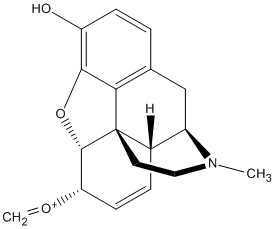
Codeine
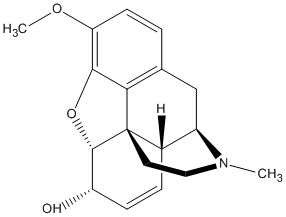
Morphine
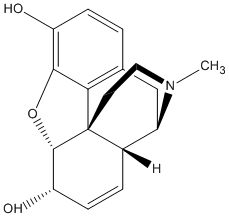
Ok...so codeine has to be O-demethylated (have the methyl group removed from the oxygen) to morphine, and I know this occurs in the liver. The enzyme responsible is CYP2D6.
However, during this process, does the CYP2D6 enzyme also alter that amine group to the position it takes on the morphine diagram? Does the wedge bonded hydrogen also move? Or do these not really matter in terms of the morphine molecule fitting into the opiate receptor?
Also, if anyone can explain it, how does that extra methyl group allow codeine to be a full opiate receptor agonist but have a very weak affinity for the receptor?
Codeine
Morphine
Ok...so codeine has to be O-demethylated (have the methyl group removed from the oxygen) to morphine, and I know this occurs in the liver. The enzyme responsible is CYP2D6.
However, during this process, does the CYP2D6 enzyme also alter that amine group to the position it takes on the morphine diagram? Does the wedge bonded hydrogen also move? Or do these not really matter in terms of the morphine molecule fitting into the opiate receptor?
Also, if anyone can explain it, how does that extra methyl group allow codeine to be a full opiate receptor agonist but have a very weak affinity for the receptor?