



-
Neuroscience & Pharmacology Discussion Welcome Guest
Posting Rules Bluelight Rules Recent Journal Articles Chemistry Mega-Thread FREE Chemistry Databases! Self-Education Guide -
N&PD Moderators: Skorpio
You are using an out of date browser. It may not display this or other websites correctly.
You should upgrade or use an alternative browser.Purpose of delta FOSB
- Thread starter Neuroprotection
- Start date


Neuroprotection
Bluelighter
- Joined
- Apr 18, 2015
- Messages
- 1,265
According to some studies, Delta FOSB levels in the hippocampus can be increased by seizures and can lead to cognitive impairment by dramatically decreasing/Blocking calcium entry through AMPA receptors. this decreases efficiency of LTP needed for new memory formation. interestingly, these same properties of Delta FOSB actually protect hippocampal neurons against seizure induced cell death as well as reducing the likelihood of future seizures.Neuroprotection
Bluelighter
- Joined
- Apr 18, 2015
- Messages
- 1,265
Here’s something very interesting about Delta FOSB and its relevance to behaviour. In mice overexpressing Delta FOSB in the nucleus accumbens, very low doses of cocaine produced powerful rewarding and locomotor stimulating effects, Yet such doses didn’t affect wild-type mice. furthermore, Delta FOSB Overexpressing mice paradoxically self administered less cocaine than wild-type mice. I was a bit surprised by this at first, but on second glance, it actually makes a lot of sense. given that Delta FOSB so dramatically enhances reward sensitivity, mice over expressing it probably need far less cocaine to reach euphoria and feel satisfied. it should also be noted that since Delta FOSB very strongly protects against depression, stress/despair and anhedonia, mice with high levels of it might already be in an enhanced state of well-being intern decreasing their desirability or at least need for cocaine.
With all this in mind and much more I’ve heard, i’ve come to this conclusion. of course,
Delta FOSB makes the addictive drug/habit more rewarding while simultaneously suppressing the fear/Perception of risk regarding that behaviour. however, I believe the major problem with Delta FOSB is that it maintains reward sensitivity for the addictive agent/behaviour. unlike negative reinforcement factors like depression, stress and anxiety which pushe The abstinent person back to addiction, my theory is that Delta FOSB acts as a pull factor. through positive reinforcement E.g. euphoria/Well-being, it makes the relapse feel very rewarding and entices the recovering addict back to the habit.Neuroprotection
Bluelighter
- Joined
- Apr 18, 2015
- Messages
- 1,265
That first paper only increased it in certain circuits via cre + floxed viruses. I think it would be quite a bad thing to globally induce deltsfosb.
Yes, of course I wouldn’t intend to do that and that would be very difficult anyway. my hope is that it can be increased specifically in the nucleus accumbens via Transcranial magnetic stimulation. I know animal studies don’t always correlate with the human experience, but I think The impact of Delta FOSB over expression in the nucleus accumbens is pretty clear and consistent. of course, assuming I am correct, we do have to consider The impact of reward supersensitivity and stress resilience along with decreased risk perception on complex human behaviours and interactions. for people like me, I believe such a treatment would be very beneficial, yet for others it could lead them down a path of destructive behaviours.
Do you have any opinions on my conclusions? could I be looking a bit too deep into things?Neuroprotection
Bluelighter
- Joined
- Apr 18, 2015
- Messages
- 1,265
For any cannabis lovers out there, this article give some good reasons why you should love Delta FOSB
Delta FosB and AP-1-mediated transcription modulate cannabinoid CB1 receptor signaling and desensitization in striatal and limbic brain regions - PMC
Repeated Δ9-tetrahydrocannabinol (THC) administration produces cannabinoid type 1 receptor (CB1R) desensitization and downregulation, as well as tolerance to its in vivo pharmacological effects. However, the magnitude of CB1R desensitization varies ... www.ncbi.nlm.nih.gov
Sensitization to rewards is not a good thing. It is pretty inseperable to the processes of addiction. This is not something you would want to induce to get out of anhedonia (where you would want to strengthen circuits related to rewards that are sustainable, rather than all rewards).For any cannabis lovers out there, this article give some good reasons why you should love Delta FOSB
Delta FosB and AP-1-mediated transcription modulate cannabinoid CB1 receptor signaling and desensitization in striatal and limbic brain regions - PMC
Repeated Δ9-tetrahydrocannabinol (THC) administration produces cannabinoid type 1 receptor (CB1R) desensitization and downregulation, as well as tolerance to its in vivo pharmacological effects. However, the magnitude of CB1R desensitization varies ...
www.ncbi.nlm.nih.gov
I guess where I feel you are off base is that you keep talking about it at global/anatomy based levels, which will sensitize you to both positive and negative rewards.
Honestly, you keep saying you want to increase deltafosb through these different mechanisms, just do rewarding things such as exercise and it will increase modestly (and in circuits regarding beneficial things).Neuroprotection
Bluelighter
- Joined
- Apr 18, 2015
- Messages
- 1,265
Sensitization to rewards is not a good thing. It is pretty inseperable to the processes of addiction. This is not something you would want to induce to get out of anhedonia (where you would want to strengthen circuits related to rewards that are sustainable, rather than all rewards).
I guess where I feel you are off base is that you keep talking about it at global/anatomy based levels, which will sensitize you to both positive and negative rewards.
Honestly, you keep saying you want to increase deltafosb through these different mechanisms, just do rewarding things such as exercise and it will increase modestly (and in circuits regarding beneficial things).
Sorry about that, I guess you’re right. I was just fascinated bye it’s because of its dual reward enhancing and stress resilience properties. i’ve always been fascinated by anything that can improve well-being but as you said, good old methods like exercise are probably the best available. I don’t know if there are serious ethical issues, but I’ve noticed the medical and scientific field including psychiatry seem very disinterested in developing a sustainable mood enhancer and they generally view things like euphoria as a side-effect. I found something similar on Reddit, where one user complained that too much focus was being placed on sustainable cognitive enhancement drugs rather than well-being enhancers. they claim that when they used Nootropics, they noticed cognitive benefits but had low mood and no motivation if I remember correctly. However, when they discontinued Nootropics and switched to the MAOI Meclobamide, there was no cognitive enhancement to speak of, yet they were motivated and able to get large amounts of work done.Neuroprotection
Bluelighter
- Joined
- Apr 18, 2015
- Messages
- 1,265
Sorry, not trying to push the Delta FOSB idea any further, I fully understand your opinions on that. I remember you saying you had some knowledge on AMPA receptor function and phosphorylation. A lot of information is available about AMPA receptor subunits, but most is focused on GLUR1 which is understandable. Just wondered if you knew anything about GLUR2 and whether anyone has considered modulating it. it is one of the most prominent targets of Delta FOSB and usually renders AMPA receptors impermeable to calcium. unlike elevated GLUR1 levels which enhances memory and opposes nucleus accumbens acute reward sensitivity, elevated GLUR2 does the opposite and enhances acute reward sensitivity. AMPA receptors in addiction is a complex issue, but there are some surprising results. Apparently, The calcium permeable GLUR2 lacking AMPA receptors, which definitely contribute to anhedonia and depression might simultaneously assist with extinction of drug cravings. i’m wondering if under certain circumstances and in certain individuals, this could decrease the purported value of the drug and help them make the decision to quit. This isn’t my own theory, but something I’ve read online. on the other hand, from what I’ve read, I believe calcium impermeable AMPA receptors favour synaptic stability and in the nucleus accumbens enhanced reward sensitivity. while this can suppress escalation of drug intake, at least in animal studies, over expression of GLUR2 just like overexpression of Delta FOSB leads to decreased drug intake with cocaine self administration but much more frequent relapse and making it difficult if not impossible to extinguish drug use.
Maybe this is one of the problems with long-term chemical well-being enhancement, but hopefully we will find ways to manage this.Neuroprotection
Bluelighter
- Joined
- Apr 18, 2015
- Messages
- 1,265
Just a quick update on my thoughts on this protein and what I found out recently. Delta FOSB accumulation in the striatum is believed to be involved in the levodopa induced dyskinesia which is quite interesting. however, I think what really makes Delta FOSB unusual and remarkable is it’s ability to sensitise specific components downstream of dopamine receptors and the neurons that express them. it’s unusual because One would expect a transcription factor with that Long half life to be promoting tolerance, Not boosting reward sensitivity. furthermore, it might not just be dopamine action which is boosted. Delta FOSB enhances the immediate rewarding effects of morphine and enhances self administration in animals, but simultaneously intensifies physical withdrawal, an effect attributed to down regulation of The endogenous Kappa opioid agonist Dynnorphin. Delta FOSB May also be involved in the precipitation of chronic pain via the same mechanism, while simultaneously bolstering resilience to psychological stress including the ability to deal with that pain. this indicates that two completely separate forms of pain exist, physical and emotional, with these commonly overlapping and co-occurring but being highly separable and frequently occurring alone. in my opinion, psychological pain/suffering is often far more devastating and future research should focus on targeting it directly.Neuroprotection
Bluelighter
- Joined
- Apr 18, 2015
- Messages
- 1,265
The role of Delta FOSB in behaviour outside the addictive drug context is very interesting. it’s especially relevant to depression and anhedonia, which seem to be related, generally co-occurring but separable conditions. this article compared the effects of striatal overexpression of Delta FOSB with high-dose ketamine on their ability to reverse social avoidance behaviour and anhedonia in rats after chronic social defeat stress. The results were surprising. both Delta FOSB Overexpression and high-dose ketamine could prevent or reverse social avoidance behaviour. however, ketamine was unable to reverse anhedonia, whilst overexpression of Delta FOSB was able to do so.
Neuroprotection
Bluelighter
- Joined
- Apr 18, 2015
- Messages
- 1,265
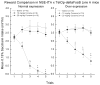
just as I thought it couldn’t get any better, I find this Study about Delta FOSB. when overexpressed in the brains of mice or rats, it blocks the ability of cocaine to suppress conditioned saccharine intake. suppression of saccharine intake by cocaine is thought to occur due to reward comparison phenomena. This is where the brain devalues natural rewards like sweet taste or social interaction as it perceives drug reward to be much better. The authors initially thought Delta FOSB was at the heart of this given its well-known role in addiction, but they wanted to prove it by overexpressing it in the brain of animals. unexpectedly, they found that Delta FOSB Overexpression stopped cocaine from suppressing saccharine intake, something they attributed to strong magnification of natural reward bye Delta FOSB. in my opinion, this means that whilst Delta FOSB is a key part of the addiction process, it might also play a very important protective Roll in keeping the ability to desire, pursue and respond to/experience natural rewards. that’s not to mention its other amazing functions, like ruthlessly suppressing The accursed state of anhedonia, suppressing aversion to risk and risk perception and strongly boosting stress resilience.
Overexpression of DeltaFosB is associated with attenuated cocaine induced suppression of saccharin intake in mice. (2009) - Your Brain On Porn
FULL STUDY Behav Neurosci. 2009 Apr;123(2):397-407. Freet CS, Steffen C, Nestler EJ, Grigson PS. Source Department of Neural and Behavioral Sciences, Pennsylvania State University College of Medicine, Hershey, PA 17033, USA. [email protected] Abstract Rodents suppress intake of saccharin when it is... www.yourbrainonporn.com
Neuroprotection
Bluelighter
- Joined
- Apr 18, 2015
- Messages
- 1,265
Here’s the study I couldn’t find earlier about the protective effects of Delta FOSB in epilepsy. it builds up in response to repeated seizures and is shown to contribute to some cognitive/memory impairments. these impairments are most likely because Delta FOSB Decreases hippocampus neuronal excitability, but the study I will link here suggests that this mechanism is actually neuroprotective and prevents further neuron damage and perhaps seizure propagation.

Frontiers | ΔFosB is part of a homeostatic mechanism that protects the epileptic brain from further deterioration
Activity induced transcription factor ΔFosB plays a key role in different CNS disorders including epilepsy, Alzheimer’s disease, and addiction. Recent findin... www.frontiersin.org
Neuroprotection
Bluelighter
- Joined
- Apr 18, 2015
- Messages
- 1,265

Reduced ΔFosB expression in the rat nucleus accumbens has causal role in the neuropathic pain phenotype
The neuropathic pain phenotype is the consequence of functional and morphological reorganization of the PNS and CNS. This reorganization includes DRGs and the spinal cord, and extends to multiple supraspinal areas including the limbic and reward systems. ... www.ncbi.nlm.nih.gov
Neuroprotection
Bluelighter
- Joined
- Apr 18, 2015
- Messages
- 1,265
I got so nostalgic looking through this thread. TS2000 16 - 2020 were honestly some of the best of my life.
What I found amazing is how much I’ve learnt and how my opinions have drastically changed over the years on certain topics, yet how little I’ve matured according to some of my family members.
I remember hating Delta FOSB when I first started this thread because I thought its main function was tolerance and depression induction. then I came to forget about it for a few years but when I re-stumbled upon it in 2023, I learned that it was a inducer of stress resilience and reward sensitiser so I came to absolutely love it.
If you’ve seen some of my other threads, you might notice I also hated GSK3 and some protein phosphatases because I wrongly thought they were inherently and inseparably linked to neuron damage/death. what annoyed me even more is that these proteins vital for mood regulation, reward functioning, prevention of unnecessary/harmful memory formation and powerful protection against seizures. I didn’t like that such potentially dangerous enzymes could have such amazing effects which exclusively relied on their function, something that made inhibiting them counter-productive and activating them very dangerous. thankfully, in 2023 I discovered that the mood regulating effects of GSK3 Beta comes directly from its kinase function, where as the proapoptotic effect requires it to travel to the nucleus and might rely more on the body/structure of the enzyme rather than the actual enzymatic activity.
Furthermore, both GSK3 and protein phosphatases ultimately rely on mitochondrial proapoptotic proteins like BAX, BAD and BIM etc. without these, protein phosphatases and GSK3 would actually promote cell survival and stress resistance.
Just wondered if anyone else has had drastic shifts of opinion on any scientific or drug related topic over the years.
Sometimes I wish I knew then what I know now although some people do say that knowledge comes to us only when we’re ready for it.Neuroprotection
Bluelighter
- Joined
- Apr 18, 2015
- Messages
- 1,265
i’ve looked through quite a few Delta FOSB Overexpression animal studies but compared to manipulations on other proteins, they seem to be quite rare and only test for very limited things. I think it would be interesting to overexpress Delta FOSB in the reward circuits of primates rather than just rodents, and then observe their behaviours over their entire lifespan. it would be particularly interesting to see how the stress resilience aspect translates into behaviour.
