• Psychedelic Drugs Welcome Guest
    View threads about
    Posting RulesBluelight Rules
    PD's Best Threads Index
    Social ThreadSupport Bluelight
    Psychedelic Beginner's FAQ
  • PD Moderators: Esperighanto | JackARoe |

psychedelics allow you to see wavelengths of light not visible to the normal brain?

I'm not sure about being able to see other wavelengths (or that there'd be anything worth seeing in there anyway), though in the case of sound, the ear can physically only hear up to a surprisingly low frequency (2KHz?) and the higher frequencies are detected/created in the brain with clever processing/analysis (like stereo perception); maybe an analogous post-proccessing can happen with light frequencies (seems unlikely that this ability would only show up when we take psychedelics though)

however, if sticking to 'pothead theories', there's all sorts of wacky properties of the light in itself that you could imagine might have an impact on different mindstates.

Eg Richard Feynman used to talk about there only being one photon: because it's at the speed of light, infinite time dilation means it would touch every time and every point in the universe, hence a single photon (i think he said this was just a way of thinking about it rather than a physical reality, but the idea remains... (especially in a pothead theory)). Maybe you can tap into the photon's reality in some way and get new information while in non-ordinary mindstates; or maybe almost, but not quite tapping into this causes distortion effects we see as pretty colours and such
 
Answering this question requires an understanding of how color vision works. The part of the human eye that catches light is called the retina. On the retina are two types of cells that respond to light, "rod" cells and "cone" cells. The rod cells are highly sensitive but do not distinguish colors, so they are responsible for colorless night-vision. The cone cells need more light to work, but they allow us to see in color.

The human eye contains three types of cone cells: "S" for "short wavelength," "M" for "medium wavelength," and "L" for "long wavelength." As their names imply, each type responds to a different wavelength of light. The human-visible light spectrum is the 400 nanometer to 700 nm range. Light in the 400-450 nm range activates "S" cones strongly while activating the "M" and "L" cones little or not at all. The brain interprets that signal as "blue" or "violet." In the 450 to 500 range, the "S" and "M" cones respond strongly while the "L" cones do not, so our brain interprets these wavelengths as "cyan" or "green." By moving up the spectrum we can find the rest of the visible colors.

You might be interested to know that your computer screen only has three colors on it, ever. The screen is covered with tiny red, green, and blue lights. It uses the fact that our eyes only really "see" those three colors, and tricks our brains into thinking that more colors are there. Wherever your screen is white, thats where the red,green, and blue lights are all on (when all three cone types are activated, our brain sees "white"). Wherever it is yellow, that's where the red and green lights are on(when "M" and "L" are both activated, "yellow"). In the BL logo, just the blue lights are on (with a tiny bit of red and green, giving "light blue").

So the question is, can psychedelic drugs change the wavelengths that cone cells respond to? The answer is no, and the reason lies in an even deeper understanding of how they work. Each cone cell has pigment molecules on its surface that react when they're hit with a certain wavelength of light, in fact the main difference between the three cone cell types is that each uses a slightly different pigment molecule. In order for our eyes to "register" infra-red light, some cone cells would have to switch to a different pigment. I've seen a dubious theory that this can accomplished by adopting a certain diet, but that such a change would be caused by PD's is extremely unlikely.

We can't see UV light because the lens of the eye blocks it (well, most of it). The reason it's blocked is because UV light causes damage to rod and cone cells - that's why you shouldn't stare at the sun.

IMHO, it's much more likely that the changes in color perception caused by PD's are caused by changes in the way that the brain interprets signals from cone cells, not by changes in the cone cells themselves.

 
vice versa
Right. Nevermind.
rgb_cmyk.png
 
there are some good ideas and explanations here.

As much as drugs can change the brain and all other processes going on in the body. I don't think it is completely out of line to think that drugs may cause a physiological change that somehow then lets light slightly outside of the visible wavelengths "register" or not be filtered out.

who has proof that the rods and cones are not limited to wavelength certain wavelengths during normal use, but a drug cannot possibly change this? if this is not possible, please tell me why? as in why the eye can only elicit a response from certain wavelengths and not others? it would seem that light with shorter wavelengths could just as easily if not better cause the olefin isomerizations that are responsible for ultimately being translated into a visible perception.

I thought that the cones of the eye could only be stimulated by light of specific wavelengths due to their own size/length. Humans are tri-chromatic, meaning we see only 3 discrete colours, because we have three different sized cone receptor cells. This is the most basic functioning of the eye really. No drug is going to be able to change that aspect of the physical eye anymore then a psychedelic could change the length of your fingers. No radio-labelled tests have ever found that psychedelics are entering the actual eye, so whilst we cannot be 100% certain, its probably fair to say that psychedelics and other drugs are not altering a physical structure; more so, they are altering the brains interpretation of data relayed through that physical structure.

However, read this little article- http://en.wikipedia.org/wiki/Tetrachromacy

I'm not sure about being able to see other wavelengths (or that there'd be anything worth seeing in there anyway), though in the case of sound, the ear can physically only hear up to a surprisingly low frequency (2KHz?) and the higher frequencies are detected/created in the brain with clever processing/analysis (like stereo perception); maybe an analogous post-proccessing can happen with light frequencies (seems unlikely that this ability would only show up when we take psychedelics though)

Do you have a source for this claim regarding the ear? I have studied audio engineering and have absolutely never heard this before.
 
Tetrachromancy is cray. I remember reading about that a while back.

I'm also curious about the 2KHz thing, I've been an audiogeek for ages and also never heard that. In fact, I'm certain that if I played a 5-15KHz tone in just one ear on some headphones that I would be able to hear it just fine, and roughly be able to identify the frequency, so I guess I don't believe it.
 
I think he meant 20hz when talking about the audible frequencies before ^, but i think we can hear as low as 15hz in total silence. 2khz is where vocals often sit. 5-15khz is mostly cymbals/percussion
 
^You are probably correct there, but even so, we can't actually hear over 20kHz (well, most of us) so the point is moot really. :)
 
. Each cone cell has pigment molecules on its surface that react when they're hit with a certain wavelength of light, in fact the main difference between the three cone cell types is that each uses a slightly different pigment molecule. In order for our eyes to "register" infra-red light, some cone cells would have to switch to a different pigment. I've seen a dubious theory that this can accomplished by adopting a certain diet, but that such a change would be caused by PD's is extremely unlikely.

.


this is the information i was looking for. I guess these pigment molecules can ONLY be activated by very specific wavelengths, other wavelengths do nothing to them. I was wondering if maybe non visible light has pigment molecules it activates in our eyes but some other process inhibits its eventual perception…this is where a drug could shake things up.

I'm no evolutionary biologist but Since we are related to animals and they can see other wavelengths, I was wondering if its possible that we just don't normally see these other types of light because of some inhibitory process, which snakes for example don't have going on and allows them to see other types of light that humans can't see.


i know this thread is very potheaded….i know its much more likely that a drug just fucks with your brain and the visuals are not light that is actually there just invisible, but its fun to think about.
 
Last edited:
I don't know a lot about this all from a jargon standpoint, but yes I think that some visuals may be more real, having read somewhere a theory that they open up visual filters. Sounds kind of like joe rogans "fart principle" tho lol..
 
TBH, your question is not as crazy as I first thought it was. The cones we have ARE capable of reading UV light, even though they're blocked from doing so by the lens. Some people who lack a lens can see UV light and they report it as a light bluish-purplish light.

Of course, some other animals do have pigments capable of picking up light of wavelengths longer than 700 nm (though they're far from covering the entire IR range) and human eyes may indeed contain vestigial amounts of those pigments. It's just that after all the evolution that has occurred, getting entire cells to switch over to producing and using those pigments would require a lot more genetic modification than a single dose of one PD is capable of.

Still, I think the fact that our brain invents millions of colors based on just those three wavelengths, and that drugs can influence that process, is a much more interesting phenomenon anyway!
 
one who looks to new world science for these answers are just gonna get confused with theory based on 3d principle and jargon
even if i come off a bit preachy the simple answer is yes! psychedelics open up light past the 7 spectrum's there are about 360-365 spectrums of light give or take a few but its the same as earths rotation 360 degrees but if you want a less metaphysical concrete way of saying this
just look at the snake and the deer the deer has no sclera its eyes are totally black no white it can pick up all spectrum's of light invisible in darkness!that's why we can feel things in the dark but are unable to see them thus causing us to use are imaginations its been said deers can see into other dimensions and disappear behind trees in the dark even if they are only a few yards away any one who lived in the woods could attest to this why do you think when deers cross the road they become deers stuck in the headlights cause bright artificial light causes there natural nightvision to short circuit now for the snake it sees in black and white and in heat vision this is why they where depicted more then any other creature in the ancient world they could sense energy where as a deer can only see all spectrum's in darkness the snake sees all colors invisible to the human eye but also the snake was cursed cause its doomed to slither against the earth too feed on beast and eggs since the snake is the most intelligent grounded animal its literally a natural circuit attuned to magnetism electricity energy and vision threw radiation a slithering spinal cord with a brain more adaptable then any creature on earth (naturally)hmmm yet its envious of mans beauty =p..... us as human beings share all these traits with all the animals we have a snake inside of us grounded threw the serpents temptation by ingesting the apple (psych) we can see are true potential could it be called cheating whos to say every spectrum of light a animal can see so can we i also believe human beings are the only creatures on 3d earth that can remain lucid astrally threw death any how as the childs soft spot hardens and 1 becomes I (ego) and gets bombarded with artificial light and vaccinated medicated tricked his pineal gland develops its veil and loses these gifts given by god in the womb we start out as a light code <platonic solid> in darkness are light expands
in the primordial waters <mothers womb> to all forms of nature from protozoa <sperm> to amphibious <tadpole> and so on in a 9 month cycle instead of 12 thus we are manmals ascending well im ranting sorry hope i helped some im just trying to explain things in metaphysical laymens terms and it seems like im ringing some bells this will be my last post i don't wanna stir the pot till it spills on me.

anyhow experience is the best teacher so you know what that means get your self some mirrors different colored stones gems a ankh compass etc and see what you can (See<--) but beware this is not fun and games and can have severe consequences on your psyche and spiritual well being that katy perry song dark horse tells you don't fuck around there are reasons secrets remain secrets
 
Last edited:
I just found this cool retro chart of cosmic vibrations.
NSFWd for size.

NSFW:
aekz7j5.jpg


Probably out-dated by several decades, but I thought it fit the discussion.

Interesting how there is a psychic blue in the solar spectrum part.
 
Do you have a source for this claim regarding the ear? I have studied audio engineering and have absolutely never heard this before.

I read it in a book called Designing Sound by Andy Farnell - excellent book on PureData, and pretty reliable on acoustics (i could probably dig it out to find his reference if you want). I might have got the number wrong (maybe it was 5KHz). I was really surprised when i read it either way as it's definitely 'hearable' frequencies.

It's to do with the cochlea and the way it detects frequency (the wave touches a different bit according to its wavelength as it curves round or something). But there is an upper physical limit to this due to the size of the cochlea. To get around this the brain takes multiple consecutive 'samples' and puts them together somehow to calculate the higher frequencies in the brain.

After remembering more about how the eye detects colour i'm not sure this analogy could hold with the current topic though (although many other amazing things are possible with post processing...)
 
Last edited:
There is some really bunk-ass crazy talk in here. Not talking about you ^ Vurtual, although I am skeptical. If you can dig up the reference I'd be interested to check it out.
 
The deer is missing the red-sensitive (long-wave) cone and UV blocking lens of our eye. Light passes through their retina twice using a reflective lens in the back of their eye, the tapetum. Their pupils are wider.

Pit vipers can see IR beyond what our own technology sees, in a range 8 times wider than our visible spectrum. They cannot move their eyes.

Because light is absorbed by atoms and released at a different frequency, undetectable UV light (black light) is transformed by certain objects' atomic structures into visible light. In essence florescence and, for longer periods of time, phosphorescence act as a third eye.
uv1.jpg

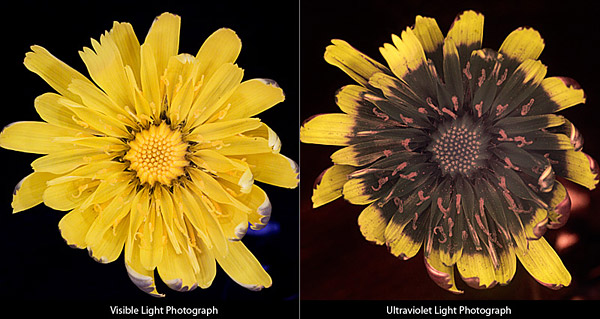
Flowers have abundantly dissimilar image patterns, co-evolving with pollinators sensing UV light.
 
Last edited:
Just looked at the book now and i got it confused and pretty much totally wrong (sorry (stupid brain)) - It's more to do with discrimination of frequencies, or frequency resolution than absolute detection of a frequency.

Frequency is detected by the position on the cochlea as i described, but this does go up to 20KHz (or whatever). However the resolution of this only allows 18,000 discrete frequencies (the number of hair positions on the cochlea). To increase the resolution it also takes timing information from the pulses on the cochlea - the highest firing rate of a neuron is thought to be 1 KHz but higher frequencies are detected by summing several neurons output later on (basically what i misremembered). The information from position on the cochlea and the timing of the firing is combined in the brain to give overall frequency perception.

So i was sort of right in that the perception of frequencies overall is largely down to post processing (but still totally wrong really)

//In other cosmic animal eye info: aren't frogs eyes really sensitive - so they can even detect individual photons (i read this so it's probably totally wrong ;)

///More cosmic animal eye news: The mantis shrimp has by far got the coolest eyes - they can detect the angle of polarisation of light among other things (but don't take my word for it - https://en.wikipedia.org/wiki/Mantis_shrimp#Eyes
They have 16 types of photoreceptor to our four (12 for colour, 4 for polarisation)
 
Last edited:
Top