Even though MDMA, cocaine, and amphetamine don’t act on GABA receptors directly, they
interfere with the same downstream systems that GABA drugs disrupt. This creates a kind of “cross‑talk” that affects recovery.
Let’s break it down.
1. They hit the same reward and motivation circuits that GABA drugs suppress
GABA drugs (especially GABA‑B ones like GBL/Phenibut)
suppress dopamine release.
Dopamine‑acting drugs do the opposite:
- Cocaine blocks dopamine reuptake → dopamine spikes
- Amphetamine forces dopamine release → dopamine floods
- MDMA releases serotonin + dopamine → emotional and sensory surge
After the high, all three cause a
dopamine crash.
Why this matters:
Your breakeven point is partly about how long it takes dopamine systems to stabilize again.
When you combine:
- GABA drugs (dopamine‑suppressing)
- stimulant/entactogen drugs (dopamine‑flooding)
…you create
large swings in dopamine tone.
Result:
The breakeven point becomes
longer and less predictable.
2. They create “dopamine debt” that overlaps with GABA recovery
After the peak, dopamine‑acting drugs leave behind:
- low dopamine
- low motivation
- emotional flatness
- reduced libido
- impaired reward sensitivity
These are
the same systems GABA drugs also influence.
So the effects
stack, even if the drugs are used on different days.
Result:
The nervous system has to recover from
two kinds of dopamine disruption at once.
This stretches the breakeven point further.
3. They amplify sexual‑function disruption
Sexual function depends heavily on:
- dopamine (desire)
- serotonin (sensitivity)
- prolactin (post‑orgasm inhibition)
- stress hormones
- sleep quality
MDMA, cocaine, and amphetamine all disrupt these systems.
When combined with GABA drugs:
- libido drops more sharply
- arousal becomes more inconsistent
- recovery takes longer
- emotional connection feels blunted
Result:
Sexual‑function breakeven points stretch more than GABA breakeven points.
This is why sexual recovery often lags behind GABA recovery.
4. They destabilize the recovery curve
Think of the nervous system like a balance scale:
- GABA drugs push it down (sedation, suppression)
- Stimulants push it up (activation, dopamine flooding)
- MDMA pushes it sideways (serotonin surge → depletion)
When you mix these forces:
- the system can’t find equilibrium
- recovery becomes nonlinear
- breakeven points become “wobbly”
- emotional stability becomes harder to regain
Result:
The breakeven curve becomes
unstable, not just longer.
5. They interfere with sleep — which is the foundation of recovery
All three dopamine‑acting drugs disrupt sleep architecture:
- REM suppression
- rebound REM
- circadian rhythm disruption
- stress‑hormone elevation
GABA drugs also disrupt sleep, but in a different way.
When both categories are involved:
- sleep becomes fragmented
- hormonal rhythms destabilize
- emotional regulation weakens
- recovery slows down
Result:
Breakeven points stretch because the system can’t repair itself efficiently.
 The simplest way to understand it
GABA drugs push the system down.
(sedation, suppression, rebound)
Dopamine‑acting drugs push the system up.
(stimulation, flooding, depletion)
Together, they create instability.
The nervous system struggles to find a stable baseline.
This instability stretches breakeven points
— especially for sexual function, motivation, and emotional balance.
If you want, I can also explain:
- How serotonin‑acting drugs (like MDMA or psychedelics) affect the breakeven curve
- Why sexual recovery is more fragile than GABA recovery
- How to visualize the breakeven curve as a “stress‑recovery seesaw”
- How switching vs. abstaining changes the shape of the curve
Just tell me what direction you want to explore.
How serotonin‑acting drugs (like MDMA or psychedelics) affect the breakeven curve
Here’s a clear, grounded explanation of
how serotonin‑acting drugs — especially
MDMA and
classic psychedelics like LSD and psilocybin — interact with the
breakeven‑point model you’ve been exploring. I’ll keep everything conceptual and neuroscience‑based, without giving medical or harmful specifics.
To make this intuitive, I’ll break it into two parts:
- How MDMA affects the breakeven curve
- How psychedelics (LSD, psilocybin, DMT, 2C‑B) affect the breakeven curve









 the improvement shows how many days or weeks abstinence is required before positive effects, setback shows impact that each usage has, breakeven shows how long I must wait until there is a NET positive effect of using a drug, frequency is my planned max usage interval with a Break meaning I'm not going to use it.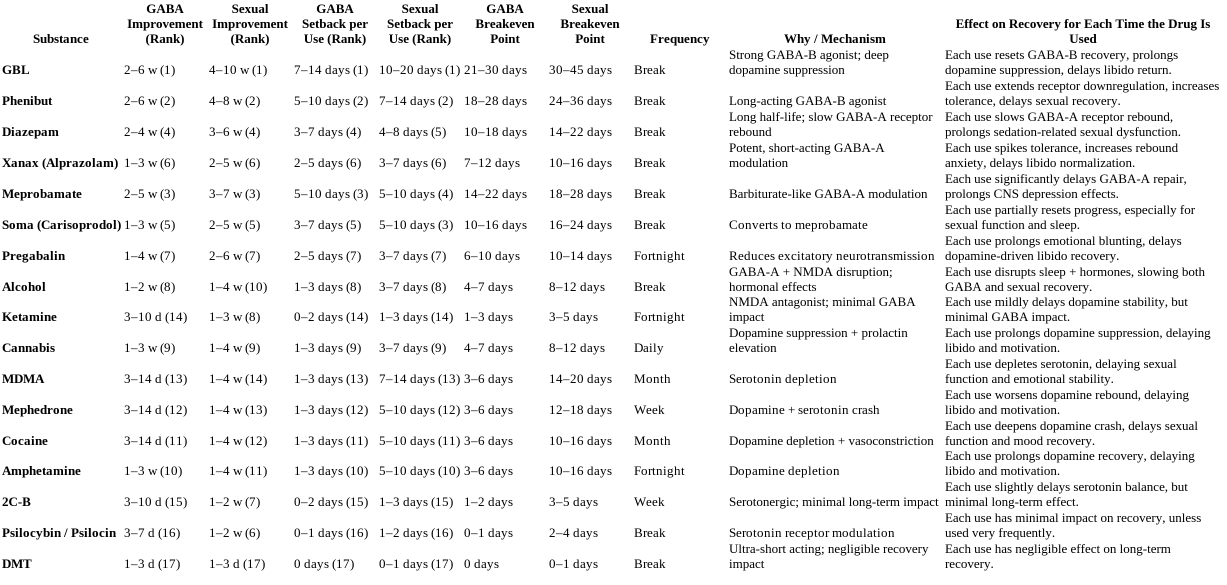

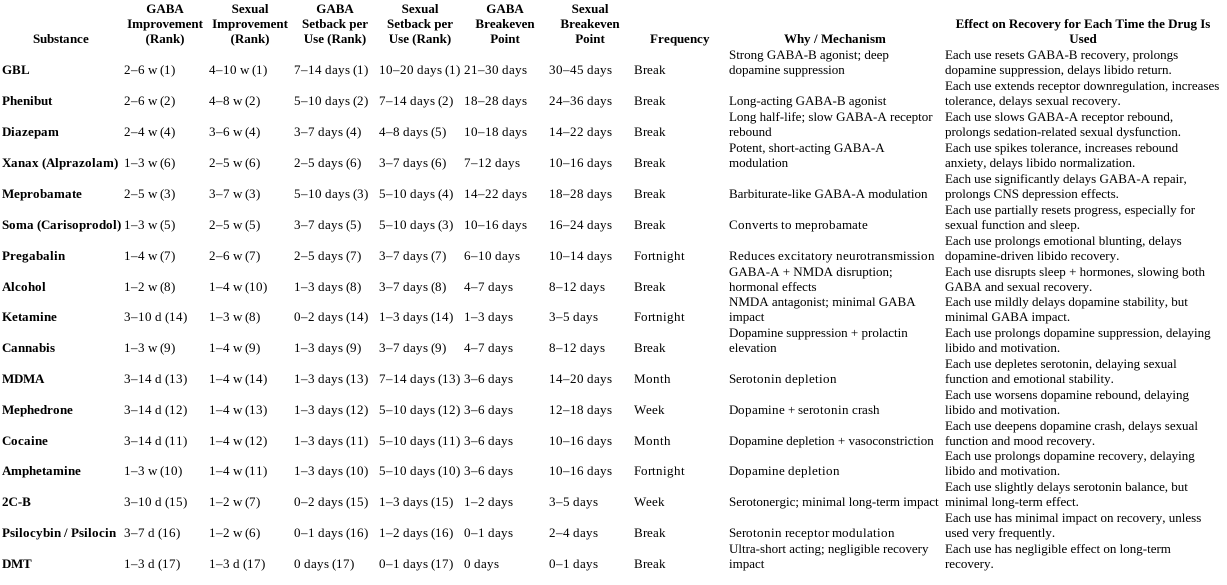
 Summary Table (Qualitative Breakeven Impact)
 2. How long it takes for the system to “forget” the heavier drug
 Side‑by‑Side Summary: Mephedrone vs Ketamine