• N&PD Moderators: Skorpio

Novel Putative Bicyclic Psychedelics?

Riemann Zeta

Bluelighter
Joined
Apr 21, 2004
Messages
1,655
Location
The Land of Wind and Ghosts
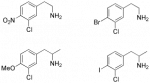
This is based largely on a paper that is in press in Bioorganic & Med. Chem. concerning benzazepine-based 5-HT2C agonists. A number of these compounds also seem to have a rather high affinity for the 5-HT2A receptor (although all possess a higher affinity for the 2C receptor). Here is a little table with the structures, 5-HT2A/5-HT2C receptor affinities (by radioligand binding) and overall efficacy (Emax). For comparison sake, I also listed two prototypical classic psychedelics (my personal faves) from Siegel, et al (1996). Would they make decent psychedelics despite their rather high 5-HT2C activity? Based upon what is known about the 5-HT2C receptor, they might be a little 'tweaky,' with anorectic and stimulant-type effects.

This also got me thinking about the proper phenethylamine and amphetamine analogues of these benzaz... chemicals. One does not usually see an active two-substituent phenethylamine (based on 3,4-DMA and 3,4-PEA), so I am not certain what to think. Could these big-ass substituents have large enough atomic/molecular orbital radii to give 5-HT2A agonist activity to a 3,4-amphetamine?
 

Attachments

  • Novel Bicyclic Psychedelic Design.png
    Novel Bicyclic Psychedelic Design.png
    8.4 KB · Views: 311
  • untitled.png
    untitled.png
    4.1 KB · Views: 250
Last edited:
Nice find, of the amphetamine analogs the p-MeO one is probably active, p-Hal amps are neurotoxic though aren't they?

Be interesting to see a 2C-B analog, or 2C-G for symmetry!
 
Yeah all the p-Hal amphets are neurotoxic other than p-F .

Maybe that ring provides the right conformational restriction to the amine for these weird substitution patterns to work :/ ? There's clearly more to the story though because of the selectivity for 2C shown.

Cool find, thanks :) !
 
I wouldn't touch para-fluoro, either, though. How would the benzazepines line up in 3D to the psychedelic PEAs? Be interesting to see how these would fit with FnB's pan-psychedelic theory.

Edit: They have the chloro in the same place bupropion does? That seems odd; looking for 5HT receptor agonism, I wouldn't look to bupropion-type substitutions. Why the halo at all, why not methoxy a la 2C-B and Mescaline?

I wonder if they tried more typical PEA substitutions.
 
Last edited:
Para-fluoro-amphetamine is supposedly quite sublime, but I as well would be sketched out by all of these heavy halogens--there is a difference between something that binds to a particularly fun set of receptors in vitro and a safe, non-toxic compound for humans.
 
I don't doubt that it's really fun, but aside from a single use (which is so not me!), I doubt that it isn't more toxic than MDMA and straight amphetamine.
 
What, para-fluoroamphetamine? In terms of MDMA-esque neurotoxicity, I would suspect that it is far more neurotoxic than regular amphetamine, but not quite as bad as MDMA itself. I say this because the sensitivity of the methylene bridge in MDMA lends itself to generation to 3,4-dihydro and hence quinone oxidation products. But this is just a theory, 4-FA could certainly be equal to MDMA.

Definately not something for frequent use as a psychostimulant, like amphetamine proper.
 
No, actually, as a theory it makes a lot of sense. I hadn't put as much thought into it as you obviously have. I hadn't really thought about metabolites, but considering them, I don't doubt that MDMA ends up being significantly more neurotoxic, especially in the long run.
 
There are some reports os 24 hour+ sickness with redosing 4-fa in doses over 100mg. Be careful with this one.
 
Riemann: Check this one out. It'll give you some additional information if you haven't read it.

J. Med. Chem., 2006, 49, 5794
 
I have a copy of that if anyone wants it, btw. They have a 7 sided ring as well, but without the amine. I haven't read through that paper yet, but I'd imagine that the tricyclic ones are active.
 
I have read the fused cyclobutene ring one.

There was some interest in it also from the boyz on S.M. concerning its synthesis.

Even though it is not permitted to discuss this here, that was the main stumbling block on these compounds.

Nobody is in any doubt that they possess an interesting pharmacological profile of activity.
 
Egor: I only have paper copy, sorry.

The benzocyclobutene one basically said that that kind of structure matched the active conformation. The N-benzyl one investigated SAR on those kind of structures and found some very potent compounds.

About the original topic. The ratios 5HT2A and 5HT2C are very different in the investigated compounds compared to LSD and DOI. What this means is out of my league. I'm pretty sure it means something significant though.
 
These 3-Benzazepines have huge potential as novel, non-analog psychedelics. You are just looking at the wrong substitution pattern. Arena Pharmaceuticals now has (1R)-8-Chloro-2,3,4,5-tetrahydro-1-methyl-1H-3-benzazepine (Lorcaserin) in clinical trials, at 10mg once or twice daily. It's a selective 5-HT2C agonist. But changing the substitution pattern a bit, you get compounds which are equally potent at 5-HT2C and 5-HT2A receptors and match the potency of Lorcaserin, so should be active as psychedelics at about 10mg. Btw, all PEA and tryptamine psychedelics are mixed 5-HT2A/C agonists.
 
Right. That is what I was thinking. Ratio of 5-HT2A/5-HT2C binding notwithstanding, with enough compound, one will hit both receptors. Thus, if one can tolerate the 5-HT2C agonist properties (which most psychedelics have anyway), the concentration required for 2A activity is only 2x-3x greater.

Of course, not all 5-HT2A agonists are ipso facto psychedelic--they seem to have to trigger the correct downstream cascade pathway in order to be psychically active. For example, I think that bromo-LSD is still a potent 5-HT2A/C agonist, but it is psychically inert.
 
when i saw..

That Shulgin reported that 3,4 dimethoxy PEA was inactive and noted a strange result, all i could think of is that it being a PEA is too closely related to Dopamine itself which is not penetrable to the BBB. Ther must be some transmembrane resistance to DA crossing as the only PEA that gets through to any extent is mescaline, and the relative amount needed is quite a large bit (in the 300-600 mg range. Amphetamines don't have this problem it seems. The 3-benzazepines might also have to have some kind of alpha methyl substitution, because they are only restricted conformational analogd to PEA's, Just because they exhibit potent receptor binding numbers , doesn't mean they will exhibit the same properties in-vivo.
 
Top