




Riemann Zeta
Bluelighter
This is based largely on a paper that is in press in Bioorganic & Med. Chem. concerning benzazepine-based 5-HT2C agonists. A number of these compounds also seem to have a rather high affinity for the 5-HT2A receptor (although all possess a higher affinity for the 2C receptor). Here is a little table with the structures, 5-HT2A/5-HT2C receptor affinities (by radioligand binding) and overall efficacy (Emax). For comparison sake, I also listed two prototypical classic psychedelics (my personal faves) from Siegel, et al (1996). Would they make decent psychedelics despite their rather high 5-HT2C activity? Based upon what is known about the 5-HT2C receptor, they might be a little 'tweaky,' with anorectic and stimulant-type effects.
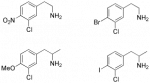
This also got me thinking about the proper phenethylamine and amphetamine analogues of these benzaz... chemicals. One does not usually see an active two-substituent phenethylamine (based on 3,4-DMA and 3,4-PEA), so I am not certain what to think. Could these big-ass substituents have large enough atomic/molecular orbital radii to give 5-HT2A agonist activity to a 3,4-amphetamine?
This also got me thinking about the proper phenethylamine and amphetamine analogues of these benzaz... chemicals. One does not usually see an active two-substituent phenethylamine (based on 3,4-DMA and 3,4-PEA), so I am not certain what to think. Could these big-ass substituents have large enough atomic/molecular orbital radii to give 5-HT2A agonist activity to a 3,4-amphetamine?
Attachments

Last edited:



 !
!


