Mesembryanthemum crystallinum L.
Common Ice Plant
Mesembryanthemum nodiflorum L.
Small Ice Plant
Introduction
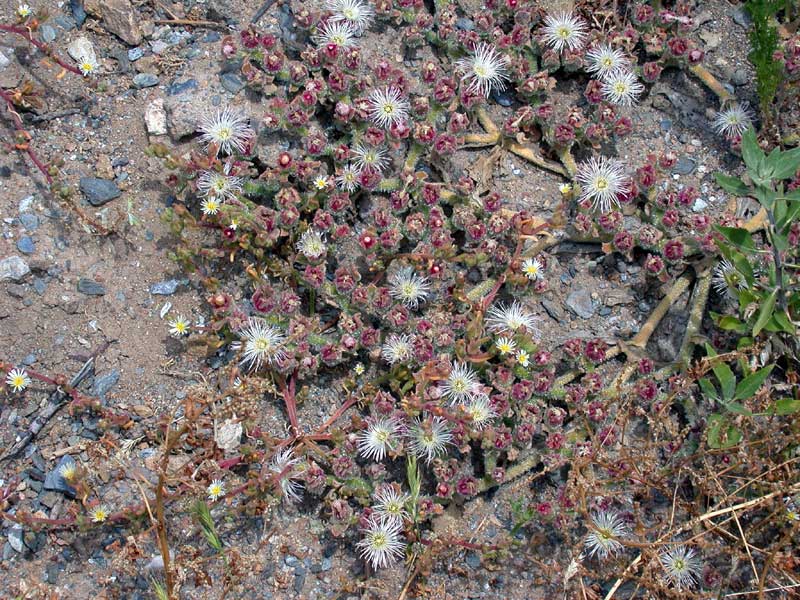
Mesembryanthemum crystallinum and M. nodiflorum are prostrate succulent herbs covered in large bladder cells, giving them a distinctive glistening appearance. Introduced from Europe and Africa, their unique physiology and ability to accumulate salt has enabled them to establish in disturbed and saline areas across southern Australia.
Taxonomy and Ecology
Classification
Family: Aizoaceae
Genus: Mesembryanthemum- c. 25 species, mostly in the northern hemisphere, but also southern Africa. Three species naturalised in Australia.
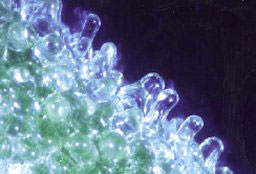
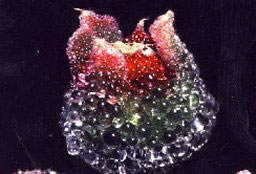
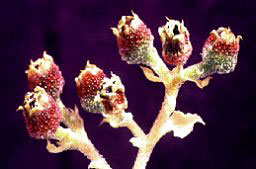
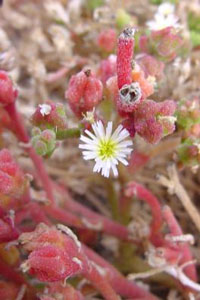
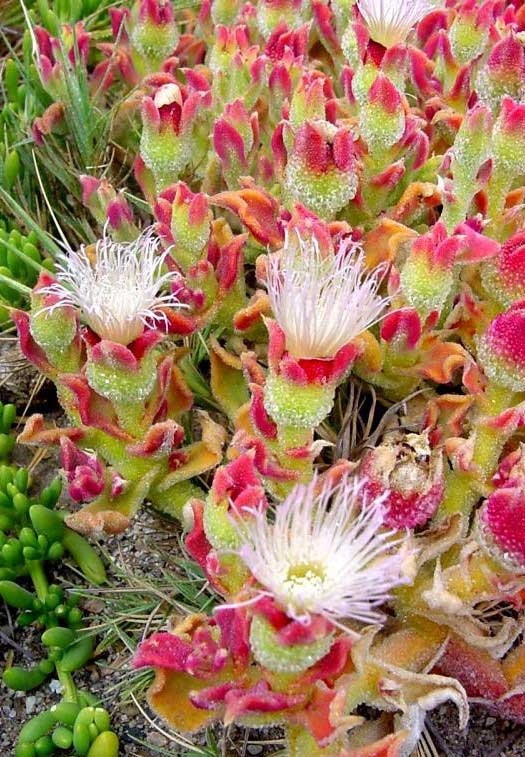
Mesembryanthemum crystallinum is a robust succulent herb or dense prostrate shrub to 1 m wide (Venning, 1984; Jacobs and Highet, 1990). Plants are densely papillose with large bladder cells, especially prominent on the receptacle (Hartmann, 2002). These give the plant a glistening appearance, and hence the species name "ice-plant" (Bohnert Laboratories, 2003). Mesembryanthemum crystallinum can be annual, biennial or perennial (Western Australian Herbarium, 199

, but its life cycle is usually completed within several months, depending on environmental conditions (Bohnert and Cushman, 2000).
Mesembryanthemum nodiflorum is morphologically similar to M. crystallinum, although it tends to be smaller in all its parts. It also posseses the distinctive, conspicuous bladder cells found in the latter species (Venning 1984; Jacobs and Highet, 1990; Hartmann, 2002). Distribution and habitats are similar for both species (see below). See Venning (1984) for further descriptive information.
Distribution
Mesembryanthemum crystallinum is native to Europe and Africa. It is introduced in Australia and is now widely distributed throughout the southern area of the continent, extending as far north as Exmouth on the Western Australian coast (Venning, 1984; Australia’s Virtual Herbarium, 2004). Mesembryanthemum nodiflorum is native to southern Africa. It is introduced in Australia and occurs widely throughout the southern inland areas of the continent (Venning, 1984; Australia’s Virtual Herbarium, 2004)
Habitat
Mesembryanthemum crystallinum is found on wide range of soil types, from well-drained sandy soils (including sand dunes), to loams and clays. It prefers acid, neutral or alkaline soils, but can tolerate nutritionally poor or saline soils (Plants For A Future - Species Database, 1997-2003; Australian National Herbarium, Canberra, 2004). It occurs in a range of vegetation communities, including saltmarsh, samphire flats eucalypt woodlands and shrublands (Cunningham et al., 1981; Venning 1984), and as with many introduced species, also grows in disturbed sites such as roadsides, rubbish dumps and homestead yards (Cunningham et al., 1981; Australian National Herbarium, Canberra, 2004). It tends not to grow in shade (Plants For A Future - Species Database, 1997-2003). Similar habitat preferences are exhibited by M. nodiflorum.
"Status" in community
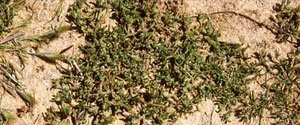
Abundance of M. crystallinum and M. nodiflorum appears to be tied to climatic factors, with both species most common in years of relatively high winter-spring rainfall. Both species occur as scattered patches in a community (Cunningham et al., 1981), occasionally forming more extensive swards in favourable habitats (e.g. saline sites).
Associated species
No species are recorded as particular associates for M. crystallinum and M. nodiflorum, due to their wide tolerance and occurrence in a variety of vegetation communities. Associates species recorded on specimen labels in the Australian National Herbarium include chenopods (including samphires), Muehlenbeckia sp., Acacia spp., Zygophyllum spp. and Eucalyptus largiflorens (woodland) and E. camaldulensis (forest).
Qualitative and quantitative data – abundance, cover, biomass
No specific data is available relating to cover, abundance or biomass. Mesembryanthemum species can form dense ground cover mats locally reaching high proportions of cover in restricted areas.
Species – interactions with other biodiversity
Mesembryanthemum crystallinum and M. nodiflorum are salt accumulators. After plant death, the salt leaches from the decaying plant into the surrounding soil. This increased salinity stops other, less salt-tolerant species from establishing (see Physiological traits for more details).
Physiological traits and adaptations
Mesembryanthemum crystallinum has a developmentally programmed switch from C3 photosynthesis to Crassulacean Acid Metabolism (CAM) which is accelerated by salinity and drought (Adams et al., 1998). The cold- and moderately salt-tolerant seedlings and juveniles display relatively high rates of vegetative growth by engaging in C3 photosynthesis as long as soil moisture remains sufficient (Bloom and Troughton, 1979; Winter et al., 1978 both in Bohnert and Cushman, 2000). With the onset of progressive drought, the plant switches to CAM, which minimises water loss and ensures reproductive success in the absence of rain and in saline soils (Winter, 1985 in Bohnert and Cushman, 2000). CAM prolongs the period of net carbon gain, resulting in enhanced seed production (Winter and Ziegler, 1992 in Bohnert and Cushman, 2000). The plant dies from the root, progressively transferring resources towards the seed capsule (Adams et al., 1998).
Mesembryanthemum crystallinum accumulates salt throughout its life, in a gradient from the roots to the shoots, with the highest concentration stored in epidermal bladder cells (Adams et al., 1998). The salt is released by leaching once the plant dies. This results in a detrimental osmotic environment preventing the growth of other, non-tolerant species (Vivrette and Muller, 1977) while allowing M. crystallinum seeds to germinate (Bohnert and Cushman, 2000).
Root growth is retarded under salinity indicating that water uptake by the root system is not essential for plant survival at the late developmental stages under heavy salinity (Kholodova et al., 2002).
Mesembryanthemum nodiflorum also displays the shift from C3 to CAM present in M. crystallinum (Sayed and Hegazy, 1994). Mesembryanthemum nodiflorum is also a salt accumulator and adds salt to the soil after death (Dale, 1986 cited in Ruff, 1999).
Reproduction and Establishment
Mesembryanthemum crystallinum and M. nodiflorum flower in spring to early summer (Cunningham et al., 1981). Flowers open in the morning and close at night (Smith, 1998), and are insect pollinated (Western Australian Herbarium, 199
.
In Mesembryanthemum crystallinum, the magnitude of seedset depends on CAM and the size the plant has attained in its juvenile growth phase (Adams et al., 1992 in Adams et al., 1998). During seed production, older portions of the plant progressively senesce, die off and dry out. The developing seed capsules continue to sequester salt and produce viable seeds (Adams et al., 1998). Seeds at the top of the capsule germinate immediately on imbibation while seeds at the base remain dormant for long periods (in excess of four weeks) (Fukuhara et al., 1999 cited in Bohnert and Cushman, 2000).
Dispersability; establishment and growth
In M. crystallinum and M. nodiflorum, seeds germinate during the cooler months of the year and the plants grow though to mid- or late-summer after which they dry out and die. Some plants may survive another year if conditions are favourable (Cunningham et al., 1981). In lab experiments five distinct growth phases have been identified for M. crystallinum: germination, juvenile, adult, flowering and seedset. It is in the adult phase that the plants change from C3 to CAM (Adams et al., 1998).
Juvenile period
Under lab conditions the juvenile phase of M. crystallinum lasts for approximately six weeks. Adult growth can be prolonged for many months. The onset of flowering is accelerated by environmental stress, most rapidly by salt stress. Seedset occurs about six weeks later and is accompanied by decay of the roots, shoots and leaves (Adams et al., 1998). Similar patterns could be expected for M. nodiflorum.
Hydrology and salinity
Salt Tolerance
Both M. crystallinum and M. nodiflorum often grow in saline situations (Cunningham et al., 1981). Optimal growth for M. crystallinum is obtained at moderate salinity (0.1-0.2 M NaCl). Up to 0.5 M NaCl is tolerated well and accelerates reproductive development (Kuznetsov et al., 2000 in Bohnert and Cushman, 2000).
Response to disturbance (non-hydrological)
Grazing
Mesembryanthemum crystallinum and M. nodiflorum are rarely, if ever, utilised by domestic stock (Cunningham et al., 1981).
Other
Both M. crystallinum and M. nodiflorum occur in disturbed sites, and physical disturbance of the soil may well favour establishment and growth of both species (B.J. Lepschi, pers. obs.)
Conservation status
Mesembryanthemum crystallinum and M. nodiflorum are introduced to Australia.
Uses (including ethnobotanical)
The leaves of M. crystallinum are edible. Seeds can also be eaten. The crushed leaves can be used as a soap substitute and has some medicinal uses (Plants For A Future - Species Database, 1997-2003). Mesembryanthemum crystallinum is also used as a model in plant physiologic research (Bohnert and Cushman, 2000), and is grown as a garden ornamental (Jessop, 1986). Due to its salt accumulation, M. crystallinum may be useful for bio-remediation (Bohnert Laboratories, 2003).
Summary
The ability of Mesembryanthemum crystallinum and M. nodiflorum to switch from C3 photosynthesis to CAM enables plants to adapt to high saline and arid situations and to withstand stressful conditions. The ability to accumulate salt, which is leached to the soil on death, and to suppress growth of other species, provides us with experimental potential and ability to test movement of salt in riparian areas.
Changes in water table levels and differing environmental flow regimes with consequent effects on salinity levels may affect the distribution of these Mesembryanthemum species, and other native species associated with them.





 .
.