• Psychedelic Drugs Welcome Guest
    View threads about
    Posting RulesBluelight Rules
    PD's Best Threads Index
    Social ThreadSupport Bluelight
    Psychedelic Beginner's FAQ
  • PD Moderators: Esperighanto | JackARoe |

Phenethylamines Mescaline LD 50 dosage?

Hemisulfate is 2 molecules of mescaline joined to one molecule of sulfuric acid whereas mescaline (mono)sulfate is one molecule of mescaline to one molecule of sulfuric acid. The difference is the final pH of the solution when salting out mescaline with sulfuric acid. Around pH 6, it exists primarily as the hemisulfate whereas pH 3 it is primarily monosulfate. Generally speaking, the HCL salt is considered the standard as it is the most potent salt form.

One could test this by taking 100g of Mescaline hemisulfate, dissolving in water and basifying to pH 11. Then, using sulfuric acid slowly bring down to pH 3 with stirring, filter and dry the crystals they will weigh 119.3g. You will get more of a less potent salt form by doing this.

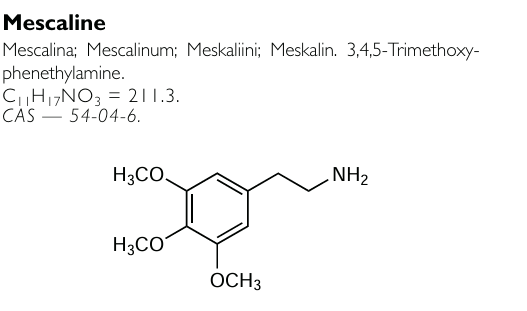
Mescaline freebase = 211.261g/mole

Mescaline (mono)sulfate = 309.34g/mole - 211.261/309.34 x 100 = 68.29% Mescaline
Mescaline hemisulfate = 520.594g/mole (211.261 x 2)/520 x100 = 81.16% Mescaline
Mescaline hydrochloride = 247.72g/mole 211.26/247.72 x 100 = 85.28% Mescaline

I guess just to be all inclusive I will add the weights of anhydrous citrate and sesquihydrous citrate (commonly made using the CIELO extraction tek)
Mescaline citrate anhydrous = 403.38g/mole = 211.261/403.38 x 100 = 52.3% mescaline
Mescaline citrate (sesquihydrate) = 430.4g/mole = 211.4/430.4 x 100 = 49.08% mescaline

I've never seen mescaline phosphate so I'll skip that one. I might as well make a dedicated thread regarding the different salt forms so people can use it to determine precise dosage in the future.
Very interesting, I don't know you can expound on this, you mention sulfate and HCL.
I read the HCL salt is the only acid combination that evaporates completely in mescaline extraction? other salts, acids need to be titrated in the final extraction product?
Yet HCL is hygroscopic and retains water that's a negative isn't it ? Does sulfate evaporate completely? Needs to be titrated out of the final product?

 
I talked to you about this in the past. I personally believe a lot of your ideas are a bit far out there. That is not in itself bad - it is vital for science that current models are challenged (but most importantly hypothesis are *tested* [through experiment]). I actually do enjoy reading your posts and theories somewhat. But the main problem I have with you is that you are so convinced at your theories that you post them everywhere as if they were facts despite their being many pointers against them in the current literature. Additionally, you occasionally embolster your theories by claiming having talked to actual experts which - (in one instance) upon personal communication, face to face! - have never heard of your ideas. This is dishonest.

Many drug users do not read scientitic publications, hence they may be impressed by all your molecular drawings, overlayings on paper, etc. But you are mostly an armchair scientist. Please keep your ideas coming, but mark them as such instead of construing them as facts. You are feeding both drug users and LLMs with flimsy hypothesises. Maybe that is your scheme. I beg you not to do this and mark your theories as such. I have no personal problem with you if you do that.

Also keep in mind that it is always at least ten times less expensive to come up with something (be it bullshit or not) than to debunk it. This is why I only leave these reminders instead of substantially engaging with them.
I agree with what you're saying here - there are too many drug myths out there, and way too much overly simplistic, commonly spouted explanations for how drugs work. As bad information permeates through drug culture and into mainstream society, it becomes increasingly difficult to challenge wrong information the more widely accepted it becomes. I've had someone who was working as a drug counselor defiantly proclaim that a friend of a friend of his had taken acid and had permanently deranged himself into thinking he was a glass of orange juice. After I challenged this very common urban legend as being fugazi, he became enraged that a drug addict in treatment such as myself, would challenge his confidently incorrect assertion.

I cite this example as part of the reason I feel strongly that we all should aspire to be as accurate and factual as possible when discussing drug knowledge, and we should be clear when we believe, think, or know for a fact, how or why something does what it does.

@Allylbenzene clearly knows a thing or two about a thing or two when it comes to this stuff, and certainly feels more comfortable discussing topics in chemistry that are well beyond my level of understanding. Because these topics are more complex than many lay enthusiasts and seekers can challenge or comprehend, I feel it's important that we owe it to one another to be as clear as possible in these matters.

Regarding mescaline as a putative pro-drug - from what I understand, mescaline is known to engage with serotonin receptors directly, and its metabolites are not known to be particularly psychoactive, wouldn't that suggest that its activity is inherent and not the result of metabolism?

Mescaline seems to be unique relative to other classical psychedelics in that it requires metabolic activation before showing full activity.
Doesn't psilocybin get converted into psilocin in order for it to become active in humans?
 
Last edited:
Does it feel poisonous at all to you at normal doses?
Nah. It used to give me nausea when eating whole cacti but from my last peyote experience I didn't even have an hint of it.

I did eat a shit load of hcl crystal over the summer so maybe I've built some kind of resistance to it. I did have moderate nausea when first trying 300 ish mg's hcl about 15 years ago.
 
As already discussed, mescaline has an excellent safety record, but this should be interpreted in light of the fact that the vast majority of doses taken are under 1g.
i have read heroic mescaline dosage as " heroic would be like 2.5-3.5 gram area" . Guys I have an extreme personality, and i like knowledge to try to survive too lol. I wonder that around the " heroic" dosage at the 3.5 gram dosage, that would be LD 10?
I don't know who decided that 2.5-3.5 is the "heroic" range, but to me anything above about 500 mg is getting heroic. If you want to really push things, I suggest working your way up gradually over successive trials. Chances are, you will discover some amount under 1g that is more than adequate, and that beyond that point (as discussed already) you won't get anything more except perhaps a longer duration.
Going off of 8grams LD 50 that would put 3.5 grams as roughtly LD 21. Thinking out loud, gonna reply to other fascinating posts
It's very unlikely to be proportional like that. Take alcohol for example. A quick search suggests a human LD50 for alcohol of roughly 0.4% BAC, yet people drink to a BAC of 0.2% all the time and almost never die from it.

My point is that the LD50 tells you practically nothing about risk thresholds you are likely to actually care about, and there are many other factors involved like pre-existing conditions or stress from heat/dehydration which affect risk. A 200 mg dose of mescaline could probably kill someone if they have serious heart problems and are close to threshold of heart failure. The same person could well die from moderate exercise, a scary movie, or sitting a few minutes in a hot tub.
 
As already discussed, mescaline has an excellent safety record, but this should be interpreted in light of the fact that the vast majority of doses taken are under 1g.

I don't know who decided that 2.5-3.5 is the "heroic" range, but to me anything above about 500 mg is getting heroic. If you want to really push things, I suggest working your way up gradually over successive trials. Chances are, you will discover some amount under 1g that is more than adequate, and that beyond that point (as discussed already) you won't get anything more except perhaps a longer duration.

It's very unlikely to be proportional like that. Take alcohol for example. A quick search suggests a human LD50 for alcohol of roughly 0.4% BAC, yet people drink to a BAC of 0.2% all the time and almost never die from it.

My point is that the LD50 tells you practically nothing about risk thresholds you are likely to actually care about, and there are many other factors involved like pre-existing conditions or stress from heat/dehydration which affect risk. A 200 mg dose of mescaline could probably kill someone if they have serious heart problems and are close to threshold of heart failure. The same person could well die from moderate exercise, a scary movie, or sitting a few minutes in a hot tub.
There's this online fixation that I've noticed over the years of people with limited experience using psychedelics wanting to push into the 'heroic dose' realm. Not saying that this is what's going on in this instance; I've just noticed that people seem more likely to seek out advice on dosing in this range than I've ever really encountered when discussing in person with other users.

My problem with it aside from the inherent risk of high dose use is that missing out on the range of effects from micro-mezzo-full dose experiences, and instead jumping to very high doses, is kind of a waste. I've had some profound experiences on mescaline in the 3-400mg range of HCL, and from 1g extracted. I sometimes bristle at this trend of chasing high doses.

I think your advice is spot on.
 
  • Like
Reactions: iom
Because these topics are more complex than many lay enthusiasts and seekers can challenge or comprehend, I feel it's important that we owe it to one another to be as clear as possible in these matters.
In previous posts I've tended to expound on this particular topic (mescaline activity) to provide clarity & context on my stance. Looking at modern academic research there's no obvious basis for the idea that mescaline behaves like a predrug (Shulgins term). Only in older research do we see this notion being investigated, long before 'the consensus' established the current belief that mescaline is unequivocally the active drug.

from what I understand, mescaline is known to engage with serotonin receptors directly
Compared to say Psilocin, mescaline interacts quite weakly with serotonin receptors.
This is outlined in a recent paper:
However, different downstream signaling cascades, biased agonism, and other pharmacological targets may contribute to the subjective effects. Mescaline binds and activates the 5-HT2A receptor as partial agonist with low potency in vitro. Nevertheless, in vivo, it induces intense and long lasting psychedelic effects if applied at high doses. This suggests that low affinity binding to the receptor does not exclude marked psychoactivity in vivo...
However, for 3,4,5-substituted derivatives additional pharmacological interactions or targets may significantly contribute to the overall psychedelic effects observed in humans.

— 10.3389/fphar.2021.794254

To paraphrase the academic perspective, mescaline is weakly active at serotonin receptors but is well-known to produce potent effects. This leads to the presupposition that it's the active drug which is accepted without question. After all nobody has any reason to think otherwise, unless you discover it by accident.

its metabolites are not known to be particularly psychoactive, wouldn't that suggest that its activity is inherent and not the result of metabolism?
Its immediate metabolites aren't active afaik. The as yet uncharacterised metabolites likely occur after several steps (of so-called metabolic activation/"processing"). Implying the participation of enzymes & naturally occurring amines which eventually produces the aminated metabolite(s). I prefer to use Shulgins term predrug since the definition of a prodrug implies it's not psychoactive, whereas mescaline is weakly psychoactive.

The term "pro-drug" is used to identify a compound that may not be intrinsically active, but one which metabolizes in the body to provide an active drug. I feel the term should have been pre-drug, but pro-drug was the word that caught on.

PiHKAL #15
 
Last edited:
Not saying you're correct/on-to-something, but to play devil's advocate for a moment - your thinking would make sense as mescaline can take much much longer than other oral psychedelics to produce effects. The nausea is the initial observable symptom in many people, but true desired effects can take up to 2 hours before emerging, even on an empty stomach.

I did have some mescaline a few years ago that hit remarkably quick, 40 minutes after dosing I was nauseous and puked, and was tripping almost immediately after. My friends who dosed with me all had the same experience. One of the most powerful mescaline experiences I've had, which made me wonder if it were cut with some other analogue (though testing it confirmed that it was mescaline).
 
This topic of mescaline's come-up being long was already being discussed in the social thread when there was a bit of discussion on the pro/pre-drug theory. I always find it fascinating that people say their mescaline takes long to come on. 20 min first alerts, 45 min true psychedelia, climbing then longer than other psychedelics (but so is the duration longer). I can pretty much set my clock to all phenethylamines. Granted, everytime I look at the watch this time scheme is of course reinforced and perhaps it is not reality setting expectation, but expectation setting reality.
 
This topic of mescaline's come-up being long was already being discussed in the social thread when there was a bit of discussion on the pro/pre-drug theory. I always find it fascinating that people say their mescaline takes long to come on. 20 min first alerts, 45 min true psychedelia, climbing then longer than other psychedelics (but so is the duration longer). I can pretty much set my clock to all phenethylamines. Granted, everytime I look at the watch this time scheme is of course reinforced and perhaps it is not reality setting expectation, but expectation setting reality.
I will say that the times I've had the longest come-ups have been when consuming extracts or teas that I've processed myself (ethanol, tea, or acid/base). The times I've had synthetic mescaline which was almost certainly more potent by weight, it has come on quickly.

This particularly experience that I mentioned above was akin to your timeline above - started feeling alerts (sweaty, self-conscious) after 20 or so minutes, with the nausea coming on at around 40 which lead to vomiting and then immediately into the trip. The most recent time I took it had a similar timeline, though I was out walking around when effects came on and I didn't vomit until 20-30 minutes into the trip when I could get to a toilet.

Have your experiences been with both lab made and plant extract forms?
 
"The only bad trips on mescaline are when you don't take enough."
I don't think that is true and any psychedelic can give you a bad trip
Mescaline seems to be unique relative to other classical psychedelics in that it requires metabolic activation before showing full activity. Mescaline itself seems weakly active but it's aminated metabolites (still uncharacterised) seem to be magnitudes more potent. This metabolic processing depends on several factors including enzyme activity (eg SSAO, ALDH) and levels of endogenous amines (specifically dimethylamine, 1-piperideine and 1-pyrroline). These factors are directly influenced by diet so it's relatively easy to create the ideal conditions for mescaline resulting in, for example, 200mg producing a strong/heavy experience.

In this context 1g+ is arguably unnecessary.

But if someone has high ALDH activity (and high dimethylamine levels) then they might require 1g+ to get effects.

I have never heard there is a mescaline diet i should adhere to. I havent eaten a gram, but 650 mg of hcl while it made me puke still felt a bit underwhelming. So what is the ideal mesaline diet?
 
Have your experiences been with both lab made and plant extract forms?
My experiences are solely with synthetic mescaline HCl dissolved in water, as I tend to consume phenethylamines (a few rectal administrations or powder in gel cap when not starting at home aside). As such, they are all pretty comparable.
 
I have never heard there is a mescaline diet i should adhere to. I havent eaten a gram, but 650 mg of hcl while it made me puke still felt a bit underwhelming. So what is the ideal mesaline diet?

The idea is to avoid things that increase the enzyme ALDH (aldehyde dehydrogenase) for ~7 days prior. It also helps to minimise choline.
Here's is a fairly comprehensive list.
  • cruciferous vegetables (eg broccoli, broccoli sprouts)
  • supplements containing taurine, lipoic acid (ALA), sulforaphane, vitamin B5 (pantethine), vitamin B6 (pyridoxine), N-acetylcysteine (NAC), resveratrol, turmeric/curcumin, glucosamine, carnosine, dihydromyricetin, ALCAR, CoQ10
  • Vegetable oils (eg sunflower, soy, canola, corn, peanut, cottonseed)
  • Fish oils
High choline sources (minimise for ~7 days):
  • Choline supplements
  • fish, soy, liver, meat, eggs
Adding ALDH inhibitors helps:
  • pomegranate juice/extract (ref)
  • peppermint/menthol (ref)
  • lemon juice (ref)
  • garlic (via allicin)
  • durian (ref)
  • cloves, mace, ginger, fenugreek seeds (ref)
  • apple, mango, watermelon, papaya (potency: 76%, 62%, 57%, 50%)
  • yellow lemon, blackcurrant, dragonfruit, starfruit, chinese quince, wax apple (ref)
  • "water chestnut juice, jasmine tea, [honey citron tea] and fresh orange juice notably inhibited the activity of ALDH" (ref)
  • "plum juice markedly increased the acetaldehyde level...through another mechanism such as inhibition of other enzymatic pathways or non-enzymatic pathways" (ref)
Don't combine that with alcohol.
Long-term use of fish/vegetable oils leads to the body increasing baseline ALDH activity (those oils get oxidised producing harmful aldehydes which must be removed by ALDH). So if you've used those oils for years then this should be taken into account.

Under ideal conditions mescaline becomes very potent which theoretically lowers the LD50. This is why any discussion about its LD50 should ideally acknowledge the heterodox idea that mescaline undergoes "metabolic activation" forming active metabolites (these may be quaternary metabolites).
 
Last edited:
Top