paradoxcycle
Bluelight Crew
We all know by now that there are three major subtypes of opioid receptors: μ (mu), κ (kappa), and δ (delta). An alternative classification system is based on their order of discovery the receptors being termed OP1 (δ), OP2 (κ), and OP3 (μ).
Many of you may not be aware of this, but there is also an "orphan" receptor has been identified and cloned based on homology with the cDNA.
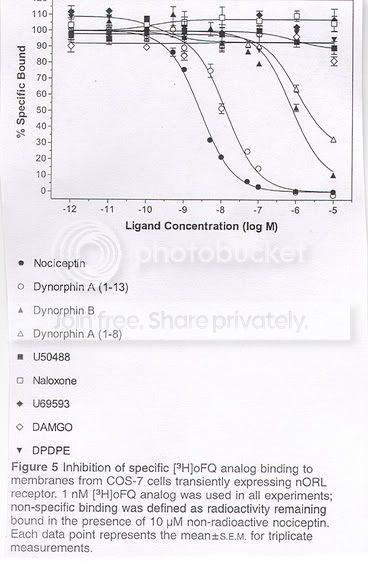
Originally the formal genes coding for the opiate receptors were called OP1 for delta, OP2 for kappa and OP3 for mu. When they used the structure of these genes and scanned cDNA libraries (which are libraries made from RNA with the non-coding regions called exons removed) there was a receptor that was very similar to the classic opiate receptors, but did not bind any known peptide or non-peptide opiates or antagonists. It was called ORL1 for Opioid Receptor-Like, and it was referred to as an orphan receptor because the endogenous ligand that binds there was unknown.
Two groups came up with an endogenous ligand that binds to ORL1.
The first one called it Orphanin FQ because the first and last amino acids in the peptide's sequence were Phenylalanine (which is abbreviated F) and Glutamine (which is abbreviated Q).
The second group called it Nociceptin (NC) because it reduced the pain threshold when injected intraventricularly (Pain perception is also know as nociception). Now you often see it abbreviated OFQ/N . It is structurally similar to the opiopeptide called Dynorphin A, but it does not bind to any of the other opioid receptors. It activates all the classic intracellular mechanisms of the opioids like inhibiting Adenylate Cyclase, activating potassium channels and inhibiting calcium channels. Now the gene for the OFQ/N receptor is referred to as OP4.
So these are the only agreed upon opiate receptors by the International Congress of Pharmacology, but there are most likely a wide range of other receptors that belong to this family but as of now, there is not unanimous agreement.
I think this is a really interesting topic; let's discuss!
Many of you may not be aware of this, but there is also an "orphan" receptor has been identified and cloned based on homology with the cDNA.
Originally the formal genes coding for the opiate receptors were called OP1 for delta, OP2 for kappa and OP3 for mu. When they used the structure of these genes and scanned cDNA libraries (which are libraries made from RNA with the non-coding regions called exons removed) there was a receptor that was very similar to the classic opiate receptors, but did not bind any known peptide or non-peptide opiates or antagonists. It was called ORL1 for Opioid Receptor-Like, and it was referred to as an orphan receptor because the endogenous ligand that binds there was unknown.
Two groups came up with an endogenous ligand that binds to ORL1.
The first one called it Orphanin FQ because the first and last amino acids in the peptide's sequence were Phenylalanine (which is abbreviated F) and Glutamine (which is abbreviated Q).
The second group called it Nociceptin (NC) because it reduced the pain threshold when injected intraventricularly (Pain perception is also know as nociception). Now you often see it abbreviated OFQ/N . It is structurally similar to the opiopeptide called Dynorphin A, but it does not bind to any of the other opioid receptors. It activates all the classic intracellular mechanisms of the opioids like inhibiting Adenylate Cyclase, activating potassium channels and inhibiting calcium channels. Now the gene for the OFQ/N receptor is referred to as OP4.
So these are the only agreed upon opiate receptors by the International Congress of Pharmacology, but there are most likely a wide range of other receptors that belong to this family but as of now, there is not unanimous agreement.
I think this is a really interesting topic; let's discuss!