• Select Your Topic Then Scroll Down
    Alcohol Bupe Benzos
    Cocaine Heroin Opioids
    RCs Stimulants Misc
    Harm Reduction All Topics Gabapentinoids
    Tired of your habit? Struggling to cope?
    Want to regain control or get sober?
    Visit our Recovery Support Forums

Let's Talk About the Orphan Opioid Receptor!

paradoxcycle

Bluelight Crew
Joined
May 5, 2004
Messages
5,568
Location
East coast, USA
We all know by now that there are three major subtypes of opioid receptors: μ (mu), κ (kappa), and δ (delta). An alternative classification system is based on their order of discovery the receptors being termed OP1 (δ), OP2 (κ), and OP3 (μ).

Many of you may not be aware of this, but there is also an "orphan" receptor has been identified and cloned based on homology with the cDNA.

Originally the formal genes coding for the opiate receptors were called OP1 for delta, OP2 for kappa and OP3 for mu. When they used the structure of these genes and scanned cDNA libraries (which are libraries made from RNA with the non-coding regions called exons removed) there was a receptor that was very similar to the classic opiate receptors, but did not bind any known peptide or non-peptide opiates or antagonists. It was called ORL1 for Opioid Receptor-Like, and it was referred to as an orphan receptor because the endogenous ligand that binds there was unknown.


Two groups came up with an endogenous ligand that binds to ORL1.

The first one called it Orphanin FQ because the first and last amino acids in the peptide's sequence were Phenylalanine (which is abbreviated F) and Glutamine (which is abbreviated Q).

The second group called it Nociceptin (NC) because it reduced the pain threshold when injected intraventricularly (Pain perception is also know as nociception). Now you often see it abbreviated OFQ/N . It is structurally similar to the opiopeptide called Dynorphin A, but it does not bind to any of the other opioid receptors. It activates all the classic intracellular mechanisms of the opioids like inhibiting Adenylate Cyclase, activating potassium channels and inhibiting calcium channels. Now the gene for the OFQ/N receptor is referred to as OP4.

So these are the only agreed upon opiate receptors by the International Congress of Pharmacology, but there are most likely a wide range of other receptors that belong to this family but as of now, there is not unanimous agreement.

I think this is a really interesting topic; let's discuss!

 
What is the reason for the disagreement?

Excuse my ignorance on the subject, but is the ORL1, or Orphan Receptor, expressed in humans?

Seems like quite an interesting topic, but I'll withhold my other questions until this is answered.
 
It's been demonstrated that ORL1 is expressed in human neuroblastoma SK-N-SH and SH-SY5Y cell lines by radioligand binding assay, reverse transcription polymerase chain reaction (RT-PCR) and Northern analysis.

ORL1 transcripts are particularly abundant in the central nervous system.
 
Hey there PDX...good day to 'ya...:)

I'm wondering if some of these orphan receptors are involved with the way that certain "poisons" from frogs that contain endogenous opioid peptides work.
You know- "poison dart frogs"...not the curare containing ones, but the ones that contain dermorphin and such...

...hmm...
I wish I had time to do some thorough research right now, but the "grind" is killing me currently. Let me know...
 
What about exogenous ligands? If there are no selective ligands for the ORL1, then we cannot truly understand the phenomenological worthiness of this receptor. But then again, we have little understanding of the function and purpose of delta and kappa opioid receptors.

Right now, the ORL1 seems similar to the neuronal trace amine receptor (hTA1), in that we know it exists because it has been cloned from cDNA libraries and PCR'ed genomic DNA libraries. However, we know little about its function, signaling pathway or its role in physiology. It would be an interesting one to study in a conditional knock-out model or via siRNA. Is it an honest GPCR, or could it be like the sigma receptor and be an ion channel auxillary subunit with channel modulating activity.
 
Last edited:
^^...for sure...
It's one thing to know that something exists, but to figure out how/why it exists is a totally different thing... :\

BTW, I was hoping that you'd see this thread, Zeta...wow...talk about instant karma...I should try that more often...

Very good questions, indeed.
 
soundphaRm said:
I'm wondering if some of these orphan receptors are involved with the way that certain "poisons" from frogs that contain endogenous opioid peptides work.You know- "poison dart frogs"...not the curare containing ones, but the ones that contain dermorphin and such

Oh, definitely, I agree. OSU did a study recently in which they cloned and characterized ORL1 receptor from a from a urodele amphibian and discovered that the GPCR cloned from the amphibian brain is the homologue of the mammalian ORLI receptor. The amphibian receptor shared >50 amino acid sequence identity with the four main opioid receptor types cloned from other species and has the highest identity to the ORLI receptors (>64.2%)

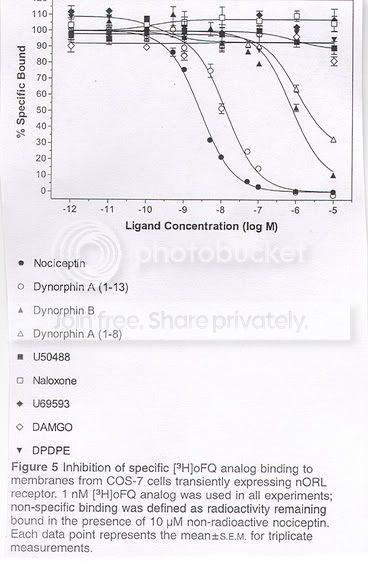
Graph.jpg
 
Last edited:
Very nice, PDX, researcher extraordinaire. :)

I was thinking about these amphibians lately...
Thanks for bringing up the subject!

Man, I need about 10-15 more hours in our "day"...
OSU...would that be Oregon State?
Where...Eugene or Portland?

I had the chance to "snag" some dermorphin about a year ago at the U of I (Champaign, IL), but I was kind of intimidated by it, since I didn't know exactly how it worked, and considering how potent it is...so I didn't...:\
 
If the orphan receptor had to be cloned to be identified, does that imply it is not present in large numbers in the human brain?

Couldn't find much info on it, there is not much info even on the Delta receptor as it is.

Sure could do some interesting experiments by using the cDNA and inserting it into bacterial vectors.
 
Well how else are you gonna identify a receptor unless you clone it? Even pharmacological identifications aren't that useful (which wasn't done in this case first) because as was the case with the NMDA receptor, you can pharmacologically identify several binding sites, but they all might actually belong to the same receptor.

I think the important part of the question is what is the distribution of this receptor (something I don't know as I write this). Because if its not localized to the cortex, and more importantly, to the meso-limbic/cortical reward pathway, then it's not going to be any use as a recreational drug (might be good for honest to god pain patients thought)

Well the receptors don't have too interesting a distribution

ORL-1%20distribution1.jpg

ORL-1%20distribution2.jpg


You can see mild expression in the cortex, the striatum is relatively free. The amygdala has higher still and ventromedial hypothalamus is invested strongly. Some mid-line thalamic nuclei seem highly labelled, but the midbrain dopaminergic structures seem relatively unlabeled.

You note that that study is actually looked at agonist stimulated G-protein activation, so it shows not all receptors, just ones that can sense agonist activity. (Ro64-6198 is a ORL-1 agonist).

Nociceptin/orphanin FQ is distributed in a similar pattern to these receptors; there is some investment in the cortex, esp. frontal and medial, the medial spetum and amygdala are higher still, there cerebellum and basal ganglia are relatively free. The anterior nuclei and the medial geniculate nuclei of the thalamus are invested; but the hypothalamus, all over, especially the ventromedial nucleus is dripping with the peptide.[2]]

However, a majority of ORL-1 receptor positive neurons in the ventral tegmetal/Substantia nigra (75%) expressed TH mRNA (i.e. are dopaminergic) and roughly half of the TH-containing neurons expressed ORL-1 mRNA. This might be a bad thing for recreational puerposes, as ORL-1 should inhibit neuronal firing [3].

And *cue evil music* so it seems to. Administration of nociceptin I.C.V. decrease dopamine release in the nucleus accumbens [4].

So I don't see a big reason to expect fun from ORL-1 ligands.
 
Last edited:
Top