
izo
Bluelighter
gonna start this thread as it fits better into the neuroscience forum. here are all infos i could find to this plant.




N&PD Moderators: Skorpio
You are using an out of date browser. It may not display this or other websites correctly.
You should upgrade or use an alternative browser.
lactuca virosa - ingredients and effects
izo
Bluelighter
gonna start this thread as it fits better into the neuroscience forum. here are all infos i could find to this plant.


izo
Bluelighter
im just trying my luck with some 100:1 Lactuca virosa extract.

Lactuca virosa - Wikipedia
en.wikipedia.org
tried something like 150mg and there is something going on, although not very strong. gonna go a bit higher today.
these are the papers i found to be relevant:
Analgesic and sedative activities of lactucin and some lactucin-like guaianolides in mice
Untersuchungen zur Darstellung von Lactucin und Lactucopikrin aus Lactuca-virosa-Pflanzen
Biomedical analysis of New Psychoactive Substances (NPS) of natural origin
gonna read through christian rätschs encyclopädia article on lactuca virosa.
as said, some effect but not that strong so far.
some ingredients that already got their own wiki entry, if somebody knows the main constituent please mention it:

Lactucopicrin - Wikipedia
en.wikipedia.org

Lactucin - Wikipedia
en.wikipedia.org
izo
Bluelighter
dose related statements from christian rätsch:
A psychoactive dose is 28 g lettuce leaves (MILLER 1988: 1170; as the medicinal, largest single dose of the lactucarium
0.3g; the total daily dose is 1.0 g (ROTH et al. 1994: 4440.
izo
Bluelighter
about the ingredients:
ingredients
The Lactucarium contains the sedatively effective sesquiterpene lactone bitter substances (guaianolides) lactucin (C,5H„05) and its p-
Hydroxyphenylacetic acid ester, lactupicrin (= lactucopicrin)'ys, as well as triterpene alcohols (lactucerol), a melampol
Glycoside (lactuside A) and other guaianolides (11ß,13-dihydrolactucin, 8deoxylactucin,
jacquineline, zaluzanine derivatives;
STOJAKOWSKA et al. 1993 and 1994). In the older literature, the presence of a "hyoscyamine-like
alkaloids” (cf. tropane alkaloids) (FROHNE and PFÄNDER 1983: 67£*).
Incidentally, opium-like alkaloids also occur in garden lettuce or lettuce (Lactuca sativa L.) (BIBRA 1855: 259*). if
When the lettuce shoots out and forms stalks, a white milky juice is produced that contains alkaloids that have a sedative effect (RÄTSCH
1995a* and 1995c* ). The variety Lactuca sativa var. capitata L. grown as a garden lettuce is also called lettiice opium or frerich
lactucarilitrl (BROWN and MALONE 1978: 23*).
izo
Bluelighter
and about its effects:
Effect
Lactucarium has analgesic, sedative and antitussive effects (STOJAKOWSKA et al. 1993). The effect
was formerly even compared to that of deadly nightshade (Atropa belladonna) (HARLAN 1986: 10). You also have them to explain
used for the kava effect (see Piper methysticum).
The effect is described as a "weak dream state" (MILLER 1988:
118*) or aphrodisiac »high«.
The pioneer Freiherr Ernst von Bibra (18061878), who experimented a lot with Lactucarium, came to the following conclusion:
»Very similar to opium, the lactucarium appears to consist of the various species and varieties of the lactuca species
possessing somewhat different properties, but in the main effects it is the same, like opium."
(BIBRA 1855: 255* )
The guaiane-type sesquiterpene lactones found in latex, which are often present as glycosides, are said to be responsible for the sedative
effect (STOJAKOWSKA et al. 1994: 93).
izo
Bluelighter
the three main constituents from the following paper:
Analgesic and sedative activities of lactucin and some lactucin-like guaianolides in mice
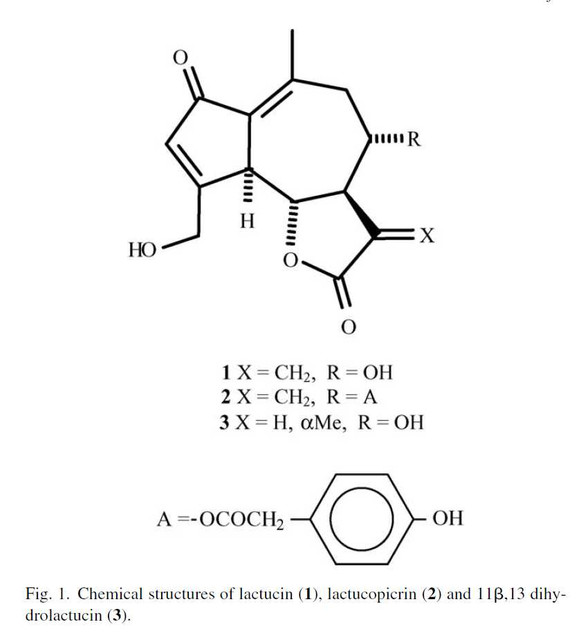
izo
Bluelighter
ok, 300mg 100:1x extract taken in a few doses orally, along with a light dose of mephedrene. its somehow sedating, not strong but definetively active.
izo
Bluelighter
a quote from the paper from where the moluecule structures came from:
A comparison of the results obtained for two thermal assays
suggests that ibuprofen is a better analgetic than (1), (2) and
(3) in the hot plate test but not the tail-flick test.
izo
Bluelighter
and the conclusions from the above paper:
Conclusion
On the basis of these investigations, it may be concluded
that lactucin (1) and its derivatives (2) and (3) possess analgesic
activities in thermal models of nociception similar to that
observed for ibuprofen used as a standard drug. The two former
compounds also possess sedative properties. It is noteworthy
that (3), in contrast to (1) and (2), do not affect the spontaneous
locomotor activity of mice and this is a beneficial feature of compounds
with an analgesic profile. These observation confirm at
least partly the ancient use of Lactuca virosa as an analgesic and
sedative herbal remedy, and suggest that not only Lactuca virosa
but also Cichorium intybus may possess analgesic and sedative
properties due to the presence of lactucin and lactucin-like
guaianolides. The mechanisms involved in their action are not
completely understood and further studies seem to be necessary.
izo
Bluelighter
Tried 1,1g of 100:1x extract today, almost no effects. You might get better results with the fresh plant.

Neuroborean
Bluelight Crew
I've read that the virosa resin/extract is barely active with oral ROA, that it works much better if you vaporize it, but never tried, so I don't know how to explain how to do it succesfully.
I also read that the best way is to use it via the fresh, recently collected, virosa latex.
Tried 1,1g of 100:1x extract today, almost no effects. You might get better results with the fresh plant.

4meSM
Bluelighter
There's barely any research on the psychoactive effects of lactucin derivatives. Most of the research is about their antimicrobial properties (also other stuff like hepatoprotective effects).
They seem to be pretty weak sedatives, at least when consumed orally.
I wonder if some simple chemical modifications could increase their potency...
The thing is they're really fucking expensive if you want to buy them pure (~2000$ for 50mg), although they're fairly easy to extract.
Oh and by the way, I don't think they're able to handle high heat without decomposing so smoking may not be the best way either.
izo
Bluelighter
im not that sure but i think this kind of lettuce was growing in our fromt garden years ago, just some days ago i found enough of this for a tasty mushroom pan:

Xerocomellus chrysenteron - Wikipedia
en.wikipedia.org
izo
Bluelighter
almost as good as

Boletus edulis - Wikipedia
en.wikipedia.org
which is the best edible shroom i know.