• N&PD Moderators: Skorpio

Is there a search for a drug that inhibits or reverses tolerance?

neversickanymore

Moderator: DS
Staff member
Joined
Jan 23, 2013
Messages
32,300
Location
babysitting the argument in my head
It seems clear to me that a cure for many parts of addiction could be found in a chemical that would inhibit tolerance. along the same line of thought a cure for addiction could lie in a drug that is able to recant tolerance. Even if this is not the case, wouldn't it reduce the impact of addiction significantly. all this set aside is there any work being done on this and if so what is it, and if not why not? Is there anything known about how tolerance works?
 
Ultra low dose naltrexone is being looked into for opioid tolerance. Check out oxytrex.
 
Yep. The potential profits are keeping every virtually every major drug company hard at work, granted many of them are lacking proof of concept drug. Ibogaine is under investigation, but it requires much less toxic analogs to be produced before there is any hope of seeing that on the market.
 
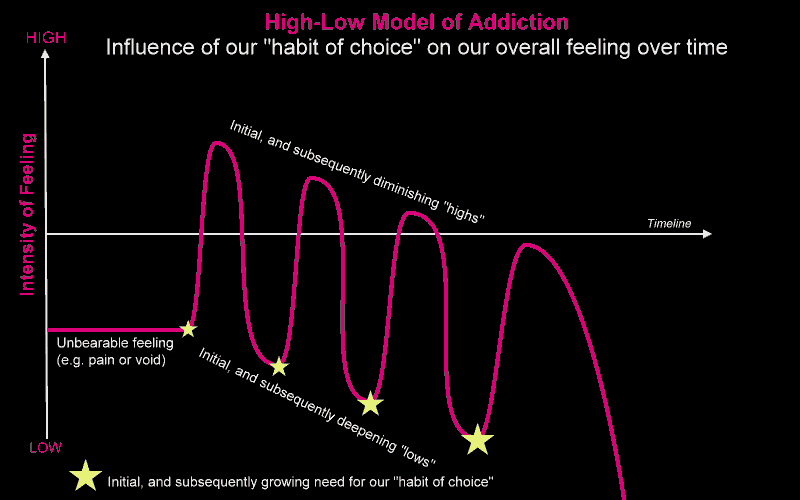
if down regulation is referring to a drug that prevent this below.. I believe that the point where use is needed to maintain a "normal" feeling will indicate the point at which an addict "losses control" in the cycle of addiction graph below.. as far as actually eliminating addiction i guess I may have spoke unclearly.. rather eliminating many negative parts of addiction, if not the eventual desire, like the need to eventually redose, over and over, with substances that have little or no physical withdraw just to feel ok, but yes it would probably also be very conclusive on physical dependence wouldn't it..

Is there a target portion of the brain that is thought to responsible for the phenomenon of tolerance?

601-counselling-london-psychotherapy.gif


cycle-of-addiction.jpg
 
Last edited:
If it were only that simple....

Downregulation is a term referring to what happens when some classes of receptors (5-HT2a, mu-opioid, et cetera) interact with ligands... in the case of 5ht2a even *antagonists* actually cause downregulation. The body naturally responds to overactivation of receptors by e.g. moving them inside the cell. (internalisation via beta arrestin) over time, and the net effect is homeostasis is achieved.

There are thought to be some "general" pathways of drug tolerance; the NMDA receptor is one that gets discussed a lot for amphetamine/opioid tolerance as blocking it potentially can slow the onset and extent of desensitisation in some individuals. But a lot of research is in rats, or in cells in culture, not in people, and it's not a cure for pre-existing tolerance.

Ibogaine is said to have powerful antiaddictive properties that are possibly mediated through that mechanism, and there are derivatives that lack the hallucinogenic effects. But ibogaine is still a "dirty" drug that hits many targets, and it shares with its analogues the property of beign a hERG channel blocker, which can cause/exacerbate long Qt syndrome.

LSD is also said to be a good treatment, at least for alcoholics, but how much of that is a chemical change and how much a psychological change is up for discussion.

Rat Park is also an interesting case study, too. Maybe it's not the brain you have to change.

 
If it were only that simple....

Downregulation is a term referring to what happens when some classes of receptors (5-HT2a, mu-opioid, et cetera) interact with ligands... in the case of 5ht2a even *antagonists* actually cause downregulation. The body naturally responds to overactivation of receptors by e.g. moving them inside the cell. (internalisation via beta arrestin)
sorry if you already answered this via (internalisation via beta arrestin).. but how is there an idea as to how this is facilitated and are there similar know celular absorptions of other key unrelated receptors.. how is it specific to certain receptors?

damn curiosity is triggered.. what are the key texts or papers to look at to begin explore this.. I will ramp down from there and follow the branches down to capture the substantial knowledge i lack.. if you choose to take the time and humor me i thank you in advance:)
 
Last edited:
I always found actually that mescaline
was the best I could find for opiate addiction. Chipping plus a trip was amazing maybe miraculous? Also I read of repeated doses of mescaline or maybe peyote, after which the tolerance is in effect and no hallucinations occour, it becomes a pain killer. Source from Peyote: The Divine Cactus. Edward F. Anderson
 
There are thought to be some "general" pathways of drug tolerance; the NMDA receptor is one that gets discussed a lot for amphetamine/opioid tolerance as blocking it potentially can slow the onset and extent of desensitisation in some individuals. But a lot of research is in rats, or in cells in culture, not in people, and it's not a cure for pre-existing tolerance.

I wish we had more research like this. http://www.ncbi.nlm.nih.gov/m/pubmed/11512037/

As far as I know, there aren't any human trials for the specific application with regards to amphetamine. The anecdotes and my own experiences are promising, but still need to be taken with a grain of salt...and about 100 confounds.
 
Top