-
Neuroscience & Pharmacology Discussion Welcome Guest
Posting Rules Bluelight Rules Recent Journal Articles Chemistry Mega-Thread FREE Chemistry Databases! Self-Education Guide -
N&PD Moderators: Skorpio
You are using an out of date browser. It may not display this or other websites correctly.
You should upgrade or use an alternative browser.I Like to Draw Pictures of Random Molecules
- Thread starter nuke
- Start date
- Status
- Not open for further replies.
 I have used Sci-Hub in the past to obtain pdf copies of ACS journals but my attempts to get a JOC article didn't work this AM. It is a way to make isopropenyl acetate without using ketene starting from allyl acetate, which should either be available commercially or easy enough to make.SECOND GENERATION DESIGNER BENZOS: Some are not like your mother's diazepam (Valium).
In 2012 new designer benzos began appearing in head shops & online RC suppliers: pyrazolam, flubromazepam & diclazepam (structures to follow in next post). As soon as these were scheduled, a second generation of these drugs began to appear (this post): clonazolam, deschloroetizolam, flubromazolam, & meclonazepam. I haven't had a chance to look into the pharmacology of all of these, but flubromazolam should be considered a very dangerous & potent drug: 'Flubromazolam is a novel synthetic depressant substance of the benzodiazepine class which produces anxiolytic, disinhibiting, sedative, muscle relaxant, and memory suppressing effects when administered. It is incredibly potent (active in the microgram range) with an unusually long 18 hour duration.'
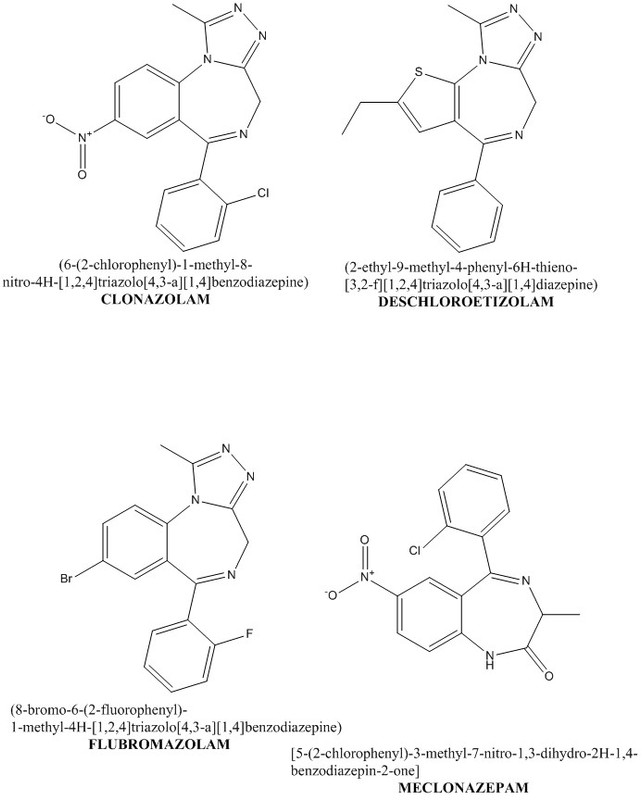
These molecules appear to have been taken from the patent literature, as many thousands of benzos have been synthesized & tested since their discovery in the 1960s. Most never made it to market as many, like flubromazolam, were found to be either too potent or toxic for safe & effective use.Last edited:As mentioned in the last post, here are the structures of the 3 benzos that were initially available earlier in this decade. As indicated by the 'Ro-5-' number for diclazepam, these were originally made by big pharma in the 1960s-70s, in this case Hoffman-LaRoche.
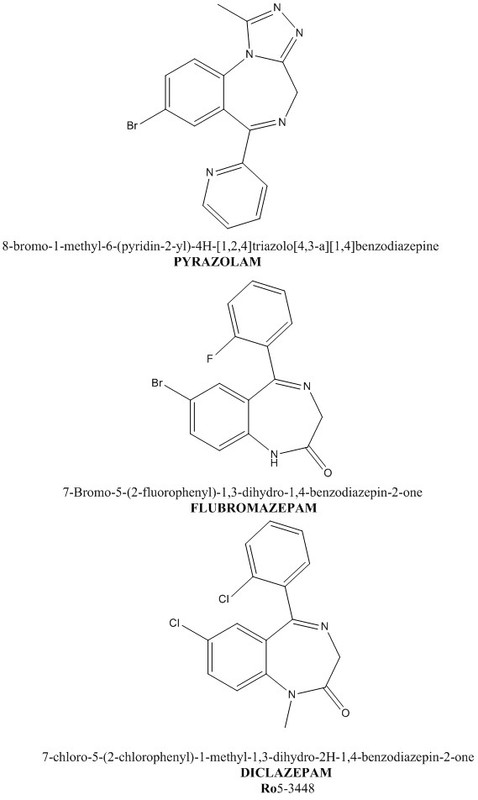
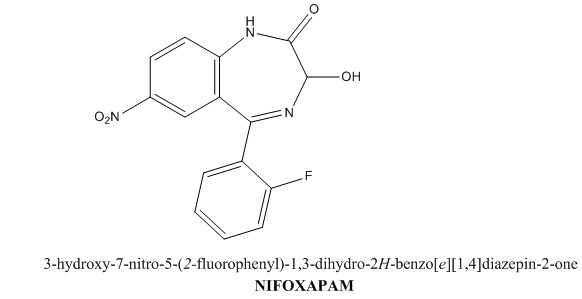
To indicate the potency of these molecules, diclazepam was said to be 10 times more potent than diazepam (Valium).Last edited:While compiling this list of designer benzos, I overlooked nifoxapam. From WikiPedia: Nifoxipam produces strong tranquillising and sleep-prolonging effects and has much lower toxicity compared to lormetazepam and flunitrazepam in mice.
 Most never made it to market as many, like flubromazolam, were found to be either too potent or toxic for safe & effective use.
(...]
To indicate the potency of these molecules, diclazepam was said to be 10 times more potent than diazepam (Valium).
10 times as potent as diazepam isn't a big deal. So is lorazepam.
Alprazolam is 20 times the potency of diazepam and 40 times the potency of temazepam, yet doctors are less reserved about prescribing xanax than they are about restoril.
Heck, triazolam and brotizolam are pharm benzos that are considered twice as potent as alprazolam (and thus roughly as potent as clonazolam or flubromazolam).
Personally, I'd wager the main reason most of these designer benzos never saw the light of day was simply because getting a drug to market costs a lot of of money, and it didn't take too long for those markets to become saturated with benzos of different half-lives and effects profiles.
Don't get me wrong though: RC benzos, especially the strongly hypnotic ones, absolutely aren't something to fuck around with; I am just saying that the main issue here is people being able to easily acquire obscene quantities of these on the net, sometimes even as a pure powder.
There's a difference between some dude in Japan getting a script for 2x0.5 mg of etizolam per day from a legit psychiatrist for an anxiety disorder, and a guy in America ingesting 20 mg of etizolam solution, blacking out, and crashing their car in a stupor.10 times as potent as diazepam isn't a big deal. So is lorazepam.
Alprazolam is 20 times the potency of diazepam and 40 times the potency of temazepam, yet doctors are less reserved about prescribing xanax than they are about restoril.
Heck, triazolam and brotizolam are pharm benzos that are considered twice as potent as alprazolam (and thus roughly as potent as clonazolam or flubromazolam).
Personally, I'd wager the main reason most of these designer benzos never saw the light of day was simply because getting a drug to market costs a lot of of money, and it didn't take too long for those markets to become saturated with benzos of different half-lives and effects profiles.
Don't get me wrong though: RC benzos, especially the strongly hypnotic ones, absolutely aren't something to fuck around with; I am just saying that the main issue here is people being able to easily acquire obscene quantities of these on the net, sometimes even as a pure powder.
There's a difference between some dude in Japan getting a script for 2x0.5 mg of etizolam per day from a legit psychiatrist for an anxiety disorder, and a guy in America ingesting 20 mg of etizolam solution, blacking out, and crashing their car in a stupor.
Interesting observations about triazolam & brotizolam. I'll have to check into those.
Tolerance to benzos acquired over both long & short periods of time is something that I'm veryinterested in. I took flurazepam for sleep for years, then a new doc switched me to temazepam, which did very little by comparison. A couple of years ago I askedmy then doc for a scrip for flurazepam. It was interesting that even 2 caps had no effect. I had obviously built up a strong tolerance to it.
During a recent endoscopy they were shoot a mix of fentanyl & midazolam into my IV line but I was conscious throughout the whole operation. This was only my third experience with fentanyl, which knocked me right out when I had cataract surgery. I've woken up under midazolam during a colonoscopy. It seems to be the GI docs favorite for that op. My last colonoscopy I had them use propofol, which worked like a charm, though I had to be entubated for oxygen during. So I think I've developed a tolerance for both midazolam & fentanyl after only brief exposures.
My favorite mystery benzo is alprazolam. I've been taking it for 40 years & have built up almost no tolerance, which is very interesting. My doctor wants me to taper off it but the withdrawal experiences at my age don't seem worth the bother if drug works & I'm experiencing none of the published side effects.
Of course, fentanyl is an antinociceptive/narcotic unlike benzos which are more hypnotics. And fentanyl is much more potent than most prescribed benzos.Last edited:Here is the chemistry of triazolam (Halcion) & brotizolam. Halcion is marketed by prescription in the U.S. while the other is sold as Lendormin in Europe & Japan.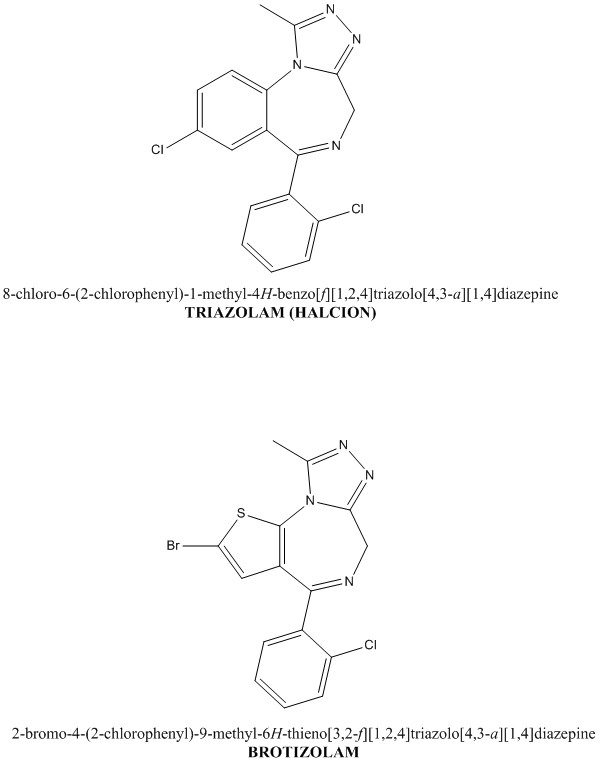
Halcion: 'The recommended dose for most adults is 0.25 mg before retiring. A dose of 0.125 mg may be found to be sufficient for some patients (e.g., low body weight). A dose of 0.5 mg should be used only for exceptional patients who do not respond adequately to a trial of a lower dose since the risk of several adverse reactions increases with the size of the dose administered. A dose of 0.5 mg should not be exceeded.'
In my experience, this makes 0.125 mg of Halcion equal to roughly 2 mg of alprazolam, or about 16 times as potent.
Brotizolam: ' It is used in the short-term treatment of severe or debilitating insomnia. Brotizolam is an extremely potent drug and has shown anti-anxiety activity at doses as low as 0.08 to 0.1 milligrams, but the usual hypnotic dose of brotizolam is 0.125 to 0.25 milligrams,[7] and it is rapidly eliminated with an average half-life of 4.4 hours (range 3.6–7.9 hours).' That makes it, in my experience, about 8 times more potent than alprazolam ( 2mg dose).Last edited:I'd say your math is way off, or you're seriously underestimating your own alprazolam tolerance.
I've said it before on other threads about alprazolam dosages, and I think this bears repeating here:
The fact that in the US, the 2mg "bar" has become the standard for a "single dose" of alprazolam, is kind of fucked up.
A bar should be enough to treat someone's anxiety over a whole day when divided into 4x0.5 mg doses. Heck, the average patient should probably try not to exceed 1 mg in total per day on average, since they're going to be experiencing diminishing returns with increased doses anyway. In some countries, 2mg xanax "bars" are even in a different Controlled Substance Schedule than the .25/.5/1mg "footballs", and thus virtually unseen except as counterfeit presses from the dark web.
As someone who was on alprazolam for years, and also tried triazolam once, I can tell you that a .25mg football of triazolam hit pretty much as hard as a .5mg football of alprazolam; there is no way that triazolam could be considered "16 times" the potency of alprazolam, unless you were mistakenly comparing daily doses (triazolam is used purely as a hypnotic, meaning it is only taken once per day at bedtime, while alprazolam can be dosed several times per day for around-the-clock anxiety relief).
Edit: That said, triazolam is different from alprazolam in that it is more selective for different subunits of the GABA receptor, so a dose that provides the same degree of anxiety relief is going to feel somewhat more sedating... but still, certainly not to the point where .125 mg of triazolam would feel as sedating as 2 mg of alprazolam.Last edited:IMO none of the information in the literature supports the notion that triazolam is 8 or even 16 times as potent as alprazolam.
The standard dose of triazolam as a sleep aid is .125 to .25mg.
If it really was 16 times as potent as alprazolam, you'd think people using xanax as a sleep aid would be told to eat a whole bar or two at bedtime, which I'm pretty sure doesn't happen. At least not anymore.
People - especially in the US - used to be fairly careless about prescribing high doses of xanax because they thought it was more benign than some of the more sedating benzos... which it may very well be, just not to the point where it would be a good idea to script someone more than 2mg per day unless their anxiety is downright crippling and they already have a certain benzo tolerance. Of course triazolam, too, used to be overprescribed. The song "Halcyon" by the British trance duo Orbital and its music video are about the artists' mother and her addiction to triazolam (sold under the brand name "Halcion").
If a doctor were to prescribe xanax for insomnia today, they probably wouldn't start off their patient on more than .5 mg per day, just like they wouldn't start someone off on more than .25 mg of triazolam.IMO none of the information in the literature supports the notion that triazolam is 8 or even 16 times as potent as alprazolam.
The standard dose of triazolam as a sleep aid is .125 to .25mg.
If it really was 16 times as potent as alprazolam, you'd think people using xanax as a sleep aid would be told to eat a whole bar or two at bedtime, which I'm pretty sure doesn't happen. At least not anymore.
People - especially in the US - used to be fairly careless about prescribing high doses of xanax because they thought it was more benign than some of the more sedating benzos... which it may very well be, just not to the point where it would be a good idea to script someone more than 2mg per day unless their anxiety is downright crippling and they already have a certain benzo tolerance. Of course triazolam, too, used to be overprescribed. The song "Halcyon" by the British trance duo Orbital and its music video are about the artists' mother and her addiction to triazolam (sold under the brand name "Halcion").
If a doctor were to prescribe xanax for insomnia today, they probably wouldn't start off their patient on more than .5 mg per day, just like they wouldn't start someone off on more than .25 mg of triazolam.
My original alprazolam scrip for was for panic attacks - 1 mg/day. A succession of doctors kept increasing it. I'm still amazed that there is no evidence of tolerance, I think most consider it to be fairly benign until you wind up in the hospital for mixing things like alcohol with it.
In my experience, 1 mg Xanax gives you 1 hour of deep sleep. Two mg = 2 hours.Last edited:Here is the chemical structure of Xanax (alprazolam) Notice the similarities with respect to the earlier posted structures, especially with regard to the chlorine atom on the 2' position of the phenyl ring. Alprazolam differs from Halcion by the absence of this chlorine atom.
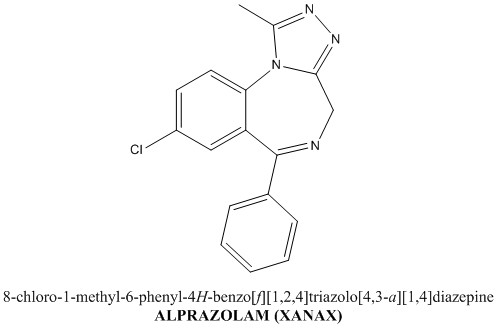 Last edited:My original alprazolam scrip for was for panic attacks - 1 mg/day. A succession of doctors kept increasing it. I'm still amazed that there is no evidence of tolerance, I think most consider it to be fairly benign until you wind up in the hospital for mixing things like alcohol with it.
In my experience, 1 mg Xanax gives you 1 hour of deep sleep. Two mg = 2 hours.
No evidence of tolerance?
Have you ever tried going off all benzos c/t for a week?
The fact that you woke up during your midazolam anaesthesia points to a significant degree of benzo tolerance (the benzodiazepines are all cross-tolerant with each other).
Also, you have to consider that benzodiazepines have non-linear dose-response curves, and people on benzos are notoriously limited in their ability to tell how strongly they are affected by the drug (what people are sometimes calling "delusions of sobriety") ...been there, done that, as they say.
At any rate, getting back to the benzo SAR's, I recently noted in a thread on clorazepate that it's interesting how the vast majority of benzos seem to have a chlorine substituent in the 7 position of the benzodiazepine ring (or the 8 position, if you go by the numbering scheme of the triazolobenzodiazepines), to the point where many of them don't even bother to put a "clo-" in their name:
Sure, there's chlordiazepoxide, clorazepate and clobazam proudly flying the flag, but on the other hand you've got diazepam, flurazepam, estazolam, midazolam, alprazolam, triazolam, tetrazepam, oxazepam, prazepam, temazepam, nordazepam, adinazolam and many others seemingly trying to hide their humble chlorine-substituted origins
I wonder if substituting alkyl groups would be possible in this position. Etizolam is a triazolo-thienodiazepine which has an ethyl group on its benzothiophene ring, although I wonder if this substitution would work on a normal benzodiazepine lacking the electronegative sulfur atom in the thiophene ring. Etizolam is, after all, pretty damn potent due to the presence of the triazole ring, but still signficantly less potent than its closest chlorine-substituted triazolobenzodiazepine analogues.Has weird substituting group been tried as BZP analogues?
i am guessing EWG pseudohalogen would work, since other strongly EWG like a nitro work.
By this i also include one that substituted diredtly onto the ring, eg. Pyridinyl instead of Phenyl.By this i also include one that substituted diredtly onto the ring, eg. Pyridinyl instead of Phenyl.
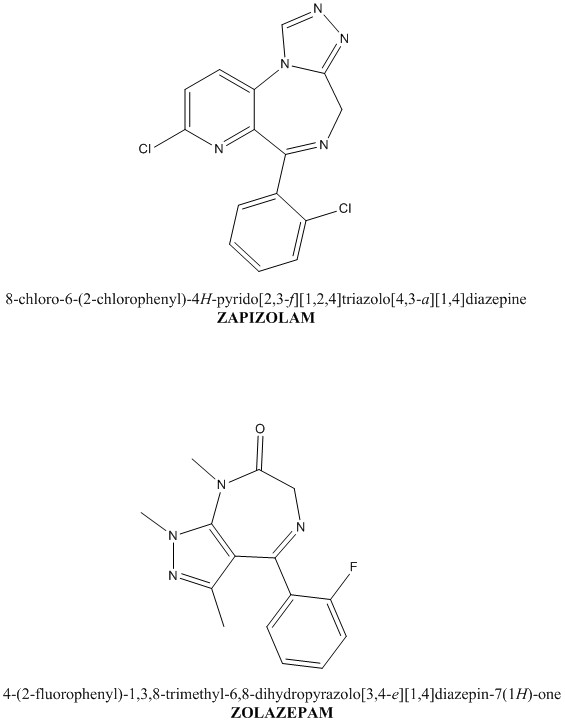
There is a pyridodiazepine called zapizolam, which I don't think was ever sold as a legit pharmaceutical, but was apparently banned in Sweden some time ago, so presumably it was made available as an RC at some point. No idea about the effects though.
https://en.wikipedia.org/wiki/Zapizolam
Zolazepam, on the other hand, is known to be approximately 3 times as potent as diazepam, and is commonly used as an animal tranquilizer in conjunction with the dissociative tiletamine under the brand name "telazol".
Here, the diazepine ring is fused to a dimethylpyrazole ring without any additional EWG's on it. It is water-soluble but will still rapidly penetrate the blood-brain-barrier, which are obviously desirable qualities for a substance intended to rapidly knock out animals upon IM administration.
https://en.wikipedia.org/wiki/ZolazepamNo evidence of tolerance?
Perhaps some in that I'm taking 4 mg/night as compared to 40 years ago I was taking flurazepam for sleep, not Xanax. The danger here is that flurazepam is supposed to be long-lasting while Xanax is only 1-2 hours. Getting up to go pee while hung on flurazepam sounds dangerous to me. Falls in the bathroom get you EMS rides to trauma hospitals which in my area are nearly an hour's drive away. I fell down a short flight of stairs into the garage while on Ambien & it compression fractured several of my lumbar vertebrae which means I'm now 2.5 inches shorter.
Have you ever tried going off all benzos c/t for a week?
No, nor would I try that. I go to sleep usually with no benzo in my system, but that only lasts 1-2 hours, when I have to get up to pee. It's then I need 2 mg to get back to sleep. With no benzo I would be a zombie trying to deal with 1-3 hours of sleep/night, which is very unpleasant. And insomnia is one of the effects of benzo withdrawal. I also suffer from nocturnal polyuria. Humans produce more urine at night & by urodynamic measurement 4 years ago my bladder capacity is only about 100 cc, so I'm up at least twice at night to pee & wake up with a partially full bladder.
The fact that you woke up during your midazolam anaesthesia points to a significant degree of benzo tolerance (the benzodiazepines are all cross-tolerant with each other).
It's interesting that I also apparently developed tolerance to non-benzo fentanyl on the third experience. No wonder people OD on this popular stuff.
Propofol is my anesthetic of choice now. Rapid onset, quick recovery, no hangover. But you need a full-time anesthesiologist to give you oxygen & monitor your vital signs.Last edited:I'd be interested in evaluating an azido (Nsub3) group in place of the main ring system chlorine. I've seen nitro. Another EWG that is of interest to me is CFsub3. I'm sure they've all been made & evaluated. Too potent or toxic?
Azido is electron donating, which is why it doesn't appear. Here is a table of EWGs:
Magnitude of the EWG effect
Substituent Name Structure Strong: Triflyl-SO2CF3, trihalides-CF3, -CCl3 cyano groups-C≡N, sulfonates-SO3H, nitro group-NO2, ammonium-NH3+, ammonium (quaternary amine)-NR3+. Moderate: aldehyde-CHO, ketones-COR, carboxylic acid-COOH, acyl chloride-COCl, esters (benzoate)-COOR, amide-CONH2 Weak: halides-F, -Cl, -Br, -ILast edited:Zolazepam[1] (Flupyrazapon) is a pyrazolodiazepinone derivative structurally related to the benzodiazepine drugs, which is used as an anaestheticfor a wide range of animals in veterinary medicine. Zolazepam is usually administered in combination with other drugs such as the NMDAantagonist tiletamine or the α2 adrenergic receptor agonist xylazine, depending on what purpose it is being used for. It is around four times the potency of diazepam (0.32 mg/kg versus 1.2 mg/kg in animal models) but it is both water-soluble and un-ionized at physiological pH meaning that its onset is very fast.[2]
Zolazepam was developed by Horace A. de Wald and Donald E. Butler for Parke-Davis[3] and was the result of a very detailed analysis of the benzodiazepine structure (U.S. Patent 3,558,605 filed in 1969).
Zolazepam, in combination with tiletamine, has been used in the tranquilization of wild animals, such as gorillas and polar bears, and has been found to be superior to ketamine because of reduced side-effects.[4][5] A 1:1 mixture of zolazepam and tiletamine is sold under the name Telazol.
========================================================
The interesting thing here is that I know Don Butler & called on him at the Pfizer facility in Holland, MI. He's a good friend but I haven't talked to him in years. He also invented the process for making Lipitor (atorvastatin) for controlling cholesterol biosynthesis.
- Status
- Not open for further replies.