-
Neuroscience & Pharmacology Discussion Welcome Guest
Posting Rules Bluelight Rules Recent Journal Articles Chemistry Mega-Thread FREE Chemistry Databases! Self-Education Guide -
N&PD Moderators: Skorpio
You are using an out of date browser. It may not display this or other websites correctly.
You should upgrade or use an alternative browser.I Like to Draw Pictures of Random Molecules
- Thread starter nuke
- Start date
- Status
- Not open for further replies.

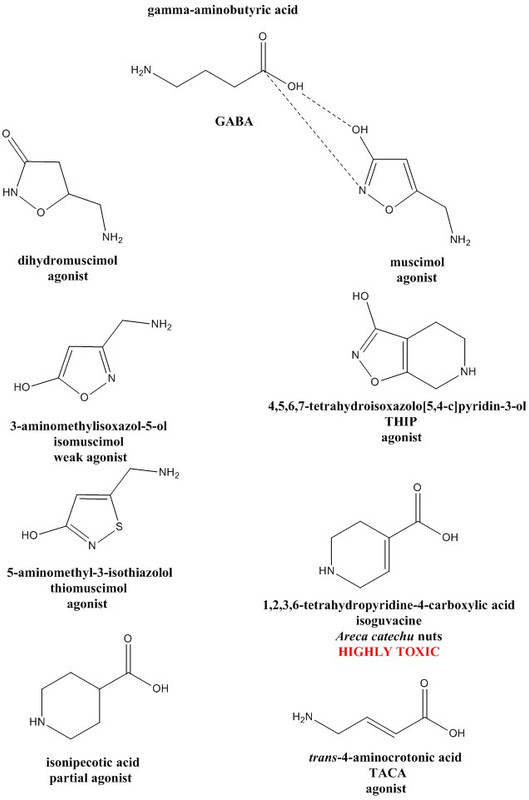
 ^ in the correlation above; carbonyl C in GABA should be dotted into carboximino C in muscimol, not at N. They are isostere.
Isoguvacine is not toxic as a gaba agonist, but by other mechanism. (Being michael acceptor to unknown amino group target) causing cancer.
Isonipecotic acid main action to raise gaba isnt acting as direct agonist, but as GATI.Here's a summary breakdown of the phytochemicals found in Passion Flower:
Constituents:Alkaloids; harmine, harman, harmol, harmaline, harmalol, and Passiflorin.
Flavonoids: apigeninand various glycosides, homoorientin, isovitexin,kaempferol, luteolin, orientin, quercitin, rutin, saponaretin, saponarin and vitexen.
Chemical Composition:Alkaloids,Apigenin,Carbohydrates,Coumarins,Flavonoids,Fructose,Glucose,Gum,
Harmaline,Harmalol,Harman,Harmine,Maltol,Plant alcohols,Orientin,Raffinose,
Saponaretin,Saponarin,Scopoletin,Stigmasterol,Sitosterol,Sterols,Sucrose,Umbelliferone,Vitexin.
Phytochemicals:
Chemical analysis on Passionflower indicates it contains three main groups of active chemicals: alkaloids, glycosides, and flavonoids. Interestingly, when the glycosides and flavonoids are isolated and tested individually they have demonstrated the opposite effects for which the plant is commonly used for. Only when the two groups of chemicals are combined as a whole herb, do researchers observe the plant's sedative effect. Passionflower also contains naturally occurring serotonin as well as a chemical called maltol which has documented sedative effects (and which might explain the naturally calming properties of passionflower). A group of harmane alkaloids in passionflower have demonstrated antispasmodic activity and the ability to lower blood pressure. In addition, a flavonoid named chrysin has demonstrated significant antianxiety activity.
The main plant chemicals in passionflower include: alkaloids, alpha-alanine, apigenin, aribine, chrysin, citric acid, coumarin, cyclopassifloic acids A-D, cyclopassiflosides I-VI, diethyl malonate, edulan I, edulan II, flavonoids, glutamine, gynocardin, harmane, harmaline, harmalol, harmine, harmol, homoorientin, isoorientin, isoschaftoside, isovitexin, kaempferol, loturine, lucenin-2, lutenin-2, luteolin, n-nonacosane, orientin, passicol, passiflorine, passifloric acid, pectin, phenolic acids, phenylalanine, proline, prunasin, quercetin, raffinose, sambunigrin, saponarin, saponaretin, saponarine, schaftoside, scopoletin, serotonin, sitosterol, and stigmasterol.
There is some controversy over the exact composition of P. incarnata. Approximately 2.5 percent appears to be flavonoids such as vitexin, orientin, homo-orientin, saponarin, schaftoside, and a few others as glucosides, together with free flavonoids including apigenin, luteolin, quercetin, and kaempferol.
In Europe, passionflower is required to contain not less than 0.8 percent total flavonoids, calculated as vitexin.
The harman alkaloids that have been identified by some chemists are disputed by others. Umbelliferone, scopoletin, and maltol have been reported.
An antifungal, antimicrobial compound dubbed passicol is found in fresh plant matter but dissipates quickly from the dried herb or aqueous extract.
======================================================
Harmaline is psychoactive: https://en.wikipedia.org/wiki/Harmaline
Harmine inhibits the enzyme MAO-A: https://en.wikipedia.org/wiki/Harmine
Harman (Harmane) is another MAO inhibitor & acts at the benzodiazepine receptor
Harmalol is a scheduled poison. See https://en.wikipedia.org/wiki/HarmalolLast edited:^ prodrug of amphetamine?. like Captagon? aka phenethylline ie Chocolate(theophylline) conjugated to amphetamine aka ISIS amphetamine) .. interesting
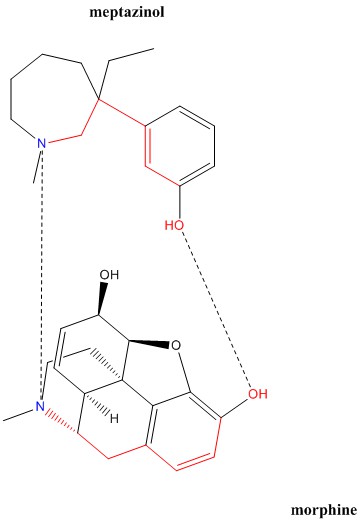
Meptazinol, a very simple opioid analgesic.
kind of not too active tho..mixed agonist-antagonist half codeine ??!!
Not so much by reaction with amino groups in proteins (most amino groups of proteins are charged at physiological pH so not so reactive.. But on the other hand, thiols of proteins cysteine residues are extremely reactive towards michael acceptors like those.. they'll react pretty much indiscriminately with SH to give covalent adducts and wreak HAVOC.. cancer is one.. liver necrosis .. hypoxia and brain death..etc pretty nasty compounds..^..Isoguvacine is not toxic as a gaba agonist, but by other mechanism. (Being michael acceptor to unknown amino group target) causing cancer...
Here's a summary breakdown of the phytochemicals found in Passion Flower:
..In Europe, passionflower is required to contain not less than 0.8 percent total flavonoids, calculated as vitexin.
The harman alkaloids that have been identified by some chemists are disputed by others. Umbelliferone, scopoletin, and maltol have been reported.
An antifungal, antimicrobial compound dubbed passicol is found in fresh plant matter but dissipates quickly from the dried herb or aqueous extract.
======================================================
Harmaline is psychoactive: https://en.wikipedia.org/wiki/Harmaline
Harmine inhibits the enzyme MAO-A: https://en.wikipedia.org/wiki/Harmine
Harman (Harmane) is another MAO inhibitor & acts at the benzodiazepine receptor
Harmalol is a scheduled poison. See https://en.wikipedia.org/wiki/Harmalol
Good to know passion flower extracts contains harman alkaloids besides flavonoids.. That explains why they're as good as benzo as anxiolytics.. Lots of harmans are BZ receptors modulators: Harmine is believed to be endogenous benzodiazepine receptor ligand (agonist).. but there's lot of controversy with harman alkaloids.aspiringdrugdesign
Bluelighter
- Joined
- Jul 5, 2017
- Messages
- 67
little known Cannabis molecules:
Cannabisativine (isolated from roots bark of sativa not the buds!):

Looks (remotely) like anandamide (endogenous cannabinoid receptor ligand) could be CB agonist or antagonist.. anybody knows anything about this compound??
Here is Anandamide :

A 13 member cyclic ring, well I neveraspiringdrugdesign
Bluelighter
- Joined
- Jul 5, 2017
- Messages
- 67
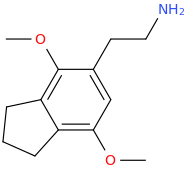
DotChem, would it be a prodrug of amphetamine or would it have pi stacking similar to NBOMe's n-benzyl functions?aspiringdrugdesign
Bluelighter
- Joined
- Jul 5, 2017
- Messages
- 67
@Pomzazed,
There's nothing wrong with it, I just feel like they're not a common sight especially when it comes to medicines and drugs. Wouldn't it be slightly unstable and prone to breaking open at the amide?
which structure? the one mentioned by @roi: yeah I think so: it might get metabolized (first pass by the liver) into 4-FA and ortho-chlorobenzaldehyde (and further to o-Chlorobenzoic acid) so it is really a prodrug of 4-Fluoroamphetamine (4-FA). Similar to phenethylline (gets metabolized to amphetamine and theophylline or caffeine) or lysdexamphetamine (metabolized to dextro-AMPH and Lysine).. I dont see no advantages of AMPH prodrugs over plain d-AMPH beside going around legal issues and the law..DotChem, would it be a prodrug of amphetamine or would it have pi stacking similar to NBOMe's n-benzyl functions?
The 13-member macrocycle I mentioned was extracted from cannabis sativa strain roots. Was wondering if it may have any psychoactivity at all..but who knows?.. yeah the synthesis will be tricky (may be high dilution techniques may help).. but then again, since it can be extracted from cannabis..cheaper than synthesis.. here is one route (AMAZINGLY complex.. a PhD student thesis maybe): Total Synthesis of Cannabisativine .. have a good day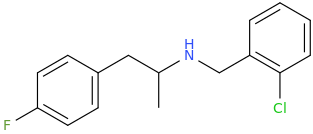
Fluclobenzorex. Fluzx? Kinda surprising that there haven't been any (?) NBCl RCs, given that Clobenzorex is a known pharmaceutical and orally active and stuff.
The ortho-chlorobenzyl group is an interesting choice. It would likely be somewhat slower to metabolize to the amphetamine than if a simple N-benzyl group were present. If one were trying to make a phenethylamine prodrug of this type with the intention of having the prodrug cleaved as quickly possible, I would go for an ortho- or para-methoxy benzyl. Perhaps this is why the 25I series tends to be fairly ineffective when taken orally: they are rapidly transformed into their 2C-x equivalents, drugs that are active at much larger doses.@Pomzazed,
There's nothing wrong with it, I just feel like they're not a common sight especially when it comes to medicines and drugs. Wouldn't it be slightly unstable and prone to breaking open at the amide?
No.
There is very few ring strain energy in 13-membered cycles, even lower than a 5 or 7 membered ring! It is large enough to "act much alike a straight chain" already
See number on the table in this wiki link and follow ref[4] if you are interested:
https://en.wikipedia.org/wiki/Ring_strain
The only hard part is to make it out; they just don't like to cyclize in large cycles due to the many loss of dS due to the loss in degree of freedom from a loss of "conformational modes" the ring-atom-members could have been
(just a hint: dG = dH - TdS)Limpet_Chicken
Bluelighter
I wouldn't even compare meptazinol to 0.5~ codeine. Only thing remotely interesting about it IMO is that its selective IIRC for the MOR1 isoform.
Tried it, and you couldn't pay me to take it again, felt like it was ripping me a whole new set of arseholes. Due to the free phenol, perhaps. I recall years ago, preparing the benzoyl and the propionyl ester, can't remember which of them it was that got tried, but general thinking was along the lines of being inspired by aspirin, to reduce potential GI side effects, seemed to fly, in that respect, but it was an exercise in turd-polishing to be quite honest. Both of them got made, one of them went down the bog, well, chucked both of them IIRC, but one of them was tested in-vivo and found to be as pointless and unrewarding as the parent compound, minus the awful GI effects.I take 145 mg of
![O-isopropyl-2-[4-(4-chlorobenzoyl)phenoxy]-2-methyl-propanoic%20acid.png](/community/proxy.php?image=https%3A%2F%2Fopsin.ch.cam.ac.uk%2Fopsin%2FO-isopropyl-2-%5B4-%284-chlorobenzoyl%29phenoxy%5D-2-methyl-propanoic%2520acid.png&hash=031cbcfa358679d4cac4577a67c545f3)
TRICOR (fenofibrate)
every AM for high blood triglycerides.
I'd be careful taking this long term, especially if you take other things that affect your liver: alcohol, statins, azole antifungals. See The side effects of fibrates include nausea, stomach upset, and sometimes diarrhea. Fibrates can irritate (inflame) the liver. The liver irritation usually is mild and reversible, but it occasionally can be severe enough to require stopping the drug. Fibrates can cause gallstones when used for several years.I don't agree. I don't have my original source for that receptor correlation but I did find this:
https://www.sciencedirect.com/topics/neuroscience/muscimol
Muscimol is a conformationally restricted analog of GABA in which a hydroxyisoxazole moiety replaces the carboxyl group of GABA. The 3-hydroxyisoxazole is recognized as a carboxyl group equivalent by GABAA and GABAC receptors but not by GABABreceptors. The neuronal GABA uptake system recognizes the 3-hydroxyisoxazole moiety, in that muscimol is a weak inhibitor of GABA uptake but is neither an inhibitor of nor a substrate for GABA aminotransferase, indicating that this enzyme does not interact with the 3-hydroxyisoxazole moiety.Meptazinol isomer - pure agonist? Known compound but could find no info on biological activity. I would think this stuff would act as a pure opioid agonist. But a study I read says that the isomers of meptazinol have equal activity (structures not identified). Ortho, meta, para hydroxy forms? Last edited:
- Status
- Not open for further replies.