• MDMA &
    Empathogenic
    Drugs

    Welcome Guest!
  • MDMA Moderators: Esperighanto

How we rolled in the 90s when the pills were super strong

Slightly modified version but very close to what you think.

1.Salt type
2.Isomers
3.Binders
4.Impurities from synths
5.Crystal structure
6.How compacted the pill is
7.Adulterants
8.Dose
9.Fillers (pseudo, sugars)(could argue this is adulterant)

Wow, these are just physical variants of the drug that can effect a roll. Think of all the other variables that exist. For example individual biological, such as different metabolism of isomers, tolerance, time from previous roll) or psychological (placebo effects, expectations, mind set) and on and on and on.

To accurately compare the effects of different compounds you are either going to have to control for all these variables or get true random sampling of subjects. And you will have to determine the group size and power of experiment; just how significant of differences are you looking for (larger sample sizes produce significant differences with smaller effects). And would subjects just experience one of the different compounds or would same subjects be comparing different? Then you would have to give different compounds in different orders.

Man, it's hard enough for me just by myself to compare different doses, pre-loads, etc. because for one thing it's not a blind study and my comparisons and memories of rolls I know effect my judgement. (ie I consider the first roll the best, but was it really...)
 
Last edited:
What kind of wine did you try it with avcpl?

Did you also try sugar with it?

What was the mix MDMA Xtal or pill?

port wine, which is red. once there was some sugar (as had some ginger soda at the same time). Both rolls within the "average" range. The thing is a lot of these things reported "work" and do it fantastically and many members report.

BUT, are the results replicable? Are you getting the same level of increase in the subjective "roll" every time you roll with the technique?

I posted a thread asking users of piracetam if the restoration of the "magic" continued for each and every roll after, but didn't get any responses.

A lot of these tricks are due to novelty/expectations/placebo effect, which is great for them, but how many continue to hold up use after use?
 
Hello Avcpl

thanks for getting back to me on this.

I posted a thread in reaction to your comments. There is a science behind this. All the details are on the thread. Would rally appreciate it if you could add your comments on there also.

This one will require a group response to hash it out.

Be interested to see what results come back :)
 
I feel my unusual history with this substance is worthy of contribution to this thread.

I missed most of the 90's but not all of it. I consumed mdma (in pills) about 5 times in total, and got the full magic as would be expected. I then basically left everything except weed alone for 15 or so years. Over the last year and a half I have got (a little too heavily) into pure mdma crystal only, but that is the subject of another thread. The contribution here is that the peak solo experience I had which changed my life (killed long term depression) happened near the start of this recent exploratory journey. What I am saying is from my perspective the mdma has not deteriorated somehow, where this perspective is nothing more than one where excessive use in the 90s didnt happen.

Hope this contribution is of some minor value xx

My speculation, and it is only this, is that maybe the older pills had more unreacted MDA precursor in content, which in some ways is more potent than MDMA. The longer 4 hour buzz before feeling any tail off mentioned by several seems reasonable evidence of this. I apologize in advance if the higher % of MDA theory has already been put to bed, I haven't read the whole thread.
 
No worries trytamine all input on here is welcome. The thread is way to long to read the whole thing. Interesting to hear MDMA having some kind of theraputic effect.

My speculation, and it is only this, is that maybe the older pills had more unreacted MDA precursor in content,

Most of us speculate here every now and again a chemist chimes in and sets things right so add all the theories you can. My theory is - In the 90s Piperonal was a much more available and unwatched precursor. The piperonal to MDA route is relatively easy. Strikes book total synthesis 1 covers the topic of MDA well. (if you have a pdf copy of this book by the way please let me know)

The big question is would a chemist then go MDA > MDMA? or leave the MDA as active product and then use more piperonal and go piperonal > MDMA? I think MDA > MDMA would be an unusual choice.

In a clan lab time is of the essence. Active product is ready to go. Why synth it more?

As a result I am not sure if your theory would be a majority situation. Always possible of course. And yes MDA > MDMA is of course very possible I am just not sure about the motives to do it in most cases.
 
As far as I'm aware you wouldn't need any more expensive methylene-dioxy precursors (MDA, safrole, piperonal, MDP2P etc) to go from MDA to MDMA, it would just be extra time. The only motivation to take this extra step is the completely different drug that results. MDA is very amphetamine like, while MDMA is not. It is just the addition of a single carbon atom to go from MDA to MDMA. Although such additions are never that simple...

I will search around for that book... I saw the American news show thing (available on youtube) where they 'exposed' Strike, which is highly entertaining itself. I have friends who thought it was spoof. But it really is the case that serious American shows are presented in that way. Shocking and funny at the same time. Highly recommended!
 
As far as I'm aware you wouldn't need any more expensive methylene-dioxy precursors (MDA, safrole, piperonal, MDP2P etc) to go from MDA to MDMA

You are right here.

it would just be extra time

and product loss also.

The only motivation to take this extra step is the completely different drug that results

Why not just go from piperonal or equiv direct to MDMA?

The only motivation to take this extra step is the completely different drug that results

Not so sure. Product is product. Average raver at the time didnt care. No pillreports etc then.

I will search around for that book... I saw the American news show thing (available on youtube) where they 'exposed' Strike, which is highly entertaining itself. I have friends who thought it was spoof. But it really is the case that serious American shows are presented in that way. Shocking and funny at the same time. Highly recommended!

thanks in advance for the search.

Your friends have a point I dont think it was a spoof as Hobart was registered on the US jail database for release I think in 2009. Of course this could be a setup.

Although I would agree although entertaining it all seemed very very suspect. I kind of wondered if the whole Hive strike thing was a DEA sting? if you think about it an awesome way to sniff out all the chemists in the USA. Since the whole Hive / Science Alliance went down the Ecstasy scene in the USA turned into total junk. Only the mint and pokeballs survived.

Would any ex MDMA chemist honestly set up a drug synth forum (the first), write a book about sources and then set up a chemical suply house in TEXAS of all places?

If you look at this document

http://www.erowid.org/archive/rhodium/chemistry/mda.dalcason.html

The DEA were not afraid of revealing MDMA guide books. Many argue this document is as informative as Strikes book hence why it is still on Erowid to this day.

Whats to stop the DEA from publishing Total Synthesis, Setting up the Hive and then supplying every drug supplier in the country with all the chemicals they require. once you build a trust and fan base on this level you have the entire American Underground at your fingertips.

The bee on strikes desk, the interview, MBC does their homework man, his sisters taking chemistry degrees, his smiley face in the interview, the dry wipe board for the 'suspicious' orders, That just ridiculous scene where by a dude allows the students to video tape him selling industrial glassware and a schedule 1 chemical 11 litres of safrol, basically all the kit they need to set up an industrial scale E lab. he even agrees the sale on tape. No way just simply would not happen!!

And this coming from a already convicted felon who has served time. written Sources for fucks sake telling you how not to get caught.

If I am honest I truly beleive this was the biggest and smartest sting the DEA has ever done. When the hive went down the entire US ecstasy world went down with it.

Thats my theory.
 
MDA is very amphetamine like, while MDMA is not.

Well it is much more dopaminergic, but I've always found MDA to be MUCH more flooring that MDMA. Last time I took it I was melting into the floor for like 3 hours lol

MDEA sounds like a great time, but I've only had it in low doses so far. I would REALLY love to see more MDxx compounds on the market... but of course, I would like them sold as MDA or MDE and not just "ecstasy"


I'm not even going to try and debate the chemistry of this though... simply don't have the motivation to do the hours of research on chemistry that I would need to be able to effectively weigh in here without just guessing.. maybe after a few chemistry classes, eh?
 
MDEA sounds like a great time, but I've only had it in low doses so far. I would REALLY love to see more MDxx compounds on the market... but of course, I would like them sold as MDA or MDE and not just "ecstasy"


MDEA isn't much fun, it's a smashed wasted drunkish feeling I don't dig it e.g.Pink Rockstars.
 
Some people report that they don't like MDE, but I think I'd like it (in pure form, the Rockstars were MDMA + MDE + Caffeine). It's supposed to be a nice mellow and almost "stoney" roll, I LOVE being floored so I think me and Eve would get along. I bet it would go amazing with some LSD

It's next to impossible to find MDE. MDA and MDMA aren't as hard to find, but I don't think I'll ever get to try MDE :(


MBDB is another cool MDxx that was out in the 90s that I'd want to try as well. I will say, the diversity of pills in the 90s was a lot better... but that was before reagents and GC/MS testing made the market MDMA only


#106 MDE
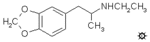
MDEA; EVE; N-ETHYL-MDA; 3,4-METHYLENEDIOXY-N-ETHYLAMPHETAMINE

SYNTHESIS: (from MDA)

DOSAGE: 100 - 200 mg.

DURATION: 3 - 5 h.

QUALITATIVE COMMENTS: (with 100 mg) There was a warm light all about me. And a gentle, almost alcohol-like, intoxication. The drug seems to change my state of awareness, but it does nothing else. The world is as intense or as dull as I choose to make it. At the 1.5 hour point I was clearly dropping, and an hour later yet, completely without residue.

(with 160 mg) The first effects were felt in forty minutes and I seemed to be completely there by the end of that first hour. There was an initial slightly dizzy intoxication, and then I felt very nice. A good intoxication, with maybe a little motor incoordination. There was absolutely no appetite at all. The next morning there was still some feeling of elation but I was still very relaxed. High marks for the quality of the experience.

(with 160 mg) Overall this was a wonderful experience. I felt that the effect was stronger and smoother than MDMA, but perhaps the group enhancement may be partly responsible. I felt definitely fewer physiological side-effects than with MDMA, particularly the urinating problem; although there was dehydration, there was less burning annoyance.

(with 160 mg) I was hard hit, to the extent that there was difficulty in verbalizing and following other people's thoughts. I entered the experience with some cold symptoms, and my sore throat disappeared. I felt quite intoxicated and tranquilized.

(with 200 mg) Very stoned. There was some nausea in the beginning of the experience. As it developed I found it very difficult to concentrate on what I was thinking or saying simply due to the extraordinary nature of coming on to this material. There is noticeable jaw-clenching and rice crispies in the ears. This is a meditative material not unlike MDMA except there are more difficulties in forming words. And there is a problem in focusing the eyes, what I want to call `eye-romp.' My anorexia was extremely long-lived-- perhaps a total of 72 hours. This may have been too high a dosage.

EXTENSIONS AND COMMENTARY: This immediate homologue of MDMA has a very similar chronology but requires a slightly larger dose. Another similarity is the occasional report of teeth clenching, especially following the use of supplemental dosages intended to extend the effects of the drug. These supplements have been explored in the 50 to 75 milligram range, usually at the two hour point. In one unpublished clinical experiment with MDMA, an extension was attempted at the 1 hour 45 minute point with MDE rather than with MDMA, to see if there was any change in the qualitative character of the experience. The effective time of intoxication was extended, but the group fell surprisingly quiet, with a drop in the usual urge to converse and interact.

The effects of MDE are similar in many ways to those of MDMA, but there are believable differences. The particular magic, and affective transference, does not appear to be there. There is a stoning intoxication, as there is with MDA, and there is a seemingly unrewarding aspect to the upping of the dosages, again similar to MDA, and the properties of unusually easy communication and positive self-viewing of MDMA seem to be absent. Maybe the "S" isomer would have these properties, and they are lost in the racemate due to something coming from a more potent "intoxicating" "R" isomer. The optical isomers have never been evaluated separately in man.

There are only two ways in which two drugs can interact to produce a result that is not obvious from the summing of their individual actions. One is the process of synergism, where two active materials are allowed to interact within a single individual and at one time, and the consequence of this interaction is different than that which would have been expected. The other is the process of potentiation, where only one drug is active, but the presence of the second (and inactive) drug enhances the observed action of the first. MDE seems to fall in the first category.

The "piggy-back" or "window exploitation" studes were first discovered and explored with MDE, and have subsequently been extended most successfully with MDMA. The earliest procedure used was to assay modest quantities of active materials at the drop-off period of MDE, to exploit the open and benign state that was present. Usually, only a fraction of the standard dosage of the following drug was necessary to evoke a full experience. In psychotherapy applications, this sequence has been frequently used with MDMA followed by a second material that has been chosen to modify and expand the opening that the MDMA produced.

With the placement of MDMA under legal control in 1985, MDE occasionally appeared in the illicit street trade. It had been called EVE, which carries some perverse logic in light of the nickname used occasionally for MDMA, which was ADAM. The term INTELLECT has been used for it as well, but there has been no apparent reason advanced for this. And a final note on nomenclature. An old literature use of the code MDE was for the compound 3,4-methylenedioxyethanol-amine. See the discussion on this under the recipe for DME.

I have been told of an analogue of MDE that has been synthesized, and explored by the researcher who synthesized it. It contains the N-trifluoroethyl group common to several pharmaceuticals such as Quazepam. The analogue is 3,4-methylenedioxy-N-(2,2,2-trifluoroethyl)amphetamine hydrochloride (mp 207-209 °C) which was made from 2,2,2-trifluoroethylamine and 3,4-methylenedioxyphenylacetone and sodium cyanoborohydride in methanol. The best final line for this compound is that it is "possibly active." The most heroic dosage schedule mentioned was a total of 500 milligrams, taken in three approximately equal portions over the course of five or six hours, with only a very mild intoxication and little or no sympathomimetic effects. And what little there might have been was quickly gone. A collection of totally unexplored N-substituted homologues and analogues of MDE is gathered at the end of the recipe for MDBZ.

Another direction that has been used to homologate the MDMA and MDE structure is with the length of the aliphatic chain that carries the phenyl ring and the amine function. RHS shows the two-carbon chain, "I" shows the amphetamine chain length, and MDE can be called ETHYL-I. The four-carbon chain is the RJS group, and this entire Muni-Metro concept is explained under METHYL-J.
 
Last edited:


#100 MDA
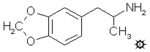
3,4-METHYLENEDIOXYAMPHETAMINE

SYNTHESIS: (from piperonal)

DOSAGE: 80 - 160 mg.

DURATION: 4 - 6 (revised, Sep 2001).

QUALITATIVE COMMENTS: (with 100 mg) The coming on was gradual and pleasant, taking from an hour to an hour and one half to do so. The trip was euphoric and intense despite my having been naturally depleted from a working day and having started so late. One thing that impressed itself upon me was the feeling I got of seeing the play of events, of what I thought to be the significance of certain people coming into my life, and why my `dance', like everyone else's, is unique. I saw that every encounter or event is a potential for growth, and an opportunity for me to realize my completeness at where I am, here and now, not at some future where I must lug the pieces of the past for a final assemblage `there.' I was reminded of living the moment to its fullest and I felt that seeing this was indicative that I was on the right track.

(with 128 mg) Forty-five minutes after the second dosage, when I was seated in a room by myself, not smoking, and where there was no possible source of smoke rings, an abundance of curling gray smoke rings was readily observed in the environment whenever a relaxed approach to subjective observation was used. Visually these had complete reality and it seemed quite unneccessary to test their properties because it was surely known and fully appreciated that the source of the visual phenomena could not be external to the body. When I concentrated my attention on the details of the curling gray forms by trying to note how they would be affected by passing a finger through their apparent field, they melted away. Then, when I relaxed again, the smoke rings were there. I was as certain that they were really there as I am now sure that my head is on top of my body.

(with 140 mg) I vomited quite abruptly, and then everything was OK. I had been drinking probably excessively the last two days, and maybe the body needed to unpoison itself. The tactile sense is beautiful, but there seems to be some numbness as well, and I feel that nothing erotic would be do-able. Intimacy, yes, but no performance I'm pretty sure. I saw the experience start drifting away only four hours into it, and I was sad to see it go. It was an all around delightful day.

(with 200 mg, 2x100 mg spaced 1 h) The first portion was apparent at one-half hour. There was microscopic nausea shortly after the second portion was taken, and in an hour there was a complete +++ developed. The relaxation was extreme. And there seemed to be time distortion, in that time seemed to pass slowly. There was a occasional LSD-like moment of profoundness, but by and large it was a simple intoxication with most things seeming quite hilarious. The intoxication was also quite extreme. Some food was tried later in the experiment, and it tasted good, but there was absolutely no appetite. None at all.

(with 60 mg of the "R" isomer) There was a light and not too gentle development of a somewhat brittle wound-up state, a + or even a ++. Chills, and I had to get under an electric blanket to be comfortable. The effects smoothed out at the fourth hour, when things started to return to baseline. Not too entertaining.

(with 100 mg of the "R" isomer) Rapid development from the 40 minute point to an hour and a quarter; largely a pleasant intoxication, but there is something serious there too. No great insights, and not too much interference with the day's goings-on. Completely clear at the 8 hour point.

(with 120 mg of the "R" isomer) This is a stoning intoxicant. I would not choose to drive, because of possible judgement problems, but my handwriting seems to be clear and normal. The mental excitement dropped rapidly but I was aware of physical residues for several additional hours.

(with 80 mg of the "S" isomer) A very thin, light threshold, which is quite delightful. I am quite willing to push this a bit higher.

(with 120 mg of the "S" isomer) Perhaps to a one +. Very light, and very much like MDMA, but perhaps shorter lived. I am pretty much baseline in three hours.

(with 160 mg of the "S" isomer) The development is very rapid, and there is both muscular tremor and some nausea. The physicals are quite bothersome. With eyes closed, there are no effects noticeable, but with eyes open, things are quite bright and sparkling. The muscular spasms persist, and there is considerable teeth clenching. I feel that the mental is not worth the physical.

EXTENSIONS AND COMMENTARY: There are about twenty different synthetic routes in the literature for the preparation of MDA. Many start with piperonal, and employ it to make methylenedioxyphenylacetone or a methylenedioxydihydro-cinnamic acid amide instead of the nitrostyrene. The phenylacetone can be reduced in several ways other than the cyanoborohydride method mentioned here, and the amide can be rearranged directly to MDA. And there are additional methods for the reduction of the nitrostyrene that use no lithium aluminum hydride. Also there are procedures that have safrole or isosafrole as starting points. There is even one in the underground literature that starts with sassafras root bark. In fact, it is because safrole is one of the ten essential oils that MDA can humorously be referred to as one of the Ten Essential Amphetamines. See the comments under TMA.

There is a broad and checkered history concerning the use and abuse of MDA, and it is not the case that all the use was medical and all the abuse was social. One of the compulsive drives of both the military and the intelligence groups, just after World War II, was to discover and develop chemical agents which might serve as "truth serums" or as incapacitating agents. These government agencies considered the area of the psychedelics to be a fertile field for searching. The giving of relatively unexplored drugs in a cavalier manner to knowing and unknowing subjects was commonplace. There was one case in 1953, involving MDA and a psychiatric patient named Howard Blauer that proved fatal. The army had contracted with several physicians at the New York State Psychiatric Institute to explore new chemicals from the Edgewood Arsenal and one of these, with a chemical warfare code number of EA-1298, was MDA. The last and lethal injection into Blauer was an intravenous dose of 500 milligrams.

There have been a number of medical explorations. Under the code SKF-5 (and trade name of Amphedoxamine) it was explored as an anorexic agent. It has been found promising in the treatment of psychoneurotic depression. There are several medical reports, and one book (Claudio Naranjo's The Healing Journey), that describe its values in psychotherapy.

MDA was also one of the major drugs that was being popularly used in the late 1960's when the psychedelic concept exploded on the public scene. MDA was called the "hug-drug" and was said to stand for Mellow Drug of America. There was no difficulty in obtaining unending quantities of it, as it was available as a research chemical from several scientific supply houses (as were mescaline and LSD) and was sold inexpensively under its chemical name.

A few experimental trials with the pure optical isomers show a consistency with all the other psychedelic compounds that have been studied in their separated forms, the higher potency with the "R" isomer. The less potent "S" isomer seemed to be more peaceful and MDMA-like at lower doses, but there were worrisome toxic signs at higher levels.

The structure of MDA can be viewed as an aromatic ring (the 3,4-methylenedioxyphenyl ring) with a three carbon chain sticking out from it. The amine group is on the second of the three carbon atoms. The isomers, with the amine function moved to the first of these carbons atoms (a benzylamine) and with the amine function moved to the third (furthest out atom) of these carbon atoms (a (n)-propylamine), are known and both have been assayed.

The benzylamine counterpart (as if one were to move the amine function from the beta-carbon to the alpha-carbon of the three carbon chain of the amphetamine molecule) is alpha-ethyl-3,4-methylenedioxybenzylamine or 1-amino-1-(3,4-methylenedioxyphenyl)propane, ALPHA. The hydrochloride salt has a mp of 199-201 °C. At low threshold levels (10 milligram area) there were eyes-closed "dreams" with some body tingling. The compound was not anorexic at any dose (up to 140 milligrams) and was reported to produce a pleasant, positive feeling. It is very short-lived (about 3 hours). The N-methyl homologue is alpha-ethyl-N-methyl-3,4-methylenedioxybenzylamine or 1-methylamino-1-(3,4-methylenedioxy-phenyl)propane, M-ALPHA. It is similar in action, but is perhaps twice as potent (a plus one or plus two dose is 60 milligrams) and of twice the duration.

The (n)-propylamine counterpart (as if one were to move the amine function the other direction, from the beta-carbon to the gamma-carbon of the three carbon chain of the amphetamine molecule) is gamma-3,4-methylenedioxyphenylpropylamine or 1-amino-3-(3,4-methylenedioxyphenyl)propane, GAMMA. The hydrochloride salt has a mp of 204-205 °C. At oral levels of 200 milligrams there was some physical ill-at-ease, possible time distortion, and a feeling of being keenly aware of one's surroundings. The duration of effects was 4 hrs.

The phenethylamine that corresponds to MDA (removing the alpha-methyl group) is 3,4-methylenedioxyphenethylamine, or homopiperonylamine, or MDPEA, or simply H in the vocabulary of the Muni-Metro world. This compound is an entry in its own rights. The adding of another carbon atom to the alpha-methyl group of MDA gives compound J, and leads to the rest of the Muni-Metro series (K, L etc). All of this is explained under METHYL-J. The bending of this alpha-methyl group back to the aromatic ring gives an aminoindane, and with J one gets an aminotetralin. Both compounds react in animal discrimination studies identically to MDMA, and they appear to be free of neurochemical toxicity.

The two possible homologues, with either one or two methyl groups on the methylene carbon of the methylenedioxy group of MDA, are also known. The ethylidene compound (the acetaldehyde addition to the catechol group) has been encoded as EDA, and the acetone (isopropylidine addition to the catechol group) is called IDA. In animal discrimination studies, and in in vitro neurotransmitter studies, they both seem to be of decreased potency. EDA is down two to three-fold from MDA, and IDA is down by a factor of two to three-fold again. Human trials of up to 150 milligrams of the hydrochloride salt of EDA producd at best a threshold light-headedness. IDA remains untested as of the present time. The homologue of MDA (actually of MDMA) with the added carbon atom in, rather than on, the methylenedioxy ring, is a separate entry; see MDMC.

A final isomer to be mentioned is a positional isomer. The 3,4-methylene-dioxy group could be at the 2,3-position of the amphetamine skeleton, giving 2,3-methylenedioxyamphetamine, or ORTHO-MDA. It appears to be a stimulant rather than another MDA. At 50 milligrams, one person was awake and alert all night, but reported no MDA-like effects.

Duration Revision, September 2001 In september 2001, Erowid altered its duration for MDA from 8-12 hours to 3-6 hours. After discussing the subject with Sasha, he asked us to revise the online entry to reflect his revised view of MDA's duration.

 
Last edited:


#109 MDMA
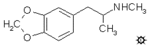
MDM; ADAM; ECSTASY; 3,4-METHYLENEDIOXY-N-METHYLAMPHETAMINE

SYNTHESIS: (from MDA)

DOSAGE: 80 - 150 mg.

DURATION: 4 - 6 h.

QUALITATIVE COMMENTS: (with 100 mg) MDMA intrigued me because everyone I asked, who had used it, answered the question, 'What's it like?' in the same way: 'I don't know.' 'What happened?' 'Nothing.' And now I understand those answers. I too think nothing happened. But something seemed changed. Before the 'window' opened completely, I had some somatic effects, a tingling sensation in the fingers and temples--a pleasant sensation, not distracting. However, just after that there was a slight nausea and dizziness similar to a little too much alcohol. All these details disappeared as I walked outside. My mood was light, happy, but with an underlying conviction that something significant was about to happen. There was a change in perspective both in the near visual field and in the distance. My usually poor vision was sharpened. I saw details in the distance that I could not normally see. After the peak experience had passed, my major state was one of deep relaxation. I felt that I could talk about deep or personal subjects with special clarity, and I experienced some of the feeling one has after the second martini, that one is discoursing brilliantly and with particularly acute analytical powers.

(with 100 mg) Beforehand, I was aware of a dull, uncaring tiredness that might have reflected too little sleep, and I took a modest level of MDMA to see if it might serve me as a stimulant. I napped for a half hour or so, and woke up definitely not improved. The feeling of insufficient energy and lack of spark that I'd felt before had become something quite strong, and might be characterized as a firm feeling of negativity about everything that had to be done and everything I had been looking forward to. So I set about my several tasks with no pleasure or enjoyment and I hummed a little tune to myself during these activities which had words that went: 'I shouldn't have done that, oh yes, I shouldn't have done that, oh no, I shouldn't have done that; it was a mistake.' Then I would start over again from the beginning. I was stuck in a gray space for quite a while, and there was nothing to do but keep doing what I had to do. After about 6 hours, I could see the whole mental state disintegrating and my pleasant feelings were coming back. But so was my plain, ornery tiredness. MDMA does not work like Dexedrine.

(with 120 mg) I feel absolutely clean inside, and there is nothing but pure euphoria. I have never felt so great, or believed this to be possible. The cleanliness, clarity, and marvelous feeling of solid inner strength continued throughout the rest of the day, and evening, and through the next day. I am overcome by the profundity of the experience, and how much more powerful it was than previous experiences, for no apparent reason, other than a continually improving state of being. All the next day I felt like 'a citizen of the universe' rather than a citizen of the planet, completely disconnecting time and flowing easily from one activity to the next.

(with 120 mg) As the material came on I felt that I was being enveloped, and my attention had to be directed to it. I became quite fearful, and my face felt cold and ashen. I felt that I wanted to go back, but I knew there was no turning back. Then the fear started to leave me, and I could try taking little baby steps, like taking first steps after being reborn. The woodpile is so beautiful, about all the joy and beauty that I can stand. I am afraid to turn around and face the mountains, for fear they will overpower me. But I did look, and I am astounded. Everyone must get to experience a profound state like this. I feel totally peaceful. I have lived all my life to get here, and I feel I have come home. I am complete.

(with 100 mg of the "R" isomer) There were the slightest of effects noted at about an hour (a couple of paresthetic twinges) and then nothing at all.

(with 160 mg of the "R" isomer) A disturbance of baseline at about forty minutes and this lasts for about another hour. Everything is clear by the third hour.

(with 200 mg of the "R" isomer) A progression from an alert at thirty minutes to a soft and light intoxication that did not persist. This was a modest +, and I was at baseline in another hour.

(with 60 mg of the "S" isomer) The effects began developing in a smooth, friendly way at about a half-hour. My handwriting is OK but I am writing faster than usual. At the one hour point, I am quite certain that I could not drive, time is slowing down a bit, but I am mentally very active. My pupils are considerably dilated. The dropping is evident at two hours, and complete by the third hour. All afternoon I am peaceful and relaxed, but clear and alert, with no trace of physical residue at all. A very successful ++.

(with 100 mg of the "S" isomer) I feel the onset is slower than with the racemate. Physically, I am excited, and my pulse and blood pressure are quite elevated. This does not have the 'fire' of the racemate, nor the rush of the development in getting to the plateau.

(with 120 mg of the "S" isomer) A rapid development, and both writing and typing are impossible before the end of the first hour. Lying down with eyes closed eliminates all effects; the visual process is needed for any awareness of the drug's effects. Some teeth clenching, but no nystagmus. Excellent sleep in the evening.

EXTENSIONS AND COMMENTARY: In clinical use, largely in psychotherapeutic sessions of which there were many in the early years of MDMA study, it became a common procedure to provide a supplemental dosage of the drug at about the one and a half hour point of the session. This supplement, characteristically 40 milligrams following an initial 120 milligrams, would extend the expected effects for about an additional hour, with only a modest exacerbation of the usual physical side-effects, namely, teeth clenching and eye twitching. A second supplement (as, for instance, a second 40 milligrams at the two and a half hour point) was rarely felt to be warranted. There are, more often than not, reports of tiredness and lethargy on the day following the use of MDMA, and this factor should be considered in the planning of clinical sessions.

With MDMA, the usual assignments of activity to optical isomers is reversed from all of the known psychedelic drugs. The more potent isomer is the "S" isomer, which is the more potent form of amphetamine and methamphetamine. This was one of the first clear distinctions that was apparent between MDMA and the structurally related psychedelics (where the "R" isomers are the more active). Tolerance studies also support differences in mechanisms of action. In one study, MDMA was consumed at 9:00 AM each day for almost a week (120 milligrams the first day and 160 milligrams each subsequent day) and by the fifth day there were no effects from the drug except for some mydriasis. And even this appeared to be lost on the sixth day. At this point of total tolerance, there was consumed (on day #7, at 9:00 AM) 120 milligrams of MDA and the response to it was substantially normal with proper chronology, teeth clench, and at most only a slight decrease in mental change. A complete holiday from any drug for another 6 days led to the reversal of this tolerance, in that 120 milligrams of MDMA had substantially the full expected effects. The fact that MDMA and MDA are not cross-tolerant strengthens the argument that they act in different ways, and at different sites in the brain.

A wide popularization of the social use of MDMA occurred in 1984-1985 and, with the reported observation of serotonin nerve changes in animal models resulting from the administration of the structurally similar drug MDA, an administrative move was launched to place it under legal control. The placement of MDMA into the most restrictive category of the Federal Controlled Substances Act has effectively removed it from the area of clinical experimentation and human research. The medical potential of this material will probably have to be developed through studies overseas.

A word of caution is in order concerning the intermediate 3,4-methylene-dioxyphenylacetone, which has also been called piperonylacetone. A devilish ambiguity appeared in the commercial market for this compound, centered about its name. The controversy focused on the meaning of the prefix, piperonyl, which has two separate chemical definitions. Let me try to explain this fascinating chaos in non-chemical terms. Piperonyl is a term that has been used for a two-ring system (the methylenedioxyphenyl group) either without, or with, an extra carbon atom sticking off of the side of it. Thus, piperonylacetone can be piperonyl (the two-ring thing without the extra carbon atom attached) plus acetone (a three carbon chain thing); the total number of carbons sticking out, three. Or, piperonylacetone can be piperonyl (the two-ring thing but with the extra carbon atom attached) plus acetone (a three carbon chain thing); the total number of carbons sticking out, four.

Does this make sense?

The three carbon sticking out job gives rise to MDA and to MDMA and to many homologues that are interesting materials discussed at length in these Book II comments. This is the usual item of commerce, available from both domestic and foreign suppliers. But the four-carbon sticking out job will produce totally weird stuff without any apparent relationship to psychedelics, psychoactives or psychotropics whatsoever. I know of one chemical supply house which supplied the weird compound, and they never did acknowledge their unusual use of the term piperonyl. There is a simple difference of properties which might be of value. The three carbon (correct) ketone is an oil with a sassafras smell that is always yellow colored. The four carbon (incorrect) ketone has a weak terpene smell and is white and crystalline. There should be no difficulties in distinguishing these two compounds. But unprincipled charlatans can always add mineral oil and butter yellow to otherwise white solids to make them into yellow oils. Caveat emptor.
 
Last edited:
Hey mark did you see the mdma and wine thread? thats the latest theory :) did you mix the rockstars with sugar?

I did not see the MDMA and wine thread - what does that do? And the sugar...yet to try but whats the deal, does it turbo the MDMA or just better absorption?

There are ways to boost drugs - for instance, need a better dunt out of your weed, drink 10 units of alcohol first.

Or, go to the gym have a hard workout then smoke a joint, boom!

Or take some 5htp for a few days then smoke weed, better high.
 
Hello mark the wine contains tartric and citric acid.

Rumour has it its like taking a mix of MDMA HCL, MDMA tartrate, mdma citrate.

Add some sugar in the wine also
 
(with 120 mg) As the material came on I felt that I was being enveloped, and my attention had to be directed to it. I became quite fearful, and my face felt cold and ashen. I felt that I wanted to go back, but I knew there was no turning back. Then the fear started to leave me, and I could try taking little baby steps, like taking first steps after being reborn. The woodpile is so beautiful, about all the joy and beauty that I can stand. I am afraid to turn around and face the mountains, for fear they will overpower me. But I did look, and I am astounded. Everyone must get to experience a profound state like this. I feel totally peaceful. I have lived all my life to get here, and I feel I have come home. I am complete.

That part has always stuck with me. Even though I've had good rolls, I have yet to re-experience that level of awe--and I am saddened to think that I may not ever again... :(
 
Hello mark the wine contains tartric and citric acid.

Rumour has it its like taking a mix of MDMA HCL, MDMA tartrate, mdma citrate.

Add some sugar in the wine also

OK so I drink some wine then drop MDMA...but what effect is it going to give? More high? More empathy? More wasted?
 
Top