• N&PD Moderators: Skorpio

Hexacyclic indole Tryps, naptha-analogic Tryps

gladiolus

Bluelighter
Joined
Dec 29, 2007
Messages
59
Hi,

there's a recent uprising in psychopharmcodynamics that are using the naptha-analogues of basic tryptamines as marketable drugs.
For instance, the main exhibit is Agomelatine, a naptha variant of the melatonin molecule. Replace the 5-membered [indole] N-ring with another benzo, and Bingo! you've got a drug that has been released into various countries as a sleep agent, and an antidepressant. Also, thank god, as a 5htc-2c antagonist, which gives it anti-depressant activity, probably legitamising it in some way.

But have you heard of the naptha-analogue of AMT? It is called napthylaminopropane, PAL-287; currently under research as a SRA and NRA, also DRA. So why not the 4-hydroxy or the 4-hydroxy n,n dimethyl naptha?

How about going even further and trying the cyclohexan-analogue of AMT and melatonin? In the same way that companies introduced cyclohex[ethyl]amine in nasal medications.

 
naphthylaminopropane is best thought of the naphthyl analogue of amphetamine, not AMT.

given that basic words are spelled incorrectly, it's hardly a surprise that basic concepts are confused here...
 
are these benzo+antidepresseants abusable?

because if not it sounds like something i could use given my past of benzo abuse
 
A while ago, I was wondering the same question, too... namely, is the naphthyl ring analogous to a phenyl or an indolyl? I also found a research report on the naphthyl analogue of melatonin. Unfortunately I don't know any more about this than you do.
 
Napthyl groups catch a bad rap because metabolism of them almost always requires epoxidation, which generates cancer causing metabolites. It's also a bit wide for binding to many 'good' receptors - like 5ht2a.
 
You'll want something like 4-(2-aminopropyl)-quinoline.

qamt0.png
 
are these benzo+antidepresseants abusable?

because if not it sounds like something i could use given my past of benzo abuse

I think you're in the wrong thread, dear. No one is talking about benzodiazepine+AD combinations here... the closest is the word "benzo" which isn't referring to benzodiazepines in this case (it won't often in this subforum, particularly).

A while ago, I was wondering the same question, too... namely, is the naphthyl ring analogous to a phenyl or an indolyl? I also found a research report on the naphthyl analogue of melatonin. Unfortunately I don't know any more about this than you do

In the case of these, it would probably make more sense to consider them analogues of PEAs, since they're more closely related (the NH group isn't there, for one), and those known have activity most similar to PEA's, not tryptamines.

You could replace the indole base for tryptamines with a naphthoyl group and see what happens, but with something like naphthylaminopropane, it's obviously most similar to amphetamines, no tryptamines. Sure, you could consider it an AMT analogue, but wouldn't it make more sense to compare it to the PEA's since that's its closest relative both structurally and functionally?

Ultimately though, it doesn't really matter that much.

It doesn't make any sense to look at agomelatine, since melatonin is a melatonin receptor agonist, and we're talking about naphthylethylamines ability to bind to 5HT2a receptors.

If the goal is for the naphthylethylamines and naphthylisopropylamines to have any psychoactivity, sure, this is a family that will be sure to have many active compounds. So far, though, if naphthylaminopropane and naphyrone offer any insight into the potential of this family, they aren't looking very good.

PAL-287 has some 5HT2a affinity.
 
A general rule applies.

naphthyl = grease

the common trend with a med chemist short of ideas is to increase the affinity by increasing the lipophilicity. It usually works, but at a price, the price is a poor metabolic profile poor availability and induction of all sorts of enzymes you probably don't want to induce. then there is the potential nastiness of naphthyl metabolites and the list goes on.

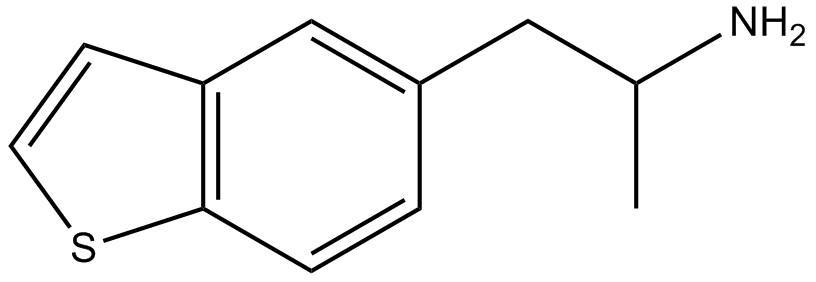
Naphthyl is like thiophene only use it if all else fails.
 
I had earlier posted a thread about substituting a thiophene onto a tryptamine and in addition to hearing a lot of feedback about how toxic this would be, there was also some speculation that this would not be an active compound due to the bulkiness of the aromatic amine and thus the difference in shape between the tryptamine and seratonin. Why would naphthyl be more active?
 
nzh1W.png


I recall that the thiophene analogs of amphetamine were active (plus the bonus odour :p). Napthalene groups are active and are only slightly smaller than benzothiophenes.
 
Last edited:
^thiophene, being aromatic, doesn't have the foul odor of thioethers like tetrahydrothiophene. so thats not a concern
 
Unpleasant body odour was actually reported as a sideeffect of the thiophene-analogs of (meth)amphetamine. Maybe it stems from a metabolite.

- Murphy
 
There are psychoactive naphthyl derivatives in PIHKAL. These are G-N (1,4-dimethoxynaphthyl-2-isopropylamine) and 2C-G-N (1,4-dimethoxynaphthyl-2-ethylamine). 2C-G-N is a long lasting psychedelic active at 20-40 mg. However, these are phenethylamines, not tryptamines.
 
To answer my own question according to this article (citation below) the indole and adenine rings are stacked. I have not done the resonance structures for any of your proposed molecules, but a possible stumbling block would be that different bond sites would result in different low energy states, thus causing the molecule to become quickly inactive. Determining the theoretical shape of the proposed tryptamines would give very clear indicators of whether it would likely be active.
Binding of tryptamine and 5-hydroxytryptamine (serotonin) to nucleic acids. Fluorescence and proton magnetic resonance studies

First PageHi-Res PDF[856 KB]Citing Articles
Claude Helene, Jean L. Dimicoli, Francine Brun
Biochemistry, 1971, 10 (20), pp 3802–3809
DOI: 10.1021/bi00796a025
Publication Date: September 1971
 
it would probably make more sense to consider them analogues of PEAs, since they're more closely related (the NH group isn't there, for one), and those known have activity most similar to PEA's, not tryptamines
.

Doesn't it make more sense to consider Agomelatine an analogue of [trypaminergic] melatonin than it does to consider it a PEA analogue? -Especially given it's not especially NA-ergic or dopa-ergic, and has considerable agonism at melatonin receptors?

In a similar way, who is to say that if you were to try PAL-287 that you would not find it more akin in activity to AMT than to amphetamine? PAL-287 has quite considerable SRA and serotonin activity that places it pretty much in the realm of AMT than it does some curious di-phenylAmphetamine.

given that basic words are spelled incorrectly, it's hardly a surprise that basic concepts are confused here...

OK I spelt a couple of words wrong. Are you referring to "legitamising" instead of "legitamizing" - because I deliberately sometimes not use the "z", being english rather than of US persuasion: or are you referring to the missing "a" when I mis-spelt "psychopharmacodynamics"? Either way, and considering both, your comment seems arrogant and your replies dogmatic.

Thirdly, what about the nature of the hexal-analogue of the tryptamines? This type of substitution cannot be considered to have the same type of "hammilton" problems as the naptha-derivatives.
 
What do you mean by hexal? Do you mean the decalin ring system which is a completely hydrogenated version of naphtalene? Obviously propylhexedrine has a stimulant effect(althought less than amphetamine) so maybe decalinylisopropylamine would have some activity too...
 
Doesn't it make more sense to consider Agomelatine an analogue of [trypaminergic] melatonin than it does to consider it a PEA analogue? -Especially given it's not especially NA-ergic or dopa-ergic, and has considerable agonism at melatonin receptors?
of th

melatonin receptors aren't "tryptaminic" they bind melatonin, which is an amide, along with the rest melatonin receptor ligands, they're not amines so they can't be tryptamines.

and yes, it does make more sense to consider agomelatine an analogue of melatonin because that's whose activity it most resembles. if there were a class of melatonin agonists derived from n-phenethylacetamide, for which evidence of alternate binding modes and substantial physiological effects was present, then I'd compare it to those.

There's nothing set in stone to make the judgment automatic, but it makes sense to be comparing a compound a) to the compound it most closely resembles b) the compound which has the most similar binding pattern c) the compound with most similar physiological activity. AMT has some similarity to MDA, a 5HT2a agonist with serotonin and (maybe?) dopamine releasing effects. We're talking about 5HT2a affinity here, though, and since it still binds like a tryptamine, it should be compared to the tryptamines.

The question of how these compounds bind could be relatively easily answered. If you were to find out that N,N-dimethyl-2-(naphthalen-2-yl)ethanamine was more potent at 5HT2a than 2-(naphthalen-2-yl)ethanamine, the n,n-desmethyl analogue, odds are fair that it's binding like a tryptamine. If that drops potency, it's probably binding like a PEA. Or it could be binding in some unique manner. Hard to say. I feel like these compounds have to have been made and assayed somehow.

edit: just for the record, are we talking about 2-(naphthalen-1-yl)ethanamines or 2-(naphthalen-2-yl)ethanamines? I've been thinking of the latter, since we were talking about the PAL compound earlier. Haven't thought enough about the 1-yl compounds yet.
 
Last edited:
Top