Ex-Marine sees dramatic drop in symptoms after party drug-therapy
By Don Lattin
Updated 6:37 pm, Saturday, May 23, 2015
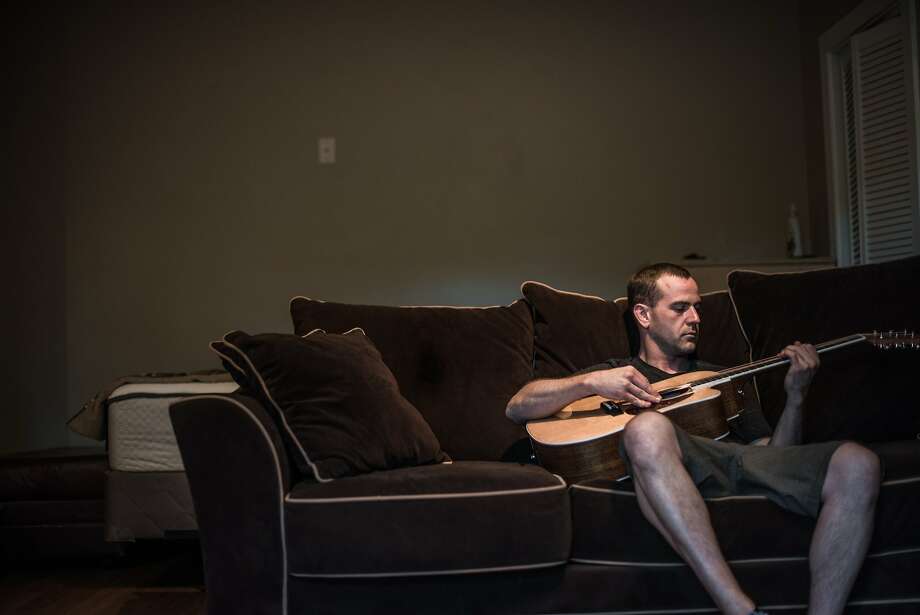
Nigel McCourry plays guitar in his new home in Asheville, North Carolina on Thursday May 21, 2015. McCourry, an ex Marine suffered from problems sleeping and severe anxiety brought on by Post Traumatic Stress Disorder, but took part in a clinical study in South Carolina combining therapy with the drug MDMS, and it has dramatically reduced his symptoms.
Nigel McCourry couldn’t sleep, and when he did, the nightmares about what he’d done in Iraq would wake him up.
McCourry, who had been there as a lance corporal in a weapons platoon in the U.S. Marine Corps, would stand at the window of his apartment in Asheville, N.C., until 4 or 5 in the morning, convinced someone was coming to get him.
Crowds terrified him. Other times he’d get this strange sensation that he was living his life from a third-person perspective, like he was watching a film about himself. And it could turn easily into a horror movie, especially when he thought back to that moment in 2004 when he and a machine gunner opened fire on a truck that refused to stop as it approached his platoon during a firefight south of Baghdad.
Two little girls, not more than 4 and 6 years old, had been riding in the truck with their father. The dad survived, but the daughters didn’t, and McCourry couldn’t get the blood-drenched images of the aftermath out of his mind.
PTSD diagnosis
It took seven long years for him to get a diagnosis from the Veterans Administration that he was suffering from post-traumatic stress disorder. By then, in 2011, he’d alienated most of his family and friends and had grown increasingly isolated. He’d been drinking heavily, which “took off the edge” but did not address the underlying guilt, anger and fear he felt.
The VA prescribed talk therapy and a series of medications — antidepressants, antipsychotics and antianxiety medications — that seemed to cause more problems than they solved.
Then his sister heard about a study in which a pair of psychologists were giving intensive therapy to veterans in conjunction with a drug called MDMA, also known as ecstasy.
McCourry had taken half of an ecstasy pill once before, back during his senior year of high school at a dance club with some friends.
“I can’t say for sure if it was MDMA, but it was not an unpleasant evening,” he said.
It turned out the study was being conducted in South Carolina, not far from Furman University in Greenville, where McCourry was studying biochemistry. He applied and in May 2012 had his first session, which involved swallowing a dose of MDMA and spending the next six hours talking to two psychotherapists about his experiences in Iraq.
“It was remarkable,” McCourry said. “My sleep issues got better after the first session. Three years later, I still have the bottle of Ambien sleeping pills that the VA gave. I haven’t had to use them.”
McCourry did four more of the six-hour MDMA-assisted therapy sessions over the next five months.
“The sessions were very exhausting and very challenging,” he said. “I confronted some of my biggest underlying fears and psychological problems. Afterwards, I felt worn out.”
Looking back, McCourry said, “I don’t feel cured of PTSD, but now I can manage my symptoms in a whole lot better way. Now my actions don’t cause huge disruptions at work, school or with family and friends. … I can have a girlfriend now. Before I’d break up after a couple weeks.”
McCourry now works for a small pharmaceutical company in Asheville. He believes that MDMA gave him greater insight into his problems but also that the drug works by “balancing out brain chemistry.”
“It prepares the brain to have a healing experience,” he said. “When I was on the MDMA, I felt for the first time like I was able to clearly see the individual components that were working together to create PTSD. Before it just seemed like this jumbled-up mess of psychological junk that I couldn’t work through. It was like the MDMA gave me an aerial view of the terrain.”
Study shows good results
McCourry was not alone. The South Carolina research led by psychiatrist Michael Mithoefer found that 80 percent of the 20 patients in the study had no PTSD symptoms two months after the completion of the treatment, compared with 25 percent who got a placebo pill.
Follow-up studies have shown long-term success, so the Multidisciplinary Association for Psychedelic Studies, which funded the research, plans more extensive research that will eventually enlist hundreds of patients across the country.
The project is being closely watched by federal officials struggling with an onslaught of PTSD patients. In 2013, 535,000 veterans, including 141,000 from the Iraq and Afghan wars, sought PTSD treatment from the VA. Many of them have not responded well to conventional drugs and therapies.
“This isn’t an area where we already have great treatments,” said Dr. Thomas Insel, the director of the National Institute of Mental Health. “We need something different. We need something new.”
Dr. Paula Schnurr, executive director of the National Center for PTSD, an arm of the U.S. Department of Veterans Affairs, cited studies showing that 60 to 80 percent of patients “show clinically meaningful improvement” with existing treatments. But she said the MAPS studies with ecstasy-fueled therapy has produced findings that suggest “the importance of more research.”
“The basic idea is that the drug somehow helps you in the context of psychotherapy to learn things or feel things that you otherwise wouldn’t,” she said. “So I can see how people would feel this is a transformational experience.”
Don Lattin is a former San Francisco Chronicle staff writer and the author of five books, including “The Harvard Psychedelic Club.” For more information on his work, go to
www.donlattin.com.