



• N&PD Moderators: Skorpio

ethyl-Methylpentynol fix CYP450 problem?

Synaps3

Bluelighter
Joined
Sep 14, 2011
Messages
260
I'm back with another post about obscure alcohols. I was thinking about how methylpentynol is a relatively unhealthy drug because of how it depletes the cytochrome P450 and causes liver damage. 2-methyl-2-butanol does not, however, because it can be oxidized into a diol, but it is much less potent. So I was thinking what if you put the triple bond from methylpentynol on an ethyl instead of methyl (resulting in 3-methylhex-5-yn-3-ol). Would this allow the molecule to be safely oxidized to a diol like 2m2b or would the problem still occur?

Here is a visual of what I mean:

2m2b oxidation:
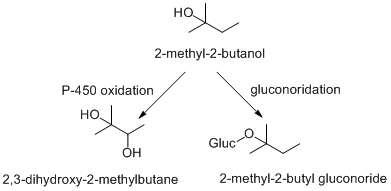
tertamyl.gif


methylpentynol:
ImagesHandler.ashx


ethyl-methylpentynol (or 3-methylhex-5-yn-3-ol)
ImagesHandler.ashx


I'm thinking the same might also apply to ECX (1-ethynylcyclohexanol).

Hexapropymate vs Ethinamate:
http://en.wikipedia.org/wiki/Ethinamate
http://en.wikipedia.org/wiki/Hexapropymate
(ignore the carbamate - I'm just looking at the alcohol)

EDIT: I think I made a mistake. It would be propargyl-methylpentynol.
 
Last edited:

... I don't think you can deplete P450 system, that doesn't even make sense. In fact the body upregulates in response to repeated inhibition.

The P450 system is a complex system that performs a wide array of functions, I'd be shocked if any one thing damaged the entire system.

As for altering the molecule, sorry, chemistry's not my strongsuit.
 
Thank you. I'll check it out.

Wish this forum was more lively...
What doses are used rec? Cause that paper indicates pretty high doses are being used without any toxicity, so this could be a moot point?
 
2 questions:

1. Are these effects actually permanent? Because "suicide inhi tion" refers to a temporary process, and the term "enzyme destruction" is ambiguous, but never does it flatly say the changes are permanent.
And
2. Which isozymes is it referring too? Because it says this effect is unit observed in izozymes that are induced by pentobarbital, well, AFAIK, PB only induces a few select P450's.

Interesting nevertheless, but if something actually indiscriminately destroyed the P450, well it would be a dangerous substance, since over well over half of all known drugs are metabolized by P450(in fact, I think the majority are) so losing broad P450 function could actually be deadly. A lot of substances become toxic without the ability to metabolize them.
 
I think the problem arise from terminal alkyne moiety itself, not regarding of the position.
Terminal alkynes are not a healthy moeity, i dont have time to fatch the reference,
But i think this is quite well known in designing a pharmaceutical.
Search google or so with "terminal alkyne hepatotoxic" should give many results you
could dig up for further references.

And in several case, this moeity is replace with a cyclopropyl moeity,
this is true for some NSAIDs, but idk if it is applicable to alcohol sedatives.

PS. Isnt that pic of 2M2B metabolites copied from my post somewhere?:D
 
Last edited:
Another question could be asked:

161z728.jpg


If it's only the first, then I think my change would work. I still don't completely understand the metabolization. Could it be both? If you increase the chain length, does each link get oxidized? I thought I read somewhere that only the one closest to the HO gets oxidized and that's why I think my solution may work.

1. Are these effects actually permanent? Because "suicide inhi tion" refers to a temporary process, and the term "enzyme destruction" is ambiguous, but never does it flatly say the changes are permanent.
And
2. Which isozymes is it referring too? Because it says this effect is unit observed in izozymes that are induced by pentobarbital, well, AFAIK, PB only induces a few select P450's.

No idea. These questions are beyond me. It's funny it never says if it's permanent when that's the most important part basically.

What doses are used rec?

About 250-1000mg I think.

Isnt that pic of 2M2B metabolites copied from my post somewhere?

I copied it from another post here on bluelight. It probably was :)
 
Another question could be asked:

161z728.jpg


If it's only the first, then I think my change would work. I still don't completely understand the metabolization. Could it be both? If you increase the chain length, does each link get oxidized? I thought I read somewhere that only the one closest to the HO gets oxidized and that's why I think my solution may work.


No idea. These questions are beyond me. It's funny it never says if it's permanent when that's the most important part basically.


About 250-1000mg I think.


I copied it from another post here on bluelight. It probably was :)

And you're question is beyond me :)

But the pharmacology is not, and I doubt it's permanent.

The point of my questions is that this could be a non-issue; the drug in question has been tested long term, and at doses greater than 1 gram apparently had no long term effects.

Doesn't make it the safest thing in the world, but I wouldn't rely on that article alone, since it fails to mention whether it is even permanent(the most important question, as you said). Not to mention it's technically another substance.

I mean is this for practical use, or just for the hell of it?

(I will say, if it is somehow permanently destroying CYP's, well, it would be the only substance I've ever heard of doing such a thing! After years, as well.)
 
Doesn't make it the safest thing in the world, but I wouldn't rely on that article alone, since it fails to mention whether it is even permanent(the most important question, as you said). Not to mention it's technically another substance.

I mean is this for practical use, or just for the hell of it?

(I will say, if it is somehow permanently destroying CYP's, well, it would be the only substance I've ever heard of doing such a thing! After years, as well.)


Covalent enzyme modification = permanent inhibition. The enzymes that interact with this drug are permanently inhibited, they will never perform a metabolic function again and will eventually be degraded. Over time the liver will synthesize new enzymes and regain metabolic function.

The inhibition is permanent from the enzyme's perspective, the body eventually replaces those enzymes though.
 
Top
