




Synaps3
Bluelighter
- Joined
- Sep 14, 2011
- Messages
- 260
I'm back with another post about obscure alcohols. I was thinking about how methylpentynol is a relatively unhealthy drug because of how it depletes the cytochrome P450 and causes liver damage. 2-methyl-2-butanol does not, however, because it can be oxidized into a diol, but it is much less potent. So I was thinking what if you put the triple bond from methylpentynol on an ethyl instead of methyl (resulting in 3-methylhex-5-yn-3-ol). Would this allow the molecule to be safely oxidized to a diol like 2m2b or would the problem still occur?
Here is a visual of what I mean:
2m2b oxidation:
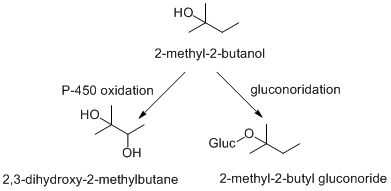
methylpentynol:

ethyl-methylpentynol (or 3-methylhex-5-yn-3-ol)

I'm thinking the same might also apply to ECX (1-ethynylcyclohexanol).
Hexapropymate vs Ethinamate:
http://en.wikipedia.org/wiki/Ethinamate
http://en.wikipedia.org/wiki/Hexapropymate
(ignore the carbamate - I'm just looking at the alcohol)
EDIT: I think I made a mistake. It would be propargyl-methylpentynol.
Here is a visual of what I mean:
2m2b oxidation:
methylpentynol:
ethyl-methylpentynol (or 3-methylhex-5-yn-3-ol)
I'm thinking the same might also apply to ECX (1-ethynylcyclohexanol).
Hexapropymate vs Ethinamate:
http://en.wikipedia.org/wiki/Ethinamate
http://en.wikipedia.org/wiki/Hexapropymate
(ignore the carbamate - I'm just looking at the alcohol)
EDIT: I think I made a mistake. It would be propargyl-methylpentynol.
Last edited:



