dr.red.evil
Bluelighter
- Joined
- Sep 13, 2006
- Messages
- 51
edit
Last edited:




N&PD Moderators: Skorpio
You are using an out of date browser. It may not display this or other websites correctly.
You should upgrade or use an alternative browser.
Ditt, 5meoditt, 5meodmp
dr.red.evil
Bluelighter
edit
Last edited:



MattPsy
Bluelighter
N-(2-(2-(3,5-dimethylphenyl)-1H-indol-3-yl)ethyl)-4-(4-fluorophenyl)butan-1-amine
Replace the flouro with para substituent of choice.
Or for a friendlier name:
N-(4-(4-fluorophenyl)butyl)-2-(3,5-dimethylphenyl)tryptamine
Again, replace the fluoro with chosen para substituent.
Though you'll want fastandbulbous and someone like that to confirm this, i'm still new to naming.

specialspack
Bluelighter
I've no idea what DITT might stand for...
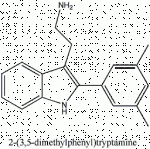
What does 2-(3,5-dimethylphenyl)tryptamine look like anyway... come on nomenclature peeps!
MattPsy
Bluelighter
A aromatic ring off the -2 position on the 5-membered indole ring. The -2 position is the one in between the tryptamine side chain (ethylamine) and the indole ring nitrogen.
And that phenyl ring has methyls at the 3 and 5 positions... a dual meta config.
specialspack
Bluelighter
Thanks!
dr.red.evil
Bluelighter
THanx for your help.

fastandbulbous
Bluelight Crew
hugo24 said:
Why should this be a psychedelic?
They're not - the 'add ons' to the tryptamine nucleus are going to make binding to the 5HT2a receptor very highly unlikely.
Just because something is a tryptamine doesn't mean that it's going to be psychedelic in nature
dr.red.evil
Bluelighter
I didnt say it would be psychadelic.I just wanted to know more about all 3 of them.

hugo24
Bluelighter
The 2-Methyl DMT's though seem to have a certain psychedelia attached,and even are orally active.The quality of the experience though seems lesss memoarble.Might have something to do with the mess of selectivity (now that they mention GnRH),a not uncommon problem/positive with tryptamines.
MattPsy
Bluelighter
Tyrptamine-type ligands are certainly less selective for 5-HT2A in general anyway compared to phenylalkyl-type ligands, IIRC (in terms of 2C activation)...
A phenyl substituent at the 2 position probably has too much stearic hindrance anyway, with it "getting in the way".
 .
.