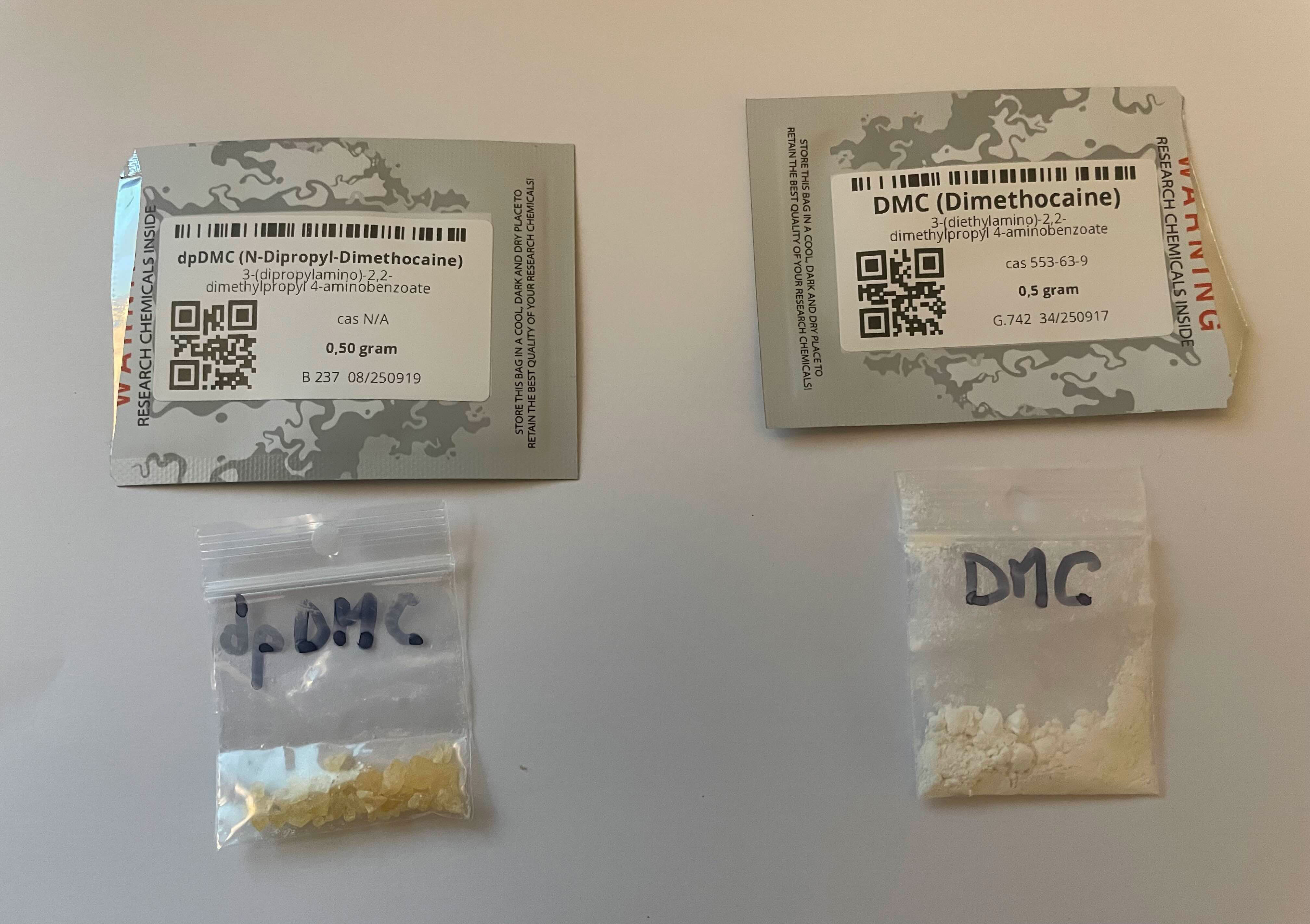
I am unaware of any local anasthetic that does not impact vascular function. But empirical evidence suggests that cocaine remains the safest.
We simply lack sufficient information to judge if clofenciclan is a safer alternative (or indeed if it is AT ALL SAFE). As far as I can work out, Dr Kurt Stach and his student, (Dipl-Chem) Werner Winter set out to find novel agents that could treat Parkinson's disease and the and the Parkinsonian side-effects of the first generation of antipsychotic medications. Later researchers continued the work that might suggest it had some merit as a potential treatment.
But I lack the technical German to really understand their work. IF it is indeed a selective dopamine releaser, it somewhat marries up with the case of Barry Kidson whose failure to read a patent properly rendered him the first victim of MPTP (MPP+ being the toxic metabolite) which as we all know, produces severe Parkinsonian symptoms within a matter of hours at high doses. Kidson was apparently caught abusing the medication he was initially given to control the symptoms but evidently worked out that injecting cocaine was a viable alternative. Now the episode of 'Horizon' titled 'The Case of the Frozen Addicts' does not reveal what medication Kidson was but at the time levodopa was just about the only option BUT I note abuse of levodopa is now recognized (but thankfully rare).
So while I have NO IDEA what the sought effect of levodopa might be, we do know that it has a narrow theraputic window which inevitably gets narrower and narrower. So I suggest that MAYBE it is euphoric in the short-term, it's something of a one-way street and not something that should ever be consumed outside clinical neccecity.
Likewise, sorry to say but in the late 1950s, new medications were being introduced with shockingly poor prior testing and pharmacovigilance. Thiopropazate was patented in 1956, introduced in 1957 and seemed to disappear rather quickly (Tonquil and Verisan being brand-names of the combination). If you have to add a second medication to offset the side-effects of the first medication, that's generally not a good sign, but even today, levodopa remains the 'gold standard' for advanced-stage Parkinson's disease.
So when I council caution, it's because I have some understanding that sooner or later, it's inevitable that an RC will have some unforeseen chronic toxicity.