• Psychedelic Drugs Welcome Guest
    View threads about
    Posting RulesBluelight Rules
    PD's Best Threads Index
    Social ThreadSupport Bluelight
    Psychedelic Beginner's FAQ
  • PD Moderators: Esperighanto | JackARoe |

Crude oil 4 aco dmt (can it be smoked or vaped)

I just wanted to know if this stuff could be smoked and now I'm afraid to try it, even orally. I mean I probably still will but now I'm afraid that it'll nag at my subconscious and possibly ruin my trip which is a shame cause I've heard really good things about this one and really wanted to try it.

Besides that nobody has even answered my question, regardless of whether or not it's a good idea, should this be active vaped, in theory?

Also if I post an NMR or HNMR for this substance can anybody tell me if there's anything toxic in it?
 
I'm gonna look around in that case because if the HNMR the vendor provided for the oil is significantly different then ones on the net for pure 4 aco dmt then i think it's the actual HNMR for the substance. Another reason I think it could be the actual HNMR is that of the 4 substances I ordered from said vendor, this is the only one that came with an HNMR, the rest just came with an MSDS which funnilly enough the MSDS for the 4 aco dmt was for the pure hcl which is obviously not what it is so maybe the included HNMR is legit.

How can I post an attachment, I don't wanna link to the vendors site and I'm posting from my iPhone.
 
You have to upload it to something like photobucket.com.

Then there´s an "add image" button were you can add images to your post.
 
LOL what kind of lab has the resources to do NMR spectroscopy, but doesn't have the ability to run this "crude oil" stuff through a preparative column to isolate the 4-AcO-DMT fraction... makes no sense man.

But yeah, if you post up the NMR spectrum we'll take a look at it. But keep in mind that there's no way to verify whether the sample they analyzed via NMR is the same as the stuff you received.
 
Last edited:
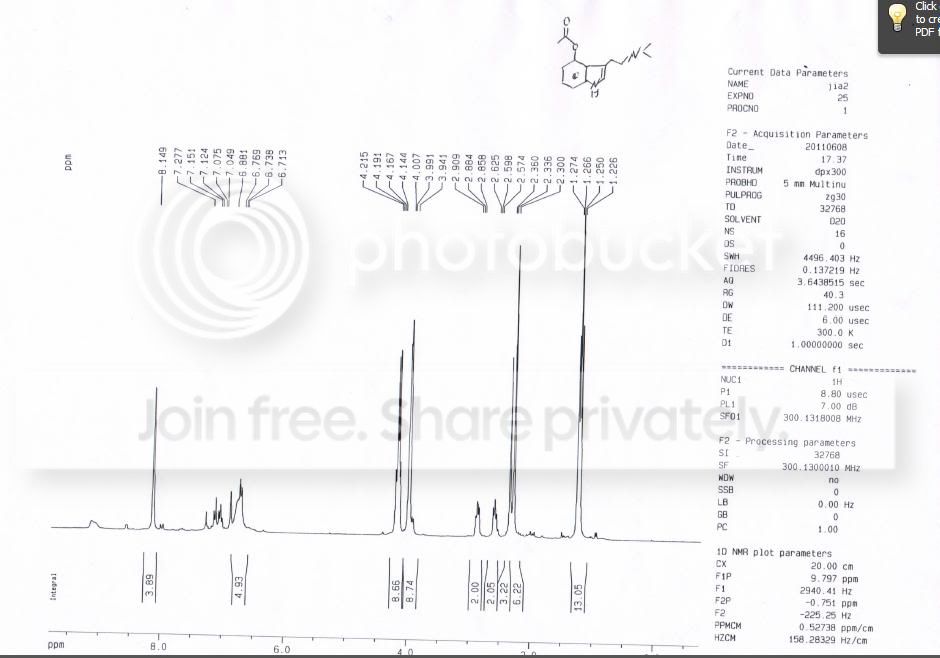
heres the provided NMR, Im still searching the net trying to find one to compare it to, and its proving to be a bit more difficult than just google image searching it so im posting it here in the meantime.

Thanks in advance to anybody who actually takes a look at it, i really appreciate it.

http://i1084.photobucket.com/albums/j406/shaps420/4acodmtNMR.jpg

Thats the url, i cant get it to post as an image because it keeps saying invalid url every time i try.
 
NSFW:
4acodmtNMR.jpg


Figured out how to manually work the image tags, tried to delete this post and edit it into the previous one but it wouldn't let me delete it for some reason.

Anyway this is the provided NMR
 
Last edited:
Hah, I mean there is definitely something else aside from just the 4acodmt in there. But its going to be really difficult to know what that is, and plus there Could be other waste products or leftover reagents (possibly) that wouldn't show up on NMR, depends on how they synthed it really. If we wanted to have a good idea what that is we would need the original file to properly analyze it and even then it would be difficult to say really. GC/MS is needed.

Anyway (not that this necessarily helps), I would say the stuff around 4 ppm and the stuff around 1.2 ppm is the crap that does not belong as well as possible some of the crap mixed into that jumble of aromatic peaks (~7ppm).
 
Yeah that farthest upfield peak definitely shouldn't be there... between 3-4 there are 2 extraneous peaks. Aromatic region is a mess, I don't think that farthest downfield singlet should be there (?)
 
But it would be free rat shit! 8(

Touche! Hopefully its strong rat shit.;):|8(

To OP
When you smoke (burn) something, it causes a chemical reaction. This can cause a normal everyday safe to eat substance, to become toxic. You wouldn't smoke tylenol would you? Vaporizing is different obviously, heating a substance to it's boiling point, but you should know the boiling point. That being said, I'm not saying it's unsafe to smoke/vape 4aco in the proper form. But "crude oil" just doesn't sound friendly. I myself am not a big fan of smoking research chemicals, the whole carcinogen angle puts me off.
 
^i realize smoking anything can release carcinogens but being a pack a day smoker this doesn't concern me that much.

Thanks Adrian and Roger for your responses but TBH I don't really know the specifics of what you guys are talking about, I'm not that well versed in chemistry.

Is there anything in there that stands out as being obviously toxic? Arent concentrations of 3 to 7 ppm small enough to be relatively harmless at ~20mg doses as long as they aren't extremely toxic?

I'm sorry I just don't know that much about this stuff but I've been readin trying to educate myself most of the afternoon.

Anyway my original question was would this stuff be active if vaped and so far I've only gotten one response (by faggot I think) saying it isn't because of something to do with the aco group. Can anyone expand on this or contradict it maybe?

I think I'm going to try it out tomorrow (hopefully I'll have time) and I'll post how it goes. Even If it is rat shit.
 
Do you know if this is fumarate salt?
And ppm on that chart does not have to do with concentration.

If we knew what the last steps in the making of this were, then itd be easier to say what that is
 
Last edited:
Is there anything in there that stands out as being obviously toxic?

Sorry, there's no way to know from this NMR alone. We would need other data.

Arent concentrations of 3 to 7 ppm small enough to be relatively harmless at ~20mg doses as long as they aren't extremely toxic?

Oh no, this isn't quantitative, eg it doesn't tell you how much of anything is in there. When we say a signal is at a certain ppm value, we mean whatever frequency the signal resonates at divided by the "magnetic field strength" of the NMR instrument. The signal frequency is measured in hertz, and the field strength of the instrument is in megahertz (mega = 1million) so its parts per million.

[as an aside, the "field strength" of the instrument is not actually a measure of magnetic strength (which would be measured in gauss or tesla or something like that, not MHz), its the frequency that a proton resonates at given the actual field strength of the magnet.]

This technique only tells you what you have, it doesn't tell you how much of it you have. Essentially what you do, is you put the compound-in-question into a really strong magnetic field which causes the nuclei in the atoms to spin with the field; and then you hit the sample with radio frequency pulses and it causes them to flip to the opposite spin orientation. Judging by how much energy it takes to flip them, you can see what kind of "environment" they're in within the molecule. Also, nuclei will split the signals of their neighboring nuclei into certain patterns based upon the number of neighboring nuclei and what their spin properties are.

So from these different features of the NMR spectra, you can kind of "solve the puzzle" and figure out what compound you have. But to reiterate, it says nothing about quantities.

 
Adrian - it is not a fumarate salt as far as I know it is the freebase in a crude oil (whatever that means) form. Maybe if someone knew the synthesis they could speculate on what impurities or solvents it contains.

Roger&me - thanks for that explanation of how an NMR works. I had no idea what I was looking at and saw ppm and assumed particle concentration but now I see that doesn't make sense. I appreciate the explanation I always like learning new stuff, I had assumed it was like a GCMS and the substance could be identified just by looking at that but maybe that's not even how GCMS works either I'm just assuming based on Not much really.
 
Maybe if someone knew the synthesis they could speculate on what impurities or solvents it contains.

Actually, just had a thought, it could be tetrahydrofuran (THF).

THF has two equivalent protons, one usually shows up around 4ppm and the other one shows up under 2.

If that's even the case, then there is another impurity as well.
 
Yeah, I definitely don't think its THF anymore; 1.2ppm is low for THF, should be more like 1.8

Okay, so I peeked at Nichols' paper on 4-AcO-DMT.

Highest downfield singlet should be the fumarate anion.

One of the peaks above 4ppm and the messiness in the aromatic region is due to the benzyl part of the unreacted 4-benzyloxy-N,N-dimethyltryptamine.

Ethyl acetate accounts for the other peak around 4ppm, and the peak at 1.2ppm (which would explain the triplet, as that would be the methyl protons being split by the neighboring methylene protons); EtOAc has another peak just above 2ppm that is almost overlapping with some of 4-AcO-DMT's signals... I think the peak at 2.30ppm is the "acetate protons" in ethyl acetate.

I think that this crude oil stuff is probably a mixture of (the fumarate salts of) 4-Acetoxy-DMT and 4-Benzyloxy-DMT, sitting in ethyl acetate. I wouldn't consume this stuff, there's no telling what effects 4-BnO-DMT could have... I could definitely see it being toxic.
 
Last edited:
Could definitely see ethyl acetate being in there

The probably just either didn't run the product through a column or didn't distill it or whatever they do to purify their products. Probably just took the stuff immediately after extracting it into something like ethyl acetate and then didnt fully remove solvent plus whatever the other 4ppm and 7ppm peaks are is still in there as well
 
I've gotta say though, props to this vendor for including an HNMR that wasn't just a copy of a pure sample's NMR.

But as other's have said, if the vendor put this NMR showing a precursor and solvent it's at least as bad as the NMR shows and you're taking an unknown risk consuming it without doing some purification of your own.

And definitely don't try to smoke it if it has ethyl acetate in it. You'll either get an explosion or just be huffing a solvent, not to mention whatever could happen with the 4-benzyloxy-dmt.
 
Top