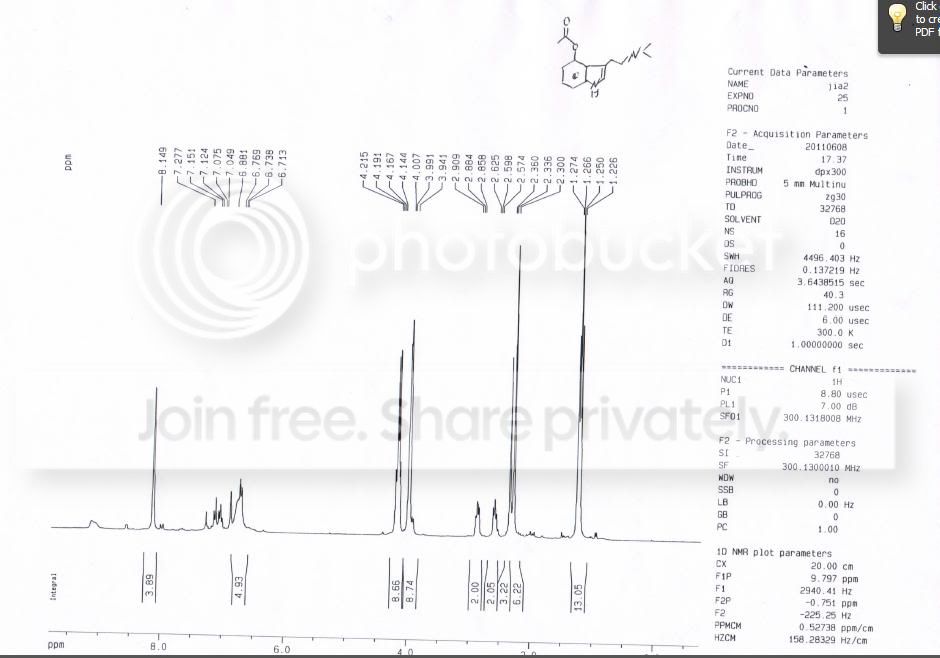
Is there anything in there that stands out as being obviously toxic?
Sorry, there's no way to know from this NMR alone. We would need other data.
Arent concentrations of 3 to 7 ppm small enough to be relatively harmless at ~20mg doses as long as they aren't extremely toxic?
Oh no, this isn't quantitative, eg it doesn't tell you how much of anything is in there. When we say a signal is at a certain ppm value, we mean whatever frequency the signal resonates at divided by the "magnetic field strength" of the NMR instrument. The signal frequency is measured in hertz, and the field strength of the instrument is in megahertz (mega = 1million) so its parts per million.
[as an aside, the "field strength" of the instrument is not actually a measure of magnetic strength (which would be measured in gauss or tesla or something like that, not MHz), its the frequency that a proton resonates at given the
actual field strength of the magnet.]
This technique only tells you what you have, it doesn't tell you how much of it you have. Essentially what you do, is you put the compound-in-question into a really strong magnetic field which causes the nuclei in the atoms to spin with the field; and then you hit the sample with radio frequency pulses and it causes them to flip to the opposite spin orientation. Judging by how much energy it takes to flip them, you can see what kind of "environment" they're in within the molecule. Also, nuclei will split the signals of their neighboring nuclei into certain patterns based upon the number of neighboring nuclei and what their spin properties are.
So from these different features of the NMR spectra, you can kind of "solve the puzzle" and figure out what compound you have. But to reiterate, it says nothing about quantities.







 8(
8(