• Welcome Guest

    Forum Guidelines Bluelight Rules
    Fun 💃 Threads Overdosed? Click
    D R U G   C U L T U R E
  • DC Moderators: ghostfreak | VerbalTruist

Codeine administration

lost weekend

Bluelighter
Joined
Dec 9, 2023
Messages
1,643
Hi I'm sorry about posting a thread that has been covered relentlessly but I was trying to search the forum threads and posts about the best way to administer codeine,i am not planning on taking such medicines. There are only a couple of posts that suggest if the tablet was placed under the tounge it would convert into morphine straight away and oral biovility was not as effective.you will have to excuse my ignorance on the science of any drugs and how it reacts or converts once inside the body ,im not very bright on these matters .it is just a general question out of curiosity I've no desire to experiment with such things.
Thanks and sorry if this has been covered in a mega thread


Genetic polymorphism.

Life-threatening toxicity in a patient given moderate doses of codeine was thought to be due to a genotype predisposing him to ultrarapid metabolism of the drug into morphine by the cytochrome P450 isoenzyme CYP2D6, coupled with drug-induced inhibition of the usual major metabolic pathway mediated by CYP3A4, and transient reduction in renal function.

Metabolism.

The analgesic effect of codeine may be partly due to its metabolite morphine and it has been suggested that its efficacy may be impaired in patients who are poor metabolizers of codeine1-4 or in those who are also receiving drugs, such as quinidine, that impair its metabolism.(1) However, patients unable to demethylate codeine to produce detectable plasma concentrations of morphine obtained a similar analgesic effect to patients with detectable plasma morphine concentrations.(5) A study(6) involving infants aged 6 to 10 months has indicated that children were capable of demethylating codeine to morphine at the age of 6 months although glucuronidation of the morphine appeared to be impaired when compared with older children. For a report of severe toxicity thought to be due to altered metabolism of codeine see Genetic Polymorphism, above.

◊ References.
(1) Desmeules J, et al. Impact of environmental and genetic factors on codeine analgesia. Eur J Clin Pharmacol 1991; 41: 23–6.
(5) Quiding H, et al. Analgesic effect and plasma concentrations of codeine and morphine after two dose levels of codeine following oral surgery. Eur J Clin Pharmacol 1993; 44: 319–23.
(6) Quiding H, et al. Infants and young children metabolise codeine to morphine: a study after single and repeated rectal administration. Br J Clin Pharmacol 1992; 33: 45–9.


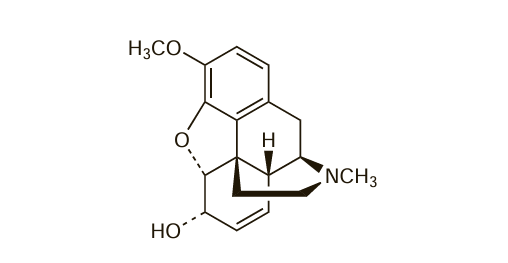
Codeine, a phenanthrene derivative, is an opioid analgesic (p.104) obtained from opium or made by methylating morphine. It is much less potent as an analgesic than morphine and has relatively mild sedative effects.
Codeine or its salts, especially the phosphate, are given orally in the form of linctuses for the relief of cough, and as tablets for the relief of mild to moderate pain, often with a non-opioid analgesic such as aspirin, ibuprofen, or paracetamol.

The phosphate is also given by intramuscular or subcutaneous injection, in doses similar to those used orally, for the relief of pain; the intravenous and rectal routes have also been used. For the relief of pain codeine phosphate may be given in doses of 30 to 60 mg every 4 hours to a usual maximum of 240 mg daily.
To allay non-productive cough codeine phosphate may be given in doses of 15 to 30 mg three or four times daily.
Codeine phosphate is also used as tablets or in mixtures for the symptomatic relief of acute diarrhoea in doses of 15 to 60 mg given 3 or 4 times daily.

etc etc etc

Other codeine salts used include the hydrochloride, sulfate, camsilate, and hydrobromide.

Codeine polistirex (a codeine and sulfonated diethenylbenzeneethenylbenzene copolymer complex) is used in modified-release preparations.

 
Last edited:
Hi I'm sorry about posting a thread that has been covered relentlessly but I was trying to search the forum threads and posts about the best way to administer codeine,i am not planning on taking such medicines. There are only a couple of posts that suggest if the tablet was placed under the tounge it would convert into morphine straight away and oral biovility was not as effective.you will have to excuse my ignorance on the science of any drugs and how it reacts or converts once inside the body ,im not very bright on these matters .it is just a general question out of curiosity I've no desire to experiment with such things.
Thanks and sorry if this has been covered in a mega thread

Codeine has an oral bioavailability of 60% (which results in roughly 10% being demethylated to morphine in the liver.) I couldn't find any study nor forum post regarding sublingual administration of codeine which makes me doubt that it would be more effective than oral (which is by far the most widespread route of administration). It should be quite a popular thing as well if sublingual worked better than oral.
 
Codeine has an oral bioavailability of 60% (which results in roughly 10% being demethylated to morphine in the liver.) I couldn't find any study nor forum post regarding sublingual administration of codeine which makes me doubt that it would be more effective than oral (which is by far the most widespread route of administration). It should be quite a popular thing as well if sublingual worked better than oral.
Thank you .if it only has an oral biovility of 60 percent and the same could be said of sublingual for arguments sake then what route of administration would be deemed the best .like I say I am just curious as I've been prescribed dhc in the past for a dislocated shoulder and am aware of the poor oral biovility of that particular pain med .in no way am I trying to find the best way for me to dose as I don't have codeine and have no intention of obtaining any.im just fascinated with how different opoids work.ive never had a stronger opioid than dhc .thanks
 
Basically, codeine is metabolised to morphine using liver enzymes. Therefore, oral administration via the stomach is the most effective. Direct to bloodstream routes such as sublingual, intranasal, intravenous, etc are much less effective as they bypass the liver.
Thank you for clearing that up ,so it turns to morphine in your body ,is that like taking morphine .thanks
 
Thank you for clearing that up ,so it turns to morphine in your body ,is that like taking morphine .thanks

Yeh, just like taking morphine, because that's what it metabolises into.

However, you have to bear in mind that the liver can only process a certain amount of codeine at one time (AKA the 'ceiling dose'). This is on average around 400mg of codeine, though this figure will vary depending upon individual physiology.


Therefore, if sHR00m's conversion rate of 10% above is correct, that means you're only getting around 40mg of morphine from 400mg of codeine - hardly an heroic dose of morphine... :\
 
Codeine requires the cyp2d6 enzyme to be metabolized into morphine. Some people are genetically better at metabolizing, some people are very poor at it, so there is a large range of effect between individuals.
For what it's worth, I read that kratom inhibits the cyp2d6 enzyme, thus affecting the body's ability to metabolize codeine. What exactly this means in practical terms, I have no idea and would be happy if someone explained it better. However, I believe it means you will get a poorer effect from the codeine because without the cyp2d6, you won't get the morphine conversion. I have heard people complain that kraton screwed up their hydrocodone and oxycodone buzzes, and hydrocodone and oxycodone are metabolized at least partly by cyp2d6 as well.
I only mention kratom because I know you have said that you take it.
 
Last edited:
Top




