 Genetic polymorphism.
Life-threatening toxicity in a patient given moderate doses of codeine was thought to be due to a genotype predisposing him to ultrarapid metabolism of the drug into morphine by the cytochrome P450 isoenzyme CYP2D6, coupled with drug-induced inhibition of the usual major metabolic pathway mediated by CYP3A4, and transient reduction in renal function.
Metabolism.
The analgesic effect of codeine may be partly due to its metabolite morphine and it has been suggested that its efficacy may be impaired in patients who are poor metabolizers of codeine1-4 or in those who are also receiving drugs, such as quinidine, that impair its metabolism.
(1) However, patients unable to demethylate codeine to produce detectable plasma concentrations of morphine obtained a similar analgesic effect to patients with detectable plasma morphine concentrations.
(5) A study
(6) involving infants aged 6 to 10 months has indicated that children were capable of demethylating codeine to morphine at the age of 6 months although glucuronidation of the morphine appeared to be impaired when compared with older children. For a report of severe toxicity thought to be due to altered metabolism of codeine see Genetic Polymorphism, above.
◊ References.
(1) Desmeules J, et al. Impact of environmental and genetic factors on codeine analgesia. Eur J Clin Pharmacol 1991; 41: 23–6.
(5) Quiding H, et al. Analgesic effect and plasma concentrations of codeine and morphine after two dose levels of codeine following oral surgery. Eur J Clin Pharmacol 1993; 44: 319–23.
(6) Quiding H, et al. Infants and young children metabolise codeine to morphine: a study after single and repeated rectal administration. Br J Clin Pharmacol 1992; 33: 45–9.
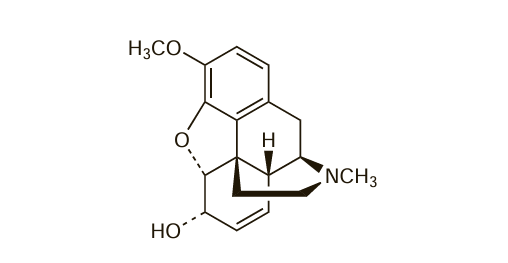
Codeine, a phenanthrene derivative, is an opioid analgesic (p.104) obtained from opium or made by methylating morphine. It is much less potent as an analgesic than morphine and has relatively mild sedative effects.
Codeine or its salts, especially the phosphate, are given orally in the form of linctuses for the relief of cough, and as tablets for the relief of mild to moderate pain, often with a non-opioid analgesic such as aspirin, ibuprofen, or paracetamol.
The phosphate is also given by intramuscular or subcutaneous injection, in doses similar to those used orally, for the relief of pain; the intravenous and rectal routes have also been used. For the relief of pain codeine phosphate may be given in doses of 30 to 60 mg every 4 hours to a usual maximum of 240 mg daily.
To allay non-productive cough codeine phosphate may be given in doses of 15 to 30 mg three or four times daily.
Codeine phosphate is also used as tablets or in mixtures for the symptomatic relief of acute diarrhoea in doses of 15 to 60 mg given 3 or 4 times daily.
etc etc etc
Other codeine salts used include the hydrochloride, sulfate, camsilate, and hydrobromide.
Codeine polistirex (a codeine and sulfonated diethenylbenzeneethenylbenzene copolymer complex) is used in modified-release preparations.







