• N&PD Moderators: Skorpio

CB-25 what is a inverse agonist?

FPU4eva

Bluelighter
Joined
Feb 27, 2008
Messages
208
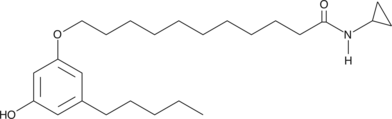
CB-25 is a stable analog of Δ9-tetrahydrocannabinol (THC) and anandamide (AEA). It exhibits high affinity for the central cannabinoid (CB1) and peripheral cannabinoid (CB2) receptors with Ki values of 5.2 and 13 nM, respectively. CB-25 behaves as an inverse agonist for the CB1 receptor as assessed in a cyclic AMP (cAMP) functional assay.1,2


so what is the actuall definition of inverse agnost? is it like CBD and THC combined? quite new to ADD so if its to newby feel free to move it, Im thinking of ordering a sample, but after the disapointment CB-13 was, I dont want to waste a hundred bucks :) thanks for the help
10010116.png
 
Given that rimonabant failed FDA-approval due to incidence of negative side-effects (eg, lowered seizure threshold, anxiogenesis, depression, exacerbation of types of inflammation), I wouldn't taste this one.

ebola
 
Inverse cannabinoid agonists are "research chemicals" in every sense of the word, they are not recreational in the slightest, have little theraputic value, and are useful only for supressing the cannabinoid system in e.g. rats. They work like the opposite of THC. This is even more of a waste of money and time than CB13.

Not everything that binds to the cannabinoid receptor is going to produce a "high".
 
Inverse agonists bind to the receptors, but produces the OPPOSITE mode of signal cascading in the cells. So what to expect from this is any feeling opposite to the THC :P
 
Something you really don't want to taste.

Are research chemical vendors really selling this stuff? What the hell? You'd expect at the very least they would research so as to become knowledgeable to a level that allows them to not lose vast amounts of money by selling at the best useless and at worst actually dangerous products.
 
Maybe it's to give an air of legitimacy, if they still bother to do that? The memory effects of rimonabant sound interesting, I'd probably try it carefully but wouldn't expect much.
 
just wait until the RC vendors discover CB1 perverse agonists, these cause stupid idiots to send money to people they don't know for chemicals they know nothing about which are probably harmful.. maybe RC vendors have already discovered them, though the prevailing wisdom is that they interact with the gullibility receptor gulR which is up regulated and over expressed in many members of bluelight.
 
Hopefully gulR works like 5-HT2A so you can antagonise it and have it downregulate at the same time :)
 
Uhm, I know this is a joke thread, but inverse agonists don't necessarily produce some type of 100% "opposite" signaling response as wikipedia apparently claims. Instead, they produce different signaling transduction than the endogenous agonist. So, for instance, you may be able to find an inverse CB1 agonist that is recreational and anorectic at the same time. Think about the different effects that opioids have, i.e., respiratory depression, constipation, and euphoria. Look up agonist directed trafficking.

http://en.wikipedia.org/wiki/Functional_selectivity
 
You do know there are many different subtypes of opiate receptors (mu 1, mu 2, mu 3 etc..)? The same doesn't hold for cannabinoid receptors, AFAIK.

Your point still stands though, you can activate receptor X and release lots of chemical A with a compound but activation of the same receptor with another chemical causes release of chemical B instead.
 
True, but to say this to a person who doesn't know what an inverse agonist is, this seems to be the shortest explanation. Although if you go further in details it isnt entirely opposite,
 
thanks for the responses what about cb-52 then? the Ki values are a little high but

CB-52 is a stable analog of Δ9-tetrahydrocannabinol (THC) and anandamide (AEA). It exhibits high affinity for the central cannabinoid (CB1) and peripheral cannabinoid (CB2) receptors with Ki values of 210 and 30 nM, respectively.1 In vitro, CB-52 behaves primarily as a CB1 receptor partial agonist and a CB2 receptor neutral antagonist.2


CB2 nueral antagonist so how would this one be? that means it doesent truely effect CB2 receptors? im quite new so im sorry if my questions seem quite newbish, theirs been a flood of new cannaboids on the market, and drug test prevent me from the real deal, so I try to find a non anxiety prown synthetic cannaboid that will be safe to consume.
 
Uhm, I know this is a joke thread, but inverse agonists don't necessarily produce some type of 100% "opposite" signaling response as wikipedia apparently claims. Instead, they produce different signaling transduction than the endogenous agonist. So, for instance, you may be able to find an inverse CB1 agonist that is recreational and anorectic at the same time. Think about the different effects that opioids have, i.e., respiratory depression, constipation, and euphoria. Look up agonist directed trafficking.

http://en.wikipedia.org/wiki/Functional_selectivity

Does this pan out in vivo? I thought I heard that inverse agonists were 'true antagonists' so to speak. That is, even in the presence of a constitutively active receptor, you could block ALL activity.

If they do work in vivo do you know what the inverse agonists usually couple with? I'm assuming that it's more complicated than the reverse (i.e. going from Gi to Gs or vice versa).
 
theirs been a flood of new cannaboids on the market, and drug test prevent me from the real deal, so I try to find a non anxiety prown synthetic cannaboid that will be safe to consume.
I feel sad that it's come to this. People who can't even spell are dabbling in organic compounds too complex for them to know what they do... None of these cannabinoids are new, either. Fewer still are worth ingesting.

Anyway, there's 2 basic variables a drug has when it interacts with the receptor.
1. Affinity - how tightly does the drug couple to the receptor? Lower numbers are better. This number is known as Ki. It is important to note that Ki means nothing about the drug's effect! Drugs with seemingly very high Kis can have strong activity if they are concentrated enough. Conversely, some drugs can bind very tightly but produce no effect.
2. Activity - what does the drug make the receptor do?

A few common types of drugs exist. Usually drugs are rapidly binding and unbinding to receptors in the brain, and only one drug at a time actually causes activaton of receptors. There are a few exceptions like the benzodiazepines but they are receptor-specific and beyond the scope of this duscussion.

Full agonists have an activity above 100% of the "reference" chemical. For instance, morphine is a full agonist of the opiate receptor. It binds and acts "like" endorphin, activating the receptor the same amounr (or more) that endorphin does.
Partial agonists have activity between 0 and 100% of the "reference" compound. THC is a partial agonist at CB1 and CB2 - it only activates the receptors partially, compared to anandamide. Drugs like buprenorphine and methadone are partial agonists. In people dependent on full agonists like morphine or heroin, these drugs only produce some of the effect - whereas in individuals who are drug-naive, they act more like their stronger full agonist friends.
A lot of drugs are redered "safer" by them being partial agonists. For instance the partial agonist THC is less likely to cause seizures and paranoia than the full agonist JWH compounds.
Neutral antagonists or competitive antagonists - These are drugs that bind to the receptor and produce no effect. Naloxone is an example of a neutral agonist - it binds to opiate receptors so opiates can't, and the end result is less opioid activity.
Functional antagonists (sometimes "inverse agonists") produce some other signallng cascade than the "reference" compound does. Sometimes this is the "opposite" of normal receptor activation, like is seen in rimonabant. Rimonabant is a CB1 antagonist that unsurprisingly acts like anti-THC - it makes you satiated, depressed, and on edge, and was discontinued because of it.

 
Last edited:
It seems to me that a cannabinoid receptor inverse agonist could be useful to keep on hand, in case you need to sober up and get unstoned in a hurry.
 
Rimonabant is a CB1 antagonist that unsurprisingly acts like anti-THC - it makes you hungry, depressed, and on edge, and was discontinued because of it.

Slight correction; it's an anorectic drug, and was developed for weight loss. But I'm sure you just mixed things up, I do that all the time too.
 
Thanks; I fixed it.

Cannabinoid recetor inverse agonists are not worth playing with, IMO. Maybe a weak partial agonist or a neutral antagonist would be useful. Even then, can you not just wait a few hours to come down? :P
 
You do know there are many different subtypes of opiate receptors (mu 1, mu 2, mu 3 etc..)?

I am not particularly familiar with opioid pharmacology, but there seems to be some debate about the existence of those mu subtypes:

http://bja.oxfordjournals.org/content/early/2011/05/24/bja.aer115.abstract

^ Published only a month ago. (Though I'm not sure I buy his argument about the knockout mice..)

Does this pan out in vivo? I thought I heard that inverse agonists were 'true antagonists' so to speak. That is, even in the presence of a constitutively active receptor, you could block ALL activity.

Inverse agonists certainly do not block all activity: Rimonabant is the relevant example. Do you have a good paper on constitutively active GPCRs? I don't know anything about them. When you speak of a true antagonist, I believe you are talking about something that other people call silent antagonism.

http://en.wikipedia.org/wiki/Receptor_antagonist#Silent_antagonists

If they do work in vivo do you know what the inverse agonists usually couple with? I'm assuming that it's more complicated than the reverse (i.e. going from Gi to Gs or vice versa).

The agonists themselves don't "couple" (in the g-protein coupled receptor sense of the word) with anything. The functional selectivity wiki article comments on the 5HT-2A receptor as an an example - check out lisuride vs. LSD-25.
 
Last edited:
Top