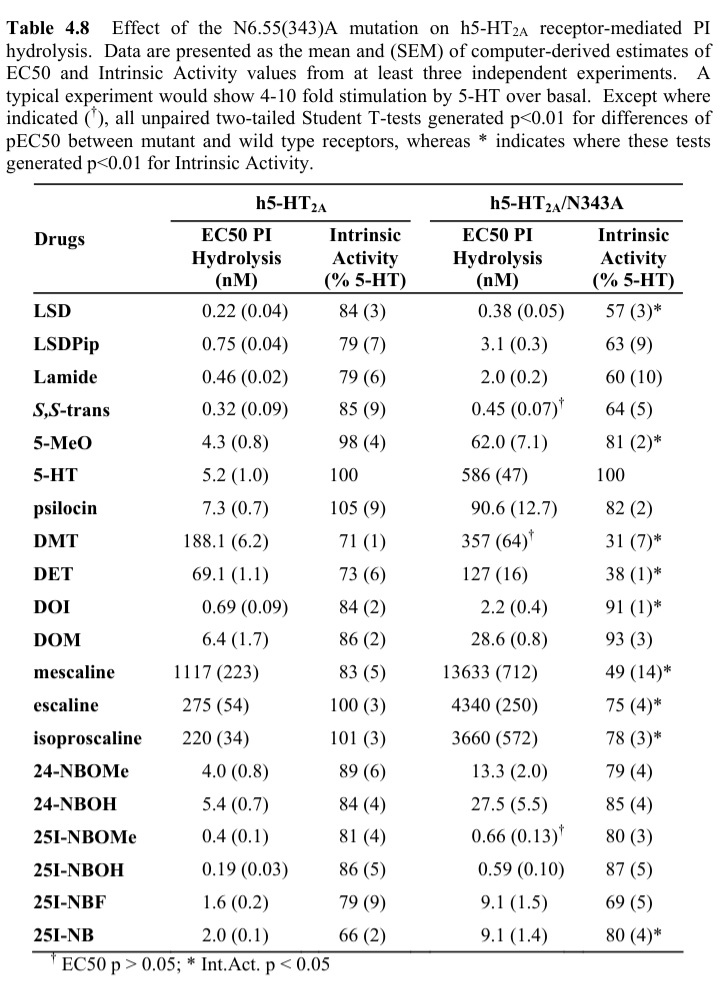
Based on these results, there were no further investigations into N-alkylation to mescal derivatives, until it was finally and surprisingly found that N-benzyl derivatives of phenethylamines can significantly increase the affinity for the serotonin-5-HT receptors: Pertz, Rheineck and Elz presented the serotonin-5-HT receptor affinities for a number of N-benzylated scalin derivatives [551. For N-(2-methoxybenzyl) mescaline (M-NBOMe; 24) they received a 68-fold increased affinitåt (isolated rat-tail artery, [3H]ketanserin marking, Fig. 8) compared to mescalin (1). Of course, the question arises, 0b because in humans the potency is also increased compared to mescalin (1), 0b N-(2-methoxybenzyl)mescaline (M-NBOMe; 24) shows a \X'irkung at all, and if so, which. An individual test (3•50 mg; separated by 1.5h each) showed that the substance is somewhat more potent, but only worked for 5-6 hours, and the effect differs significantly from that of mescaline (1). A single dose would therefore probably work 2-3 hours. The effect seemed to shift the axis of the field of view somehow, and the effects or the after-effects were unpleasant. It should be noted that N-benzylated phenethylamines administered sublingually or nasally are often more potent than administered orally. [...] FIG. 8. The attachment of a (2-methoxybenzyl) substitute to the nitrogen of mescaline (1) causes a drastic increase in the affinity for the 5-HT2A receptor (PH) marked ketanserine) [55).