• N&PD Moderators: Skorpio

Pharmacology Beta-Keto-Phenethylamines

This thread contains discussion about a Pharmacology-related topic

TheLightBringer

Bluelighter
Joined
May 25, 2022
Messages
676


Beta-keto-phenethylamines or ”alpha-desmethyl-cathinones” seem to retain their stimulant qualities as NDRAs despite loosing lipophilicity.
Even though they are described as active stimulants they appear susceptible to MAO breakdown which might be the reason they failed to substitute for Dextroamphetamine and required such high dosages.

However this has me curious as to what modifications can be made to the base beta-keto-phenethylamine structure without alkylating the alpha-position while still arriving at active stimulants
 
Now Im not as knowledgeable as others on here when it comes to predicting SAR.

However we see that in the case of psychedelic phenethylamines a beta-ketone reduces activity, for example seen in bk-2C-B
The bk- substitution increases polarity and decreases lipophilicity

If we instead go back to the alpha position and modify it by adding halogens instead of alkylating it I have hope for active stimulants, in the case of alpha-halogenated phenethylamines they become more resistant to MAO albeit with the tradeoff that they become less likely to cross the BBB (correct me if Im wrong). Now adding a beta-ketone would likely make it even more MAO resistant but lose more activity as a stimulant due to even further reduced BBB-penetration. Kind of a two-steps forward two-steps back type of deal…


What modifications could be done to the beta-keto-phenethylamine structure to arrive at sufficiently active stimulants?
 
Would playing around with alkyl or halogen substitutions on the phenyl ring, primarily the 4th position yield more active compounds?
 
Would playing around with alkyl or halogen substitutions on the phenyl ring, primarily the 4th position yield more active compounds?
Positions 2, 4, 5 would probably be worth exploring, 4 especially.

Beta-keto-phenethylamines ... seem to retain their stimulant qualities as NDRAs despite
Ok it's not a ß-keto but close: ß-methyl-NMPEA aka Phenpromethamine (former brand name Vonedrine).
The drug is a monoamine releasing agent (MRA) similarly to PEA, amphetamine, and other phenethylamines. Phenpromethamine is known to act as a norepinephrine–dopamine releasing agent (NDRA), with EC50 half-maximal effective concentration values of 154 nM for norepinephrine and 574 nM for dopamine in rat brain synaptosomes, whereas serotonin was not reported.
 
Positions 2, 4, 5 would probably be worth exploring, 4 especially.


Ok it's not a ß-keto but close: ß-methyl-NMPEA aka Phenpromethamine (former brand name Vonedrine).
Im aware of Beta-Methyl substitution on phenethylamines but Im talking specifically about beta-ketone substituted phenethylamines such as phenacylamine. I feel like beta-methyl substitutions have been overly discussed whereas beta-ketone phenethylamines without being alpha-alkylated are under discussed. Check the wikipedia links in my post
 
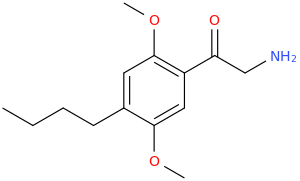
1-(2,5-dimethoxy-4-butylphenyl)-1-oxo-2-aminoethane.png


WORDY_WORD
1-(2,5-dimethoxy-4-butylphenyl)-1-oxo-2-aminoethane

Suspected Psychostimulant Drug Aromatically Inspired By Alexander "Sasha" Shulgin's DOBU. See PiHKAL.
Proceed With Caution.
 
We made a number of ßk analogues of the PEAs and it appeared that overall potency was the only thing that changed.

For reasons I can't understand the idiots made ßk-mescaline which I thought bizarre given that mescaline itself isn't very potent. In that case a user would have to consume over a GRAM, a dose that was never reached as toxic side-effects kicked in below that dose.

ßk-2-CB was decided on simply because at the time on a per dose basis it was the most profitable. We never went down the path of attempting to produce analogues of the FLY series or the NBOMe series as although likely more potent, perfecting a synthesis would have taken too long. Also it was at around that time that both the FLY and NBOMes were in the news for killing people and if nothing else, our (or at least my) top priority was that anything we put out there should be as safe as we could possibly make it.

I can't speak for others but I couldn't live with myself knowing that something I had designed had harmed people.

Full disclosure - for once the idea of making ßk analogues was not mine. I just got to do all of the data-mining.
 
Last edited:
We made a number of ßk analogues of the PEAs and it appeared that overall potency was the only thing that changed.

For reasons I can't understand the idiots made ßk-mescaline which I thought bizarre given that mescaline itself isn't very potent. In that case a user would have to consume over a GRAM, a dose that was never reached as toxic side-effects kicked in below that dose.

ßk-2-CB was decided on simply because at the time on a per dose basis it was the most profitable. We never went down the path of attempting to produce analogues of the FLY series or the NBOMe series as although likely more potent, perfecting a synthesis would have taken too long. Also it was at around that time that both the FLY and NBOMes were in the news for killing people and if nothing else, out (or at least my) top priority was that anything we put out there should be as safe as we could possibly make it.

I can't speak for others but I couldn't live with myself knowing that something I had designed had harmed people.

Full disclosure - for once the idea of making ßk analogues was not mine. I just got to do all of the data-mining.
Oh the bk-nbomes actually sound like a treat if active, hopefully they retain decent potency, although I wonder what the safety profile would be like.
 
Oh the bk-nbomes actually sound like a treat if active, hopefully they retain decent potency, although I wonder what the safety profile would be like.

THAT is exactly why we didn't make them. It seemed that both the FLY and NBOMe series killed in quite a random fashion. Since at the time nobody really understood the toxicology (and even now we still aren't certain). Even IF we had somehow been able to offer them as a 'premium product', seeing the name of something YOU designed in a news item about a fatality - that's not something I could live with.
 
Well, Like Tricky Said, In The Final Analysis The Only Person You Have To Live With Is Yourself.

I Am Not Sure What Is Morally Wrong With Synthesizing Beta-keto-Mescaline, Though TBPH.
 
THAT is exactly why we didn't make them. It seemed that both the FLY and NBOMe series killed in quite a random fashion. Since at the time nobody really understood the toxicology (and even now we still aren't certain). Even IF we had somehow been able to offer them as a 'premium product', seeing the name of something YOU designed in a news item about a fatality - that's not something I could live with.
As a slight sidenote, have you ever tasted Nbome-Escaline?

Also makes me think wether a bk-Nbome-Escaline would retain its potency over Nbome-Mescaline or if the bk- would dramatically reduce potency in this case 🤔
I cant seem to find any info on just the N-benzyl-scalines (without the 2nd position subbed) as well, I would bet they have decent potency compared to the regular scalines though…
 
Also makes me think wether a bk-Nbome-Escaline would retain its potency over Nbome-Mescaline
The mescaline 3,4,5-TMeO pattern is a special case imo which requires a regular amine, no N-methyl(s)/N-benzyl etc. The idea is that mescaline is a prodrug which must be deaminated so it can go onto form at least 3 active aminated metabolites. These are likely to be significantly more potent than mescaline considering the % of mescaline thats excreted unchanged. I estimate similar to the 2C potency of ~10-50+ mg.
 
Last edited:
Nbome mescaline is reported to be more potent than mescaline per Daniel Traschel.

Translation below
Based on these results, there were no further investigations into N-alkylation to mescal derivatives, until it was finally and surprisingly found that N-benzyl derivatives of phenethylamines can significantly increase the affinity for the serotonin-5-HT receptors: Pertz, Rheineck and Elz presented the serotonin-5-HT receptor affinities for a number of N-benzylated scalin derivatives [551. For N-(2-methoxybenzyl) mescaline (M-NBOMe; 24) they received a 68-fold increased affinitåt (isolated rat-tail artery, [3H]ketanserin marking, Fig. 8) compared to mescalin (1). Of course, the question arises, 0b because in humans the potency is also increased compared to mescalin (1), 0b N-(2-methoxybenzyl)mescaline (M-NBOMe; 24) shows a \X'irkung at all, and if so, which. An individual test (3•50 mg; separated by 1.5h each) showed that the substance is somewhat more potent, but only worked for 5-6 hours, and the effect differs significantly from that of mescaline (1). A single dose would therefore probably work 2-3 hours. The effect seemed to shift the axis of the field of view somehow, and the effects or the after-effects were unpleasant. It should be noted that N-benzylated phenethylamines administered sublingually or nasally are often more potent than administered orally. [...] FIG. 8. The attachment of a (2-methoxybenzyl) substitute to the nitrogen of mescaline (1) causes a drastic increase in the affinity for the 5-HT2A receptor (PH) marked ketanserine) [55).

 
Nbome mescaline is reported to be more potent than mescaline per Daniel Traschel.
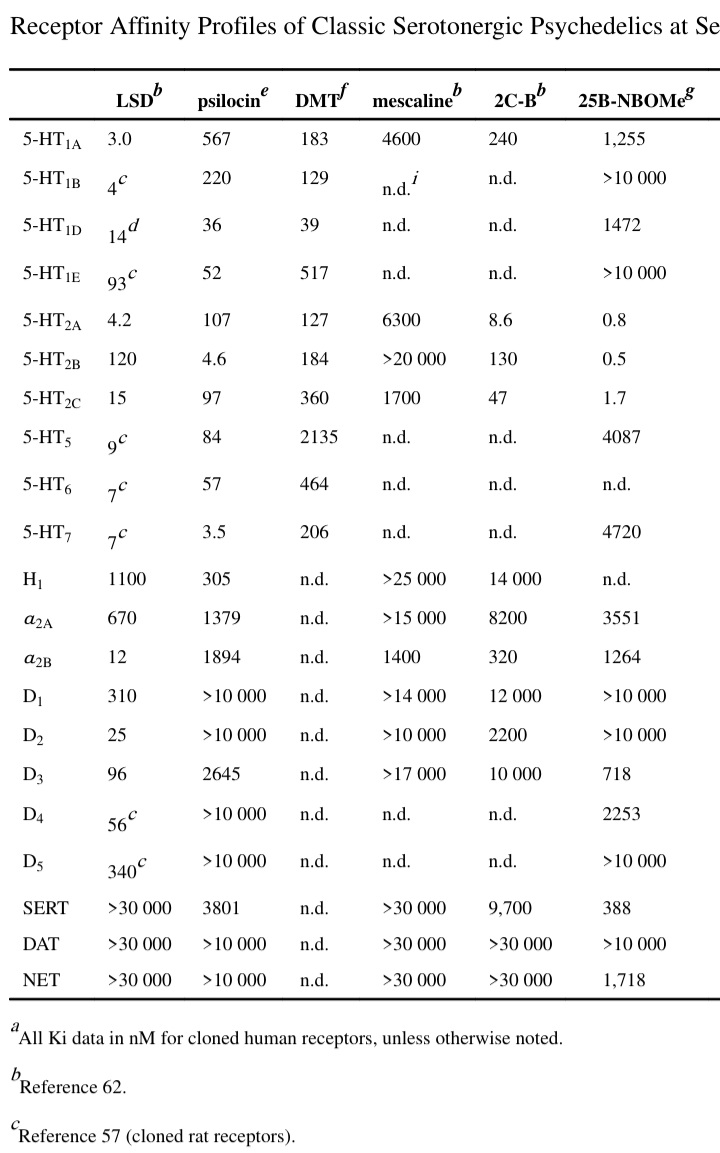
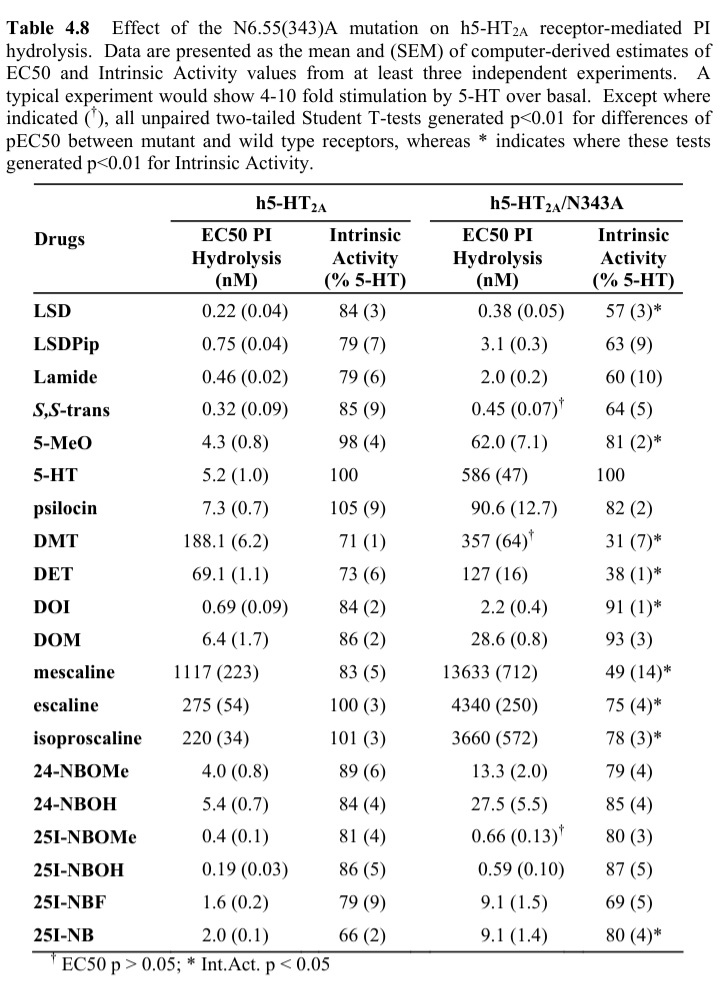
Presumably he's comparing plain mescaline with mescaline-NBOMe. If we consider that mescaline is a mildly active prodrug (for which the pharmacokinetics haven't been properly elucidated) then his comparison is misleading as are all receptor affinity analyses of mescaline (even the PLOS recepterome study).

Shulgin often reports activity in mescaline units (MU), a measure of strength relative to the psychedelic compound mescaline (given the measure 1MU). This has probably led to various misconceptions also. On the basis that mescaline is a mildly active prodrug, the efficiency of it's bio-activation seems to vary from person to person. Thus the quantification of 1MU varies from person to person.
 
Last edited:
If we consider that mescaline is a mildly active prodrug then his comparison is misleading as are all receptor profile analyses of mescaline.
Just curious where you're getting the idea that mescaline is a mildly active prodrug? I've never heard this before nor have I seen any proposed active metabolites of mescaline
 
Just curious where you're getting the idea that mescaline is a mildly active prodrug?
See this post.

I've never heard this before nor have I seen any proposed active metabolites of mescaline
The active metabolites are yet to be characterised as this area hasn't been properly investigated. The assumption is made that mescaline IS active, end of story. It's quite weak also as you might expect from a prodrug:

Screenshot-20260226-010435-PDF-Reader-Hi-Read.jpg


Screenshot-20260217-000819-PDF-Reader-Hi-Read.jpg
 
Last edited:
It's quite weak also as you might expect from a prodrug:
or that you might expect from a drug you have to consume hundreds of milligrams of to produce psychoactivity... I'm just spitballing here, but if one of the metabolites of mescaline is significantly more active than mescaline, as you claim, it would certainly have to be a rather minor metabolite otherwise one wouldn't need to consume the high dosages required by mescaline. Also from the linked post it seems you are implying that 3,4,5-trimethoxyphenylacetaldehyde (or perhaps some other oxidatively-deaminated metabolite would be active), however I am not aware of any non-nitrogenous 2a agonists in vitro or in vivo. Would you be proposing that the SSAO metabolic pathway creates another active metabolite through a mechanism other than oxidative deamination of mescaline/various phenethylamines?
 
We made a number of ßk analogues of the PEAs and it appeared that overall potency was the only thing that changed.

For reasons I can't understand the idiots made ßk-mescaline which I thought bizarre given that mescaline itself isn't very potent. In that case a user would have to consume over a GRAM, a dose that was never reached as toxic side-effects kicked in below that dose.

ßk-2-CB was decided on simply because at the time on a per dose basis it was the most profitable. We never went down the path of attempting to produce analogues of the FLY series or the NBOMe series as although likely more potent, perfecting a synthesis would have taken too long. Also it was at around that time that both the FLY and NBOMes were in the news for killing people and if nothing else, our (or at least my) top priority was that anything we put out there should be as safe as we could possibly make it.

I can't speak for others but I couldn't live with myself knowing that something I had designed had harmed people.

Full disclosure - for once the idea of making ßk analogues was not mine. I just got to do all of the data-mining.
Love your stories, man.

I'll be in touch soon.
 
...or that you might expect from a drug you have to consume hundreds of milligrams of to produce psychoactivity...
The question is why does mescaline require large doses, there are many proposed theories. When someone uses appropriate enzyme inhibition and other dietary conditions the active dose drops significantly. Theoretically in ideal conditions it would drop to 100mg or less. For a strong effect. Some people are taking 1g doses for a mild regular effect.

I'm just spitballing here, but if one of the metabolites of mescaline is significantly more active than mescaline, as you claim, it would certainly have to be a rather minor metabolite otherwise one wouldn't need to consume the high dosages required by mescaline.
Yes, it seems to be a minor metabolite considering that a large % of mescaline is excreted unchanged or as the N-acetyl. The idea is to encourage it to become the major metabolite, effectively improving the efficiency of mescalines metabolism.

Also from the linked post it seems you are implying that 3,4,5-trimethoxyphenylacetaldehyde (or perhaps some other oxidatively-deaminated metabolite would be active) however I am not aware of any non-nitrogenous 2a agonists in vitro or in vivo.
From my earlier post:
The idea is that mescaline is a prodrug which must be deaminated so it can go onto form at least 3 active aminated metabolites.
From the linked post:
Of course I'm not implying that PEAs aldehyde metabolite is active but that it acts as a prodrug of some sort.

Would you be proposing that the SSAO metabolic pathway creates another active metabolite through a mechanism other than oxidative deamination of mescaline/various phenethylamines?
No, SSAO just deaminates mescaline to the aldehyde (another prodrug) which seems to be further "bio-activated" into something aminated and active, likely sharing the 2C-× potency.
 
Last edited:
Top