• N&PD Moderators: Skorpio

Any Propositions for Exciting, New, Novel Benzos or Analogs??

From PhRMA's press release for the 1989 Discoverers Award

JACKSON B. HESTER, Ph.D.

Dr. Hester is honored for his development of Upjohn’s alprazolam (Xanax®) for panic attacks and triazolam (Halcion®) for insomnia. After joining Upjohn in 1960, Dr. Hester began to explore the relationship between pharmacological activity and chemical structure in several important classes of compounds, among them the benzodiazepines. These psychoactive drugs have become critical in thetreatment of anxiety and other mental disorders. Working with the benzodiazepine nucleus, Dr. Hester identified a structural addition tothe molecule which could both increase and modify the biologic effects of the compound. Having conceived this improvement, he then proceeded to implement it. The result was a new class of compounds designated triazolobenzodiazepines. Triazolam and alprazolam were developed from these compounds. Not content with his success, Dr. Hester synthesized an altered version of alprazolam which enhances the drug’s antidepressant effect. This is the basis of the Upjohn product candidate Deracyn...

Antidepressant by which mechanism? I don't like that term, as it tends to mean antidysphoric.

 
From PhRMA's press release for the 1989 Discoverers Award


Antidepressant by which mechanism? I don't like that term, as it tends to mean antidysphoric.

I am pretty sure its anti-depressant properties are via 5HT/NE release.

Also, it looks like it would be a partial benzo agonist, not full.-DG
 
How about a bromo analogue of midazolam... (bromine instead of chlorine on the benzodiazepine ring)

Hmm .....I still don't understand much about those different substitutions on the benzo structure though by looking at many different beno molecules on wikipedia it seems prety clear that the nitro group in many benzos increase the sedating/hypnotic effect...and so do some fluoro analogues (btw i always wondered why i have never seen a iodo conjugated benzo).

I was told by many that the most euphoric benzo was Temazepam (and i read some interesting stuff about Camazepam which is also a Temazepam prodrug).
That hydroxy group on temazepam however gives it a short half-life, and removing it would just give diazepam...so camazepam seems a good candidate.

Initially i though that methylating/alkylating the upper amine gave some euphoric properties but i admit it just a random conclusion. Could you explain to me what difference makes the cloro,bromo,nitro group on the upper phenyl?
 
For a really short acting benzo, creating a prodrug makes sense. Should remain euphoric but increase the duration a bit.

GYKI-52466 has absolutely nothing in common with the discussed benzodiazepines and doesn't belong in this conversation at all.

Deracyn in Adinazolam, but it's not marketed to treat depression. I doubt it's antidepressant effects have anything to do with serotonin, and are probably limited to increased euphoriant properties.

By non-benzo benzo agonists I'm referring to drugs like pipequaline and tracazolate (or etazolate). These are far more amenable to modification of a subunit selectivity. The reason I want a carisoprodol analogue is because then I don't have to worry about illegal possession of a pharmaceutical charges (which vary tremendously from state to state and even between municipality. I had a friend once arrested for having amoxicillin illegally. not charged, but I'd like to avoid even arrest-and-release situations).
 
I was told by many that the most euphoric benzo was Temazepam (and i read some interesting stuff about Camazepam which is also a Temazepam prodrug).
That hydroxy group on temazepam however gives it a short half-life, and removing it would just give diazepam...so camazepam seems a good candidate.

Initially i though that methylating/alkylating the upper amine gave some euphoric properties but i admit it just a random conclusion. Could you explain to me what difference makes the cloro,bromo,nitro group on the upper phenyl?

I can tell from years of experience on recreational benzo abuse of various benzos that midazolam is the #1 most euphoric benzo, but only when used intravenously. Of course this is just a subjective opinion.

As for the bromo-midazolam, the OP wanted benzo analogues that are legal (unscheduled), so this is my suggestion.

What would be ideal (for recreational use) though would be a benzo that had all the qualities of midazolam sans the amnesia...
 
6.4 hours isn't exactly short. And you'll find that with GABAergic especially, once you start increasing duration much, enjoyability drops off steeply.
 
Pinazepam is an interesting one.

Pinazepam differs from other benzodiazepines in that it has a propargyl group at the n1 position of the benzodiazepine sketal molecule. It is less toxic than diazepam and in animal studies it appears to produce anxiolytic and anti-agitation properties with limited hypnotic and motor coordination impairing properties. Pinazepam is rapidly absorbed after oral administration.
 
Also why is there always a freaking halogen on any benzos....
Is it to make it polar enough to absorbed?

It seems that 'lower' phenyl halogenations increase the hypnotic effects, and so do 'upper' conjugations as they get more electronegative Br,Cl,F,NO2....

I would gladly like to read a documentation on plain unchlorinated nordazepam to give me an idea of how different halogenations and N-methylations affect the molecule.
 
Last edited:
its seems the flunitrazepam/Nimetazepam structure yields the most recreational BZDs. i find flunitrazepam far more euphoric than midazolam, its hands down the best BZD ive tasted, in fact its the most euphoric GABAergic ive tasted period - better than both GHB and methaqualone. so what about other halo subs? 2-chlorophenyl, 2-bromophenyl, or alkyl subs 2-ethylphenyl etc. i bet any and all of these would be potent and euphoric - really flunitrazerpam is so close to perfect i would just look for the most modest structural modification possible, although a prodrug would be interesting...
 
Nimetazepam is definitely an extremely recreational BZD and anything that's related to this or Flunitrazepam is high on my "want to try" list.
 
Never managed to get a hold of flunitrazepam before. Here in Italy we have an exagerate (IMO) variety of benzos on the market, all available with a regular prescription. Flunitrazepam is the only benzo here that needs 'big papers' to get it and limited to a 30 days theraphy.
I personally loved clonazepam 'back in my days' which seems to be right below flunitrazepam on a potency/duration scale.
Though i didn't really love the high knockout and memory blasting potential it had on me sometimes. I was always told that flunitrazepam was way stronger as a knockout BZD hence why i never looked for it but would be curious to give it a try.

I always wondered though why a N-methylated version of clonazepam was never made. Seems like that methyl group really does some wonders.
 
Something i always loved, even if it isn't a BZD, is Zolpidem. Crazy.
That thing is actually psychedelic to me.... I'll never forget that time when i talked to my keyboard pretending it was alive! LMAO!!
 
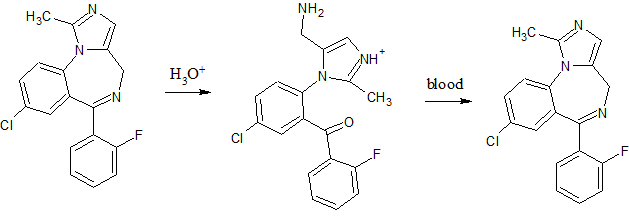
I didn't know this happened with the tricyclic benzos:

Solvolysis_of_midazolam.png


The imide of midazolam is basic enough to allow for hydrolysis in aqueous HCl. The hydrolysis fully reverses at blood pH. Essentially a prodrug.
 
Also why is there always a freaking halogen on any benzos....
Is it to make it polar enough to absorbed?

It seems that 'lower' phenyl halogenations increase the hypnotic effects, and so do 'upper' conjugations as they get more electronegative Br,Cl,F,NO2....

I would gladly like to read a documentation on plain unchlorinated nordazepam to give me an idea of how different halogenations and N-methylations affect the molecule.

Do you ever read SAR studies at all? Without a 7-halogen substitution, they lose GABA affinity. It pretty much drops to nothing. 7-Nitro obvious works as a pseudohalogen.

Some substitutions still work, such as 7-ethynyl, but they start significantly changing the effects (producing subtype selective ligands, which are definitely interesting).
 
i also LOVE zolpidem, i wonder if it would behave more like a classic psychedelic if you were to remove the oxygen...

EDIT: the reason i ask is that its one element of the molecule im not so sure about, i have never seen any data regarding subs on the amine chain like that, the third nitrogen is also something i do not understand the significance of. even the ring on the two position is not totally dissimilar from some known 5HT ligands. it also makes me wonder about the activity of 5,2,N,N-tetramethyltryptamine.
 
Last edited:
...triflubazam...

The 1,5s are only active at alpha-1? I'd like to learn more about them.

I'm too lazy to check right now... are there any benzos with TFM or CN groups in the 7-position?

From chemspider:

ImagesHandler.ashx
carbonitrilazepam
ImagesHandler.ashx
triflumetazepam
ImagesHandler.ashx
fluoroformopin (pre-empting the 2' question)


also in the catalog:
ImagesHandler.ashx
biotinylotriazolam
 
Top