• H&R Moderators: streaM Freak

Healthy Living starts in the garden...

Proper (as in not allowed to go anaerobic) compost should smell like good, rich earth. Part of my stewardship of their garden is to set up a proper composting system. I'm not going to expect them to turn it themselves, but they just had it sitting in closed, sealed drums! So wise in some areas, yet so naive in others.

I do love the smell and feel of good, rich earth though.
 
^If you do have to leave their garden with them again, make them a pile of dried leaves beside the compost so they can layer it properly. It might be useful to put it high so it's easy to reach.
 
Good tip, thanks! I'm still learning a lot about composting, but it is fascinating.
 
QUESTIONS:

I started multiple varieties of tomatoe from seed on exactly March 8th. They're probably only about 15 inches tall and already flowering. Very thick and hardy tho. This is surprising to me, is it recommended to pinch off buds to encourage more vegetative growth? I'm thinking about just letting nature do it's thing. Also, should I cut back and the Fish Emulsion feeding, and stick only with P&K? Or add the P-K in addition to the N.

What is the real story behind legumes and their nitrogen producing properties? I keep hearing different stories... First I read that they only draw nitrogen from outside souces into the surrounding soil, then I hear they actually produce their own, and release it, then that they only produce nitrogen when they die, and if you leave the roots in the soil. Is it worth it to even feed legumes with N or is that a waste?
I have them growing in between corn, and I'm wondering if it would even be necessary to feed the corn too.

And lastly, have you guys successfully grown cool-weather veggies out of season? I currently experimenting with broccolli and sugar snap-peas. I suspect it's about to get reeeal hot around here and stay that way. They're in the shade 3/4's of the day. I'm worried the indirect light won't be enough, but the sun will scorch em if I give them full, direct sun all day.


I know I have more...just forgot for now.

Proper (as in not allowed to go anaerobic) compost should smell like good, rich earth. Part of my stewardship of their garden is to set up a proper composting system. I'm not going to expect them to turn it themselves, but they just had it sitting in closed, sealed drums! So wise in some areas, yet so naive in others.

I do love the smell and feel of good, rich earth though.

Noted for later edumucations. :) I need to get into the compost game, it's pretty weak having to buy the stuff.
 
Composting isn't super hard to do really. If it has enough nitrogen, it sort of does it itself. You can even let it rot without turning and as long as it isn't kept soggy, it won't go anaerobic. It just goes a lot slower than if you turn it. I have a big pile of horse manure compost (my favourite) that I've been turning, yard waste that I turn a bit too and a wood bin full of mostly kitchen compost that I let do it's thing. I can take the top part off, and every two or three years, deep down there's a bunch of nice smelling, fully rotted stuff that I remove from the bin, throw the unfinished stuff back and continue filling. An important part is keeping the piles high and wide enough to get the fermentation happening right deep in the middle. One thing that really works good to get the nitrogen up and fermentation happening is to throw some piss in it. When I'm working outside, I piss in a bucket and throw it into the compost from time to time.
 
Last edited:
This year , blackberries, blueberries, two types of tomatoes, and two types of peppers, not to mention 4 herbs, and an aloe plant :D I gave my friend 4 tomatoes and 2 pepps, he also purchased some herbs. Were gonna be swapping a lot, pics are coming!
 
Dave said:
Except that they let their compost go anaerobic, so it smelled horrible. Two showers later and I still smell like horribly acidic shit.

You need more carbon (as Dtergent pointed out). Turning is not necessary if you don't mind waiting longer. Actually, if you don't turn, the end product will be more copious and of higher quality.

Jam said:
Mehm, I completely space out on your post. Great pictures, is the cattle used for "Kobe" beaf?

Thanks :) I love farming but it's a hard life I think. That is not Kobe beef as it doesn't come from the province of Kobe. Those cows were on an island outside of Hiroshima. We hand fed them a mixture of three different grains and three different grasses twice a day. The rest of the days were spent weed whacking big orange orchards...which seemed weird as we had a a bunch of cows around (to do the weed whacking for us. Oh well, I'm sure there were reasons.

Jam said:
This is surprising to me, is it recommended to pinch off buds to encourage more vegetative growth?

Yes, it is recommended. Pinching off the buds will make the plants get larger, and will extend their lifespan by preventing flowering.

Also, should I cut back and the Fish Emulsion feeding, and stick only with P&K? Or add the P-K in addition to the N.

Fruit plants like vegetables need more nitrogen while in vegetative growth. Don't cut this back until they start flowering. A surefire bet is hefty amounts of compost as they contain all nutrients necessary. Also, compost releases the nutrients as needed because of how the nutrients are bound to carbon in the compost. IE you can't poison plants with compost. If you wanted to, you could grow a plant in a bucket of pure compost.

What is the real story behind legumes and their nitrogen producing properties?

Bacteria living in soil "invades" legume roots and pulls nitrogen from the atmosphere. The nitrogen is then "fixed" it into the roots. Nitrogen is the one plant nutrient that exists in both gaseous and solid forms. The atmosphere is 70% nitrogen.

Symbiotic Nitrogen Fixation from http://users.rcn.com/jkimball.ma.ultranet/BiologyPages/N/NitrogenFixation.html

Symbiotic nitrogen fixation occurs in plants that harbor nitrogen-fixing bacteria within their tissues. The best-studied example is the association between legumes and bacteria in the genus Rhizobium.
Each of these is able to survive independently (soil nitrates must then be available to the legume), but life together is clearly beneficial to both. Only together can nitrogen fixation take place.

A symbiotic relationship in which both partners benefits is called mutualism.
Link to discussion of the role of nitrogen fixation in the nitrogen cycle.
Rhizobia

Rhizobia are Gram-negative bacilli that live freely in the soil (especially where legumes have been grown). However, they cannot fix atmospheric nitrogen until they have invaded the roots of the appropriate legume.

have you guys successfully grown cool-weather veggies out of season?

I've tried. The plants "bolt", which means they send up a shoot that turns into seeds. The resulting leaf growth is very bitter. You can try growing them under a shade cloth to extend the cool season.

 
Oh and I forgot to mention, to help aerate a bin or pile of compost without fully turning it, you can make air holes:

take a nice, long steel rod and jam it down through the compost into the center and wiggle it around a bit each time.
 
Hey, so im starting a lot more plants from seed in trays this year. Its like a little mini greenhouse seedtray, anyways. I put 2 or 3 seeds in each hole just to make sure if one failed the other germinated, but im finding that almost all the seeds are germing and now im thinking i should try and move them to their own homes.

My question is should i try and get the seedlings into their own homes sooner or later? today i opened up one of the trays i had some zuchinni in. I planted 2 seeds in each of these holes. But when i pulled it up i found that the roots had already taken hold and the two seeds were now tangled together at the roots. Can i pull em apart without killing em? can i leave em together, i know squash and zuchinni you can get a couple plants per hill. Or should i wait till they get stronger before trying to seperate them? They are about an inch and a half tall, still on their baby leaves.

I can get some photos up if thatll help.
 
^^don't try to seperate them, you will end up killing both plants. What you should do is pick the healthier of the two seedlings and snip the other one off with scissors at the soil.
 
Mehm, I've had a fair rate of success untangling seedlings, I just have to be sure to keep them in well-watered pots in the shade. I'm not sure about frost/etc since I'm from a tropical country.

If you really want to kill the other one, you can just plant them both and mulch the other one over with newspaper as well.
 
Hi from the new hammock!! Great new chilling spot.
_MG_0899.jpg


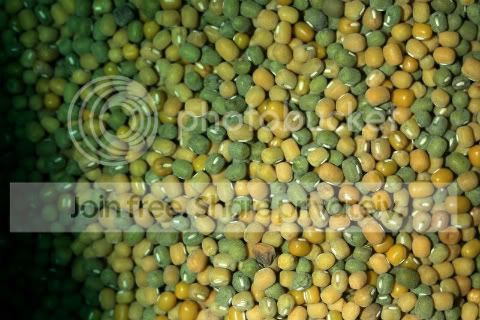
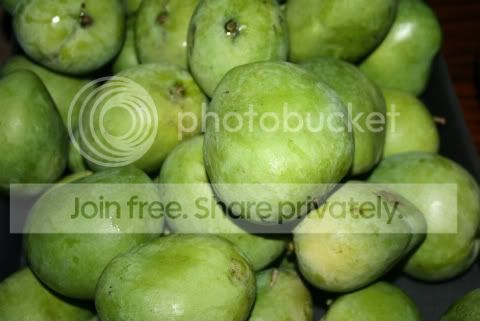
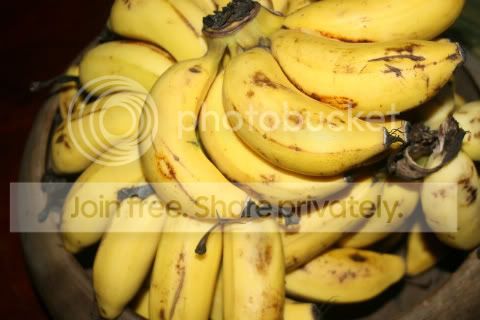
Produce! Not from our house, but our beach house which we also maintain a garden at.

Mung beans (combination of yellow and green)
IMG_1032.jpg


Green Indian mangoes
IMG_1030.jpg


Bananas
IMG_1031.jpg


There are more more more! Maybe I'll upload them later on :)
 
that garden of mine has so much potential, only problem being I"m away half the time visiting my partner ~

presently growing; Bok Choi, Cos Lettuce, Cucumber, Zucchini, Broccoli, Beetroot, verarious herbs (Parsley, Basil, Rosemary and a few others randoms),

+ some fruit trees: New Guinea Red Paw Paw, Avocado, Mango, Rollinia, Black Sapote, Lychee, Soursop, Jakcruit

when I find my own land to create, sometime soon no doubt, I'm gonna make a massive big mandala food system, all centered around the living space ~ designed on permacultural principles
 
^Nice!

Where are you from? Thats' a lot of trees I'm growin as well :) I'm growing black sapote too, from seed! The fruit tastes-- interesting :p It's taking quite sometime.

Awesome! I just got my permaculture certification a few months ago, after years of reading up on it. Mehm has been doing it for sometime now, if I'm not mistaken.
 
^^I don't have a certification or anything. Just a long standing active interest :)
 
Top