I've never seen any medical literature describing the short and long-term negative effects of commonly used psychedelic research chemicals such as 2C-E/I/D/B. Are these chemicals in any way hurting your brain? I've never seen anything with Shulgin's writing pertaining to health effects. MDMA is neurotoxic, could it be possible for any of these new chemicals to be the same, safer, or worse?




-
Neuroscience & Pharmacology Discussion Welcome Guest
Posting Rules Bluelight Rules Recent Journal Articles Chemistry Mega-Thread FREE Chemistry Databases! Self-Education Guide -
N&PD Moderators: Skorpio
You are using an out of date browser. It may not display this or other websites correctly.
You should upgrade or use an alternative browser.Research Chemical Safety
- Thread starter veRGe
- Start date




fastandbulbous
Bluelight Crew
^ I've never seen anything about alphamethyldopamine being neurotoxic, only that it can cause severe depression...
fastandbulbous
Bluelight Crew
^ I've never seen anything about alphamethyldopamine being neurotoxic, only that it can cause severe depression...
Hammilton
Bluelighter
- Joined
- Sep 2, 2008
- Messages
- 3,435
Whether it is isn't really important because it's metabolites definitely are:
Glutathione and N-acetylcysteine conjugates of alpha-methyldopamine produce serotonergic neurotoxicity: possible role in methylenedioxyamphetamine-mediated neurotoxicity.
Bai F, Lau SS, Monks TJ.
Division of Pharmacology and Toxicology, College of Pharmacy, University of Texas at Austin, Austin, Texas 78712, USA.
Direct injection of either 3,4-(+/-)-methylenedioxymethamphetamine (MDMA) or 3,4-(+/-)-methylenedioxyamphetamine (MDA) into the brain fails to reproduce the serotonergic neurotoxicity seen following peripheral administration. The serotonergic neurotoxicity of MDA and MDMA therefore appears to be dependent upon the generation of a neurotoxic metabolite, or metabolites, the identity of which remains unclear. alpha-Methyldopamine (alpha-MeDA) is a major metabolite of both MDA and MDMA. We have shown that intracerebroventricular (icv) injection of 2,5-bis(glutathion-S-yl)-alpha-methyldopamine [2, 5-bis(glutathion-S-yl)-alpha-MeDA] causes decreases in serotonin concentrations in the striatum, cortex, and hippocampus, and neurobehavioral effects similar to those seen following MDA and MDMA administration. In contrast, although 5-(glutathion-S-yl)-alpha-methyldopamine [5-(glutathion-S-yl)-alpha-MeDA] and 5-(N-acetylcystein-S-yl)-alpha-methyldopamine [5-(N-acetylcystein-S-yl)-alpha-MeDA] produce neurobehavioral changes similar to those seen with MDA and MDMA, and acute changes in brain 5-HT and dopamine concentrations, neither conjugate caused long-term decreases in 5-HT concentrations. We now report that direct intrastriatal or intracortical administration of 5-(glutathion-S-yl)-alpha-MeDA (4 x 200 or 4 x 400 nmol), 5-(N-acetylcystein-S-yl)-alpha-MeDA (4 x 7 or 4 x 20 nmol), and 2, 5-bis(glutathion-S-yl)-alpha-MeDA (4 x 150 or 4 x 300 nmol) causes significant decreases in striatal and cortical 5-HT concentrations (7 days following the last injection). Interestingly, intrastriatal injection of 5-(glutathion-S-yl)-alpha-MeDA or 2, 5-bis(glutathion-S-yl)-alpha-MeDA, but not 5-(N-acetylcystein-S-yl)-alpha-methyldopamine, also caused decreases in 5-HT concentrations in the ipsilateral cortex. The same pattern of changes was seen when the conjugates were injected into the cortex. The effects of the thioether conjugates of alpha-MeDA were confined to 5-HT nerve terminal fields, since no significant changes in monoamine neurotransmitter levels were detected in brain regions enriched with 5-HT cell bodies (midbrain/diencephalon/telencephalon and pons/medulla). In addition, the effects of the conjugates were selective with respect to the serotonergic system, as no significant changes were seen in dopamine or norepinephrine concentrations. The results indicate that thioether conjugates of alpha-MeDA are selective serotonergic neurotoxicants. Nonetheless, a role for these conjugates in the toxicity observed following systemic administration of MDA and MDMA remains to be demonstrated, and requires further experimentation.
I've never looked into a-MeDA toxicity proper, though. I should be more careful in my statements though.
Rectify
Bluelighter
- Joined
- Oct 20, 2008
- Messages
- 11,873
MDMA is absolutely one of the safest drugs you're ever going to find. Its safety profile is comparable to that of aspirin. The number of people who have already died from research chemicals is far greater proportionally than the number of people who have died after taking ecstasy. Ecstasy kills about a half a person a year. The most dangerous research chemicals so far in terms of death have been 2ct7, alpha-ethyltryptamine, and alpha-methyltryptamine.MurphyClox
Bluelighter
- Joined
- Mar 26, 2008
- Messages
- 1,416
I've never seen any medical literature describing the short and long-term negative effects of commonly used psychedelic research chemicals such as 2C-E/I/D/B.
For the 3 mentioned compounds: Unlikely, if the dose is kept reasonable and one avoids repeated redosing., signifcant, as with all stimulants resp. psychedelics (assuming that the 2C-family is somewhere in-between).
- Murphy
Hammilton
Bluelighter
- Joined
- Sep 2, 2008
- Messages
- 3,435
[1] That's a total red herring. In a conversation about long term consequences, not about what's more likely to kill you, the number of DEATHS occuring is irrelevant. It's a bit of a short term problem, afterwards you don't have to deal with it, unless you're a Christian...
MDMA use carries with it the risk of serious long term consequences. Taking known therapeutic levels of Aspirin won't have you on the edge of suicide, even if you over do it a little. It won't cause permanent memory impairment.
Is it the most dangerous thing out there? No, not really. Talking about MDMA here. Ecstasy can only be described as much worse, but that's entirely the result of adulteration, not MDMA itself.
[2] That's absolutely nonsense. You might want to google numbers before posting them, because that's super nonsense.MDMA is absolutely one of the safest drugs you're ever going to find. Its safety profile is comparable to that of aspirin.[1] The number of people who have already died from research chemicals is far greater proportionally than the number of people who have died after taking ecstasy. Ecstasy kills about a half a person a year. [2] The most dangerous research chemicals so far in terms of death have been 2ct7, alpha-ethyltryptamine, and alpha-methyltryptamine [3].
The rate of serious adverse events in MDMA users appears to be low. A UK parliamentary committee commissioned report found the use of "Ecstasy" to be less dangerous than tobacco and alcohol in social harms, physical harm and addiction.[15] In terms of deaths, figures in the United States show that fewer than 10 people per year die with only MDMA in their system, and fewer than 100 per year with MDMA and other drugs.[16][17] In England and Wales, in the five years between 2001 and 2005, there were an average 27 deaths per year attributed to MDMA alone.
^ a b Science and Technology Committee Report (page 114), 2006).
^ TheDEA.org: Ecstasy Statistics
^ Caned In Totnes - Clubbers Guide to Ecstasy (MDMA)
^ Deaths related to drug poisoning, England and Wales
Deaths involving MDMA (from districts reporting to SAMHSA):
Year: 1994 1995 1996 1997 1998 1999 2000 2001*
Reported Deaths: 1 6 8 3 9 42 63 76
*Incomplete data; the actual total is probably closer to 100.
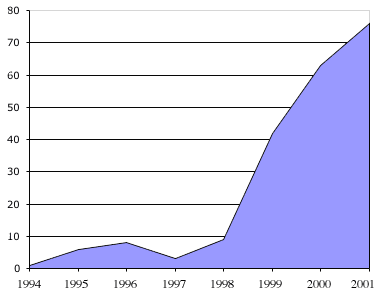
Graphically represented, the data spike of 1998-2000 is even more obvious. This increase is something of a mystery, given that the overall rate of use seems to have only about doubled between 1996 (8 deaths) and 2000 (63 deaths.) The increase in reports does, however, better match the increases in Emergency Room visits. My concern is that this trend was partly the result of MDMA's spread from users who generally knew what they were doing to younger and more ignorant users. The government failed in both respects; They were unable to stop the growth of usage, and they refused to provide useful drug education to young people.
[3] The 2CTx's are especially problematic, as they're MAOIs and may release monoamines. You can see why that's a problem.
Regarding AMT and AET, these two are both surprisingly safe. The majority of the deaths involving these two involve taking doses appropriate for alpha-Me/Et-Tryptamine when what was actually ingested was their 5-methoxy counter parts. It's unfair to blame these deaths on AMT/AET or even on 5-Methoxy-AMT. Comparing doses in individuals who didn't take 3x as much as they should have by accident is much more useful in determining toxicity.jesusisawombat
Bluelighter
I would be more worried about RC's like 4-MMC and the JWH's. But I think what is most worrying is the alarming amount of RC vendors which are accessable via very simple google searches. They are showing up more and more by the week, I think it's really getting out of hand. There is even one listing items on eBay US. I think the RC market is really under threat when people can accidentally find RC's instead of having to go looking for them. It has seemed to have really exploded in the last few months/half year, and the prices are becomming very low. I can imagine in the next few years lots of people are going to accidentally die as RC's move into the hands of the ignorant. I believe we are very close to the peak of the RC market, and it will fall down very fast once China and other big manufacturering countries make them all illegal. It will be an interesting aftermath once all the white powder clears.
tobala
Bluelight Crew
- Joined
- Jul 3, 2006
- Messages
- 9,377
My opinion is that, given their availability to teenagers and the stupid things that have been done with them, relatively speaking the number of deaths has been very small--insofar as the short term is concerned, they are amazingly safe.
The long term? How old is Shulgin now? :D
fastandbulbous
Bluelight Crew
^ Psychedelics in generall really - how old did Herr Hoffman reach? 102 wasn't it :D (LSD et al that he's responsible for were all once research chemicals)
fastandbulbous
Bluelight Crew
Regarding AMT and AET, these two are both surprisingly safe. The majority of the deaths involving these two involve taking doses appropriate for alpha-Me/Et-Tryptamine when what was actually ingested was their 5-methoxy counter parts. It's unfair to blame these deaths on AMT/AET or even on 5-Methoxy-AMT. Comparing doses in individuals who didn't take 3x as much as they should have by accident is much more useful in determining toxicity.
Er, no. AET caused deaths due to fatal agranulocytosis which developed in some patients when AET was used clinically as an antidepressant in the 60s - that's why it was withdrawn (AMT doesn't seem to have this problem from what I've read of it's clinical use in the USSR for a couple of decades)
tobala
Bluelight Crew
- Joined
- Jul 3, 2006
- Messages
- 9,377
And maybe a disclaimer should be tossed in that, with regard to our opinions about "safety," the scope we're really talking about is the PIHKAL/TIHKAL collection.
Things like the newer exotic stimulants and "designer" opiates look like a whole different ballgame...
Hammilton
Bluelighter
- Joined
- Sep 2, 2008
- Messages
- 3,435
Er, no. AET caused deaths due to fatal agranulocytosis which developed in some patients when AET was used clinically as an antidepressant in the 60s - that's why it was withdrawn (AMT doesn't seem to have this problem from what I've read of it's clinical use in the USSR for a couple of decades)
Right, but I was under the impression that this was also a very rare side effect, something like less than 1 in 30K doses, no?
Then again, it only lasted a year on the market.
Still, I would have liked to have been a depressee in 1961.
Rectify
Bluelighter
- Joined
- Oct 20, 2008
- Messages
- 11,873
Hammilton,
As an experieced drug user, I'd like to think that part of the reason that I am still alive today is that I have always been very keen on noticing which drugs and drug combinations are most lethal and then avoiding those scenarios.
The most important factor in evaluating drug safety is always lethality. Period.
I'm not quite sure by what you mean when you say that "mdma is neurotoxic." Maybe if you could show me any tangible, measurable, grave, and clinically significant manifestations of this assertion, then I would care and take that statement seriously, but you can't you never have been able to and you never will be able to and so I don't care about that statement, take it at all seriously, or am the least bit frightened by the thought of taking even large amounts of MDMA.
To be frank, the putative, United States government funded and promoted mdma neurotoxicity syndrome has become more than a bit of an ugly, long-running debacle of a joke among international research scientists. Kind of like Rush Limbaugh. Ricaurte's career, for example, is currently in utter shambles because of it, yet it seems like you are still basing your ideas on this subject on flawed research studies like his?
My saying "ecstasy kills about half a person a year" is admittedly a bit tongue and cheek, a bit of a wry statement, and a bit of a stretch BUT NOT BY MUCH. That's why it's rather funny. The actual figure is probably closer to 2 people per 100 million MDMA pills consumed. Or maybe, as you claim, 10 people. Either way, that is extremely, extremely safe for a prescription or street drug and especially so for one with such a high potential for "re-use" as mdma. In fact, it's right up there with people who supposedly die every year from peanut allergies. That is not evidence based medicine.
You go on to say that mdma can render one hopelessly depressed and suicidal. Again, my experience and observations in this regard have been totally the opposite. All of this makes me wonder just how old you are and how much real world knowledge and experience you have with mdma to begin with?
I went on to say that the most deaths so far in the research chemical department based on the number of people who have consumed each specific drug have been due to 2ct7, AMT, and AET. I stand by this true statement. The distinction that most people who died from AMT died after taking 10 hits at once doesn't change the fact that they nonetheless died any more than the fact that most people who died from 2ct7 were also rolling at the time. That is simply what happened. It is an observation based on reality rather than some pie in the sky theoretical nonsensical PET fictional holes in your brainscan government funded hysterical drug war propaganda junk science regarding mdma neurotoxicity that has long since been discredited that you still seem to be espousing. MDMA is a damn safe drug.
Hammilton
Bluelighter
- Joined
- Sep 2, 2008
- Messages
- 3,435
research chemical department based on the number of people who have consumed each specific drug have been due to 2ct7, AMT, and AET.
Again, no, AMT and AET were not the primary killers, their 5-methoxy derivatives were. People took either 5-MeO-alpha-alkyltryptamine thinking it was just A-M or E-T and died. AMT and AET were not responsible for many deaths. Death was due to massive overdose of the much more potent 5-methoxy derivatives. Seriously, read for a change.
You go on to say that mdma can render one hopelessly depressed and suicidal. Again, my experience and observations in this regard have been totally the opposite. All of this makes me wonder just how old you are and how much real world knowledge and experience you have with mdma to begin with?
Funny, an uber noob shows up one day, not having read a single research paper on the subject, and apparently not even an abstract is espousing the idea that we take anecdote over data.
It is an observation based on reality rather than some pie in the sky theoretical nonsensical PET fictional holes in your brainscan government funded hysterical drug war propaganda junk science regarding mdma neurotoxicity that has long since been discredited that you still seem to be espousing.
I can't even take you serious. If you're still referring to Ricaurte, you haven't paid attention to anything from the past 10 years. The Science study is entirely irrelevant It doesn't disprove that MDMA is neurotoxic, it shows that high dose methamphetamine is. No surprise there. Until the results of the investigation are made public, it's stupid to blame Ricaurte, because as far as I can tell, his supplier is just as likely to be at fault.
One thing is consistent and clear, throughout the past decade science has consistently agreed that MDMA is neurotoxic. Even the recently released British (IIRC) paper has agreed that heavy use is definitely associated with serious problems. Light or moderate use left the picture less clear, but this was after 10-20 years of abstinence for the most part. Short term studies are less ambiguous, finding a clear link between memory and mood problems even with moderate users. With the first large, long term study, though, it seems that time ameliorates these issues though.
If you can find 5 ADD regulars who'd say that MDMA is NOT neurotoxic, I'l be beyond amazed.
Rectify
Bluelighter
- Joined
- Oct 20, 2008
- Messages
- 11,873
My dealer had two other customers die after taking ten AMT-laced sugar cubes thinking they were acid.
Please don't tell me you have the audacity to sit here and tell me that these AMT deaths didn't happen, that my dealer is not smart enough to know which drug he ordered he ordered off the internet, or that I can't tell the difference between AMT and 5-MeO-AMT. I took the sugar cubes myself on several different occasions and they were most certainly AMT, not 5-MeO-AMT.
As for the AET lethality issue, look on PubMed yourself. A lethal, accidental overdose of a man in Amsterdam who took AET is why the Dutch government made it illegal there way back in 1996 or whenever it was that I read the abstract.
Hammilton
Bluelighter
- Joined
- Sep 2, 2008
- Messages
- 3,435
I never said no one way overdosed on either of them. I said that the worst offenders were the 5-methoxylated derivatives.
And you're still confusing anecdote for evidence.
It's always funny when average drug users read erowid for a couple days then come here and start in about all that they know.
Rectify
Bluelighter
- Joined
- Oct 20, 2008
- Messages
- 11,873
"average drug user"
That's a laughable statement to make once you know the following two facts that I (1) don't use drugs anymore (yeah, I'm an ex-drug user) and (2) am anything but average. Thanks for sharing, though.
"Those who say don't know, and those who know don't say."--Lao Tzu.