• Psychedelic Drugs Welcome Guest
    View threads about
    Posting RulesBluelight Rules
    PD's Best Threads Index
    Social ThreadSupport Bluelight
    Psychedelic Beginner's FAQ
  • PD Moderators: Esperighanto | JackARoe |

Tryptamines L. asiatica - lilliputian hallucinations

With all due respect, all the content you just posted adds little to the discussion.
Considering the thread is about Lanmaoa asiatica intoxication, my posting literature data on Lanmaoa asiatica intoxication seems relevant.
 
you have to go to china, philipines, papa new guinea, or some place where the fresh mushrooms can be aquired in restaurant or markets
 
Well he is no Albert Hoffmann is he.. oh yea that was an accident. He is no shulgin is he...
Hofmann confirmed the active ingredient of psilocybe species and of the ipomoeas by bioassay. They also assayed the analogues of LSD and psilocin they made at Sandoz. He might not have tried as many compounds as Shulgin, but he didn't shy away from confirming activity in himself.
 

Bolete Mushroom Hallucinations: The Science of Seeing Little People​

May 25, 2026
Lilliputian-Lore_Colin-Domnauer.jpg


Bolete mushroom hallucinations — vivid visions of tiny people reported independently across Papua New Guinea, Yunnan, and the Philippines — are one of mycology’s most puzzling and least-studied phenomena. Colin Domnauer, PhD, an ethnobiologist at the University of Utah, has spent years on their trail.
...
The modern scientific record of Lanmaoa asiatica‘s effects dates back only a few decades. But the cultural record may reach much further. An ancient Daoist text describes a “flesh spirit mushroom” — one associated with seeing a little person between three and thirty-three centimetres tall — and instructs that it must be consumed raw to produce the effect.
The results were clear: mice given the Lanmaoa asiatica extract showed pronounced hyperactivity followed by a sustained period of hypoactivity — a stupor-like state in which they did not react to touch. The behavioral signature was distinct from both controls, confirming a real bioactive effect and suggesting a mechanism different from psilocybin.

Fractional analysis — breaking the extract into progressively narrower chemical subdivisions and re-testing each in mice — narrowed the bioactive component down to a fraction containing one to three compounds. But the identity of those compounds could not be determined. Whether a single molecule or a synergistic combination is responsible, and whether the mouse bioassay reflects the same mechanism as the Lilliputian hallucinations in humans, remains an open question.
https://mckenna.academy/colin-domnauer-bolete-mushroom-hallucinations/
 
Last edited:
So nobody here has any trip reports for this?

Old ones...

Xiao Ren Ren: The “Little People”of Yunnan

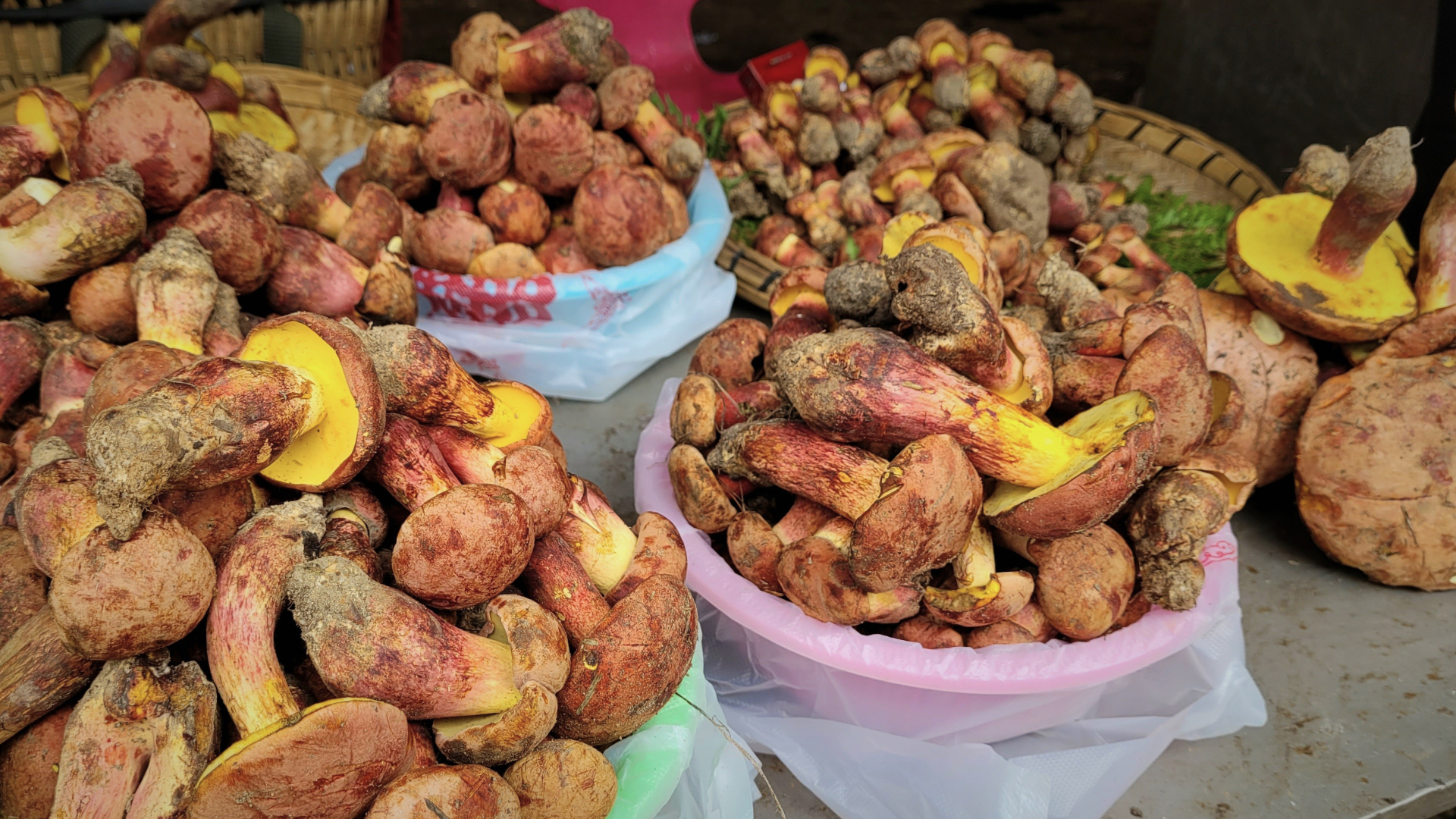
Xiao ren ren are widely known in Yunnan province, China. The phrase means “little men”or “little people” (xiao, little; ren, man or person, the redundancy being an idiom to indicate lots of men or people, which the standard plural form renmen does not necessarily connote). Xiao ren ren are typically glimpsed or experienced after dining on inadvertently undercooked, blue-staining boletes of uncertain identity. The people of Yunnan seem almost universally amused by the xiao ren ren rather than fearing them or revering them.
I have since met more than a dozen people in Yunnan who have personally seen the xiao ren ren, including one woman whose visual experience, though pleasant, was accompanied by nausea and vomiting. The two first-hand accounts below were unusual in that they were related to me in English.
...
Later, I met a professor with excellent English skills who had actually seen the xiao ren ren.
“It was in a restaurant. I asked for stir-fried mushrooms and just as I was getting ready to leave, after eating them, I noticed moving colors and shapes. I wasn’t worried. My first thought was, ‘Oh, they must not have cooked the mushrooms enough —I’ll be able to see the xiao ren ren!’
...
Her mother had bought some blue-staining boletes from the market and stir-fried them for the family, but she was in a hurry that evening and presumably didn’t cook them for the requisite amount of time. Miss Oh clearly remembered the hallucinations that began that evening and continued into the next day. The walls moved and shifted in geometrical patterns and strange shapes appeared. “I’m sleepy all day,” she said in English. “I see them [xiao ren ren]. And I see flies bigger than the actual one, perhaps two times big. I see little insects. Not all the time, but when the water splashed out.” She apparently became fascinated by the dripping kitchen faucet, for each drop would, upon hitting the sink, sprout wings and legs and crawl away. And she remembered, very clearly, staring intently at the bows of her shoelaces until they turned into butterflies and fluttered off. Her brother experienced similar effects, but her mother and father did not feel any —perhaps because they ate less proportional to their body weight.

— Arora, D. Xiao Ren Ren: The “Little People” of Yunnan. (2008) DOI: 10.1007/s12231-008-9049-0
 
https://phys.org/news/2026-08-qa-mushroom-tiny-people-hallucinations.html

What makes the hallucinations so unusual?
People pretty much always report seeing dozens or hundreds of little people, about 3 to 30 centimeters tall (1 to 12 inches), in incredible detail, like they're actually there. About 90% of people describe them as little elves or clowns or other fairy-like figures dressed in colorful clothes.

What's fascinating is they interact with the physical world using the laws of physics that govern us. They're not walking through walls or anything. They're falling off the edge of tables, walking around objects. One person told me that while they were eating soup, the little people were jumping off their spoon into the bowl and swimming around.
If L. asiatica has some compound that can reliably induce these hallucinations, it could be a very powerful tool for understanding the mechanisms behind them.
Since modern science is materialistic in nature it lacks coherent understanding of the intangible (an area which other cultures have an advanced understanding). In this context I'm doubtful academics will understand quite what is happening nor why the hallucinations explicitly engage physicality. It's obvious to an indigenous herbalist-type but the molecular biochemist is at a loss.
 
Last edited:
maybe the "herbalist-type" is just good at rationalizing their way to an explanation they like when they in reality they have no clue whatsoever?
No, they're just a lot wiser than the academics who can but speculate about these matters. Shulgin is probably the only one who would've had the right idea.
 
Last edited:
Not really. I'm a big fan of science but rational enough to appreciate it's fundamental limitations. I'd be foolish and arrogant not to.
What is this science that you speak of and how is it fundamentally limited? I think your views could use a bit more nuance.
 
What is this science that you speak of and how is it fundamentally limited?

I was replying to Didgital so it's the same science he referenced:
Allylbenzene is just condescending to science in general until it suits his beliefs.

If you saw my earlier post I referenced "academics" and "modern science". You seem smart enough to understand this I think.
Since modern science is materialistic in nature it lacks coherent understanding of the intangible (an area which other cultures have an advanced understanding). In this context I'm doubtful academics will understand quite what is happening nor why the hallucinations explicitly engage physicality. It's obvious to an indigenous herbalist-type but the molecular biochemist is at a loss.

Perhaps you missed this post(?) but to summarise; modern science is fundamentally limited as it lacks coherent understanding of intangible processes which it cannot quantify.

The majority of its followers appear unaware of its fundamental limitations (as some of them indicated in previous comments).
 
Last edited:
Perhaps you missed this post(?) but to summarise; modern science is fundamentally limited as it lacks coherent understanding of intangible processes which it cannot quantify.
No I did not miss that post! I have been following the conversation. I think your characterizations of both "science" and "other cultures" or alternatively of an "indigenous herbalist-type" and a "molecular biochemist" are stereotyped and lacking in nuance.
The majority of its followers appear unaware of its fundamental limitations (as some of them indicated in previous comments).
It's followers? As if modern science is a religion with followers? You are making serious category errors here. All this reveals your lack of serious understanding of these topics. Science is not a religion nor is it a culture. And "indigenous herbalist-type" and "molecular biochemist" are not exclusive categories. You are reasoning from a dualism that is neither real nor even coherent within your own mind.
 
I think your characterizations of both "science" and "other cultures" or alternatively of an "indigenous herbalist-type" and a "molecular biochemist" are stereotyped and lacking in nuance.
Perhaps it's simply a language barrier graced with pedantry?

It's followers? As if modern science is a religion with followers?
Followers indeed, of that specific belief system.

Scientism is a philosophical stance that asserts that knowledge about the universe can be obtained solely through scientific inquiry, particularly through the scientific method, which emphasizes empirical evidence and repeatable experiments.

Scientism as a Belief System

It may seem strange to talk about science in these terms. Science is supposed to be neutral and objective and free from beliefs. The role of scientists is to investigate the structure and laws of natural phenomena and to conduct research and advance knowledge. Science is ideally an open-minded and open-ended process, where theories are continually tested and updated based on evidence.

...science has become associated with a particular worldview, which is often maintained and defended in a similar way to a religion.

This is the worldview of materialism, which holds that matter is the primary thing in the universe, and that anything that appears to be non-physical—such as the mind, our thoughts, consciousness, or even life itself—is physical in origin, or can be explained in physical terms.


Materialism holds that human beings are just biological machines and that the only purpose of our lives is to survive and reproduce. It holds that anomalous phenomena, such as spiritual experiences, near-death experiences, or psi phenomena, are brain-generated illusions or can be explained in terms of fraud or coincidence. Materialists are particularly opposed to psi phenomena—like telepathy or precognition—which they see as anathema to science, a throwback to a pre-enlightenment world of magic.

An alternative term for this belief system is scientism since it is a paradigm that has been derived from some of the findings of modern science. As the psychologist Imants Baruss has described it, “Science is an open-ended exploration of reality based on logical thinking about empirical observations. Scientism is the adherence to a materialist version of reality that confines investigation to those sorts of things that are permitted by materialism.”

And "indigenous herbalist-type" and "molecular biochemist" are not exclusive categories.
Indigenous cultures tend to hold knowledge of things which academia remains ignorant. Whether I use the term molecular biochemist or academic, this refers to followers of modern science. These followers will tend to defend their belief system.
 
Last edited:
Top