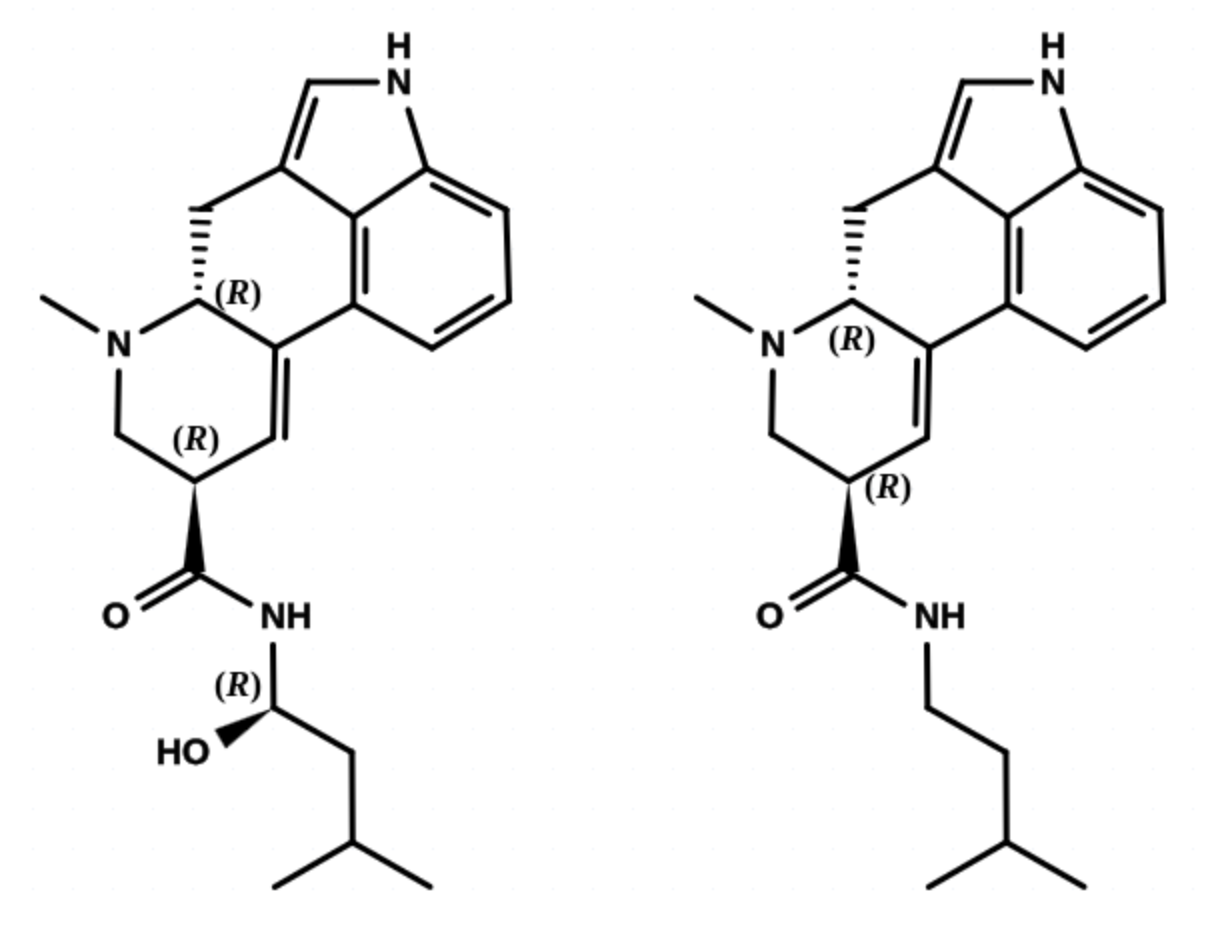
The psychoactivity of the clavines is under-researched and under-appreciated. Just like how Kash called his HBWR extract "freebase LSA" is misleading and false, it's actually a mixture of ergolines.
Claviceps fusiformis contains predominantly agroclavine and elymoclavine and does not produce lysergamides or ergopeptines.[1] People who ingested it during an outbreak experienced nausea, vomiting, giddiness, drowsiness, prolonged sleepiness, twitching, convulsions, blindness and paralysis.[2]
A 1968 study in which LSA, iso-LSA, lysergol, and a combo of those three were given to volunteers found that lysergol showed "the least subjective changes" and that those changes occurred only when a dosage of 8 milligrams was reached.[3] Lysergol is a clavine.
Someone claimed he isolated the clavines from I. tricolor seeds and ingested them:
"Clavine caused hard vasoconstrion, nausea and pupil dilation but lacked psychedelic value. I could understand its medicinal value due to its vaso properties without altering consciousness but as a mind expanding compound I don't see its place."
mrsnesbitsteaparty 2023-10-13
https://www.reddit.com/r/LSA/comments/1759wrs/deleted_by_user/k4ptn3a/
This is his write-up of the method he used:
LAA isolation: nessbit's tek
1. "Sclerotia of African and Indian isolates of
C. fusiformis from pearl millet contain agro-clavine and elymoclavine as the main alkaloid components; minor or trace components are chanoclavine, setoclavine, penniclavine and, occasionally, festuclavine. Both also readily produce clavines in submerged culture
in vitro (Banks et al., 1974, Bhat et al., 1976, Singh and Husain 1977, Kumar and Arya 1978)[3, 5, 21, 12]."
Kumari, P., Kumar, S., Godika, S., Ghasolia, R. P., Yadav, P. D., Lokesh Kumar, L. Pathogenicity, morphology and identification of Claviceps fusiformis incited ergot disease of pearl millet. 2022.
https://www.researchgate.net/public...iformis_incited_ergot_disease_of_pearl_millet
2. "The other type of ergotism, a convulsive form related to intoxication with clavine alkaloids from
Claviceps fusiformis, was last seen during 1975 in India when 78 persons were affected (21, 22). It was characterized by gastrointestinal symptoms (nausea, vomiting and giddiness) followed by effects on the central nervous system (drowsiness, prolonged sleepiness, twitching, convulsions, blindness and paralysis). The onset of symptoms occurred 1–48 hours following exposure; there were no fatalities."
"21. Krishnamachari KAVR, Bhat RV. Poisoning of ergoty bajra (pearl millet) in man. Indian Journal of Medical Research, 1976, 64: 1624–1628."
[Abstract:
https://www.bluelight.org/community/posts/16411777]
"22. Tulpule PG, Bhat RV. Food toxins and their implication in human health. Indian Journal of Medical Research, 1978, 68 (suppl.): 99–108."
Toxic effects of mycotoxins in humans. Peraica, M., Radić, B., Lucić, A., Pavlović, M. 1999. Bull World Health Organ, 77(9), 754–66
https://iris.who.int/items/bea5bbd0-9c90-4aa9-b9ff-9da3c31ec99c
3. "Lysergol shows the least subjective changes." e) Symptom distribution, page 42
"Changes only occurred at a dosage of 8 mg, with a clear slowing visible in expression and behavior. Facial expression appeared flat and speech showed a reduction in the five expressive qualities."
"Subjectively, fewer vegetative sensations were observed, but a clear inhibition of initiative was present." c) Lysergol, page 40
Heim, E., Heimann, H., Lukács, G. 1968. Die psychische Wirkung der mexikanischen Droge „Ololiuqui“ am Menschen. Psychopharmacologia, 13 (1): 35–48. 10.1007/BF00401617
Full paper (translated):
https://misc29.blogspot.com/2026/07/heim-1968.html
Quotes translated from German